An investment pitch book example from an asset manager looks like any well-made deck and reads like a contract with the regulator: each page makes claims the firm must be able to support, and the performance pages must follow specific rules. A typical institutional finals deck runs from a cover and firm overview through the team, philosophy and process, to performance, attribution, holdings, a tailored answer to the prospect's own policies, fees, any third-party recognition, and the disclosures and composite report at the back. The example below is a 26-slide finals deck for a fictional $300 million global equity separate account, built in Botminds' Pitch Book Creation by Quillfield Capital, a fictional asset manager used to demonstrate the solution. Each annotation names what the page shows, the rule or check that applies, and what the solution found on it.
One finals deck, annotated: what each key page shows and the rule behind it
Cover and agenda
Strategy, prospect, meeting date
Date the deck and name the audience. The sample is watermarked “Prepared for Harrowgate University Endowment” on release.
Firm policy
The firm at a glance
$902B, 3,860 people, 14 countries
Every material fact must be one the firm can substantiate on demand; state which assets figure it is.
206(4)-1(a)(2)
Team and succession
From the HR system, 1 Oct 2026
Names, roles and tenure as of a date. Wrong qualifications were an SEC exam finding in 2024.
206(4)-1(a)(1)
Strategy assets and capacity
$17.6B, capacity $30B
Stamped 30 June: stale until refreshed. Assets and capacity must use the stated definition and date.
206(4)-1(a)(2)
Composite returns, net and gross
1, 3, 5, 10 years and since inception
Net beside gross, same periods and method; 1, 5 and 10 years to a date no earlier than the latest year-end; index named.
206(4)-1(d)(1), (d)(2)
Attribution, 12 months
+2.2% vs +2.4% gross excess
Two correct numbers that measure different things: label what each includes.
Staff FAQ, Mar 2025
Down markets: capture ratios
Up 101%, down 84%, gross
A gross characteristic needs a gross label and the total portfolio’s gross and net returns.
Staff FAQ, Mar 2025
Applying the exclusion
A simulated ex-fossil-fuel return line
A backtest is hypothetical performance. Replaced with the holdings impact: 2 holdings, 0.9%.
206(4)-1(d)(6)
Case study
One winning holding
A specific investment shown fairly: the sample firm adds the five largest contributors and detractors.
206(4)-1(a)(5)
Fee proposal
0.50% on the first $100M, 0.42% after
Effective 0.45%, about $1.34M a year on $300M. Net returns elsewhere use the highest fee in the schedule, 0.70%.
Staff FAQ, Jan 2026
Recognition
“Top quartile” of 412 strategies
A ranking needs its date, its period, who produced it and whether the firm paid.
206(4)-1(c)
Disclosures and composite report
Attached from the disclosure library
The sample deck lacked the composite report; it was added as slide 26.
Firm policy
What does an investment pitch book contain?
An institutional pitch book contains the case for one strategy, made to one kind of client, with the evidence the client's consultant will check. The order varies by firm and by the consultant's finals letter, but the content is remarkably stable: who the firm is, who manages the money, how they invest, what the record is, what the portfolio holds, how it fits the prospect, what it costs, and the disclosures. In the sample deck that is 26 slides, 25 assembled from the firm's approved library and one added by the solution's Marketing Rule check.
The order that matters most is the prospect's. The sample consultant's finals letter asked twelve questions, from net and gross performance over 1, 3, 5 and 10 years to the proposed fee for a $300 million account, and the deck maps each to the slide that answers it. A template deck answers the firm's questions in the firm's order; a finals deck answers the consultant's.
Every pitch book an adviser uses with more than one prospect is an advertisement under the SEC Marketing Rule, and the SEC has said that customizing a template presentation by filling in an investor's name or basic information does not turn it into a one-on-one communication (86 FR 13024). The annotations below therefore treat every page as subject to the rule's general prohibitions, and the performance pages as subject to its specific conditions.
The opening pages: who you are, with every fact dated
The first pages make the claims a consultant verifies first: firm assets, headcount, ownership, team and tenure. Each is a material statement of fact, and the rule bars any the adviser has no reasonable basis to believe it can substantiate if the SEC asks (Rule 206(4)-1(a)(2)). That is why the sample deck's firm-facts slide carries a data stamp of 30 September 2026 and its team slide one of 1 October 2026 from the HR system.
Team pages are an easy place to go wrong. In its April 2024 risk alert the SEC's Division of Examinations listed advertisements with "statements representing erroneous adviser personnel qualifications, such as their education, experience, and professional designations" (SEC risk alert, 17 April 2024). A biography copied from last year's deck, with a designation still pending or a tenure not updated, is that finding waiting to happen.
Assets need one more check: which assets. Firm assets, strategy assets and composite assets are different numbers, and each consultant asks for a particular one. The sample deck's strategy slide, showing $17.6 billion against $30 billion of capacity, still carried June figures when the quarter turned and was refreshed with the rest. The definitions themselves, and how they differ between a pitch book and a consultant database, are set out in the guide to the regulatory assets under management definition.
What must the performance page of a pitch book show?
The performance page must show net returns beside any gross returns, over the same periods and by the same method, and, for anything other than a private fund, one-, five- and ten-year returns ending no earlier than the latest calendar year-end. Those are the specific conditions in Rule 206(4)-1(d); around them sit the general prohibitions and the SEC's examination findings about benchmarks and dates.
The performance page, element by element
| Element | What it must do | Where it comes from | In the sample deck |
|---|---|---|---|
| Net returns | Appear wherever gross returns do, at least as prominent and easy to compare. | Rule 206(4)-1(d)(1) | Gross and net side by side for every period. |
| Same period and method | Net and gross over the same period with the same type of return and methodology. | Rule 206(4)-1(d)(1)(ii); staff FAQ, Feb 2024 | Both from composite GQE-01 to 30 Sep 2026. |
| Required periods | One, five and ten years (or life of the portfolio), equal prominence, ending no earlier than the latest year-end. | Rule 206(4)-1(d)(2) | 1, 3, 5, 10 years and since inception in April 2008. |
| Fee basis | A model fee that gives returns no higher than actual fees would, or the highest fee charged to the intended audience; actual fees only where they would not mislead. | Rule 206(4)-1(e)(10); staff FAQ, Jan 2026 | Net after the highest separate-account fee, 0.70%. |
| Benchmark | Named and defined, with enough context to understand the comparison. | SEC exam observations, April 2024 | World All-Cap Index (net), named on the slide. |
| Date and source | An as-of date and the source of the figures. | General prohibitions; firm policy | Data stamp: as of 30 Sep 2026, performance system, GQE-01. |
| No implied endorsement | No suggestion that the SEC reviewed or approved the figures. | Rule 206(4)-1(d)(3) | None. |
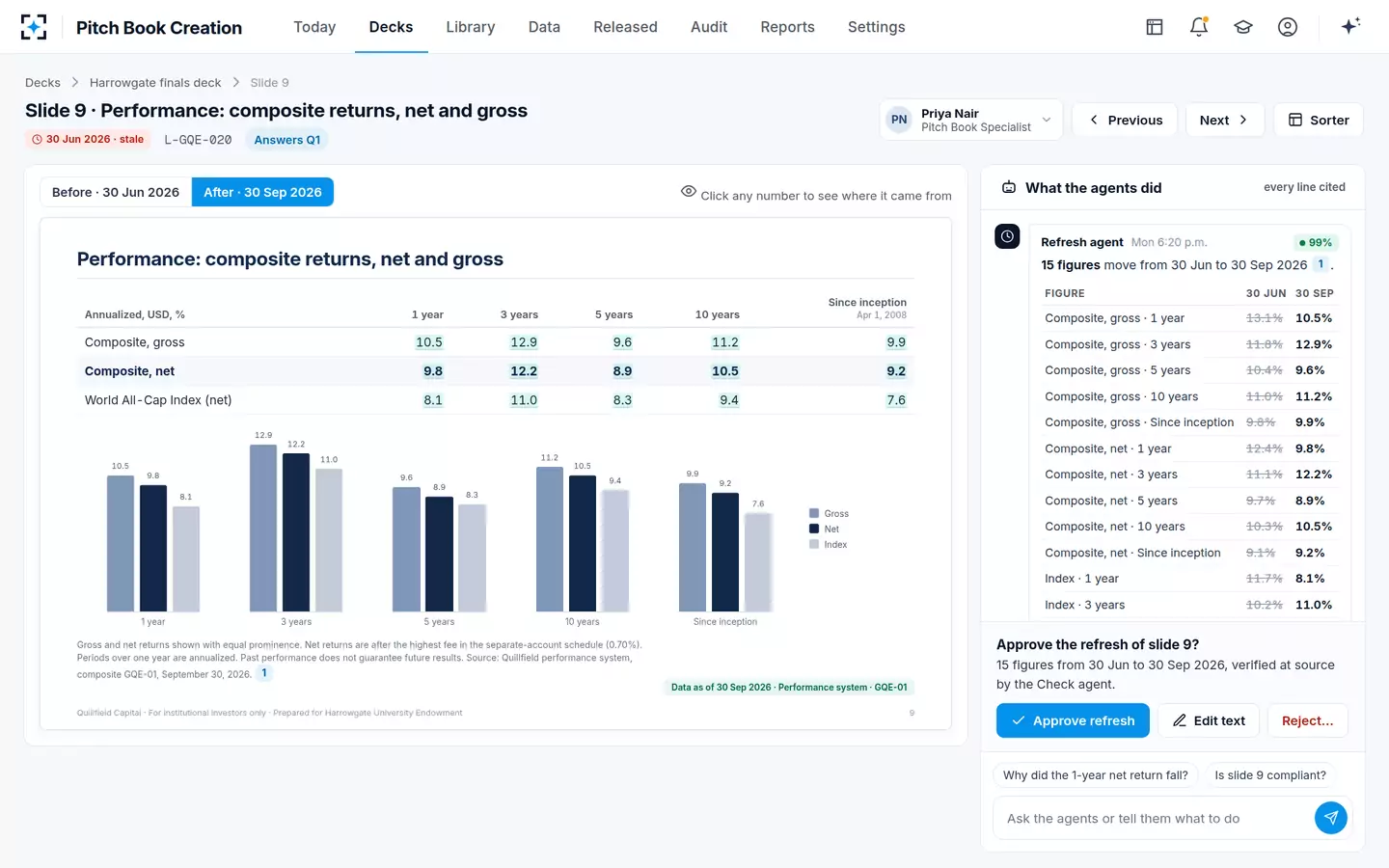
On the sample page, the third quarter changed fifteen figures at once. The one-year net return moved from 12.4% to 9.8% as a strong quarter from 2025 dropped out of the window, against 8.1% for the index; gross was 10.5%. The page passes the rule either way; what made it wrong in October was that it still showed June.
The sample performance page, after the refresh, with its data stamp
Attribution, capture and characteristics: gross figures need a label
Pages that show characteristics rather than returns, attribution, capture ratios, volatility, Sharpe ratios, sit in a grey zone the SEC staff addressed in March 2025. The staff said it would not recommend enforcement if an adviser shows a gross characteristic without the net one, provided the characteristic is clearly identified as calculated before fees and is accompanied by the total portfolio's gross and net returns, presented at least as prominently, over a period that includes the characteristic's (SEC Marketing Compliance FAQ).
The sample deck tripped on both kinds of page. Slide 11 showed up capture of 101% and down capture of 84%, calculated on gross returns, without saying so; the fix labels both as gross of fees and adds the composite's gross and net returns for the same five years. Slide 10's attribution showed a total of +2.2% against a gross excess return of +2.4% elsewhere in the deck, both correct, since holdings-based attribution leaves out trading and cash. The portfolio manager confirmed the label, so each number now says what it includes.
Holdings and case studies: show the losers with the winners
A case study about one successful holding is a reference to specific investment advice, and the rule requires it to be presented in a fair and balanced way (Rule 206(4)-1(a)(5)). The rule does not prescribe how. A practical way to meet it, and the sample firm's policy, is to show the five largest contributors and the five largest detractors over the same twelve months whenever one holding is discussed, with an offer of the full list.
Slide 18 in the sample deck was a one-page story about Halden Instruments, a fictional holding that had done well. The Marketing Rule agent raised the finding and proposed adding the five largest contributors and detractors to 30 September 2026 with equal prominence. Holdings pages raise a quieter question as well: how old the holdings are. The sample firm's setting allows holdings data 35 days old at most, and the top-ten and sector slides were refreshed with the quarter.
ESG and exclusion pages: say what the portfolio does, not what a backtest says
The tailored pages are where a finals deck wins or loses, and where invented evidence creeps in. Harrowgate's investment policy statement excludes companies with more than 10% of revenue from thermal coal or oil sands, and its consultant asked how the strategy would apply it. The draft deck answered with slide 16: a simulated five-year "ex-fossil fuel" return line showing +9.4% a year.
That line is hypothetical performance, performance no portfolio actually achieved, and the rule allows it only with policies and procedures reasonably designed to make it relevant to the audience, plus enough information to understand its criteria, assumptions, risks and limitations (Rule 206(4)-1(d)(6)). The solution flags any hypothetical for compliance to decide, and proposed a factual alternative: the holdings impact of the exclusion on 30 September 2026, two holdings, 0.9% of the portfolio. The maker accepted it. ESG claims carry their own exam history: the April 2024 risk alert lists advertisements referencing investment mandates, such as ESG mandates, that the firms did not actually use.
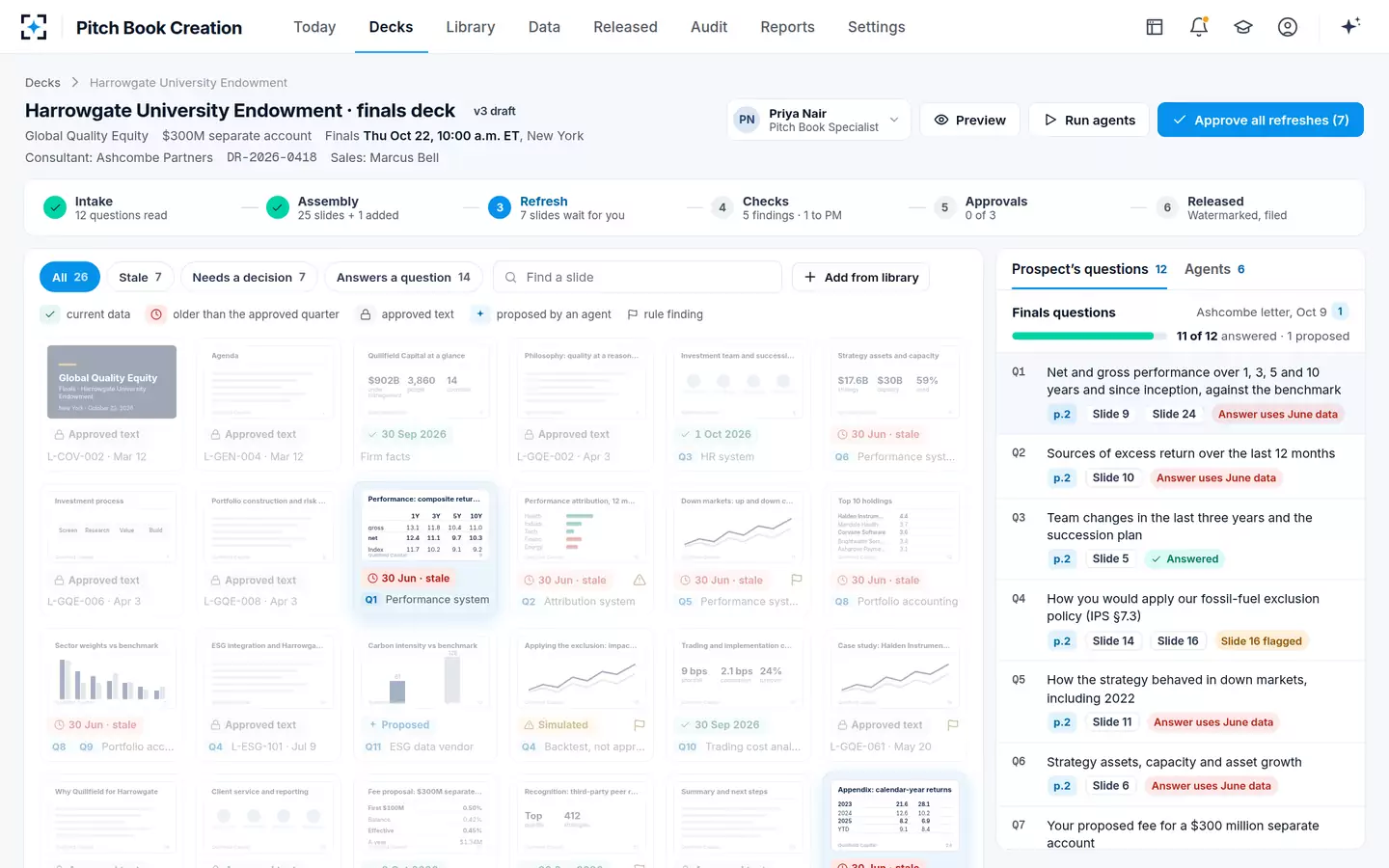
The slide sorter: every page stamped, every finals question mapped to its answer
Fees and recognition: the two pages consultants compare first
The fee page in the sample proposes 0.50% on the first $100 million and 0.42% on the balance, an effective 0.45% or about $1.34 million a year on $300 million. The consistency check that matters is between this page and the performance page: net returns elsewhere in the deck are after the highest fee in the separate-account schedule, 0.70%, so the deck never shows net returns after a fee lower than the one being proposed. The staff's January 2026 FAQ explains why that pairing matters when the audience will pay more than past clients did.
Recognition pages are short and risky. Any third-party rating or ranking must disclose, clearly and prominently, the date it was given, the period it was based on, who created it and whether the adviser paid, directly or indirectly, to obtain or use it, under Rule 206(4)-1(c). The SEC's December 2025 risk alert observed advisers using ratings without meeting some or all of those requirements, in places that included pitch books (SEC risk alert, 16 December 2025). The sample slide 22 said "Top quartile among global equity peers" with no date, no period and no statement about payment; the fix adds all three.
The back of the book: disclosures, the composite report and the appendix
The back of the book is where omissions hide, because nobody reads it until something is missing. The sample deck carries a calendar-year returns appendix, the firm's disclosures from its disclosure library, and, after the solution's check, the strategy's composite report as slide 26, which the draft did not include. For firms that claim compliance with the GIPS standards, what a composite report must contain and when it must be provided is covered in an annotated GIPS composite report.
The professional standard gives a useful test for the whole section. CFA Institute's Standard III(D) asks that performance information be fair, accurate and complete, and its guidance says that "Best practice dictates that brief presentations include a reference to the limited nature of the information provided" (CFA Institute, Standard III(D), updated April 2024). A finals deck is a brief presentation of a long record; the back of the book is where it says so and offers the rest.
From template to finals deck: what changes for one prospect
A template is the firm's best answer to a general question; a finals deck is its answer to one consultant's twelve. The difference is not only order and wording. It is which figures are shown, as of which date, with which fee, against which of the prospect's own policies.
What changes between the template and the finals deck
The firm's template pitch book: The firm’s story: firm, team, process, results.
The finals deck for one prospect: The consultant’s questions, each mapped to the slide that answers it.
The firm's template pitch book: Whatever quarter the template was last refreshed to.
The finals deck for one prospect: The latest approved quarter, stamped on every slide, re-read from source.
The firm's template pitch book: Standard schedule.
The finals deck for one prospect: The proposed fee for this mandate, consistent with the fee basis of the net returns.
The firm's template pitch book: Generic ESG and risk pages.
The finals deck for one prospect: The prospect’s own policy applied to the actual portfolio, from approved language.
The firm's template pitch book: Approved once in the library.
The finals deck for one prospect: Released by compliance for this prospect, locked and watermarked.
The firm's template pitch book: The library version.
The finals deck for one prospect: The released PDF, its data stamps, sources, checks and approvals, for five years from last use.
Before a finals deck goes to compliance, the maker can run the same checks on any deck, with or without software. The list below is the short version of what the solution checks on every slide.
Eight checks before a pitch book leaves your desk
- Every slide has an as-of date
And every date is the latest approved for its data type.
- Net sits beside every gross
Same period, same method, at least as prominent.
- The 1-, 5- and 10-year periods are there
Ending no earlier than the latest year-end, unless it is a private fund.
- Gross characteristics are labelled
Capture, attribution and ratios say “gross”, with total portfolio gross and net nearby.
- No backtest is passing as a result
Any simulated, model or targeted return goes to compliance as hypothetical performance.
- Every case study has its other side
Detractors with contributors, by the firm’s policy.
- Every ranking is dated
Date, period, provider, and whether the firm paid.
- The fee and the net returns agree
Net returns after a fee no lower than the one proposed.
The deck in this example is the one followed through every seat in asset management marketing roles, and its release and later correction are in the deck that outlives its date. To see it built on your own library and figures, start from Pitch Book Creation.
Questions people ask
Where can I find investment pitch book examples?
Asset managers rarely publish finals decks, and most examples online are investment banking pitch books, a different document. The example on this page is built on fictional sample data. Public bodies sometimes release managers' RFP responses; the SEC said in 2021 that such a response is not an advertisement merely because the entity later makes it public.
What is a pitch book template for asset management?
It is the firm's approved master deck for a strategy: standard pages for the firm, team, process, performance, holdings, fees and disclosures, usually kept in a slide library. Each finals or intro deck starts from it and is tailored to the prospect. Customizing a template with a prospect's name does not make it a one-on-one communication under the Marketing Rule.
How many pages should a pitch book have?
No rule sets a length, and consultants often set one in the finals letter or limit presentation time instead. The sample finals deck is 26 slides, 25 from the approved library and the composite report added by the check. A shorter deck is easier to keep current, since every slide with figures needs refreshing each quarter.
What should the performance page of a pitch book include?
Net returns beside any gross returns for the same periods and method, one-, five- and ten-year periods ending no earlier than the latest calendar year-end for non-private funds, a named benchmark, the fee basis of the net figures and an as-of date. Those come from SEC Rule 206(4)-1(d) and the staff's FAQ.
Can a pitch book show a backtest?
Only as hypothetical performance, which the Marketing Rule allows with policies making it relevant to the intended audience and enough information to understand its criteria, assumptions, risks and limitations. Most institutional finals decks avoid it. In the sample deck a simulated exclusion backtest was replaced with the actual holdings impact of the prospect's policy.
What is the difference between a pitch book sample and a released deck?
A sample or template shows what the firm usually presents; a released deck is the specific version compliance approved for one prospect, with its figures as of one date. Only the released version must be kept, with the records behind its performance, for five years from the end of the fiscal year it was last used.