Regulatory assets under management (RAUM) is the figure an SEC-registered adviser reports in Item 5.F of Form ADV: the securities portfolios for which it provides continuous and regular supervisory or management services, at current market value, without deducting any borrowing, measured within 90 days before the filing. It decides whether a firm registers with the SEC or a state, and it is what the public sees on the SEC's adviser search. It is also one of at least four assets figures an asset manager publishes, and the consultant databases each ask for a specific one. Botminds' Consultant Database Management reads each portal's own definition before it fills a field, so strategy assets, composite assets and firm AUM never stand in for one another.
The scale of regulatory assets under management
16,434
SEC-registered investment advisers, December 2025
$166.0tn
their total regulatory assets under management
6,463
exempt reporting advisers, with about $7.5 trillion more
What is regulatory assets under management? The Form ADV definition
RAUM is defined by Form ADV's own instructions, not by the Advisers Act or a rule. Instruction 5.b to Part 1A says: "In determining the amount of your regulatory assets under management, include the securities portfolios for which you provide continuous and regular supervisory or management services as of the date of filing this Form ADV" (Form ADV General Instructions, Instruction 5.b). Two tests follow from that sentence, and both are narrower than most marketing figures.
The first is what counts as a securities portfolio. "An account is a securities portfolio if at least 50% of the total value of the account consists of securities," and the adviser may treat cash and cash equivalents as securities for that test. Family and proprietary accounts, accounts managed for no fee and accounts of non-US clients all count. For a private fund, all of its assets are treated as a securities portfolio, and uncalled commitments are added.
The second is the service. An adviser provides continuous and regular supervisory or management services if it has discretionary authority and provides ongoing management, or if, without discretion, it has ongoing responsibility to select or recommend specific investments and arranges the trades the client accepts. The instructions list what does not qualify: market timing calls with no ongoing duties, impersonal advice such as newsletters, an initial allocation with no monitoring, and advice given only intermittently, on request or on a fixed date.
How to calculate regulatory assets under management, step by step
To calculate regulatory assets under management, apply the 50% test account by account, include the entire value of every account that passes and that the firm continuously manages, leave out any portion managed by someone else, and value everything at current market value within 90 days of filing, "using the same method you used to report account values to clients or to calculate fees for investment advisory services." The instructions' own example shows how generous the entire-value rule is.
The Form ADV example: one account, ten million dollars of RAUM
| Step | Instruction | Example account | Result |
|---|---|---|---|
| 1. Is it a securities portfolio? | At least 50% of value in securities; cash may count as securities | $6.0m stocks and bonds + $1.0m cash = $7.0m of $10.0m | 70%: passes |
| 2. Is it continuously managed? | Discretionary, with ongoing supervision or management | Whole account managed on a discretionary basis | Yes |
| 3. How much counts? | The entire value of the portfolio, unless part is managed by another person | Includes $3.0m of collectibles, commodities and real estate | $10.0m |
| 4. When and how valued? | Current market value within 90 days before filing, same method as client reporting or fee billing | Valued as on the client statement | Reported in Item 5.F |
Two exclusions matter more than they look. A portion of an account "under management by another person" comes out, and so do real estate or businesses an adviser "manages" for a client but not as an investment. Allocation work sits on the other side of the line: the instructions list a "manager of managers" as providing continuous and regular services, "but only if you have discretionary authority to hire and fire managers and reallocate assets among them."
Does regulatory assets under management include leverage?
Yes, in the sense that matters: borrowing is not subtracted. The instructions say: "Do not deduct any outstanding indebtedness or other accrued but unpaid liabilities." An account holding $140 million of securities financed with $40 million of margin debt counts $140 million toward RAUM, though the client's equity is $100 million. That illustrative arithmetic is ours, but the rule behind it is the instruction's.
The same logic makes private funds look large. A fund's gross assets count, borrowings included, and so does "any uncalled commitment pursuant to which a person is obligated to acquire an interest in, or make a capital contribution to, the private fund." A private credit vehicle early in its investment period can therefore report RAUM well above its net asset value, which is one reason a consultant field asking for net assets or strategy assets should never be filled with an RAUM figure.
Regulatory AUM vs AUM: the figures an asset manager actually reports
RAUM is one of several assets figures, and they differ by design. Form ADV itself allows a second one: Part 2A, Item 4.E asks for the "client assets you manage", split into discretionary and non-discretionary, and its note says the firm's method "can be different from the method for computing 'regulatory assets under management' required for Item 5.F in Part 1A," provided the firm keeps documentation describing the method (Form ADV Part 2, Item 4.E). Beyond the form, firms publish their own firm AUM, strategy assets and composite assets, each under internal policy.
Six assets figures, six definitions
| Figure | Who defines it | What it counts | Where readers meet it | How often it moves |
|---|---|---|---|---|
| Regulatory assets under management | Form ADV Part 1A, Instruction 5.b | Continuously managed securities portfolios at gross value; private funds with uncalled commitments | Form ADV, the SEC’s adviser search | Each annual amendment |
| Client assets you manage | The firm, with a documented method (Part 2A, Item 4.E) | Discretionary and non-discretionary assets, rounded to $100,000 | The brochure | At each brochure update |
| Firm AUM | Firm policy; for firms claiming GIPS compliance, its definition of total firm assets | All assets the firm reports as managed, by its own rules | Factsheets, RFPs, databases | Quarterly |
| Strategy assets | Firm policy, matched to each consultant’s question | Every account and vehicle run in one strategy | Consultant databases, RFPs | Quarterly |
| Composite assets | The composite definition | Only portfolios that meet the composite’s inclusion rules | Composite reports, performance tables | Monthly or quarterly |
| Assets under advisement | Firm policy only | Model delivery and advice without trading authority, as the firm defines it | Some RFPs and databases, labelled | Quarterly |
Assets under administration is a different idea again: assets a firm services, holds or reports on without managing them, a measure common among custodians and platforms. Like assets under advisement it has no definition in Form ADV, so an answer that uses either term should state the firm's definition beside the number. The GIPS standards carry their own definition of firm assets for firms that claim compliance; the guide to a GIPS composite report, line by line shows where it appears.
Which AUM figure does a consultant field ask for?
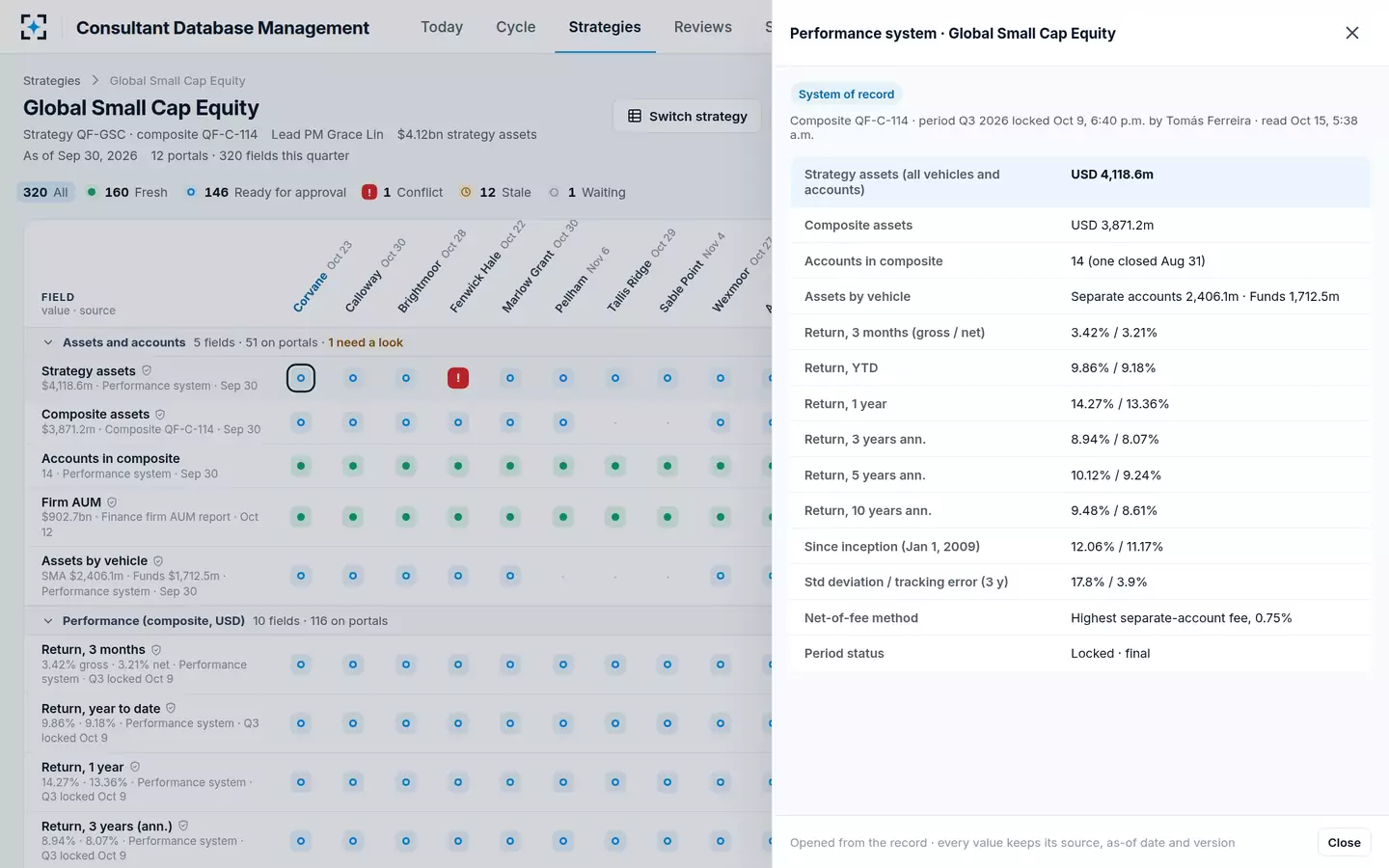
Whatever its definition says, which is why the definition has to be read before the number is typed. Take the sample firm in Consultant Database Management, the fictional Quillfield Capital, at the end of the third quarter of 2026. For its Global Small Cap Equity strategy the performance system shows strategy assets of $4,118.6 million across all vehicles and accounts ($2,406.1 million in separate accounts and $1,712.5 million in funds), composite assets of $3,871.2 million in 14 accounts, and a firm-wide AUM of $902.7 billion from the finance team's report.
One consultant's question reads: "Total strategy assets, USD millions, all vehicles and accounts." That is the $4,118.6 million figure, not the composite's $3,871.2 million, and not anything including the $0.31 billion of model-delivery assets the firm's policy reports as assets under advisement. Another consultant asks for composite assets and gets the composite figure. Neither answer is RAUM, which the firm reports once a year on a different basis entirely.
Where one strategy's assets figure lives, and which places disagree
How often each AUM figure changes, and why the calendars collide
Each figure runs on its own clock, so on any given day they disagree for timing reasons alone. Form ADV gets an annual updating amendment, due within 90 days of the adviser's fiscal year-end, and between those amendments the instructions excuse an adviser from updating Items 2, 5, 6 and 7, among others, even after they go stale (Form ADV General Instructions, Instruction 4). RAUM on the public record can therefore be more than a year old by the time the next amendment is filed.
The brochure's figure is slightly fresher. Its as-of date must not be more than 90 days before the date the brochure was last updated for Item 4.E, and the firm need not update the brochure between annual amendments solely because assets changed. Strategy and composite assets move every quarter, and consultant databases ask for them within weeks of quarter-end. A consultant who compares a profile's strategy assets with the RAUM on Form ADV will almost always see two different numbers, and that is expected; what is not expected is a profile whose strategy assets disagree with the firm's own factsheet.
The life of one assets figure, from locked period to twelve portals
A defensible figure has one source and a known path. In the sample firm the path for strategy assets runs from the performance analyst's locked quarter through the agents to the consultants, with a person approving every step that changes what a consultant sees.
One strategy-assets figure in Consultant Database Management, source to portal
A person decides
Performance analystLocks the third quarter in the performance system on October 9; the figure is now final
Agent
Sourcing agentReads each portal’s definition and fills strategy assets, composite assets or firm AUM to match
Never: Takes a number from the CRM or a previous answer
Agent
Conflict agentCompares the value on all 12 live portals, this quarter’s drafts and the sources
Never: Compares composite assets with strategy assets
A person decides
RFP and database coordinatorApproves the proposed fix for the one portal that differs
A person decides
Compliance reviewerApproves the figure with the other performance and AUM fields for that strategy
Agent
Submission agentSubmits released portals with receipts and reads each field back
Never: Sends a value that was not approved and released
How a transposed AUM digit is caught before a consultant does
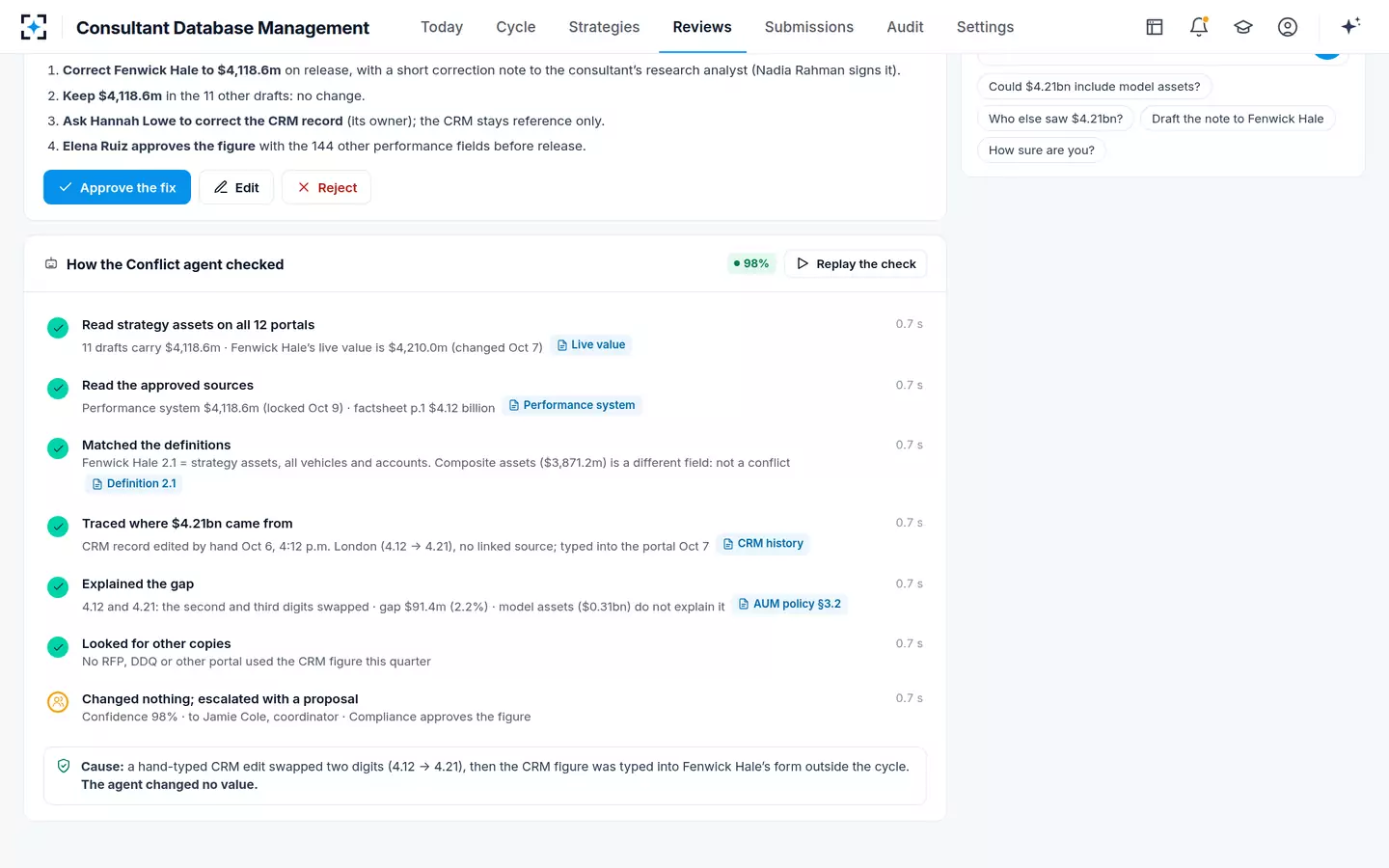
Only by comparing every place the figure lives, including the places nobody planned to update. In the sample cycle eleven portal drafts carried $4,118.6 million, but one consultant's live profile showed $4,210.0 million. The Conflict agent traced it to a hand edit of the CRM's product entry on October 6, when $4.12 billion became $4.21 billion, which someone then typed into that portal outside the cycle. The gap was $91.4 million, or 2.2%, and the agent checked and rejected the obvious innocent explanation: adding the strategy's $0.31 billion of model-delivery assets gives $4.43 billion, not $4.21 billion.
Seven steps, each with its evidence: how the agent explained the gap
The regulatory stakes are the ordinary ones. An overstated assets figure in a profile that a consultant's researchers read is a material statement in an advertisement, and the Marketing Rule bars any material statement of fact the adviser cannot substantiate on demand (17 CFR 275.206(4)-1(a)(2)). The SEC's 2021 release recalled that it had already brought a case in 1998 over performance submitted to online databases (86 FR 13024). What investment consultant databases ask, and who reads them covers that history.
Before any AUM figure goes into a consultant field
- Read the field’s definition
Strategy, composite, firm, vehicle or RAUM; USD or local currency; millions or billions; as of which date.
- Use the locked source
The performance system once the period is locked, or the finance team’s firm AUM report; never the CRM or last quarter’s answer.
- Say what is excluded
Model delivery, assets under advisement, overlay or sub-advised assets: in or out, and why, by policy section.
- Convert once, at a stated rate
One currency fixing for the quarter, applied the same way on every portal.
- Compare everywhere it lives
Every live portal, factsheet, open RFP and DDQ, so a hand-typed copy is found before a consultant finds it.
- Keep the support
The source, version and approver for each figure, for as long as the profile stays live and five years after.
For the performance fields beside the assets figures, the net-of-fees calculation shows which fee each return should deduct. To match definitions across your own portals, start from Consultant Database Management.
Questions people ask
What does regulatory assets under management mean?
It means the value of securities portfolios an adviser continuously supervises or manages, as defined in Form ADV's instructions for Item 5.F. It is measured at current market value within 90 days of filing, includes the entire value of qualifying accounts, and does not deduct borrowing. Firms use it to determine SEC or state registration.
What is the difference between regulatory AUM and AUM?
Regulatory AUM follows Form ADV's fixed method and is updated once a year. AUM in marketing material follows the firm's own policy and can include or exclude items RAUM treats differently, such as model delivery or non-discretionary assets. Form ADV Part 2A explicitly allows a firm's brochure figure to use a different method, if documented.
Do you have to recalculate regulatory assets under management every quarter?
No. Item 5.F is updated in the annual updating amendment, filed within 90 days after the fiscal year-end, and an adviser need not update Item 5 in other amendments even if it has become inaccurate. A firm near the $100 million SEC registration threshold should still watch it, because the instructions set specific rules for moving between state and SEC registration.
Are uncalled commitments included in RAUM?
For private funds, yes. The instructions tell advisers to include in a private fund's securities portfolio any uncalled commitment under which an investor is obligated to acquire an interest or make a capital contribution, and to value the fund's assets at market or fair value.
What is assets under advisement?
A firm-defined measure, usually of assets the firm advises on without trading authority, such as model portfolios delivered to a sponsor. No SEC form defines it, so any RFP or database answer that reports it should state the firm's definition and keep it separate from assets under management.