A net of fees performance calculation takes a portfolio's gross return for each period and deducts the advisory fees and other fees a client paid, or would have paid, for the adviser's services, then links the periods into the one-, five- and ten-year figures a consultant asks for. The arithmetic is simple; the judgement is in which fee to deduct. Under the SEC's Marketing Rule, net performance can reflect actual fees or a model fee, and a model fee must either produce figures no higher than actual fees would or equal the highest fee charged to the advertisement's intended audience. A consultant database profile is read on behalf of plans of every size, so the fee basis needs deciding in advance and stating beside the number. Botminds' Consultant Database Management fills each return from the locked performance period with its net-of-fee method attached, and tests the presentation before compliance approves it.
Three ways to get from gross to net, for one month
| Method | Formula | What it does |
|---|---|---|
| Subtract a monthly model fee | net = gross − annual fee ÷ 12 | Takes one twelfth of the annual rate from each month’s gross return; the months are then linked. |
| Divide out a monthly model fee | 1 + net = (1 + gross) ÷ (1 + annual fee)^(1/12) | Removes the fee as a growth rate, so it compounds the same way returns do. |
| Use actual fees | The return after the fees actually debited or accrued in each account | Measures what each account earned after its own fees, aggregated to the composite or strategy. |
What does net of fees mean?
Net of fees means after deducting the fees a client pays for the adviser's services. The Marketing Rule defines net performance as a portfolio's performance after deducting all the fees and expenses a client paid or would have paid for the adviser's advisory services to it, including, where they apply, advisory fees, "advisory fees paid to underlying investment vehicles, and payments by the investment adviser for which the client or investor reimburses the investment adviser" (17 CFR 275.206(4)-1(e)(10)). The rule lets net performance exclude "custodian fees paid to a bank or other third-party organization for safekeeping funds and securities."
Gross of fees is the mirror image: the portfolio's performance before those fees and expenses are deducted. Trading costs are usually already inside both figures, because returns are measured on the portfolio's actual transactions; the gross-to-net gap is the advisory fee and the other service charges the definition names.
Net of fees vs gross of fees: what the difference tells a reader
The gap between gross and net is the cost of the service, and readers use it that way. A consultant comparing two strategies with the same gross return will prefer the one whose net is closer, all else equal, and a plan will estimate its own net from the gap. That is why the rule requires net beside gross at least as prominently, in a format designed to make comparison easy, calculated over the same period with the same type of return and methodology (17 CFR 275.206(4)-1(d)(1)).
It is also why a net figure without its fee basis is incomplete. A 9.2% net return after a 0.75% model fee and a 9.5% net return after actual fees averaging 0.45% describe the same gross performance. Without the basis beside the number, a reader cannot tell which they are looking at.
How to calculate net of fees performance, worked
Calculate net month by month, then link. Take an illustrative portfolio that earns exactly 10.00% gross over a year, the same each month, and a 0.75% annual fee. The table shows how the methods compare, and why the shortcut of subtracting the annual fee from the annual return is not quite right.
One year at 10.00% gross and a 0.75% fee, by method
| Method | Monthly step | Annual net return |
|---|---|---|
| Annual shortcut (not a monthly method) | 10.00% − 0.75% | 9.25% |
| Subtract a monthly fee, then link | 0.7974% gross − 0.0625% = 0.7349% a month, compounded 12 times | 9.18% |
| Divide out the fee each month | (1.007974 ÷ 1.0075^(1/12)) − 1 a month, compounded | 9.18% |
Two details decide whether a firm's numbers can be reproduced. First, the fee must be deducted in the periods the return covers, so a quarterly-billed actual fee is usually spread across the quarter's months rather than taken in the billing month, or the monthly net series will jump. Second, the multi-year figures must be linked from the same net monthly series, not computed by subtracting the fee from annualised gross returns. A ten-year net return built either way will differ in the second decimal, and a consultant comparing two portals will notice.
Actual fees or a model fee? What the rule allows
Both are allowed, within limits. Net performance by definition can reflect actual fees. If a model fee is used instead, the rule gives exactly two options.
Net performance, “if using a model fee, must reflect one of the following: (A) The deduction of a model fee when doing so would result in performance figures that are no higher than if the actual fee had been deducted; or (B) The deduction of a model fee that is equal to the highest fee charged to the intended audience to whom the advertisement is disseminated.”
17 CFR 275.206(4)-1(e)(10)(ii), the Marketing Rule's definition of net performance
Actual fees are not automatically safe. In the adopting release the SEC said that where the audience is expected to pay more than the actual fees, the adviser must use a model fee reflecting the anticipated fee; in a January 2026 FAQ the staff said that statement does not ban actual-fee net returns outright, and that whether they mislead depends on the facts of each advertisement, including its disclosures. The staff added that "advisers may use various means to illustrate the effect of differences between actual fees and anticipated fees on performance" (SEC Marketing Compliance FAQ, posted January 15, 2026). The guide to gross and net attribution under the Marketing Rule quotes the footnote and the FAQ in full.
Which fee should net performance deduct in a consultant database?
Usually the highest fee in the schedule for the vehicle the profile describes, unless compliance has decided otherwise and said why. A consultant's database is read on behalf of plans of every size. A composite dominated by large accounts on low negotiated rates will show a strong actual-fee net return, but a smaller plan reading the profile would pay the top of the schedule, which is the situation the SEC's footnote and FAQ address. Using the highest standard fee answers the second model-fee option directly: it is the highest fee charged to the intended audience.
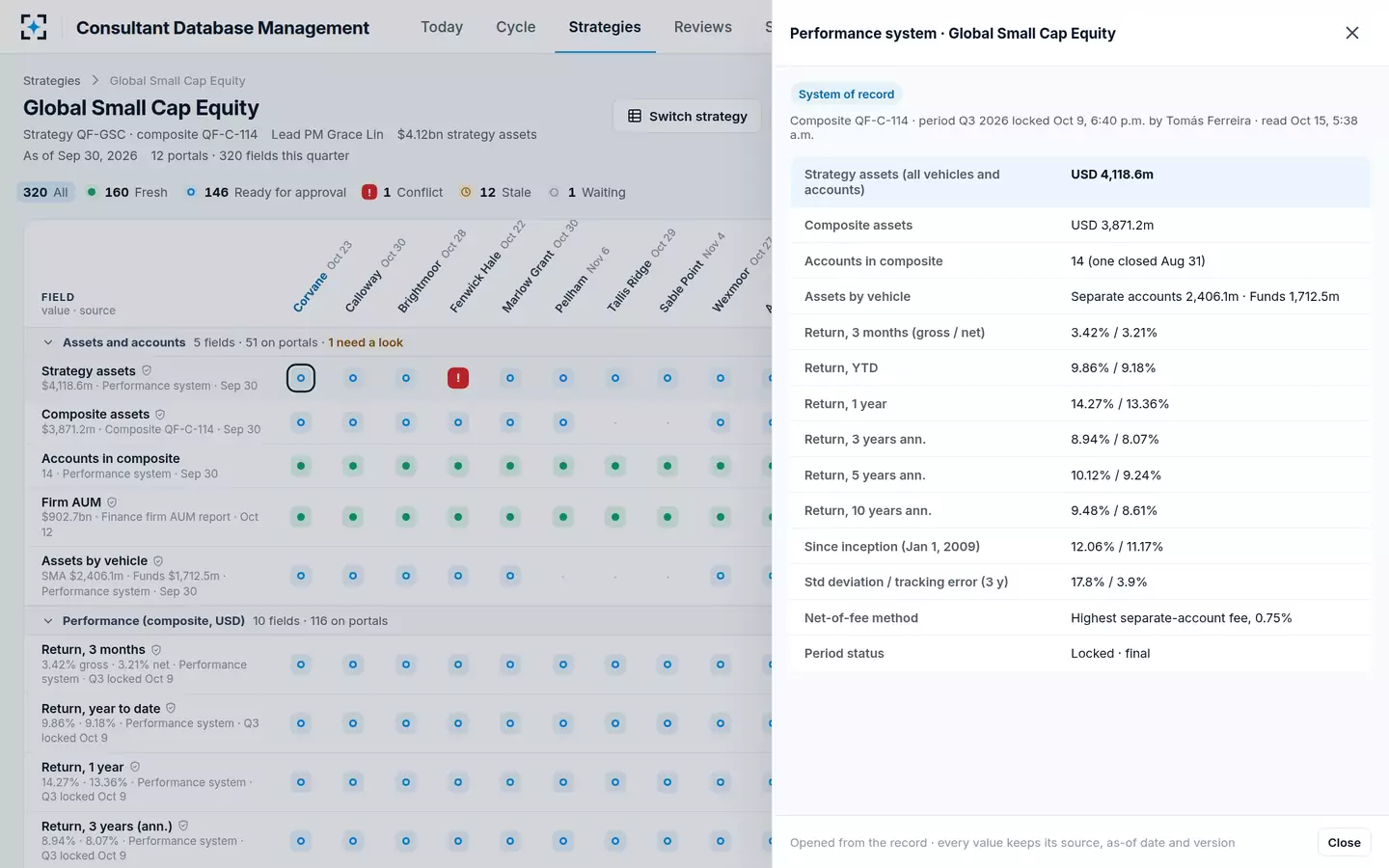
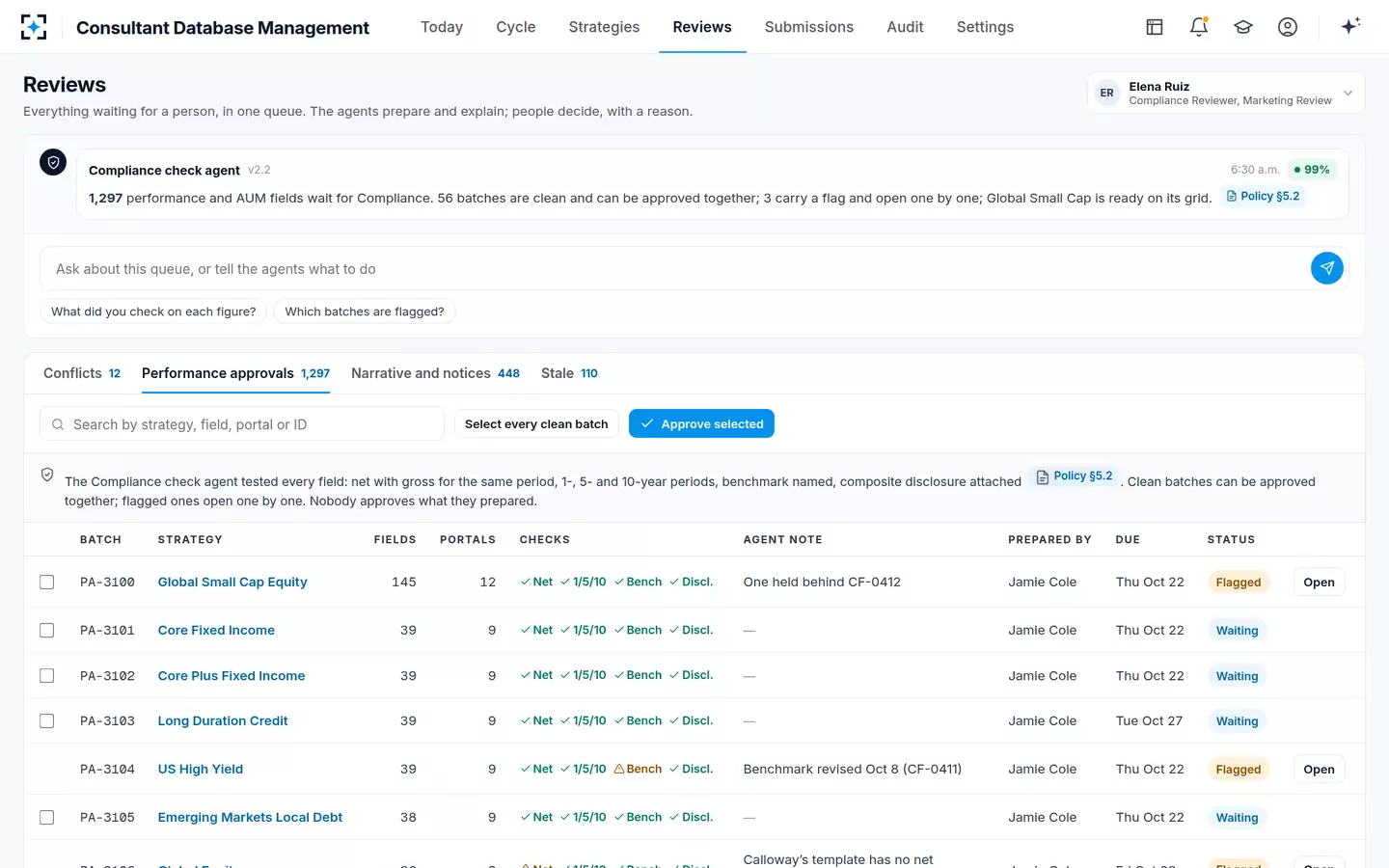
The sample firm in Consultant Database Management, the fictional Quillfield Capital, takes that approach. The locked performance source for its Global Small Cap Equity composite states the net-of-fee method as the highest separate-account fee, 0.75%, and every portal field filled from that source carries the method with it. Where a consultant's template has no column for net returns at all, the Compliance check agent flags and holds the batch rather than let gross figures go alone; in the sample cycle one consultant's template had no net column, and that strategy's batch went to the reviewer flagged.
The net-of-fee method travels with the return
Composite, representative account or fund: whose net return is it?
A net return belongs to a portfolio, and consultants' fields ask for different ones. A composite return averages the portfolios that meet the composite's rules, weighted by size; a representative account is one real account chosen to stand for the strategy; a fund's return is the vehicle's own, already net of the fund's expense ratio. The same strategy can show three different net figures for the same quarter, each correct for its portfolio.
The fee logic follows the portfolio. For a composite, actual-fee net returns reflect whatever its accounts paid, which for large mandates is often below the standard schedule, so the model-fee question above applies most sharply there. For a representative account, the actual fee is that one client's, which may be negotiated and confidential. For a fund, the published net return already deducts the management fee and other expenses at the share-class level, and a consultant asking for separate-account net returns should not receive the fund's figure in that field.
The rule ties gross and net to the same portfolio and the same method, so whichever portfolio a field asks for, both figures must come from it. In the sample firm each strategy's source carries composite returns, assets by vehicle and the net-of-fee method together, which is what lets a field be filled from the right portfolio rather than the nearest number.
Tiered fee schedules: why the effective rate changes the net
Institutional schedules usually charge less on each additional band of assets, so the effective rate falls as the mandate grows. Take an illustrative schedule of 0.75% on the first $50 million, 0.60% on the next $50 million and 0.50% above $100 million. A $25 million mandate pays 0.75%, a $100 million mandate 0.675% and a $300 million mandate about 0.558%, and the same 10.00% gross year produces three different net returns.
One gross year, four fee bases, four net returns
A third of a percentage point a year compounds: over ten years at these rates the gap grows to about seven percentage points of cumulative return. Examiners look at it for that reason. In their April 2024 risk alert on the Marketing Rule, SEC staff reported advisers computing net returns with lower fees than those offered to the intended audience, and advisers whose policies required net performance with every performance advertisement yet who showed only gross returns (SEC Division of Examinations, April 17, 2024).
What each net return field should state
A net return in a portal field is only as good as the facts beside it. Consultants' templates vary in how much room they give, so a firm should decide what accompanies each net figure and where it goes when the template has no space: in the field's comment, the profile's disclosure section or the attached composite disclosure.
Seven things to settle before a net return goes into a consultant field
- The fee basis
Actual fees, or which model fee and at what rate; for a model fee, why it meets one of the rule’s two options.
- What else is deducted
Performance fees, fund expenses where the vehicle is a pooled fund, and whether custody fees are excluded.
- The method
Monthly deduction or actual accruals, linked; the same type of return and method as the gross figure.
- The periods
The same periods as gross, including one, five and ten years for portfolios other than private funds, ending no earlier than the latest calendar year-end.
- The portfolio
Composite, representative account or vehicle, matching the portal’s definition and the gross figure beside it.
- The as-of date and version
The locked period it comes from, so a later restatement can be traced to every portal that carried it.
- The approver
Compliance’s approval of the figure and its presentation, kept with the support for its calculation.
Every return pre-tested for net with gross, then approved by a person
GIPS composites and net returns: the other rulebook
Many institutional managers also claim compliance with the GIPS standards, which have their own requirements for how composites, gross and net returns and fee disclosures are presented. Those rules sit alongside the Marketing Rule rather than replacing it, and a figure in a consultant database must satisfy whichever apply. The guide to a GIPS composite report, line by line covers the GIPS side; for database fields, the practical step is to fill from the same locked composite figures the GIPS report uses, so the two never disagree.
For the assets fields that sit beside the returns, which AUM figure each field asks for follows the same principle of matching definitions first. To test net-of-fee presentation across your own portals, start from Consultant Database Management; what consultant databases ask covers the rest of the profile.
Questions people ask
What is the difference between gross and net fee returns?
Gross returns are before the adviser's fees and the other service charges the client pays; net returns are after them. The difference is the cost of the service over the period. Under the Marketing Rule, an advertisement that shows gross must show net beside it, over the same period and by the same method.
Is a performance fee deducted in net of fees returns?
Yes, where the client pays one. The rule's definition covers all fees and expenses a client paid or would have paid for the adviser's services, which on its terms includes performance-based fees. A model-fee calculation for a strategy with a performance fee needs a stated assumption for it.
Can I show only net of fees performance?
Yes. The rule requires net whenever gross is shown, not the reverse, so an advertisement may show net performance alone. Many consultants ask for both, and a profile that answers only one of their fields should say why the other is blank.
Do net returns have to deduct custody fees?
No. The Marketing Rule allows net performance to exclude custodian fees paid to a bank or other third party for safekeeping funds and securities. The exclusion should be stated where it applies, because some consultants' definitions ask for it explicitly.
What model fee should a new strategy use?
With no actual fee history, a model fee is the only option, and it should be one the rule allows: in practice the highest fee in the standard schedule for the audience the material reaches. The firm's compliance policy should name it, and every portal should use the same one.