How many hours does it take to respond to an RFP? For an asset manager the honest answer is that it depends on four things you can count: how many fields and questions the response carries, how many seconds each takes to find and enter from an approved source, how many review loops compliance and the content owners run, and how many corrections follow. No regulator or independent study publishes a benchmark, and figures quoted in vendor surveys are not a basis for a budget. This page builds the hours and the cost for one quarter of consultant database updates, the recurring work behind every RFP, with BLS wage data and the sample firm in Botminds' Consultant Database Management, and shows how to measure your own.
The unit matters more than the total. An RFP is a one-off; the consultant database cycle comes back every quarter, carries the same figures and feeds every RFP and DDQ that follows. Pricing the field, not the document, is what lets a head of distribution compare one quarter with the next and one way of working with another.
The hours in a response cycle, term by term
Entry
fields × seconds per field ÷ 3,600
Finding the approved value, checking its date and typing or pasting it into each portal, template or answer.
RFP and database coordinator
Review
+ regulated fields × reviewer seconds ÷ 3,600
Compliance re-checking each performance and assets figure against its source and the presentation rules.
Marketing compliance
Chasing
+ owners × hours per owner
Commentary from portfolio managers, team changes from HR, marks from the fund administrator, translations.
Coordinator, with consultant relations
Corrections
+ errors × hours per correction
Re-submission, a correction note, re-approval and the call to the consultant.
Everyone above
How many hours does it take to respond to an RFP? Start from the field
A field is anything a portal or questionnaire asks for separately: one return for one period, one assets figure, one bio, one fee line. Count them before estimating anything. Take the sample firm in Consultant Database Management, the fictional Quillfield Capital: its third-quarter 2026 cycle covers 60 strategies on 12 consultant portals in 300 profiles, which comes to 9,012 fields, about 30 per profile.
Time per field is the second input. The estimate published with the solution uses about 40 seconds a field for a person working by hand: open the source, confirm the period and definition, enter the value in the portal's format. At 40 seconds, 9,012 fields take about 100 hours of entry alone. That is the floor, because it assumes every value is ready, final and unambiguous when the coordinator reaches it.
For a single RFP the same arithmetic applies, with a different mix. Most answers come from the library with a date change; some need a new figure or a redrafted paragraph; a few are new questions with no approved answer at all. Log a sample of each kind on one RFP and the totals follow; guessing them is where budgets go wrong.
Pricing one RFP, question by question
The same method prices a single RFP if the questions are sorted by how much work each needs. Most fall into four groups: answers reused from the library with only a date change, answers that need current figures filled in, answers that need a paragraph redrafted, and questions the library cannot answer at all. Time a few of each on one real RFP and the rest is multiplication. The table shows the arithmetic on an illustrative 250-question RFP; every quantity in it is an assumption to replace with your own log.
An illustrative 250-question RFP: the new questions cost the most
| Kind of question | Count | Minutes each | Hours |
|---|---|---|---|
| Reused from the library, date updated | 150 | 4 | 10.0 |
| Figures filled from current sources | 60 | 10 | 10.0 |
| Paragraph redrafted by its owner | 30 | 30 | 15.0 |
| New question, no approved answer | 10 | 90 | 15.0 |
| Compliance review of performance and assets answers | 60 | 3 | 3.0 |
| Assembly, formatting and submission | — | — | 6.0 |
Two numbers in that table deserve attention when budgeting. The ten new questions take half as many hours again as the 150 reused ones, 15 against 10, so a library that grows after every RFP pays for itself. And the sixty figure questions are where errors enter: filled from the right source they take minutes, copied from last year's answer they take seconds and carry last year's numbers.
Typical RFP response time vs the hours inside it
Response time and response hours are different measures. The response window is set by the issuer in the RFP document and runs in calendar days; the hours are the effort the firm spends inside it. A response due in three weeks may take forty hours or two hundred, depending on the questionnaire and on how much of the answer the firm can source quickly. Consultant database deadlines work the same way: in the sample cycle the twelve portals fall due between October 22 and November 13, while the effort is concentrated in the weeks after the quarter's returns are locked on October 9.
Measure both, because they fail differently. Long response times usually mean waiting: for locked returns, for a portfolio manager's commentary, for a private fund's marks. High hours usually mean rework: values copied, checked, corrected and checked again. A tool or a hire that fixes one may do nothing for the other.
What an hour costs: 2025 BLS wages and employer cost
The Bureau of Labor Statistics has no occupation for RFP writers or database coordinators, so the wage input rests on a mapping, which is ours. The closest occupation for the people doing the entry is market research analysts and marketing specialists; for the reviewers, compliance officers. Wages are not the whole cost: BLS's employer-cost survey found that wages and salaries made up 70.0% of private-industry employer compensation costs in June 2026, with benefits the rest (BLS, Employer Costs for Employee Compensation, September 9, 2026).
A loaded hour of entry and an hour of review cost about the same
| Role | Median hourly wage, May 2025 | Loaded hourly cost (wage ÷ 0.70) |
|---|---|---|
| Entry: market research analysts and marketing specialists (13-1161) | $37.87 | $54.10 |
| Review: compliance officers (13-1041) | $38.81 | $55.44 |
What does a quarter of consultant database updates cost?
Put the inputs together and one quarter of the sample firm's database cycle costs, by hand, somewhere around twelve thousand dollars in loaded staff time before a single correction, with entry the largest term. The build below is illustrative: the field count is the sample firm's, the 40 seconds is the solution's published estimate, and the other assumptions are ours, stated so they can be replaced with a firm's own logs.
One sample quarter by hand: entry dominates, corrections decide the tail
Per field, that is about $1.36, and per profile about $41. The per-field number is the one to watch, because it scales with the business: a firm that adds a strategy to eight portals adds roughly 240 fields, or about $330 a quarter, before anyone writes a sentence of commentary. It also shows why entry speed alone is the wrong target. Halving entry time saves about $2,700 a quarter; a single error that reaches a consultant and triggers a correction across three people costs more than a hundred dollars and, unlike entry, carries regulatory weight.
Which inputs move the total most
Seconds per field and the error count move the total far more than wages. The sensitivity below changes one input at a time from the base case and shows the change in the quarter's cost.
What one change does to the cost of a quarter
Two lessons follow. First, a quarter's cost is a function of process, not headcount: the same team spends about a fifth more when entry slows from 40 to 60 seconds a field, which is what happens when sources are scattered or definitions unclear. Second, errors are cheap to count and expensive to ignore. Each one costs a correction cycle, and the Marketing Rule's general prohibitions apply to the figure that went out in the meantime (17 CFR 275.206(4)-1(a)).
The hours nobody budgets: read-backs, corrections and examiner requests
Three costs rarely appear in a staffing plan. Read-backs: after submitting, someone should confirm the portal stored what was sent, because portals round, truncate and occasionally reject fields silently. Corrections: when a value is wrong on a live profile, the fix touches the coordinator, compliance and consultant relations. And requests from examiners: an adviser must keep every record needed to support or demonstrate the calculation of the performance in its advertisements (17 CFR 275.204-2(a)(16)), and finding them by hand for a profile submitted two years ago can take days.
SEC examiners have reported the gap directly. In their April 2024 risk alert on the Marketing Rule they listed, among books-and-records deficiencies, advisers that kept no documentation supporting the performance claims in their advertisements (SEC Division of Examinations, April 17, 2024). The hours to rebuild that support after the fact are the most expensive hours in the cycle.
Read-backs as part of the cycle, not an afterthought
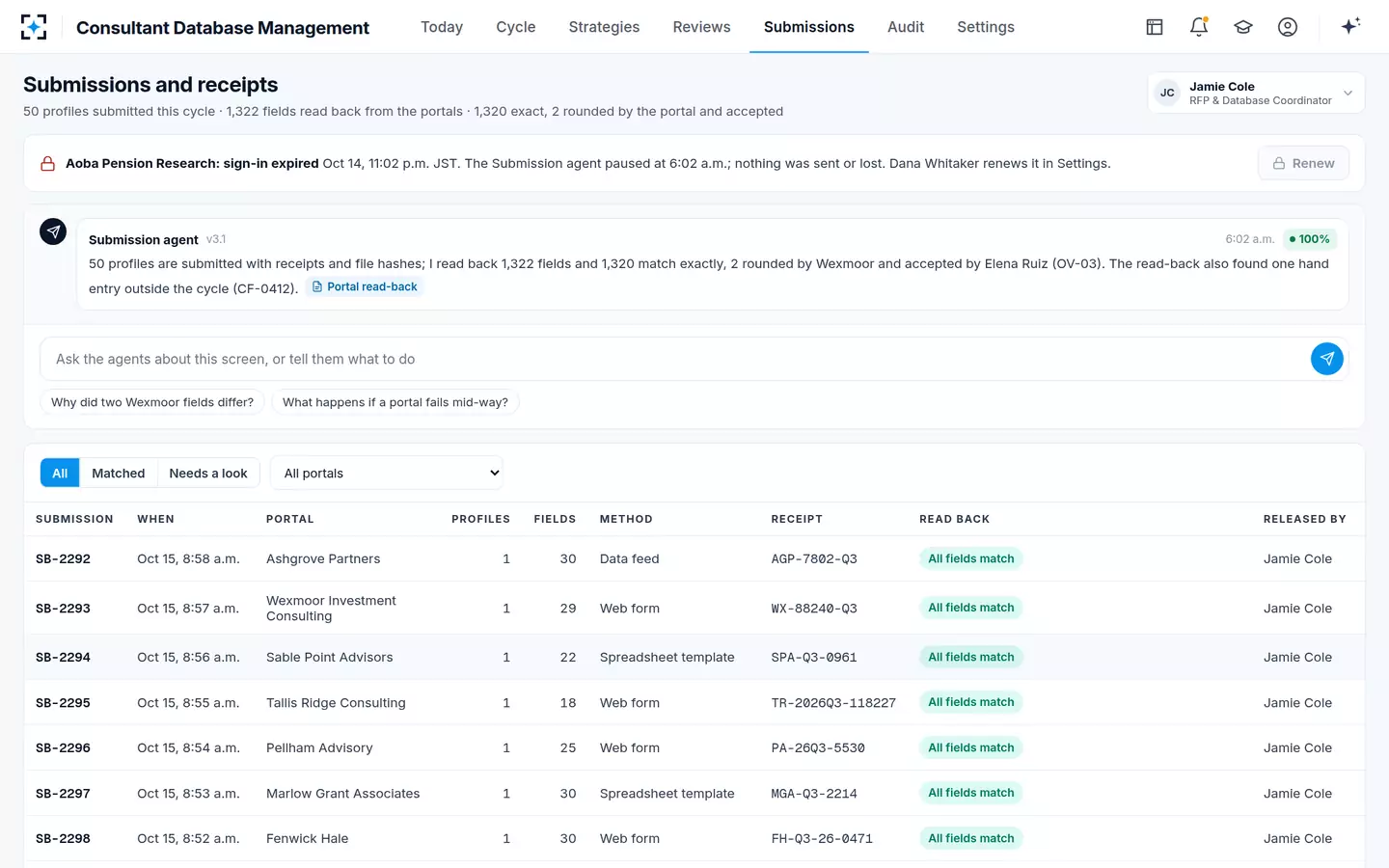
Fields counted for you: what the agents filled and what still waits
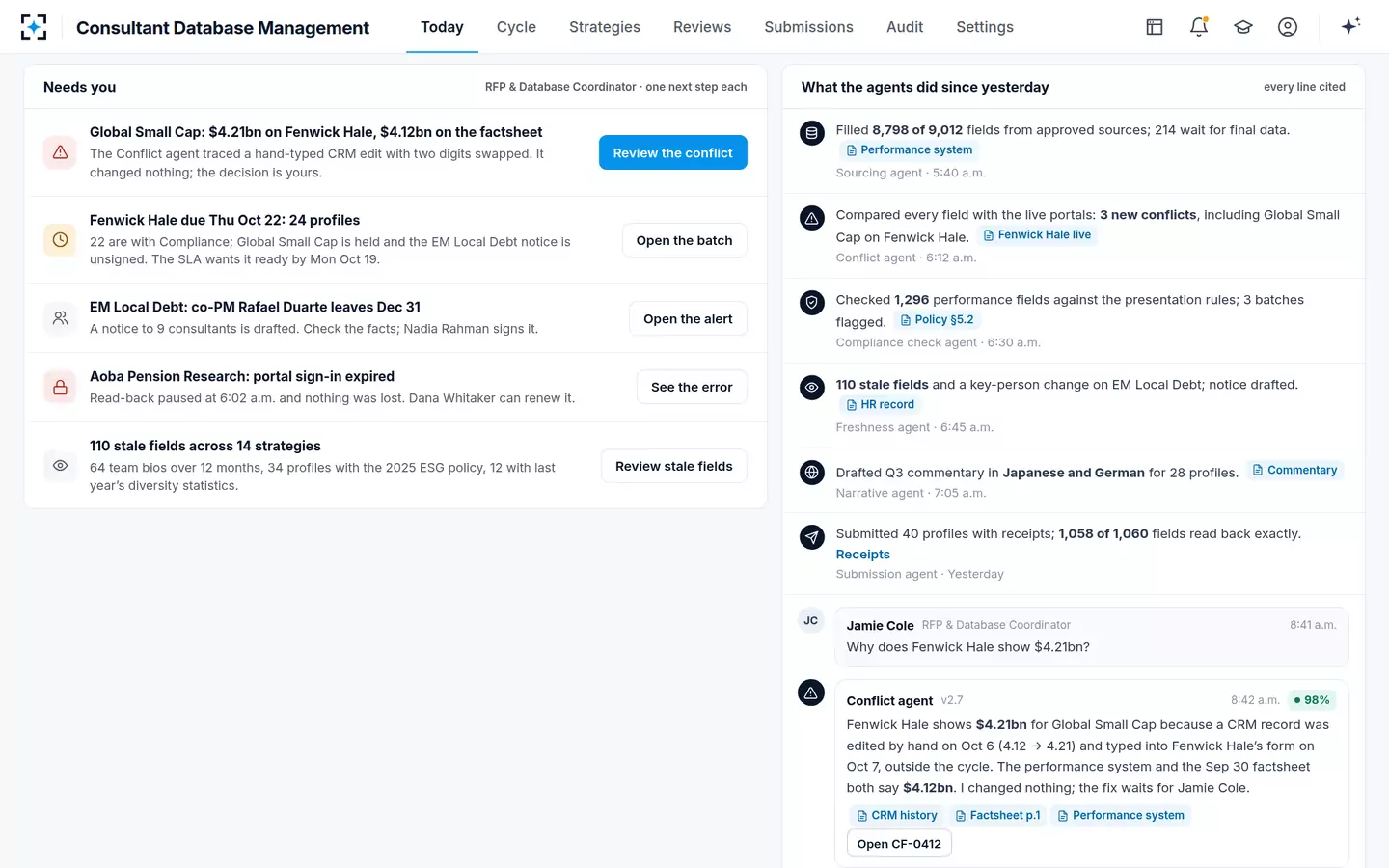
How to measure your own RFP response time and hours in one quarter
Measure for one full cycle before changing anything. The method below takes little extra effort if it starts on the first day after quarter-end, and its output is a per-field cost the firm can defend.
Seven measurements for one quarter
- Count fields, not documents
Export each portal’s field list per strategy; add the fields of every RFP and DDQ answered that quarter.
- Time a sample of entries
Fifty fields across three portals, stopwatch on, from opening the source to saving the value.
- Log reviewer minutes
Ask compliance to note minutes per batch and the number of figures in it.
- Record waiting separately
Days between asking an owner and receiving the input are elapsed time, not effort; keep them apart.
- Count every correction
Each re-submission or correction note, its cause, who touched it and for how long.
- Test a retrieval
Pick one performance figure from a profile submitted a year ago and time how long it takes to produce its source.
- Price it
Multiply each term by a loaded rate from payroll or the BLS medians above, and divide by fields.
Where agents change an RFP team's arithmetic, and where they do not
Agents change the entry and comparison terms most and the review and waiting terms least. In Consultant Database Management a Sourcing agent fills fields from approved sources and a Conflict agent compares every live portal value with drafts and sources, so the entry and self-check terms shrink. Compliance still approves every performance and assets figure, a portfolio manager still writes commentary, and a private fund's marks still arrive when the administrator sends them.
A quarter's business days by hand and with the agents
| Step | By hand (estimate) | With the agents (target) |
|---|---|---|
| Rebuilding the portal calendar and waiting on data | 2 | 0.5 |
| Copying fields into each portal’s form or template | 12 | 2 |
| Chasing portfolio managers, HR and translators | 4 | 2 |
| Compliance re-checking every figure | 4 | 2.5 |
| Submitting, screenshots and corrections | 3 | 1 |
| Total | 25 | 8 |
Read the target with care. Eight business days is what the solution is designed to reach, measured in the live solution, and the compliance term barely falls because a person still signs every regulated figure. For the RFPs and DDQs that draw on the same figures, what an agent may draft and who signs sets out the split, and the RFP writer's seat shows what the coordinator's week becomes. To price a quarter on your own strategies, start from Consultant Database Management.
Questions people ask
How long do you have to respond to an RFP?
As long as the issuer allows. The RFP document sets the deadline, the question period and any quiet period, and public plans often publish these on their procurement pages. There is no regulatory minimum or maximum; read the instructions section first and plan backwards from the due date.
What is a typical RFP turnaround time for an asset manager?
No regulator or independent study publishes one. Turnaround depends on the issuer's window and on how much of the answer the firm can source from locked figures and an approved library. Track your own median from receipt to submission, and separately the hours spent, for a quarter before setting a target.
How many questions are in an institutional RFP?
It varies with the issuer and the mandate; there is no standard count. Count fields rather than questions, because one question can ask for returns over six periods, gross and net, against a benchmark, which is twelve or more figures to source and check.
How can an asset manager reduce RFP response time?
Fix the waiting first: lock performance on a known date, keep an approved answer library with owners and expiry dates, and know each portal's definitions in advance. Then reduce rework, by entering each figure once from its source and comparing every copy, which is where most of the hours go.
Is RFP and consultant database work a cost or an investment?
Both. The cost is measurable per field; the return is harder to attribute because consultant searches start from these profiles. Research on consultants' recommendations finds they move flows, which is why what consultant databases ask matters to the budget as much as the hours do.