DDQ software for asset managers stores the firm's approved answers to due diligence questionnaires, matches each new question to the closest answer, drafts and routes responses, and tracks what was sent to whom. Most tools now add AI drafting. The differences that matter when choosing one are not in the search box or the drafting but in four places: whether every figure comes from a current, approved source; whether a person approves what goes out, and nobody approves what they prepared; whether performance answers are tested against the firm's marketing review policy; and whether the history would satisfy an examiner's request years later. This page gives twelve questions to put to any vendor, the red flags to watch for in a demo, and a trial plan using last year's questionnaires. Botminds' Consultant Database Management answers those questions for the figures and standing profile content that DDQs, RFPs and consultant databases share.
This guide is for the manager answering questionnaires. Allocators and consultants sending them, and testing whether the answers are true, need different features; due diligence questionnaire software for reviewers covers that side.
Twelve questions to ask before you buy DDQ software
- Can it show the source behind every answer?
Click any figure: it should open the locked source, its as-of date and version.
- Does every figure come from a source, not a past answer?
The performance system, the firm AUM report, the fee schedule; never last year’s DDQ or the CRM.
- Does it know when an answer has gone stale?
Owners and expiry dates on every answer, and alerts when a source changes, such as a team departure.
- Does it match by definition, not keyword?
Strategy assets and composite assets are different answers to similar-looking questions.
- Does it refuse when there is no approved source?
It should say so and route the question to an owner, not write a plausible paragraph.
- Does anything leave without a person’s approval?
Drafts are fine; sending should need a named approver for each section.
- Does it stop people approving what they prepared?
Maker and checker enforced by the tool, not by etiquette.
- Does it test performance answers against your policy?
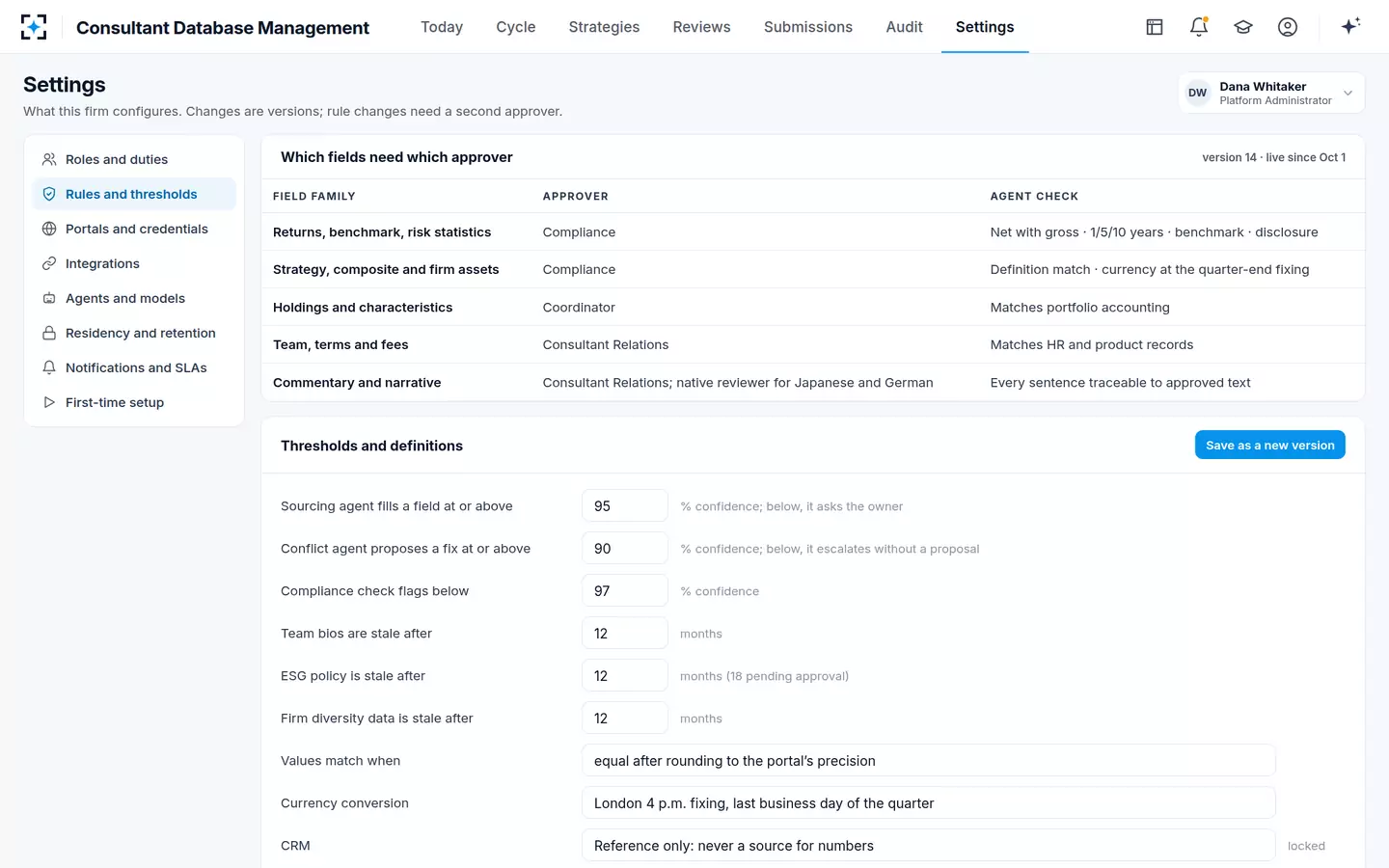
Net with gross, the required periods, the benchmark named, the disclosure attached, before compliance sees them.
- Can it list every recipient of an answer?
So a correction or a restated figure reaches everyone who received the old one.
- Would its records satisfy an examiner?
Indexed, retrievable, duplicated, protected from alteration, kept for the full retention period.
- How are its AI agents limited?
What they may never do, at what confidence they stop and ask, and how each step can be traced.
- Can you trial it on last year’s DDQs?
Compare its answers with what you actually sent, field by field, before you sign.
What does DDQ software do for an asset manager?
It turns a long questionnaire into a managed project. The basic functions are an answer library, question matching, assignment of sections to owners, deadline tracking, review and approval, and export in the issuer's format. Due diligence questionnaires from allocators, consultants and fund platforms ask several hundred questions about ownership, compliance, operations, valuation, trading, cyber security and service providers, and much of the content repeats from one questionnaire to the next, which is why a library pays back quickly.
What a library cannot do on its own is know that an answer has stopped being true. A DDQ answer about the investment team is wrong the day someone resigns; one about service providers is wrong the day a contract changes. How DDQs, RFPs and database profiles differ explains why the same facts must agree across all three.
Can DDQ software show the source behind every answer?
Good software can; ask to see it on a figure, not a paragraph. In a DDQ, the answers that carry the most risk are numbers and named facts: assets by strategy and vehicle, returns gross and net, the number of accounts, the team and its tenure, the auditor and administrator. Each of these lives in a system of record the firm already trusts. The tool should read it there, at the requested as-of date, and stamp the answer with the source and version.
The reason is practical as much as regulatory. An adviser must keep the records needed to demonstrate the calculation of any performance it presents in advertisements and the written communications it sends relating to performance (17 CFR 275.204-2(a)(7) and (a)(16)), and SEC examiners have reported advisers without documentation supporting the performance in their advertisements (SEC risk alert, April 17, 2024). A tool that keeps the source with the answer produces that documentation as a side effect.
Which approver each field family needs, as versioned settings
Approval: nothing reaches an allocator without a person
Drafting can be automated; sending should not be. FINRA has said firms are responsible for their communications whether a person or an AI tool generated them (FINRA Advertising Regulation FAQ D.8), and the SEC's fiscal 2027 examination priorities say the Division will examine whether firms using what it calls "super intelligence" still meet their existing obligations (SEC Division of Examinations, October 2026). An adviser must also adopt written policies and procedures reasonably designed to prevent violations and review them at least once a year (17 CFR 275.206(4)-7); a DDQ tool is one of the places those procedures either work or do not.
In Consultant Database Management the chain is fixed in the software: the agents prepare and check, the coordinator approves fixes and releases, compliance approves every performance and assets figure, consultant relations signs every message, and nobody approves what they prepared. The Submission agent sends only fields a person released and uses portal credentials from a vault no one sees.
Performance answers tested against your marketing review policy
A DDQ answer that shows gross returns without net, or one-year figures without the five- and ten-year periods, is a presentation problem the tool should catch before compliance does. Whether a particular DDQ answer is an advertisement under the Marketing Rule is compliance's judgement, but standard answer sets reused across many questionnaires often are, and the strictest presentation should set the standard for any figure that also appears in a database profile (17 CFR 275.206(4)-1(d)).
The useful test is automatic and visible: each performance answer checked for net with gross over the same periods, the required periods, a named benchmark, the composite disclosure and the as-of date, with clean answers approved in batches and flagged ones opened one by one. The net-of-fees calculation covers which fee each net return should deduct.
Would the record satisfy an examiner's request?
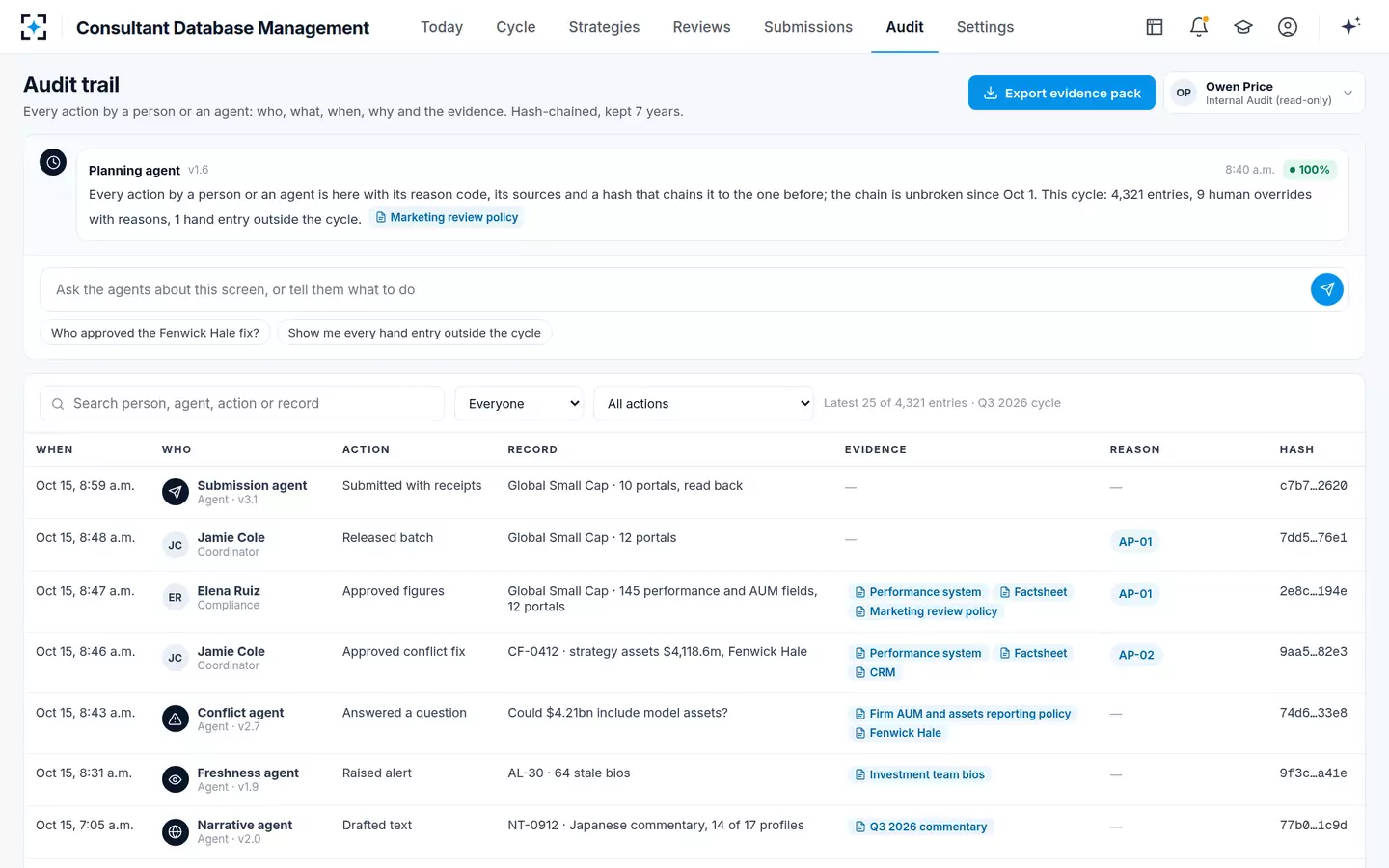
It should, because the rule is specific. An adviser keeping records electronically must arrange and index them so any record can be found and retrieved easily, be able to provide a legible, true and complete copy promptly on request, keep a separate duplicate, safeguard the records from loss, alteration or destruction, and limit access to authorised staff and the SEC (17 CFR 275.204-2(g)). Advertisements and the support for their performance must be kept for five years from the end of the fiscal year in which they were last disseminated.
Translate that into a demo request: "Show me, for a DDQ we sent eighteen months ago, the answer to question 4.2, its source and version, who approved it and when, and every other questionnaire that used the same figure." A tool that can do that in a minute has earned its place. A tool that exports a PDF of the final answers has not.
An audit trail an examiner can read: who, what, when, why and the evidence
Red flags in a DDQ software demo
Demos are built to show drafting at its best. These six signs, each easy to test in the room, suggest the hard parts are missing.
Six red flags to test for in a DDQ software demo
The demo uses only narrative questions
Ask for a performance question with gross and net over five periods, and an assets question with a definition to match.
Figures come from last year’s answer
A number copied from a past response is a copy of a copy; ask where the tool reads the current value.
It answers when the library has nothing
A fluent paragraph with no source is the most expensive kind of answer.
One click approves the whole DDQ
Bulk approval of clean batches is fine; approving flagged answers unseen is not.
Export is a PDF of answers
Without sources, approvers and dates beside each answer, the export proves nothing to an examiner.
Administrators can edit the history
An audit trail that can be changed after the fact is a log, not evidence.
AI agents in DDQ tools: autonomy, scope and traceability
Most new DDQ tools describe themselves as agentic, so ask what the agents may not do. FINRA's 2026 oversight report lists the risks of AI agents in plain terms: agents acting without human validation and approval, acting beyond the scope and authority the user intended, and multi-step reasoning that is hard to trace or explain, along with general-purpose agents lacking the domain knowledge specialised tasks need (FINRA, 2026 Annual Regulatory Oversight Report). The US Treasury's 2024 report on AI in financial services warns that generative models can produce confident but incorrect output (US Treasury, December 2024).
Each risk has a matching control to look for. Autonomy: the agent prepares, and a person approves before anything is sent. Scope: written limits, such as never overwriting a value or taking a number from the CRM. Traceability: every step the agent took, with its evidence and confidence, replayable afterwards. Confidence thresholds that send uncertain work to a person, set by the firm and changed only with a second approver, close the loop.
A library tool and source-linked agents, compared on the hard parts
Answer library tool: Typed into library answers and updated by hand
Source-linked agents: Read from the locked source at the requested date
Answer library tool: Found at the next scheduled review
Source-linked agents: Flagged when the source changes or the approval expires
Answer library tool: Checked by compliance, figure by figure
Source-linked agents: Pre-tested, then approved by compliance in batches
Answer library tool: Search for every recipient
Source-linked agents: A list of every questionnaire and profile that used the value
Answer library tool: Rebuild support from folders and email
Source-linked agents: Export source, approval and submission for each answer
Where Consultant Database Management fits, and where it does not
It fits where DDQ answers depend on figures and standing facts the firm also publishes elsewhere: assets, returns, accounts, team, fees and approved narrative. The same agents that keep every consultant database profile current fill those answers from approved sources, compare them with every live copy, test performance presentation and keep each answer's source, approval and submission on a hash-chained audit trail. It works beside an existing answer library, which it reads as one of its sources.
It is not a full DDQ project-management suite. It does not replace a proposal tool's workflow for assigning hundreds of narrative questions across a firm, and it does not decide whether an answer is an advertisement or write new policy text. A firm whose main need is coordinating narrative DDQ sections may start with a library tool and add source-linked agents for the figures; a firm whose problem is wrong or unprovable numbers should start the other way round.
A two-week trial on last year's DDQs
The only evidence worth buying on is your own. Take three DDQs answered last year and run them through the tool as if they had just arrived, then compare its output with what the firm actually sent.
Two weeks, three old questionnaires, one comparison
- Connect sources and libraryDays 1–3
- Run three past DDQsDays 4–5
- Compare field by fieldDays 6–8
- Retrieval and correction testsDays 9–10
The comparison usually teaches as much about the library as about the tool: answers nobody owns, figures typed outside any cycle, definitions never written down. The sources to bring before any agent writes lists what to fix first, and what an agent may draft sets the boundary between drafting and approval. To run the trial on your own questionnaires, start from Consultant Database Management.
Questions people ask
What is the best DDQ software?
The one that passes your own trial. Run last year's questionnaires through each candidate and count unsourced answers, wrong figures and reviewer minutes, and time how long it takes to retrieve one old answer with its source and approver. Rankings that do not test those things say little about an asset manager's needs.
What is DDQ automation software?
Software that automates the repetitive parts of answering due diligence questionnaires: matching questions to approved answers, drafting, filling figures, routing and tracking. The automation should stop at approval; a named person should still release each answer.
What is the difference between DDQ software and RFP software?
Mostly the content and the reviewers. Both manage libraries, drafting and approvals, but DDQs lean on operational and compliance answers read by due diligence specialists, while RFPs add a proposal, fees and performance scored against competitors. Many tools do both, and the figures in each should come from the same sources.
Can a DDQ tool use AI to draft answers safely?
Yes, if drafting is limited to approved sources, figures are filled rather than generated, the tool refuses when there is no source, and a person approves every answer. FINRA's view is that a firm answers for AI-generated communications as for any other.
How long should DDQ answers be kept?
For an SEC-registered adviser, written communications relating to performance and any answer that is an advertisement fall under Rule 204-2, and advertisements with their performance support are kept five years from the end of the fiscal year in which they were last used. Many firms keep all DDQ answers on the same schedule for simplicity.