Investment consultant databases are the manager research databases that institutional investment consultants maintain on asset managers and their strategies. Each manager submits a profile per strategy, usually every quarter: assets and accounts, returns gross and net of fees over standard periods, benchmark and risk statistics, holdings, team, fees and commentary, in that consultant's own fields and definitions. The consultant's researchers screen these profiles to build long lists for searches and to monitor managers their clients already employ, so the profile is often the first thing a pension plan's adviser knows about a manager. Botminds' Consultant Database Management keeps every profile current on every portal from approved fund data, with a person approving each figure before it is submitted.
The profile matters for two reasons this page sets out. Consultants' recommendations shape where institutional money goes, and the SEC has long treated performance a manager submits to a database as the manager's own advertising.
What an investment consultant database profile asks, family by family
Assets and accounts
What the consultant asksStrategy, composite and firm assets; accounts; assets by vehicle
What to confirm firstWhich definition, which currency, which date
Performance
What the consultant asksReturns gross and net over three months, year to date, one, three, five and ten years and since inception
What to confirm firstNet beside gross, the same periods, the fee basis
Benchmark and risk
What the consultant asksBenchmark returns, standard deviation, tracking error, capture ratios
What to confirm firstBenchmark named and current; revisions dated
Holdings and characteristics
What the consultant asksTop holdings, sector and country weights, valuation and duration measures
What to confirm firstEffective or modified duration; quarter-end, not month-end
Team
What the consultant asksPortfolio managers, analysts, tenure, bios, departures and additions
What to confirm firstMatches the HR system this quarter
Fees and terms
What the consultant asksFee schedule by size, minimums, vehicles and share classes
What to confirm firstThe schedule in force, not last year’s
Commentary and narrative
What the consultant asksQuarterly commentary, philosophy, process, ESG approach
What to confirm firstApproved text, translated where the portal requires
What are investment consultant databases, and who reads them?
They are research tools, not directories. A consultant's manager research team uses its database to screen the universe of strategies against a client's mandate (asset class, style, capacity, fees, track record), to compare candidates on consistent definitions, and to watch hired managers between meetings. The SEC's own description of consultants' work includes both halves, selecting managers and monitoring them, so the same profile serves the first screen and every review after a hire.
The manager does the data entry. Most consultants run a portal with web forms; others take spreadsheet templates or data feeds. Each sets its own deadline after quarter-end, its own definitions and its own precision, which is why a manager with dozens of strategies and a dozen consultants carries thousands of fields a quarter. The RFP writer's seat describes who does that work.
What does an investment consultant do?
A pension or investment consultant advises institutional investors on how to invest, and above all on which managers to hire. The SEC's 2005 staff report on pension consultants listed the services: helping plans set investment objectives and restrictions, allocating plan assets, selecting money managers, choosing the funds offered to participants, monitoring managers' and funds' performance and recommending changes, and selecting other providers such as custodians and administrators (SEC staff report concerning examinations of select pension consultants, May 16, 2005). The same report counted about 1,742 SEC-registered advisers that said they provided pension consulting services, as of November 2004.
A consultant that advises on the selection or retention of managers is itself an investment adviser and owes its clients a fiduciary duty under the Advisers Act. Many plans rely on it heavily, which gives its research database an outsized role: a manager screened out there may never see the RFP. How an RFP, a DDQ and a database profile differ follows a manager through the documents that come after the screen.
Same question, different definitions: three fields that trip managers
Each consultant writes its own dictionary, and three pairs of terms cause most of the mismatches. Strategy assets or composite assets: the first counts every account and vehicle run in the strategy, the second only the portfolios that meet the composite's inclusion rules, so the composite figure is usually smaller. Effective or modified duration: modified duration assumes cash flows do not change when rates do, while effective duration allows for options such as calls and prepayments, so for a portfolio holding callable bonds or mortgage securities the two can differ materially. Composite or vehicle inception: a strategy's composite may start years before the fund that a consultant's client would actually buy.
None of these is a judgement call once the definition is read; each is a lookup. The errors come from filling a field by its label rather than its definition, or from copying last quarter's answer to a portal that has since reworded its question. A manager should keep each consultant's wording for every field it answers, and treat a change of wording as a change of content.
Do consultant recommendations predict performance?
The best evidence says they move money but do not pick winners. Jenkinson, Jones and Martinez studied consultants' recommendations of US actively managed equity funds and found that the recommendations depended mainly on soft factors rather than past performance, had a significant effect on flows, and showed no evidence of adding value (Journal of Finance, 2016). Earlier, Goyal and Wahal examined 3,400 plan sponsors' hiring and firing decisions from 1994 to 2003 and found that sponsors hired managers after large positive excess returns that did not continue, and that had sponsors kept the managers they fired, their excess returns would have been no different from those of the managers they hired (Journal of Finance, 2008). The guide on how to evaluate a fund manager puts both studies beside the regulators' work on manager selection.
For a manager, the uncomfortable reading is also the useful one. If recommendations rest largely on factors other than past returns, then the parts of a profile that describe the firm, such as the team, its tenure and the process, carry real weight; that reading is ours, not the paper's. A stale bio, or a departure the consultant hears about from someone else, undermines exactly the parts of the profile that are not numbers.
Why a consultant database profile is an advertisement
Because it offers the manager's services to more than one person, and the manager supplies it for that purpose. In adopting the Marketing Rule in 2021 the SEC said that advisers often provide intermediaries such as consultants with advertisements to disseminate, and that these are the adviser's own indirect communications. It also recalled how long it had held that view.
The Commission brought an enforcement action against an adviser “asserting that it directly or indirectly distributed materially false and misleading advertisements, including by submitting performance information in questionnaires submitted to online databases that were made available to subscribers nationwide”.
SEC, Investment Adviser Marketing adopting release, 86 FR 13024 (2021), describing In the Matter of Profitek, Inc., IA-1764 (Sept. 29, 1998)
The consequences are concrete. Gross returns in a profile need net returns beside them with equal prominence, over the same periods and by the same method; performance for a portfolio other than a private fund needs one-, five- and ten-year periods; any material statement must be one the manager could substantiate on demand; and the manager keeps a copy of each version and the records behind its performance. The guide to the Marketing Rule's general prohibitions covers the rule itself; the point here is that a database profile is inside it.
What the SEC found when it examined pension consultants
Managers and consultants are not at arm's length, and the SEC said so two decades ago. Its examination staff looked at 24 pension consultants registered as advisers, covering January 2002 to November 2003, and reported widespread business with the managers they recommended. The figures are from 2005 and describe that sample only, but the questions they raised still shape what plan fiduciaries ask.
Twenty-four consultants examined, and the business they did with managers
13
of 24 provided products and services both to plan clients and to money managers
10
sold performance-analysis software to managers, at up to $70,000 a year
14
had affiliated or unaffiliated broker-dealer relationships (58%)
3
of the 6 that could be analysed recommended paying managers more often
The Department of Labor and the SEC turned the findings into questions for plan fiduciaries to ask their consultants, and those questions are a good guide to how a sophisticated plan sees a consultant's recommendations (DOL EBSA, Selecting and Monitoring Pension Consultants, May 2005). A manager should expect the plan to have asked them.
What plans are told to ask a pension consultant
- Are you a registered investment adviser?
And have you given us all the required disclosures, including the brochure part of Form ADV?
- Do you have relationships with the managers you recommend?
Including through a related company; describe them.
- Do you receive payments from those managers?
And how large are they relative to your other revenue?
- How do you stop those payments affecting advice?
Policies or procedures to address the conflicts.
- Will you acknowledge your fiduciary duty in writing?
As an investment adviser to the plan, while providing the consulting services.
- Do you consider yourself an ERISA fiduciary?
For the recommendations you provide the plan.
How to see which consultants a pension plan pays: Form 5500 Schedule C
For ERISA plans, the plan's own annual report shows it. Schedule C of Form 5500 "is required for a large plan" where any service provider received $5,000 or more in direct or indirect compensation during the plan year, and it identifies each provider by name and service code (Instructions for Form 5500, 2025). The Department of Labor publishes the filings as datasets covering about 800,000 retirement and welfare plans, typically updated around the first of each month (EBSA Form 5500 datasets).
Schedule C service codes that identify consultants and managers
| Code | Service | What it tells a manager |
|---|---|---|
| 16 | Consulting (general) | A consultant paid by the plan for general advice |
| 17 | Consulting (pension) | The plan’s pension or investment consultant |
| 27 | Investment advisory (plan) | An adviser to the plan as a whole |
| 28 | Investment management | The managers running the plan’s assets |
For a manager this is practical intelligence: which consultant advises a target plan, and which managers it already employs, are often visible in the plan's filings. Governmental plans fall outside ERISA's reporting provisions (29 U.S.C. 1003(b)(1)) and do not file Form 5500; for them, board papers and minutes carry the same information, and pension board meeting minutes show how to read them.
Keeping a dozen consultant profiles consistent, quarter after quarter
Consistency fails in the places nobody compares. Take the sample firm in Consultant Database Management, the fictional Quillfield Capital, which keeps 60 strategies on 12 consultant portals. One strategy's assets were right on eleven portals and wrong on the twelfth, where someone had typed a hand-edited CRM figure outside the cycle; only a comparison of every live profile with the source found it. A key-person change and three portals still showing last year's fee schedule turned up the same way.
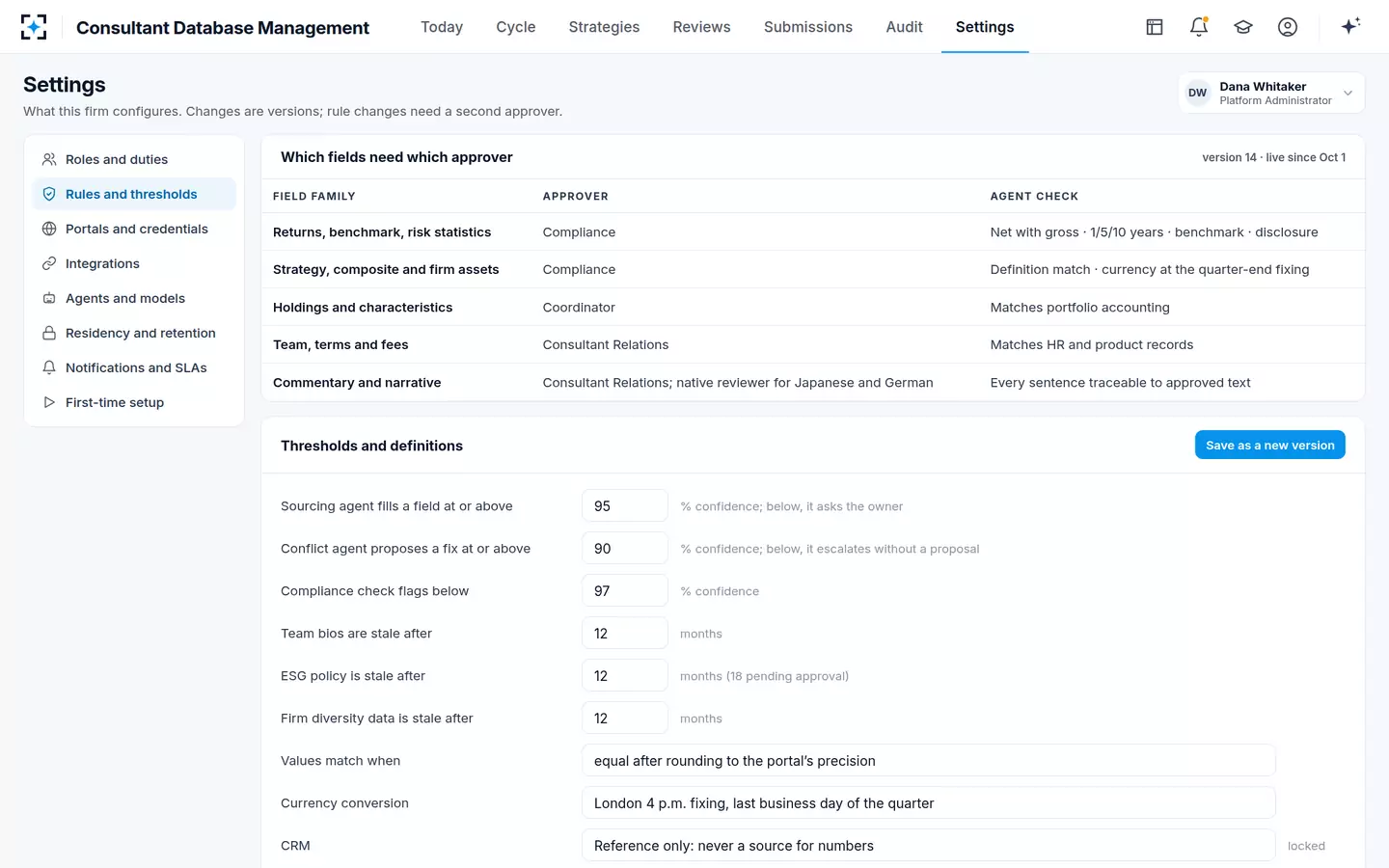
Which approver each field family needs, set once as policy
A wrong number on one live consultant database, laid out place by place
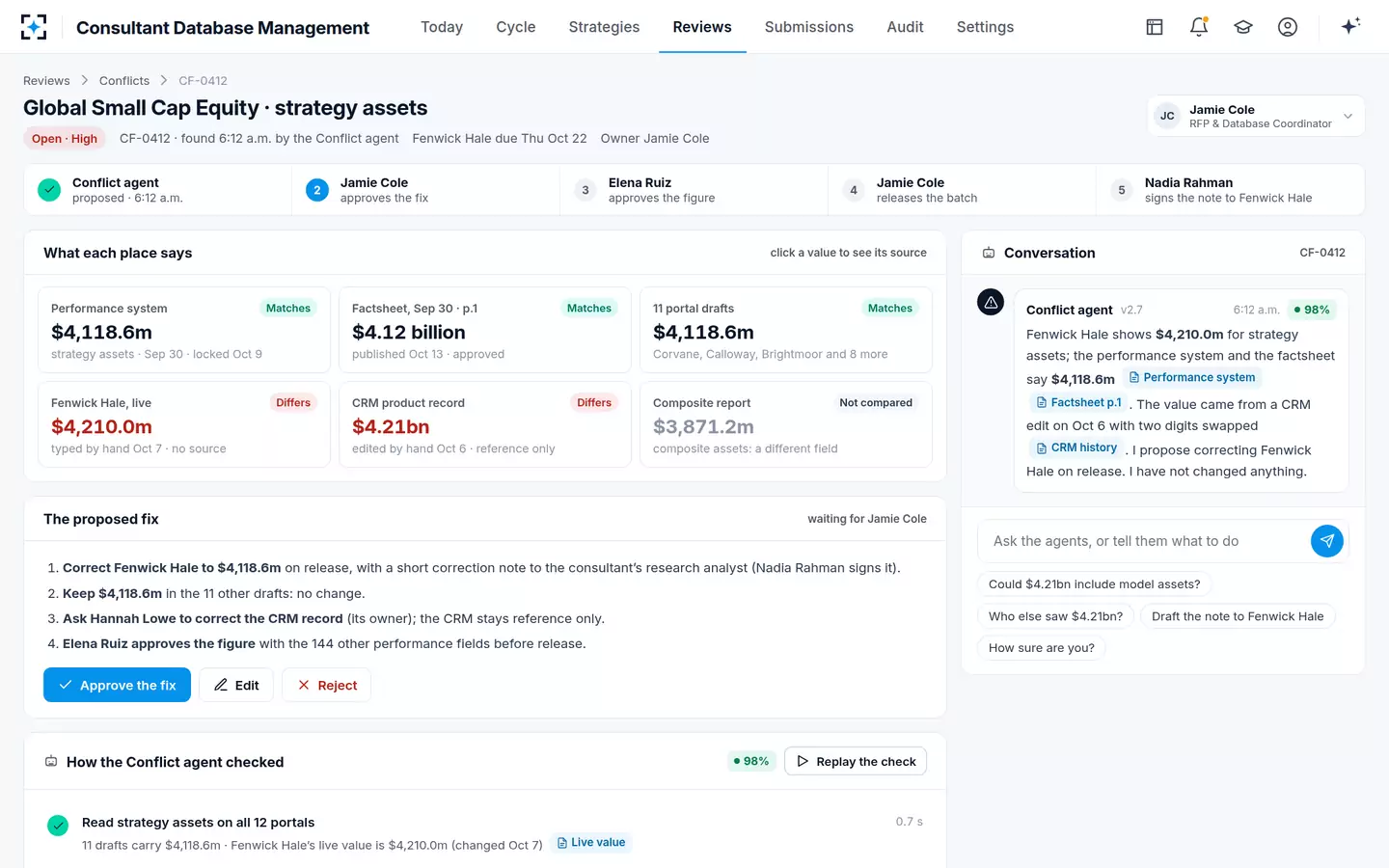
The order of work matters as much as the comparison. Fill from the locked source, compare every live copy, fix with a person's approval, and tell the consultant before its researchers find the error themselves. For the assets fields in particular, which AUM figure a field asks for is the first thing to settle. To see your own profiles this way, start from Consultant Database Management.
Questions people ask
How do investment consultants work with asset managers?
They research managers continuously through their databases, meetings and questionnaires, then recommend a shortlist when a client runs a search, and monitor the hired managers afterwards. Managers keep the database profiles current and answer the consultant's RFPs and DDQs; consultants are paid by their clients, and the SEC's 2005 report found many also did business with managers.
How do you choose a pension fund investment consultant?
Start with the DOL and SEC's 2005 questions: registration, relationships with and payments from managers, conflict policies, written acknowledgement of fiduciary duty and ERISA status. The plan's fiduciaries remain responsible for monitoring the consultant, as they are for the managers it recommends.
Are investment consultants fiduciaries?
A consultant registered as an investment adviser owes its clients a fiduciary duty under the Advisers Act. Whether it is also an ERISA fiduciary depends on the services and the agreement, which is why the DOL and SEC suggest plans ask it to say so in writing.
Do investment consultants pay attention to net or gross returns?
Both, and they compare them. A profile that shows gross returns must show net returns beside them under the Marketing Rule, and the gap tells researchers what fee was deducted. How net-of-fee returns are calculated explains which fee a database field should use.
How often must consultant database profiles be updated?
No rule sets a frequency; each consultant sets its own cycle, usually quarterly for performance and assets. The Marketing Rule's periods must end no earlier than the most recent calendar year-end, and anything material, such as a portfolio manager's departure, should not wait for the next cycle.