A key person event clause is a term in an investment management agreement, a side letter or a fund's documents that names one or more individuals, usually portfolio managers, and sets out what happens if they leave or stop devoting enough time to the strategy: the manager must notify the client within a stated period, and the client often gains a right to terminate, redeem or suspend new investment without the usual notice or penalty. No regulator defines a key person event; the contract does. But the departure that triggers the clause also has to reach places no contract names: every consultant database that lists the team, every RFP in progress, the firm's own brochure supplements and its marketing material. Botminds' Consultant Database Management watches the HR system, flags the change and drafts the notice to every consultant that carries the strategy, for consultant relations to sign.
This page deals with key person terms for separately managed accounts and institutional mandates, and with the consultant side of a team change. Key person provisions in private fund partnership agreements, which can suspend a fund's investment period, follow different mechanics.
One resignation, from the HR system to the last notice
- Found October 13; notices due within 5 business days7 days
- Team fields updated with the Q3 submissions, to November 1324 days
- Notice period until the last day, December 3148 days
What is a key person event clause?
It is a promise about people. A client that hires a manager for a strategy is usually hiring a team, and the clause makes the team's continuity a contract term. A typical clause names the key persons, defines the event (death, disability, departure, a change of role, or time devoted falling below a threshold), sets a notice period, and gives the client a remedy, most often the right to terminate without the usual notice period or fees. Some clauses let the manager propose a replacement for the client's approval before the remedy applies.
Because the clause lives in each client's agreement, a firm with many institutional clients can have many versions: different named individuals, different notice periods, different remedies. Knowing which clients have which terms is an obligation-tracking problem, and the firm's written agreements are records it must keep (17 CFR 275.204-2(a)(10)). Investment Management Agreement Review extracts these terms from the agreements themselves; the investment management agreement template guide shows where each sits and which team must act on it.
Key person terms in an investment management agreement: what to check
When a departure happens, five details of each clause decide what the firm must do, and they differ from agreement to agreement. Reading them before anyone resigns is far cheaper than reading them the week someone does. The table lists the elements to extract from every agreement, side letter and fund document that names an individual.
Five elements of a key person clause, and the question each answers
| Element | What to extract | The question it answers on the day |
|---|---|---|
| Named persons | Each individual, by name or by role, and whether all or any of them must leave | Does this departure trigger the clause at all? |
| The event | Departure, death, disability, a change of role, or time devoted below a stated level | Has the event happened yet, or only been announced? |
| Notice | Period, method, recipient and content of the notice | Who must receive what, by when, and how? |
| Remedy | Termination without notice or fees, redemption, suspension, or approval of a replacement | What can the client now do, and for how long? |
| Cure | Whether naming an approved successor within a period ends the event | Can the firm propose a replacement first? |
The second column is where announcement and departure diverge. A portfolio manager who resigns on October 13 but leaves on December 31 may or may not have triggered a clause on the day of resignation, depending on how the event is worded, and the notice period may run from either date. Legal should read each clause with that distinction in mind, and the firm's notice to consultants, which no clause governs, should not wait for the answer.
What is a key person event, and what is key person risk?
A key person event is the occurrence the clause describes; key person risk is the exposure that makes the clause worth writing. A strategy run by one portfolio manager with a short-tenured team has high key person risk, whatever its agreements say. A firm can measure it with a few plain numbers: the share of the strategy's assets that sit under agreements naming a key person, the number of strategies that depend on the same individual, the tenure of the co-portfolio managers, and whether a named successor exists. The same measures belong in the team section of every consultant profile and DDQ answer, because they are what a departure changes.
Who must be told when a portfolio manager leaves?
More people than the agreements list. The contract decides which clients receive a formal notice and when; good practice and the general rules on advertising and fiduciary duty decide the rest. The checklist below is ours and is ordered by how quickly each audience is usually reached.
Who hears about a portfolio manager's departure, and through what
- Clients whose agreements name the person
The formal notice the clause requires, by its deadline and method, with any replacement proposal.
- All other clients of the strategy
An adviser must tell clients material information that could affect the relationship, whether or not a clause applies.
- Every consultant that carries the strategy
A notice to the research analyst, then the team fields corrected in that consultant’s database.
- Prospects in open RFPs and finals
A correction before the decision, not after; a finals deck still naming the departing manager can mislead.
- Form ADV brochure supplements
Amended promptly where a supplement becomes materially inaccurate; new supplements for the replacement.
- Marketing material and websites
Factsheets, pitch books and team pages updated or withdrawn.
- Internal records
HR, the CRM, the approved answer library and the content owners for every bio.
What the rules require when a team changes
No US rule requires an adviser to notify a consultant of a team change by a deadline, but several rules reach the same departure from different directions. The brochure supplement is the most direct: Form ADV requires an adviser to amend its supplements "promptly if any information in them becomes materially inaccurate" (Form ADV General Instructions, Instruction 4). The Part 2 instructions add a broader point.
Five rules that touch a portfolio manager's departure
| Rule | What it requires | What it means for a team change |
|---|---|---|
| Form ADV Part 2B brochure supplements | A supplement for each supervised person who formulates advice with direct client contact or has discretion; amend promptly if materially inaccurate | The departing manager’s supplement comes out; the replacement’s goes to clients before or when that person begins to advise them |
| Fiduciary duty (Part 2 instructions; 2019 interpretation) | A continuing obligation to tell clients material information that could affect the relationship | Clients without a key person clause still need to hear about a material team change |
| Marketing Rule general prohibitions | No untrue statement or omission of a material fact; nothing otherwise materially misleading | A profile or deck still naming the departed manager misleads its readers |
| Books and records, Rule 204-2 | Keep written agreements, advertisements and communications relating to advice | The notice, the old and new profiles and the agreements are all records to keep |
| ERISA service-provider disclosure, 29 CFR 2550.408b-2 | Disclose changes to the required information within 60 days of being informed | Applies to changes in disclosed services, status or compensation; a team change alone may not be one |
That broader point is the one to remember. The Part 2 instructions say: "As a fiduciary, you have a continuing obligation to inform your clients of any material information that could affect the advisory relationship. As a result, between annual updating amendments you must disclose material changes to clients even if those changes do not trigger delivery of an updated supplement" (Form ADV Part 2, Instructions for Part 2B). The SEC's 2019 interpretation of the adviser's standard of conduct says that duty cannot be waived, though its application may be shaped by agreement (84 FR 33669). A key person clause shapes how and when some clients hear; it does not excuse silence to the rest.
How fast must consultants hear about a team change?
No regulation sets a deadline; the consultant's own terms and the firm's policy do. What decides the speed in practice is how the firm finds out. A resignation recorded in the HR system on a Tuesday reaches consultants that week only if someone is watching the HR system for changes to people named in profiles; if the team bios are reviewed once a quarter, the consultant may hear months later, often from someone else.
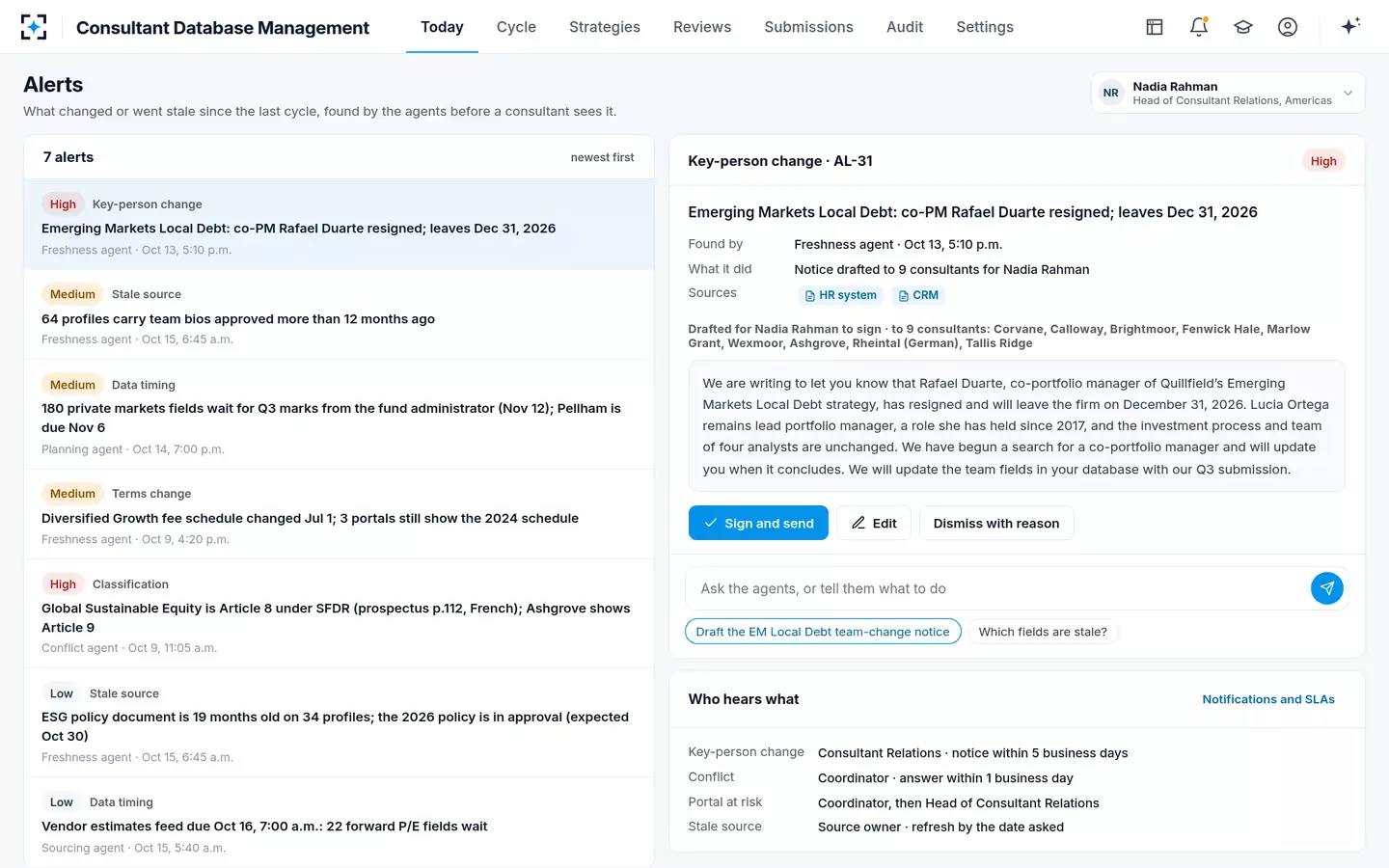
In the sample firm, the fictional Quillfield Capital, the Freshness agent in Consultant Database Management found a co-portfolio manager's resignation in the HR system on October 13 at 5:10 p.m. and drafted a notice to the nine consultants that carry the strategy the same evening. The firm's setting gives consultant relations five business days to send it. The notice says the lead manager remains in place, the process and the analyst team are unchanged, a search has begun, and the team fields will be updated with the third-quarter submissions.
A key-person change found in the HR system, with the notice drafted
Why consultants care: soft factors and the duty to monitor
Consultants care because their recommendations rest heavily on people, and their clients must keep watching what they hired. Research on consultants' recommendations of US equity funds found them driven mainly by soft factors rather than past performance (Jenkinson, Jones and Martinez, Journal of Finance, 2016); a change in the team is a change in exactly what was recommended. The guide on how to evaluate a fund manager sets the study beside the regulators' work on manager selection.
For ERISA plans there is a legal reason too. In Tibble v. Edison International the Supreme Court held that a plan fiduciary has a continuing duty to monitor investments and remove imprudent ones, separate from the duty to choose prudently at the outset (575 U.S. 523 (2015)). A consultant advising that fiduciary needs to hear about a departure to do its part of the monitoring; the guide to fund watch list criteria shows how committees turn the duty into a process.
Five people move one departure through the firm
Today
Records the resignation and the leaving date.
With agents
Unchanged: the HR system is the source the agents watch.
Still theirs: The employment record
Today
Hears late, drafts each consultant’s notice by hand.
With agents
Reviews one drafted notice per consultant, edits if needed, signs and sends.
Still theirs: Every message to a consultant
Today
Search the agreements for key person terms after the fact.
With agents
Work from a list of the agreements that name the person, with their notice periods.
Still theirs: The formal notices under each clause
Today
Updates brochure supplements when someone remembers.
With agents
Amends the supplements and approves the corrected team text.
Still theirs: Form ADV and the marketing review
Today
Finds the old bio in profiles and RFP answers one at a time.
With agents
Releases corrected team fields to every portal and open answer at once.
Still theirs: The release of each corrected profile
The cost of the gap between the HR system and the last notice
Every day between the HR change and the last corrected profile is a day a consultant's researchers read a team that no longer exists. That gap is the thing to measure, and a firm can measure it from its own files: the date HR recorded the change, the date each notice went out, the date each portal's team fields changed. In the sample firm the notices were drafted within hours and the team fields were scheduled into the third-quarter submissions; the remaining exposure was the agreements, which legal handles from the contract register.
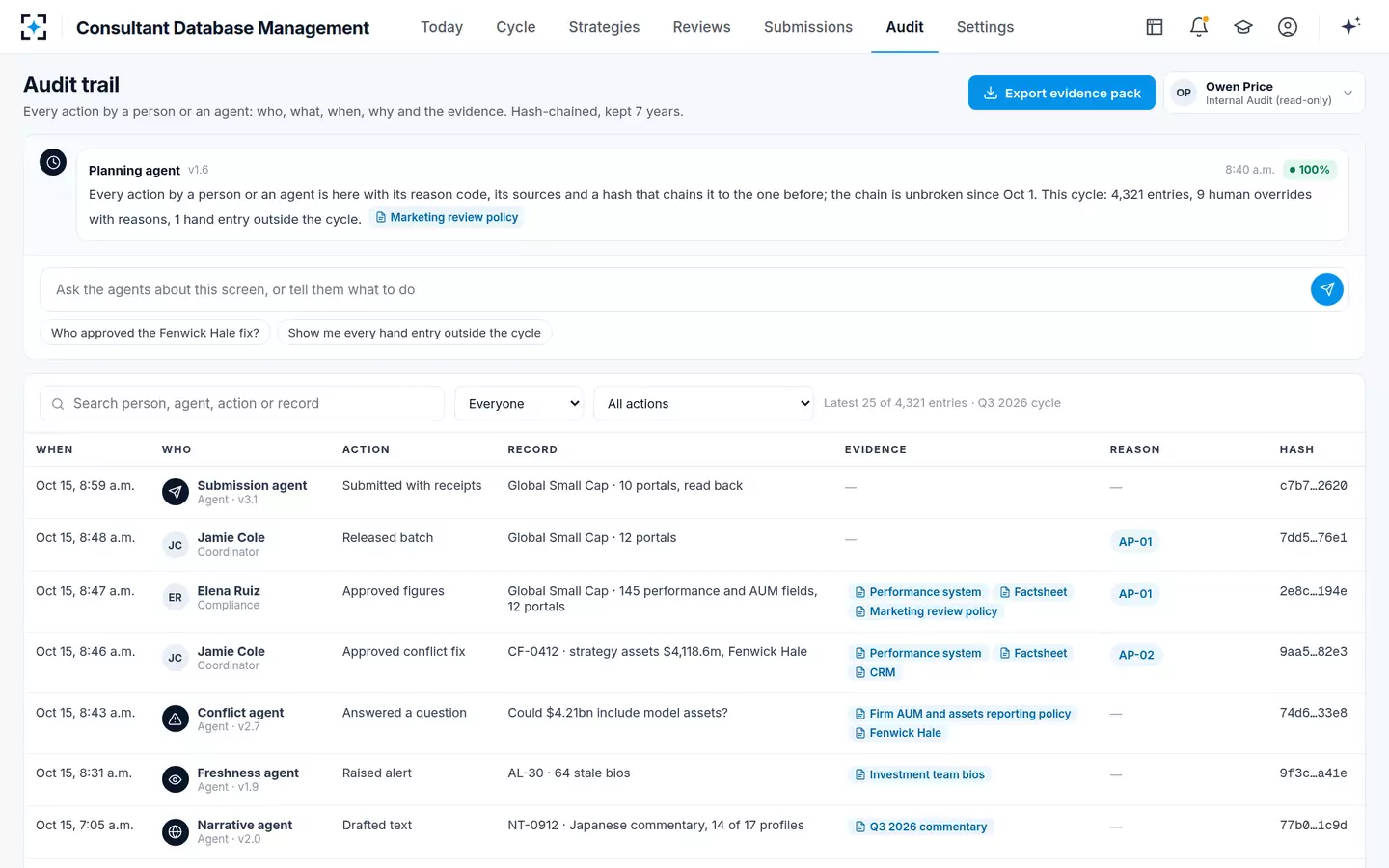
The audit trail is what makes the timing provable. Each step (the alert, the drafted notice, the signature, the release of each corrected profile) sits in the same audit trail with who did it and when, which is what a client asking "when did you know?" will want to see.
Who did what, when: the evidence behind every notice and correction
Team text is also the most common stale content in an answer library; RFP content management covers how bios get owners and expiry dates. To see a departure flow through your own portals, start from Consultant Database Management.
Questions people ask
What does key man event mean?
The older name for a key person event: the departure, death, disability or reduced involvement of a named individual that triggers rights in an agreement. Most current agreements say key person, and the terms are otherwise the same.
Is a key person clause required by law?
No. It is negotiated between the manager and the client and appears only where the client asks for it. The rules that apply regardless are the duty to tell clients material information, the brochure-supplement requirements of Form ADV and the Marketing Rule's ban on misleading statements.
What notification of key personnel changes do consultants expect?
A short written notice to the research analyst covering who is leaving and when, who remains responsible, whether the process changes, what the firm is doing about the vacancy and when the database will be updated.
Can a client terminate after a key person event?
If its agreement says so, usually yes, often without the normal notice period or termination fees. Every advisory contract must already bar assignment without the client's consent under section 205 of the Advisers Act, but a key person right is separate and comes only from the agreement's own terms.
Does a portfolio manager's departure have to be disclosed to all clients?
If it is material to the advisory relationship, yes. Form ADV's instructions state that advisers have a continuing obligation to tell clients material information that could affect the relationship, even between annual updates and even when no supplement delivery is triggered.