An investment management agreement template is the firm's starting text for appointing it to manage a client's separate account, and most templates carry the same eleven parts: appointment and discretion, investment guidelines (usually Schedule A), fees (usually Schedule B), brokerage, custody, reporting, standard of care and liability, representations, assignment, termination, and confidentiality and notices. What a template cannot show is who must act on each clause once it is signed, and that is where the work goes wrong: a side letter changes a limit, a fee promise never reaches billing, a report deadline moves and nobody tells the reporting team. Botminds' Investment Management Agreement Review reads each executed IMA, schedule and side letter as an owner map, turning every clause into an obligation sent to the team that must keep it, with the clause quoted and its page cited.
This guide does not offer a downloadable form; templates belong to each firm's counsel. It shows the anatomy every template shares, the clauses US law writes for an SEC-registered adviser whatever the template says, and what each clause asks of which team. Examples come from a fictional sample firm, Quillfield Capital, and its fictional client Marlow County Retirement System.
The eleven parts of an IMA template, and the first question each must answer
- Appointment and discretion
Is the mandate discretionary, and over which account and assets?
- Investment guidelines
Which limits apply, when are they tested, and what happens on a breach?
- Fees
What is the rate, on what base, valued when, and billed how often?
- Brokerage and trading
Which brokers, and are cross trades or affiliated brokers allowed?
- Custody and lending
Who holds the assets, and may they be lent?
- Reporting
Which statements, by which business day?
- Standard of care and liability
What does the adviser answer for, and what rights does the client keep by law?
- Representations
What does the adviser say about itself, and when could it stop being true?
- Assignment
Does it bar assignment without the client's consent?
- Termination
How much notice, and what happens to prepaid fees?
- Confidentiality and notices
Who may see the terms, and where must notices go?
What is an investment management agreement?
An investment management agreement is the contract under which a client, typically an institution such as a pension plan, endowment or insurer, appoints a manager to invest a portfolio on its behalf, usually in a separate account held at the client's own custodian. It is an investment advisory contract in the Advisers Act's terms, which defines one as "any contract or agreement whereby a person agrees to act as investment adviser to or to manage any investment or trading account of another person other than an investment company registered" under the Investment Company Act (15 U.S.C. 80b-5(d)). "Investment management agreement", "investment advisory agreement" and "portfolio management agreement" are names for the same thing; funds use their own form of advisory contract under Section 15 of the 1940 Act.
The SEC's 2019 interpretation of advisers' fiduciary duty explains why the document matters so much for institutional mandates. The obligations that flow from the duty depend on the scope of the relationship, and an adviser to a client whose contract defines the mandate "with substantial specificity (e.g., a mandate to manage a fixed income portfolio subject to specified parameters, including concentration limits and credit quality and maturity ranges)" has obligations shaped by those terms (SEC interpretation, 84 FR 33669, July 12, 2019). For a separate account, the agreement and its schedules are the mandate.
The clauses in an investment management agreement template, and who acts on each
Read as an owner map, the template's eleven parts sort into five teams. Compliance owns most of Schedule A, billing owns Schedule B, client reporting owns the deliverables, trading owns the brokerage terms, and legal keeps the rest. The table is what an onboarding analyst should be able to hand each team on the day an agreement is signed; the rest of the client file is covered in institutional account opening documents.
Every clause in a separate-account IMA, and the team that must act on it
Appointment and discretion
What it settlesWho may decide what is bought and sold, for which account, and what needs the client's instruction
OwnerLegal · portfolio management
Investment guidelines (Schedule A)
What it settlesCredit, issuer, sector and duration limits, permitted instruments, exclusions and how breaches are cured
OwnerCompliance coding · trading
Fees (Schedule B)
What it settlesRate, fee base, valuation date, billing in advance or arrears, exclusions, any most-favored-nation promise
OwnerBilling
Brokerage and trading
What it settlesBroker selection, cross trades, affiliated brokers, trade aggregation, FX
OwnerTrading
Custody and securities lending
What it settlesThe client's custodian, who may instruct it, whether lending is permitted
OwnerOperations · legal
Reporting
What it settlesMonthly and quarterly statements, deadlines, ESG and compliance certificates
OwnerClient reporting
Standard of care and liability
What it settlesThe liability standard, indemnities and what the client keeps under law
OwnerLegal
Representations and acknowledgments
What it settlesRegistration status, fiduciary acknowledgment for plan clients, brochure delivery
OwnerLegal · compliance
Assignment
What it settlesNo assignment by the adviser without the client's consent
OwnerLegal
Termination
What it settlesNotice period, transition of positions, refund of prepaid fees
OwnerLegal · billing
Confidentiality, notices, governing law
What it settlesWho may see what, where notices go, which law and courts apply
OwnerLegal · relationship team
The rows where two owners share a clause are where obligations get lost. Custody and securities lending sits between operations, which talks to the custodian, and legal, which knows what the agreement permits. In the sample firm's bundle for Marlow, the IMA allowed securities lending through the client's custodian, a later side letter prohibited it, and the custodian still showed the account enrolled. The clause changed on paper; the account did not, until a withdrawal instruction went to the custodian.
Which IMA clauses the law writes for you
Some clauses are not the drafter's choice. For an SEC-registered adviser, the Advisers Act requires every advisory contract to bar the adviser from assigning it without the client's consent, limits fees based on a share of capital gains, and requires a partnership adviser to promise notice of changes in its membership (15 U.S.C. 80b-5(a)). Any clause that binds a person "to waive compliance with any provision" of the Act or its rules "shall be void" (15 U.S.C. 80b-15(a)).
What US law requires of an advisory contract, whatever the template says
| Clause | What the law requires | Where it comes from |
|---|---|---|
| Assignment | No assignment by the adviser without the client's consent; a transfer of a controlling block of the adviser's voting securities counts as an assignment | Advisers Act §205(a)(2) and §202(a)(1) |
| Performance fee | No fee based on a share of capital gains, unless an exemption applies, such as a qualified client under Rule 205-3 | Advisers Act §205(a)(1) and (e) |
| Partnership membership | A partnership adviser must promise to notify the client of changes in its membership within a reasonable time | Advisers Act §205(a)(3) |
| Waivers and hedge clauses | A waiver of compliance with the Act is void; a clause that misleads a client about non-waivable rights can breach the antifraud provisions | Advisers Act §215(a), §206; SEC interpretation, 2019 |
| Brochure delivery | Deliver the current Form ADV brochure before or at the time the contract is entered into | Rule 204-3(b)(1) |
| Keeping the agreement | Keep all written agreements with clients, five years from the end of the fiscal year of the last entry, the first two in an appropriate office | Rule 204-2(a)(10) and (e)(1) |
| Plan clients (ERISA) | An investment manager must be registered (or a bank or insurer) and acknowledge in writing that it is a fiduciary; services and compensation disclosed in writing in advance | ERISA §3(38); 29 CFR 2550.408b-2 |
Two of these rows have recent enforcement behind them. In January 2026 the SEC found that two affiliated advisers' agreements in use from December 2017 reserved the firm's right to assign or transfer the agreement without notice to the client or its consent, that later versions still failed to require consent, in breach of Section 205(a)(2), and that the agreements also contained hedge clauses that could mislead retail clients about their non-waivable rights (SEC order, Release IA-6941, January 20, 2026, settled without admitting or denying the findings). The assignment rule is set out in full in Investment Advisers Act Section 205, and the liability clause in how to test a hedge clause.
Schedule A and Schedule B: the parts that change most
The body of an IMA changes rarely; the schedules change with every negotiation. Schedule A, the investment guidelines, is where the client's restrictions live: credit quality floors, issuer and sector caps, duration bands, permitted instruments, exclusions, and the cure period for a passive breach. Schedule B sets the fee, and its definitions matter more than its rate: which assets are in the fee base, which date values them, whether fees are billed in advance or in arrears, and whether cash or a legacy position is excluded.
A September 2026 SEC order shows why the fee base belongs in the schedule and in the billing system at once. A small adviser's agreements set a 2.5% fee on the market value of the assets listed in Schedule B; the adviser charged 3% to 28 clients and charged one client fees on cash that was not in Schedule B and was not invested with the firm at all (SEC order, Release IA-6996, September 18, 2026, settled without admitting the findings). The rate and the base were both in the schedule. Neither reached the bill. What a billing error costs once it is found is worked through in the fee structure guide.
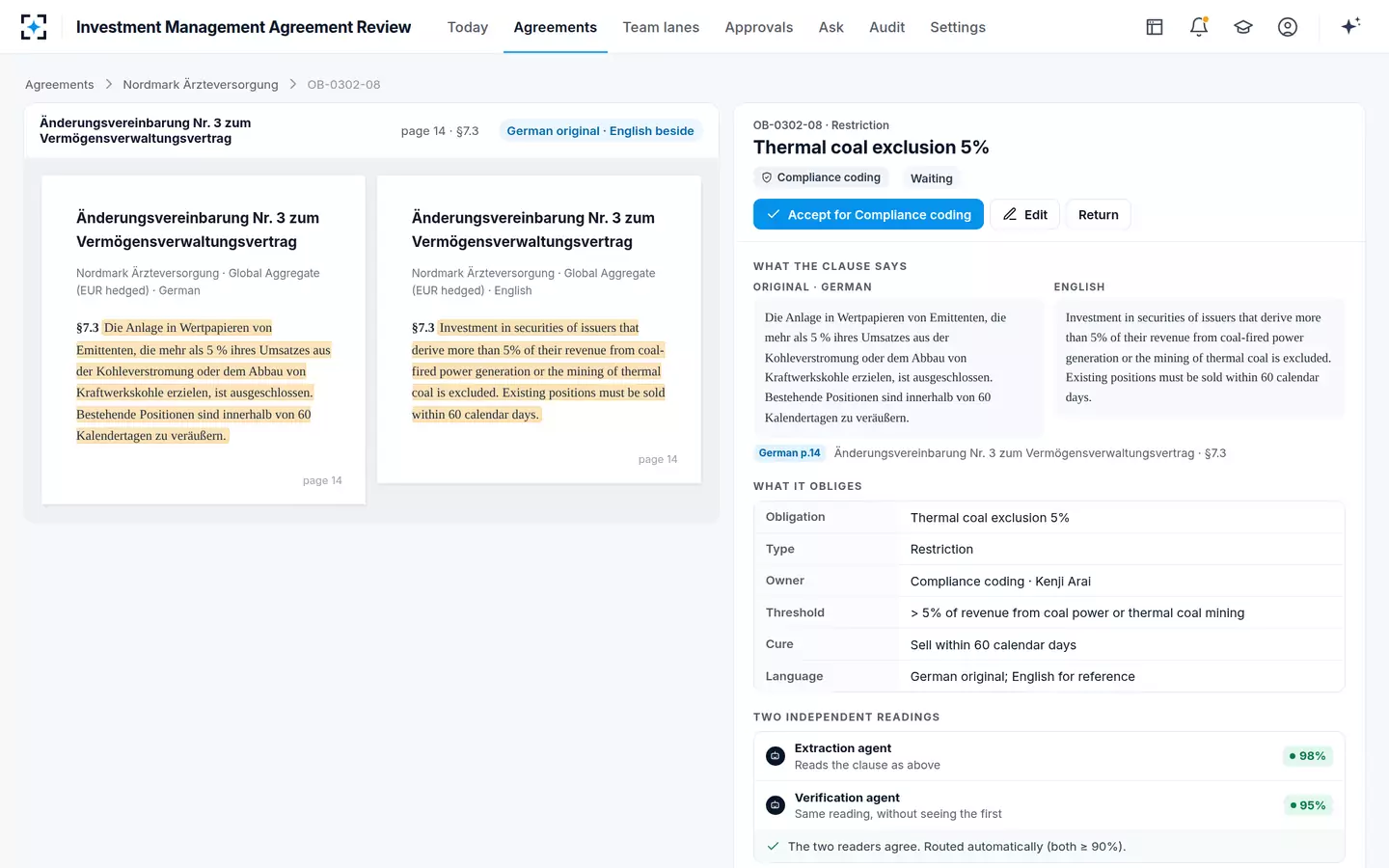
A Schedule A restriction signed in German, read in Investment Management Agreement Review beside the English
What is a discretionary investment management agreement?
A discretionary investment management agreement lets the manager buy and sell without asking the client trade by trade, within the guidelines; a non-discretionary agreement requires the client's approval or instruction before a trade. The appointment clause decides which it is, and the choice ripples through the rest of the template. Discretion is what makes the guidelines the client's main control, so Schedule A tends to be longer. It is also what makes the manager's broker selection and trade aggregation clauses matter, because the client is not choosing.
Discretionary and non-discretionary agreements put the work in different places
Discretionary: The manager, within Schedule A.
Non-discretionary: The client approves or instructs each trade, or each class of trade.
Discretionary: The guidelines, tested before and after trades.
Non-discretionary: The client's own approval of each recommendation.
Discretionary: Code every restriction into the compliance engine and test it on holdings.
Non-discretionary: Lighter guideline coding; more evidence of each client instruction.
Discretionary: A manager with power over plan assets is the plan's investment manager under §3(38), and must acknowledge in writing that it is a fiduciary.
Non-discretionary: An adviser that gives investment advice for a fee can still be a fiduciary under §3(21)(A)(ii).
Discretionary: Every limit and when it is tested: at purchase or continuously.
Non-discretionary: Who may give instructions, and how they are evidenced.
For plan clients the distinction has a statutory name. An adviser with power to manage, acquire or dispose of plan assets is an investment manager under ERISA section 3(38) if it confirms its fiduciary status in writing, while a person who "renders investment advice for a fee or other compensation" is a fiduciary under section 3(21)(A) (29 U.S.C. 1002). The template's representations section is where that acknowledgment usually sits; the QPAM representation often sits beside it.
Investment advisory agreement vs investment management agreement
Legally there is no difference: the Advisers Act's rules apply to "any investment advisory contract", whatever the document is called. In practice firms use "investment advisory agreement" for retail and wealth relationships and "investment management agreement" for institutional separate accounts, and the documents differ in length and in who negotiates them. An institutional IMA is negotiated clause by clause and often amended by side letter; a retail advisory agreement is usually a standard form signed as is.
That difference matters most for the liability clause. The SEC's 2019 interpretation judges a hedge clause in an institutional agreement on its facts, but sees almost no room for a broad one in a retail agreement (84 FR 33669). A firm that reuses its institutional template for retail clients carries the institutional liability language into a context where it is far harder to defend.
Side letters, amendments and the precedence clause
Every IMA template should say which document wins when two disagree, and many do in a precedence or order-of-documents clause; a side letter usually adds that it governs where inconsistent, as the sample firm's does. Without that clause, an obligation changed by a side letter has two versions and no rule for choosing. With it, the conflict can be settled mechanically in most cases, and only the genuinely ambiguous ones need counsel.
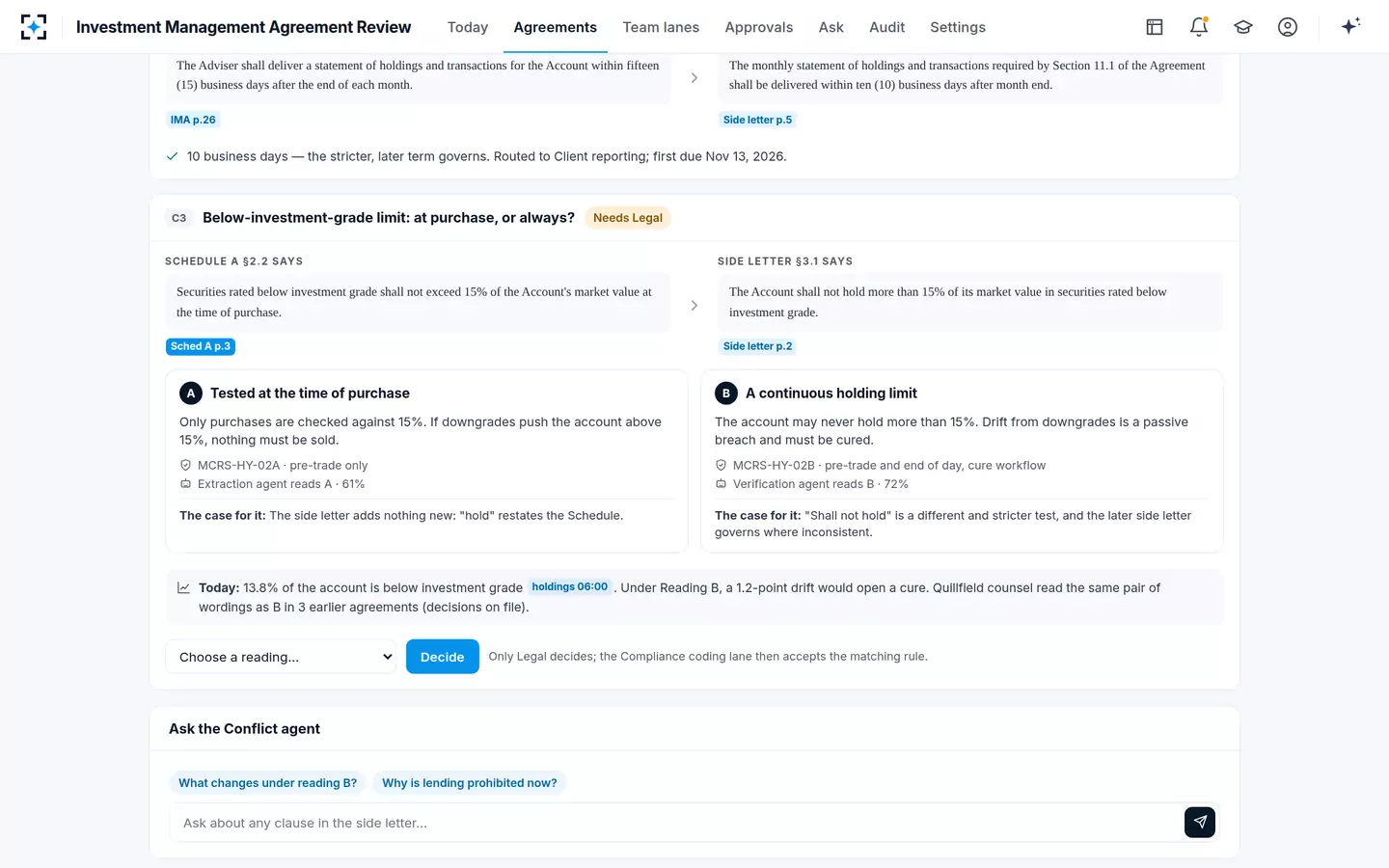
The sample bundle shows the three outcomes a precedence clause produces. On securities lending, the side letter's ban replaced the IMA's permission outright. On the monthly holdings statement, the IMA's 15 business days and the side letter's 10 resolved to the stricter, later term, first due November 13, 2026. On the 15% below-investment-grade limit, the two documents used different words for what may be the same rule, and precedence could not settle what the words meant; that one went to counsel with both readings. A template whose precedence clause is clear makes the first two automatic and leaves only the third for a lawyer, which is the right division of labor.
Amendments add a time dimension. An amendment signed in year three may change a clause a side letter changed in year one; the obligation in force is the last valid change, read through the precedence clause of the document that made it. An owner map that keeps each obligation's history, with each version cited, is the only reliable way to answer "what does the agreement say today?" for a book that has been amended for years. How private funds handle the same question is covered in side letter vs amendment.
Why a signed template still needs an owner map
A template is reviewed once, by counsel; a book of signed agreements is lived in by five teams for years. The SEC's 2021 fee risk alert describes what happens when the two drift apart: examined advisers that keyed fee percentages into their portfolio systems with errors, that left some clients on an old fee schedule after a change, and some that "did not have any written agreements or documentation establishing the client fee amount" (SEC risk alert, November 10, 2021). The alert focused mainly on retail clients, but it notes that many of the principles also apply to institutional and fund accounts.
“The staff conducted approximately 130 examinations of SEC-registered investment advisers under this Initiative (“examined advisers”) and identified deficiencies related to the advisory fees charged during most of these examinations.”
SEC Division of Examinations, Observations: Investment Advisers' Fee Calculations, November 10, 2021
Among the practices it saw working, the same alert lists a single, central billing process that checks fees against contracts and disclosures, and checklists that reconcile each client's fee calculation to its agreement. An owner map is that reconciliation done for every clause, not only the fee. It is what Botminds' Investment Management Agreement Review produces from a signed bundle: each clause becomes an obligation with its quote, page and type, an independent second agent re-reads it without seeing the first answer, and it is routed to its team's lead, who accepts it or sends it back.
Investment Management Agreement Review: the template's clause and the side letter that replaces it
When the template changes: re-papering the existing book
A new template fixes new clients only. In the January 2026 order, the advisers revised their agreement in 2020 and again in 2024, used each version "for all new clients", and "did not, however, have existing clients execute the updated" agreement; the SEC's acceptance of their offer took into account later remediation that included distributing the revised agreement to all existing clients and asking them to sign it (SEC order, Release IA-6941). A template change is therefore also a book-wide question: which signed agreements still carry the old clause, and who will tell their owners.
That question is hard to answer from a folder of PDFs and easy to answer from obligations. In the sample firm's book of 400 agreements, the solution can answer "which clients prohibit securities lending?" from the documents themselves, with each agreement cited to its page: 37, three of them in the client's own language, nine of them in a side letter rather than the agreement. The same search, run for an outdated assignment or liability clause, is the start of a re-papering plan.
Questions people ask
Is there a standard investment management agreement template?
No regulator publishes one, and each firm's counsel keeps its own. The clauses are standard; the wording is not. US law fixes some content for SEC-registered advisers, notably the consent-to-assignment clause under Section 205(a)(2) and the limits on performance fees.
Does an investment advisory agreement have to be in writing?
Section 205 governs advisory contracts without itself prescribing a written form, but in practice it must be: Rule 204-2(a)(10) requires keeping all written agreements with clients, ERISA §3(38) requires a written fiduciary acknowledgment for plan mandates, and the SEC's 2021 fee alert counted advisers with no written agreement or documentation of the client's fee among its deficiencies.
What is Schedule A in an investment management agreement?
Schedule A usually holds the investment guidelines: credit, issuer, sector and duration limits, permitted instruments, exclusions and cure periods. It is the part compliance codes into the order management system's rules, and the part a side letter most often changes.
How long must an adviser keep a signed IMA?
Rule 204-2 requires books and records such as written agreements to be kept for at least five years from the end of the fiscal year in which the last entry was made, the first two years in an appropriate office of the adviser. Clients and other laws may require longer.
What does an investment management agreement PDF from another firm tell you?
Its structure, not your obligations. A sample shows the parts and common wording; what binds your firm is the executed agreement with each client, its schedules and every later side letter and amendment, read together under the precedence clause.
Can a side letter override the IMA?
Yes, if the documents say so; most side letters state that they govern where inconsistent. In the sample bundle the side letter banned securities lending the IMA allowed and tightened a reporting deadline, so both obligations had to be sent to their teams again.