Section 205 of the Investment Advisers Act of 1940 (15 U.S.C. 80b-5) says that an adviser registered or required to be registered with the SEC may not enter into, extend, renew or perform an investment advisory contract that does three things: pays the adviser "on the basis of a share of capital gains upon or capital appreciation of the funds" of the client, unless an exception applies; "fails to provide, in substance, that no assignment of such contract shall be made by the investment adviser without the consent of the other party"; or, for a partnership adviser, fails to promise notice of changes in its membership (15 U.S.C. 80b-5(a)). Because the Act defines assignment to include a transfer of a controlling block of the adviser's voting securities, a sale or reorganization of the adviser turns every agreement into a consent to collect. Botminds' Investment Management Agreement Review reads each agreement's assignment, fee and notice clauses as obligations owned by legal, so the firm knows which contracts say what before a deal, not after.
The rule is short. The work it creates is long, because it applies to every client contract the firm has, each worded by a different negotiation. Examples come from a fictional sample firm, Quillfield Capital, and its book of 400 agreements; the law is quoted from the statute and the SEC's own rules and orders.
What Section 205(a) requires of every advisory contract
- No performance fee based on capital gains, unless exempt
Section 205(a)(1). The exceptions sit in 205(b) and, for qualified clients, in Rule 205-3.
- No assignment by the adviser without the client's consent
Section 205(a)(2). The contract must say so "in substance"; silence is a breach.
- A partnership adviser must promise notice of membership changes
Section 205(a)(3): notice "within a reasonable time after such change".
- It applies to entering into, extending, renewing and performing
An old contract that is renewed, or simply performed, must comply too.
- It applies to SEC-registered advisers and those required to register
State-registered advisers look to their state's rules.
What does Section 205 of the Investment Advisers Act require?
Section 205 requires two promises in every advisory contract and forbids one kind of fee. The promises are that the adviser will not assign the contract without the client's consent and, if the adviser is a partnership, that it will tell the client when its membership changes. The forbidden fee is one paid as a share of the client's capital gains or appreciation, with exceptions for large and sophisticated clients and certain funds. Everything else in an IMA is a matter of negotiation; these three are not.
The section's reach is wider than the signing date. It applies when an adviser will "enter into, extend, or renew any investment advisory contract, or in any way perform any investment advisory contract entered into, extended, or renewed on or after November 1, 1940" (15 U.S.C. 80b-5(a)). A contract that lacks the assignment clause is not cured by age; every day of performance under it is performance of a non-compliant contract. For the assignment and partnership clauses, subsection (d) defines the contracts covered broadly, as any agreement to act as investment adviser to, or to manage the account of, another person other than a registered investment company, so separate-account IMAs and wealth agreements alike fall within it.
Section 205(a)(2): the assignment clause, word for word
The statute asks for substance, not a formula. A clause that says the adviser may not assign the agreement without the client's prior written consent satisfies it; so does one that adds how consent is requested and given. What fails is a clause that allows the adviser to assign freely, or one that is silent. The SEC's January 2026 order against two affiliated advisers quotes the failing kind:
“[Respondents] retain[] that right to assign or otherwise transfer this Agreement or its rights or obligations set forth hereunder without notice and without Client’s consent.”
Investment advisory agreement quoted in SEC order, Release IA-6941, January 20, 2026
The order found the advisers' agreements "failed to provide, in substance, that no assignment of the advisory agreement may be made by the investment advisers without the consent of the advisory clients", that a 2024 revision "did not fix the violation", and that the firms' compliance manuals had promised a non-assignment clause in every contract. The advisers were censured and paid civil penalties of $85,000 and $65,000, settling without admitting or denying the findings, which also covered hedge clauses and custody (SEC order, Release IA-6941). The firms were small retail advisers; the lesson is not about size. It is that a clause in a template is repeated in every agreement signed on it, and fixed in none of the old ones by a new version.
What counts as an assignment of an investment advisory contract?
An assignment is any direct or indirect transfer of the contract by the adviser, or any transfer of "a controlling block of the assignor's outstanding voting securities by a security holder of the assignor" (15 U.S.C. 80b-2(a)(1)). The second limb is the one deals turn on: when the adviser's owners sell control, the contract is assigned even though the adviser, its people and its address stay the same. The Act defines control as "the power to exercise a controlling influence over the management or policies of a company"; whether a given sale moves that power is a question of fact for counsel.
The SEC narrowed the definition by rule in one direction. "A transaction which does not result in a change of actual control or management of an investment adviser is not an assignment for purposes of section 205(a)(2) of the Act" (17 CFR 275.202(a)(1)-1). An internal reorganization that moves the advisory business between subsidiaries of the same parent, without changing who controls or manages it, can therefore fall outside Section 205(a)(2). The statute also carves out partnerships: the death or withdrawal of members holding only a minority interest is not an assignment, nor is the admission of new members who remain a minority.
Is it an assignment? Four questions, in the order counsel asks them
1Is the adviser itself transferring the contract, or the rights under it, to another firm?
YesAssignment: the client must consent.
NoGo on.
2Is a controlling block of the adviser's outstanding voting securities changing hands, directly or indirectly?
YesAssignment by definition: collect consents before closing.
NoGo on.
3Does the transaction change actual control or management of the adviser?
YesTreat as an assignment and take counsel's view.
NoNot an assignment for Section 205(a)(2), under Rule 202(a)(1)-1.
4Is the adviser a partnership whose membership changes?
YesNotify the client within a reasonable time; a minority change alone is not an assignment.
NoNo Section 205 step, though the contract may still require notice.
Consent in a deal: why every IMA becomes a consent to collect
When an adviser is sold, Section 205(a)(2) turns the client book into a list of consents, and the list is only as good as the firm's knowledge of what each contract says. Some agreements say consent must be written; some name who may give it for the client; some side letters add a right to terminate on a change of control, or a notice period that starts at signing rather than at closing. The buyer's diligence and the seller's client team both need the same answer for every client: what does this agreement require, and by when?
Examiners watch the same moment. The SEC's examination priorities for fiscal 2027 say the Division "will also prioritize advisers that have grown through mergers, acquisitions or other means" and will assess whether the adviser "has adapted its compliance program in response to these changes" (SEC Division of Examinations, FY2027 priorities, a staff statement, not a rule). Collecting consents is the first step of that adaptation, and the evidence of it, client by client, is what an examiner asks to see.
Investment Management Agreement Review: one question across the whole book, agreement by agreement
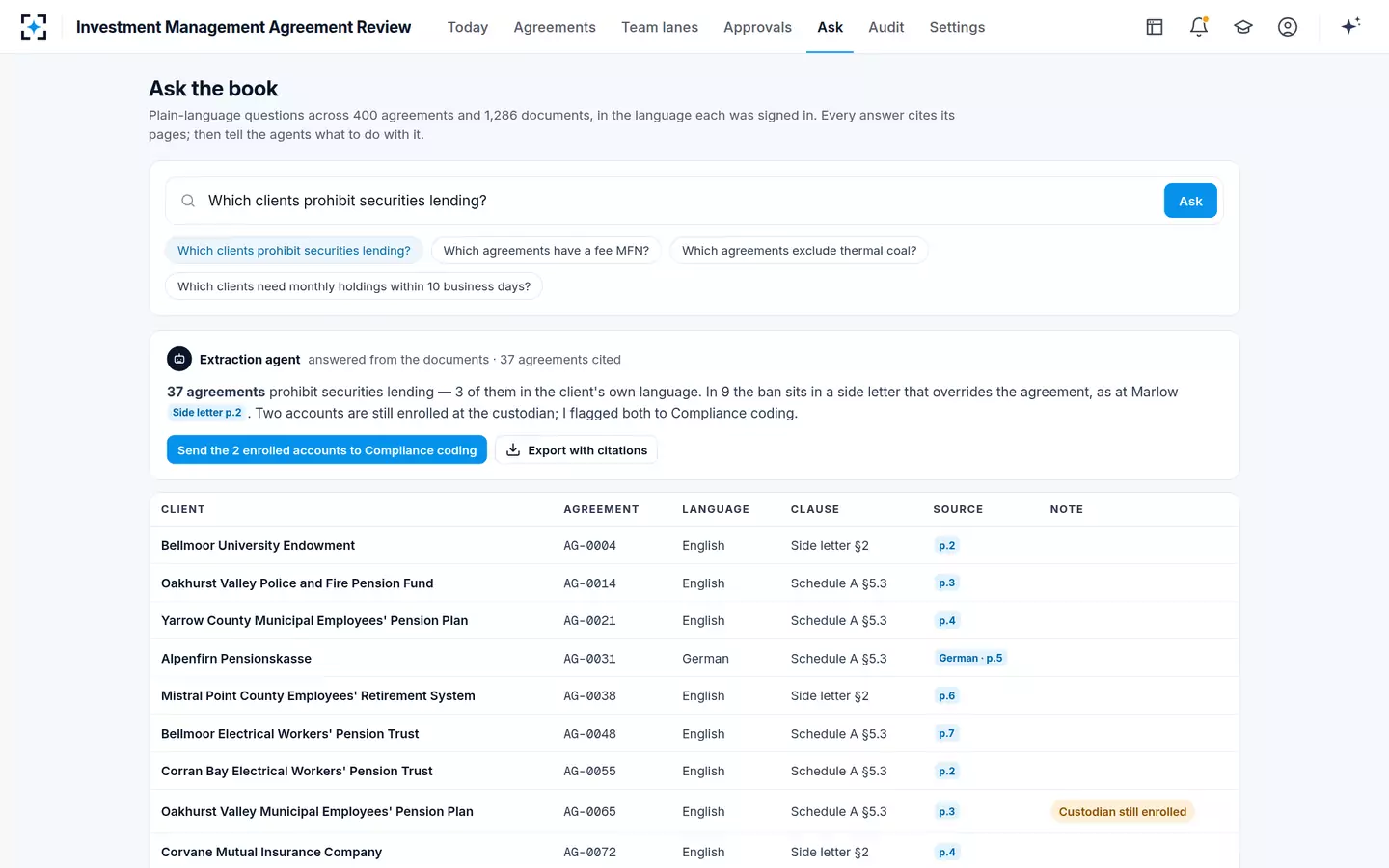
A consent campaign run from that list is a set of obligations with owners and dates: the relationship manager who asks, legal who confirms the consent meets the clause, and the onboarding team that files it. In Investment Management Agreement Review each one is routed and chased on a clock like any other obligation, and the audit trail shows who accepted what and when.
Section 205(a)(1): performance fees, and who may pay them
The statute's default is that an adviser may not be paid a share of a client's gains. Asset-based fees are expressly allowed: the bar does not reach a contract "which provides for compensation based upon the total value of a fund averaged over a definite period, or as of definite dates, or taken as of a definite date" (15 U.S.C. 80b-5(b)(1)). Performance fees need an exception, and the one most separate accounts use is Rule 205-3 for qualified clients.
The qualified client tests, from June 29, 2026
$1.4M
under the adviser's management immediately after entering the contract
Was $1.1M
$2.7M
net worth the adviser reasonably believes the client has, just before
Was $2.2M
Dec 7
in 2026, when comments close on a proposal to rewrite the definition
A proposal, not a rule
The order raised the assets-under-management test to $1,400,000 and the net worth test to $2,700,000 from June 29, 2026, and said the new amounts generally do not apply to contracts entered into before that date (SEC Release IA-6961); how the change reaches new investors in existing funds is covered in the 2026 qualified client threshold. A separate proposal published on October 6, 2026 would revise the qualified client definition to include investors who meet the accredited investor definition, and widen when regulated funds may pay performance-based fees; it is a proposal, with comments due by December 7, 2026 (91 FR 63676). An IMA with a performance fee should say which test the client met and on what date, because that date fixes which numbers apply.
The exceptions in Section 205(b): fulcrum fees, 3(c)(7) funds and non-US clients
Beyond Rule 205-3, the statute itself switches off the performance-fee bar for five kinds of contract. One matters especially for public pension mandates: the "fulcrum fee" exception, which allows a fee that rises and falls symmetrically with performance against an index for contracts over $1 million, excludes contracts with "a trust, governmental plan, collective trust fund, or separate account referred to in section 80a–3(c)(11)" (15 U.S.C. 80b-5(b)(2)(B)). A public pension's separate account may fall within that carve-out, so counsel should check before a fulcrum fee is offered; the client may still qualify through another route.
When the performance-fee bar does not apply
| Exception | Who it covers | Condition |
|---|---|---|
| §205(b)(1) asset-based fees | Any client | Fee based on asset value averaged over a definite period, or as of definite dates; not a performance fee at all |
| §205(b)(2) fulcrum fees | Registered funds; other clients with more than $1 million in the contract, except trusts, governmental plans, collective trust funds and certain separate accounts | Fee rises and falls proportionately with performance against an appropriate index over a specified period |
| §205(b)(3) business development companies | BDCs meeting the statute's conditions | No more than 20% of realized capital gains, net of losses and unrealized depreciation |
| §205(b)(4) 3(c)(7) funds | Funds excepted under Investment Company Act §3(c)(7) | None in Section 205 itself |
| §205(b)(5) non-US residents | A client who is not a resident of the United States | None in Section 205 itself |
| §205(e) and Rule 205-3 | Qualified clients | $1.4M under management or $2.7M net worth from June 29, 2026, or another route in Rule 205-3(d) |
The table also explains why fee clauses in an IMA need an owner in legal as well as billing. Billing applies the rate; only legal can say which exception a performance fee rests on, and whether a client who was eligible at signing is still eligible when the contract is renewed or amended. The statute's last subsection adds a quieter power: the SEC may by rule restrict mandatory pre-dispute arbitration clauses in advisory contracts (§205(f)), which is one more reason the dispute clause belongs on legal's list.
What happens if a contract breaks Section 205?
Two things: the SEC can bring an action, and the contract becomes vulnerable to rescission. Section 215 says every contract made in violation of the Act, or whose performance involves a violation, "shall be void" as regards the rights of the person who made or performed it in violation (15 U.S.C. 80b-15(b)). The Supreme Court read that to give clients a remedy: when Congress declared such contracts void, "it intended that the customary legal incidents of voidness would follow, including the availability of a suit for rescission or for an injunction against continued operation of the contract, and for restitution" (Transamerica Mortgage Advisors, Inc. v. Lewis, 444 U.S. 11 (1979)).
Restitution means the fees. An agreement without a compliant assignment clause, or with a performance fee no exception supports, puts the fees paid under it at risk, not just the clause. That makes Section 205 a balance-sheet question as well as a compliance one, and it is why the assignment and fee clauses belong at the top of legal's list for every agreement.
Section 205 for funds: the 1940 Act goes further
For a registered fund, the Investment Company Act sets its own terms, and on assignment it is stricter: the advisory contract must provide, in substance, "for its automatic termination in the event of its assignment" (15 U.S.C. 80a-15(a)(4)). A separate-account client can consent to an assignment and the contract continues; a fund's contract simply ends, and a new one needs approval. Section 15 reaches sub-advisory contracts too, since it covers a contract "whether with such registered company or with an investment adviser of such registered company".
Assignment under the Advisers Act and under the Investment Company Act
Separate account (Advisers Act §205): No assignment by the adviser without the client's consent.
Registered fund (1940 Act §15): Automatic termination on assignment.
Separate account (Advisers Act §205): An assignment; the contract continues if the client consents.
Registered fund (1940 Act §15): The contract terminates; a new contract needs board and shareholder approval.
Separate account (Advisers Act §205): Performance-fee limits; partnership notice.
Registered fund (1940 Act §15): Compensation described precisely; annual continuance after two years; termination on no more than 60 days' notice without penalty.
Separate account (Advisers Act §205): The client, under the agreement's consent clause.
Registered fund (1940 Act §15): The fund's board and its shareholders.
Checking a book of agreements against Section 205 with Investment Management Agreement Review
Checking one agreement takes minutes; checking a book takes a method. The steps below are the ones the sample firm's legal lane follows, and each produces evidence someone else can check.
A Section 205 review of the whole book
- Find every assignment clause, with its page
Across the IMA, amendments and side letters. A side letter can add a change-of-control termination right the IMA lacks.
- Flag the missing and the permissive
An agreement with no assignment clause, or one allowing assignment without consent, goes to counsel first.
- List every performance-based fee and its exception
Qualified client, fulcrum fee, 3(c)(7) fund or non-US client, and the date eligibility was tested.
- Check the template history
Which agreements were signed on which version, and which were never re-papered when the template changed.
- Note what consent requires
Written or not, who may give it, and any deadline, so a deal team can plan the campaign.
- Keep the evidence
Each finding cited to its clause, each consent filed with the agreement it belongs to.
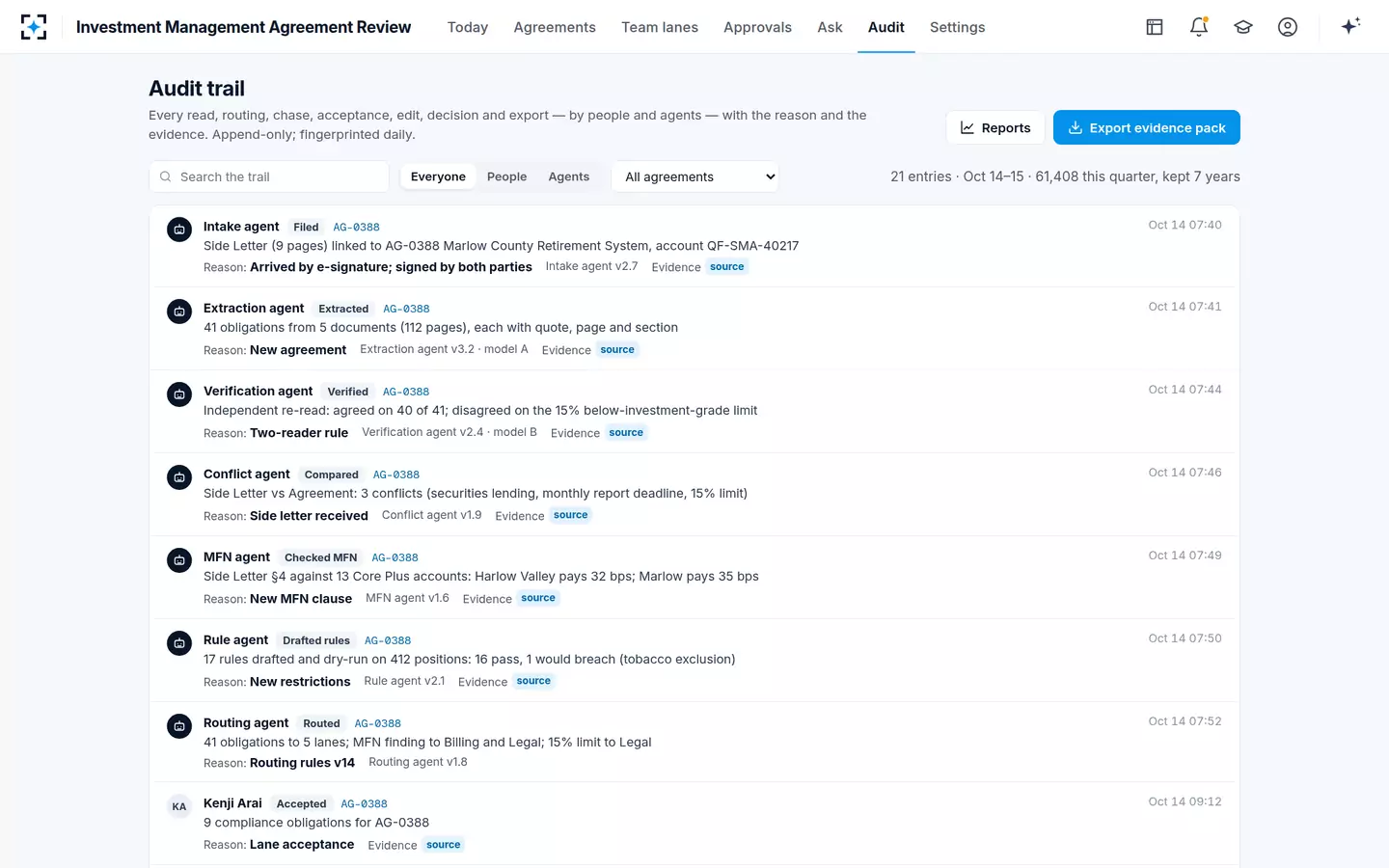
In the sample firm's new Marlow mandate, the Extraction agent found 41 obligations, "from the annual Form ADV Part 2 delivery to the assignment clause", each with its quote and page, and routed four legal terms, the assignment clause among them, to Legal's lane. Across the firm's 400 agreements, the same reading gives the legal team a standing answer to the Section 205 question. The anatomy of the rest of the agreement is in the investment management agreement template guide, the liability clause in how to test a hedge clause, and the solution itself at Investment Management Agreement Review.
The audit trail: each agent's reading and each person's decision, with the reason
Questions people ask
Is a change of control an assignment under the Advisers Act?
A transfer of a controlling block of the adviser's outstanding voting securities is an assignment by definition under Section 202(a)(1). Rule 202(a)(1)-1 adds that a transaction that does not change actual control or management of the adviser is not an assignment for Section 205(a)(2). Whether a particular deal moves control is a question of fact for counsel.
Does Section 205 apply to state-registered advisers?
The section applies to advisers "registered or required to be registered with the Commission". A state-registered adviser not required to register with the SEC looks to its state's law, which often contains similar contract requirements.
Can an advisory contract allow assignment to an affiliate?
Only with the client's consent, unless the transfer is not an assignment at all. Under Rule 202(a)(1)-1, a reorganization that does not change actual control or management of the adviser is not an assignment for Section 205(a)(2), so counsel's first question is whether control or management changes.
What does "in substance" mean in Section 205(a)(2)?
That no particular words are required, only the effect: the adviser may not assign the contract without the client's consent. In the January 2026 SEC order, a clause reserving a right to assign "without notice and without Client's consent" failed the test, and so did a later revision that still did not require consent.
Is a performance fee allowed for an institutional separate account?
Often, through an exception: a client with at least $1.4 million under the adviser's management immediately after entering the contract, from June 29, 2026, is a qualified client under Rule 205-3. The statute's fulcrum-fee exception excludes certain trusts, governmental plans and collective trust funds, so a public plan more often relies on Rule 205-3.
What remedy does a client have if the contract violates Section 205?
Section 215 makes such contracts void as regards the violator's rights, and the Supreme Court held in Transamerica Mortgage Advisors v. Lewis (1979) that this allows a suit for rescission and restitution, which can mean the return of fees paid under the contract.