Contract management software for legal departments, often called contract lifecycle management or CLM, is built to hold a company's contracts and run their life before and around signature: templates and clause libraries, drafting and redlining, approval workflows, e-signature, a searchable repository with key fields, and reminders for renewals and expiries. For an asset manager that is the right home for the investment management agreements it signs. It is not usually where the agreement's promises are kept. Each IMA, its guidelines, fee schedule and side letters bind five teams after signature, to code restrictions, apply fee terms, meet report deadlines, follow broker rules and watch assignment and notice terms, and most firms run that part on a summary spreadsheet and email. Botminds' Investment Management Agreement Review does that part with agents: it reads each executed document from the repository, turns every clause into an obligation with its quote and page, compares side letters with the agreement, tests most-favored-nation clauses against comparable fees and routes each obligation until its team accepts. This guide compares the three approaches on one bundle, honestly, including where a spreadsheet is enough.
The bundle is from a fictional sample firm, Quillfield Capital: a $1.42 billion Core Plus Fixed Income separate account for Marlow County Retirement System, also fictional, with five documents, 112 pages and a side letter that arrived after funding. Statements about contract management systems describe the category in general; products differ, and each buyer should test their own.
One IMA bundle three ways: spreadsheet, contract system, Investment Management Agreement Review
| Task | Spreadsheet and email | Contract management system | Investment Management Agreement Review |
|---|---|---|---|
| File the executed documents | A shared folder | The repository's core job: versions, signatures, search | Reads them from the repository or e-signature; holds unsigned drafts out |
| Find the obligations | One person reads 112 pages and types a summary | Key fields an analyst fills in, or an extraction feature where offered | Every clause as an obligation, with quote and page, re-read by a second agent |
| Apply the side letter | A second tab, if updated | Stored and linked to the agreement | Compared clause by clause; precedence applied; two-way readings sent to Legal |
| Test the MFN clause | By hand, if anyone remembers | Outside its data: needs other clients' billed fees | Against every comparable account in the billing system, re-run on any fee change |
| Code the guidelines | Rule analyst works from the summary | Outside its scope: lives in the order management system | Rule drafted, read back in plain English, dry-run on current holdings |
| Get each team to take its part | An email; no proof it was read | A task or reminder, where configured | Each lead accepts on a three-business-day clock, with escalation |
| Answer a question across the book | Open every file | Search on stored fields and text | A plain-language question answered from the documents, each cited |
What is contract management software, and what does it do for a legal department?
Contract management software is the legal department's home for contracts: where they are drafted from approved templates, negotiated, approved, signed, stored and found again. Its value is control over the paper. A good system knows which version is executed, who approved a deviation from the template, when a contract renews and what its key terms are, as far as someone has entered them.
For an SEC-registered adviser, part of that job is a regulatory requirement. Rule 204-2 requires an adviser to keep every written agreement it signs with a client, or a copy, for at least five years from the end of the fiscal year of the last entry (17 CFR 275.204-2). A contract repository does that well. What the rules ask next is harder: written policies and procedures "reasonably designed to prevent violation" of the Act, implemented and reviewed for effectiveness each year (Rule 206(4)-7). Keeping the agreement is storage; doing what it says is operations.
Contract management software examples: the jobs these systems are built for
The category's products differ, but most are organized around the same jobs: a template and clause library for drafting, a redlining and negotiation workspace, approval routing for non-standard terms, e-signature integration, a repository with metadata, obligation and date reminders, and reporting on cycle times and contract value. Some now add AI features that suggest clause classifications or extract key fields.
Those jobs are generic by design: the same system serves sales contracts, vendor agreements, NDAs, leases and employment agreements. Generic is a strength for a legal department that signs many contract types. It is a limit for an investment management agreement, whose most important obligations need data the contract system does not hold, such as other clients' billed fees, the account's current holdings and the compliance engine's rules, and whose owners are investment operations teams rather than lawyers.
What one sample bundle asks of the firm after signature
41obligations
across five teams, from five documents and 112 pages
13accounts
whose billed fees the MFN clause had to be tested against
412positions
the drafted compliance rules were dry-run on before go-live
The work after signature that contract systems leave to people
Four tasks decide whether an IMA's promises are kept, and each depends on something outside the contract. The MFN test needs the fees of every comparable account. Guideline coding needs the compliance engine and today's holdings: in the sample bundle, a dry run of the drafted tobacco exclusion on 412 transition positions found one bond that would breach on day one. Side-letter comparison needs a reader who knows which document governs and can see that a "shall not hold" limit is a different rule from one tested "at the time of purchase". Acceptance needs each team's lead to take on its part, on a clock, with escalation.
SEC examiners keep finding the cost of leaving those tasks to email. The June 2026 risk alert describes fees out of line with written agreements, including renegotiated arrangements and fee addenda, and firms whose policies, disclosures and "signed client agreements that contained conflicting information regarding fees" (SEC risk alert, June 9, 2026). The 2021 fee alert found fewer clients billed incorrectly where billing was centralized (SEC risk alert, November 10, 2021). Both point to the same control: one place where each agreement's terms meet the systems that apply them.
Today: the book, the waiting obligations, and the decisions with Legal
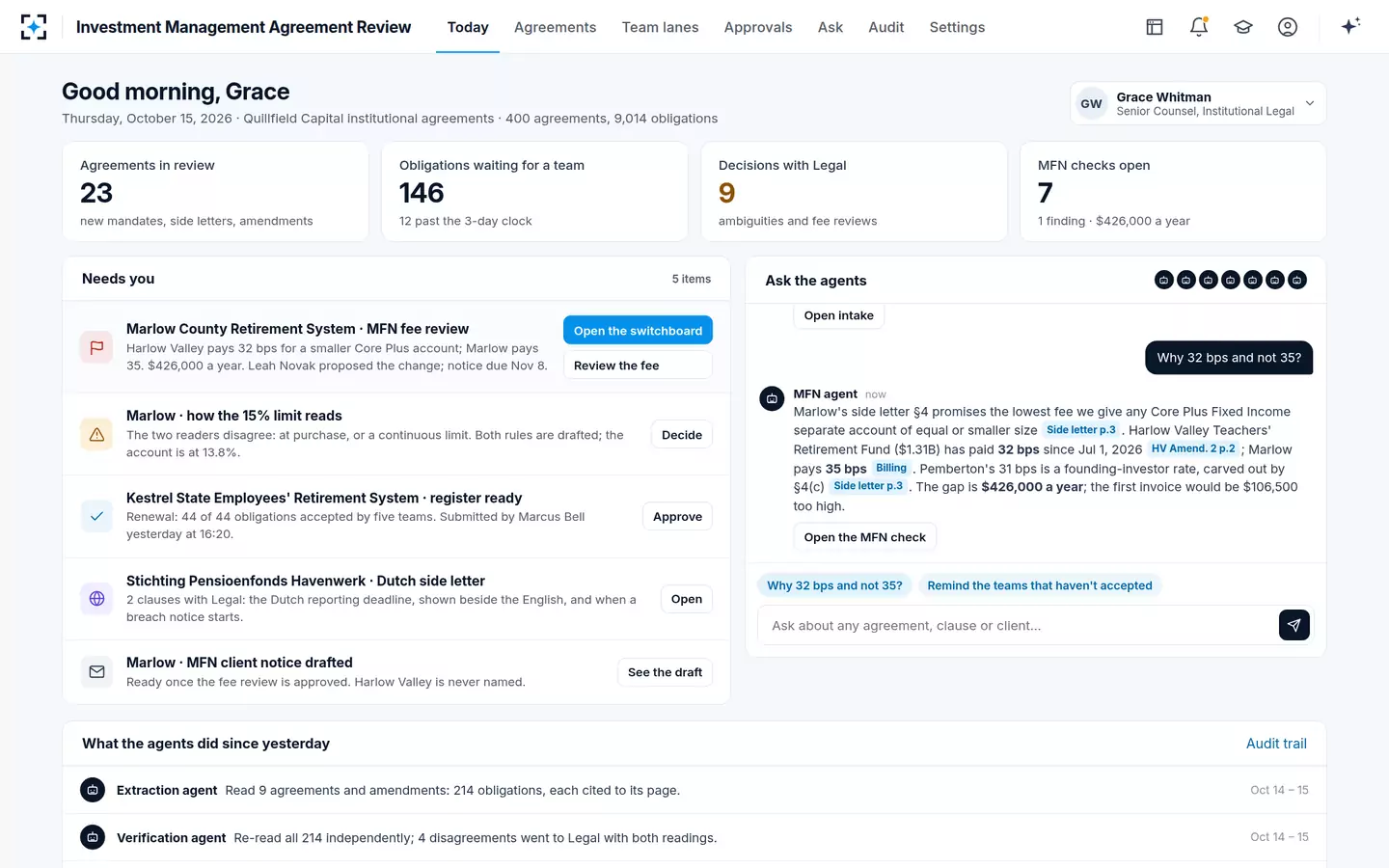
Can our CLM track obligations after signing?
It can track the ones someone enters, as dates and tasks. Most contract management systems let a legal team enter key obligations, assign them and send reminders, and that works for obligations with a date and a single owner, such as a renewal notice or an annual certificate. It works less well for obligations with a condition that depends on other data, such as an MFN, a guideline limit or a fee base exclusion, and for proving that the owner took the obligation on rather than received a reminder.
Obligations in a contract system, and obligations as agents run them
Contract management system: Entered by an analyst, or suggested by an extraction feature and confirmed.
Investment Management Agreement Review: Extracted from every clause with its quote and page, re-read by a second agent without seeing the first answer.
Contract management system: Stored and linked; the analyst updates the affected obligations.
Investment Management Agreement Review: Compared clause by clause with the IMA and schedules; precedence applied; two-way readings sent to Legal.
Contract management system: A reminder to check.
Investment Management Agreement Review: Tested: MFN clauses against billed fees, restrictions as rules dry-run on holdings.
Contract management system: A task assigned to a person.
Investment Management Agreement Review: Routed to the owning team; the lane lead accepts or returns it, on a clock, with escalation to the lane head and COO.
Contract management system: New version stored; downstream updates by hand.
Investment Management Agreement Review: A new document re-opens the obligations it touches and routes them again.
Contract management system: Approval workflow for contract terms before signature.
Investment Management Agreement Review: Counsel decides ambiguities and fee changes after signature, with a reason code; maker never checks.
The difference shows most clearly when a template changes. The SEC's January 2026 order against two affiliated advisers found agreements, revised for new clients only, that still allowed assignment without consent and carried hedge clauses, although the firms' own compliance manuals said every agreement had a non-assignment clause and none had a hedge clause (SEC order, Release IA-6941, settled without admitting or denying the findings). A repository can show which template each agreement was signed on. Knowing which signed obligations are wrong, and telling their owners, is the post-signature job.
Where the business days go, by hand and with agents
By the sample firm's estimate, a new separate-account mandate with a side letter takes about 18 business days by hand from filing to a register every team has accepted; the design target with the agents is three. The reduction is almost all in reading, comparing and drafting; acceptance by each team stays with people and becomes most of the remaining time.
Eighteen business days by hand, three with the agents
- Read, compare, code rules, set fees and calendar13 days
- Email teams and chase acceptance5 days
- Agents1.5
- Teams1.5
A contract management system shortens none of the first lane's phases on its own, because none of them is a filing or drafting task. It does shorten the work before the first lane starts: negotiation, approval and signature. That is why the two are complements, not substitutes.
When a spreadsheet is enough, and when it stops being enough
A spreadsheet is enough for a small adviser with a few dozen agreements on one standard form, no side letters, no MFN clauses and one person who reads every agreement and owns every obligation. The obligations are few, the owner is one, and the person who wrote the summary is the person who acts on it. Buying either a contract system or agents for that book would be spending on a problem the firm does not have.
It stops being enough at the first of four thresholds: the first side letter that changes an agreement after signing; the first MFN clause, which makes one client's fee depend on others'; the first agreement in a language the reader does not read; or the point where the reader and the owners are different people in different teams. Past any of those, the spreadsheet holds what one person read, not what the firm did, and the June 2026 risk alert is a list of what happens next.
Keep the CLM: how Investment Management Agreement Review sits beside it
The sensible architecture keeps each system in its job. The contract management system drafts, negotiates, approves and signs, and stores the executed agreement. Investment Management Agreement Review reads the executed documents from document management and e-signature, works with the CRM for the mandate and relationship team, drafts rules for the compliance engine in the order management system in a sandbox, reads effective fees from the billing system for the MFN watch, uses portfolio accounting and custodian feeds for dry runs and lending enrollment, and feeds the client reporting platform's deliverables calendar.
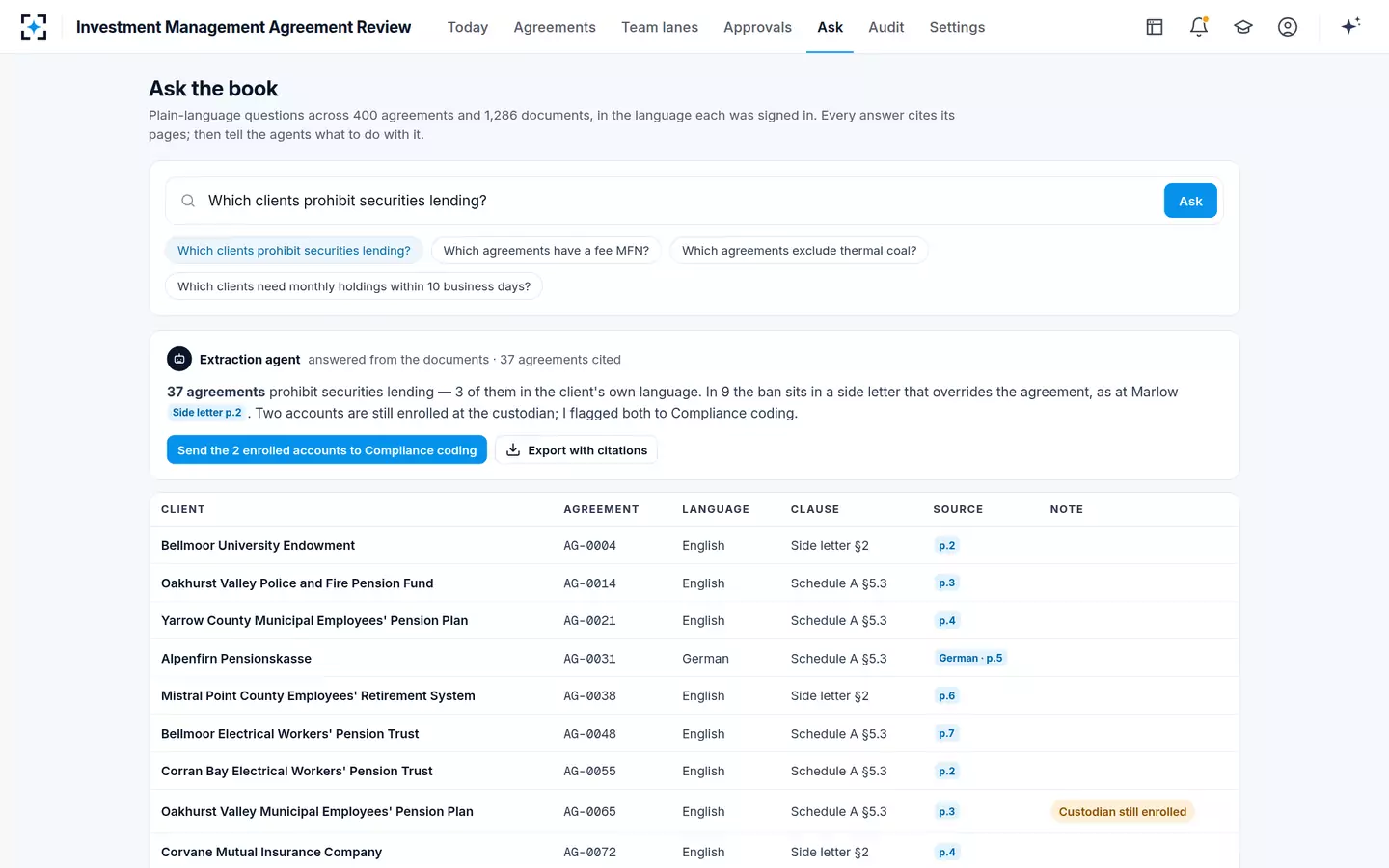
One question across 400 agreements, each answer cited to its page
The agents never accept for a team, approve, change a fee, release a rule or contact a client; those remain people's decisions, enforced by roles drawn from the firm's single sign-on groups. That boundary is what lets a legal department keep its contract system as the home of the signed paper while the post-signature work moves out of email. How to test any obligation tool on your own documents is set out in a seeded test of contract obligation tracking software, and who acts on each clause of an IMA in the IMA template, clause by clause.
Counting the cost of each approach in your own book
Contract system vendors rarely publish prices, and no regulator or independent study publishes what a separate-account IMA costs to run after signature, so the comparison has to be built from the firm's own numbers. The method is simple. Count last year's new mandates, amendments and side letters. For three recent ones, time each step from filing to every team having taken on its part: reading, side-letter comparison, emailing and chasing, guideline coding and testing, fee setup and the MFN check, and the reporting calendar. Multiply.
Then add the cost the timing hides: the errors. Count the fee corrections, late reports and guideline exceptions of the last two years whose root cause was a clause that did not reach its owner, and the refunds that followed. The SEC's alerts are a guide to where to look; the sample firm's MFN finding, $426,000 a year on one account before the first invoice, is the kind of item that pays for any approach that catches it, and the kind a summary spreadsheet does not.
Moving an existing book, not just new mandates
The harder project is the agreements already signed. A firm with hundreds of IMAs, each with amendments and side letters accumulated over years, has obligations nobody has read since signing. A contract system migration moves those files and their key fields; it does not turn their clauses into obligations with owners. Reading the back book is where agents change the economics most, because the work is large, mostly mechanical, and has to be done once before it can be kept current.
In the sample firm the back book is 400 agreements and 1,286 documents, with 9,014 obligations across them, and questions such as "which clients prohibit securities lending?" are answered across all of it, with each agreement cited. The answer found two accounts still enrolled in lending at the custodian against a ban in their documents. That is the test for a back-book project: not how many files moved, but how many promises were found that the firm was not keeping.
What to bring to a test on your own agreements
A comparison on a vendor's sample proves little. The solution is set up from a firm's own routing rules, approval roles and a sample of its agreements, and the test should use the same.
What a legal department brings to a test of agents on its IMA book
- A sample of executed agreements, with their schedules
Include one with a side letter, one amended, one in another language and one unsigned draft.
- An answer key for one bundle
The obligations a careful reader found, with page, type and owner, held back until the run is done.
- Routing rules
Which team owns which obligation type, and who leads each lane.
- Approval roles
Who may accept, submit, approve, propose and approve fee changes, release rules and send client notices.
- Billed fees for one strategy
So an MFN clause can be tested against comparable accounts.
- Current holdings for one account
So drafted rules can be dry-run before anyone trusts them.
- Your contract system's export
So the comparison is with what the firm already holds, not with nothing.
The result to look for is not a speed figure but three proofs: every obligation in the answer key found or flagged, with its page; each side-letter change applied; and each team's acceptance visible. To arrange that test, start from Investment Management Agreement Review; the clause-by-clause anatomy of what will be read is in the investment management agreement template guide.
Questions people ask
What is the best contract management software for legal departments?
No regulator or independent study ranks contract management products, and the best fit depends on the contract types a department signs. For a department that signs many kinds of contract, a general system is the right base; for an asset manager's IMA book, add a post-signature tool and test both on your own agreements.
Do asset managers need contract management software?
Most need somewhere to draft, negotiate, sign and keep agreements, and Rule 204-2 requires keeping every written client agreement. Whether that is a full contract system or a document repository with e-signature depends on volume; the obligations inside IMAs need handling either way.
Can contract management software track MFN clauses?
It can store the clause and remind someone to check it. Testing it needs other clients' billed fees, strategies, sizes and carve-outs, which sit in the billing system. In the sample firm, the MFN agent tests each clause against every comparable account and re-runs whenever any fee in the book changes.
What is contract management software for a small business or a small adviser?
Often a document repository with templates, e-signature and reminders is enough. For a small adviser with standard-form agreements and no side letters or MFN clauses, a well-kept spreadsheet and one accountable reader may be too; the need grows with side letters, negotiated fees and the number of teams involved.
Does Investment Management Agreement Review replace a contract management system?
No. It does not draft, negotiate or sign contracts or replace the repository. It reads executed agreements, schedules and side letters from the systems where they are kept and handles the obligations after signature.
How is it set up?
From the firm's own routing rules, approval roles and a sample of its IMAs, guidelines and side letters, with roles drawn from single sign-on groups. Botminds offers to run it on a sample of your own agreements first.