The fee structure in investment management is the set of terms in the investment management agreement and its fee schedule that decide what the client pays: the rate (usually basis points of assets, often tiered with breakpoints), the fee base (which assets count, and which are excluded), the valuation date, billing in advance or in arrears, how deposits and withdrawals are prorated, any householding of related accounts, any performance fee, and any most-favored-nation promise. A billing error is any gap between those terms and the invoice, and what it costs depends on who finds it: billing before the invoice, the client after it, SEC examiners, or SEC enforcement. Botminds' Investment Management Agreement Review reads every fee term out of each agreement, schedule and side letter, sends it to billing with its quote and page, and checks MFN promises against comparable accounts before the next invoice, so the first finder is the firm.
The SEC's own examinations show how often the gap opens. Examples of how the solution handles fee terms come from a fictional sample firm, Quillfield Capital; the enforcement figures come from the SEC's own orders.
What a fee error costs depends on who finds it first
1Billing, before the invoice
A corrected fee setup. Nothing is billed wrongly, nothing refunded.
The sample firm's MFN finding: $106,500 never invoiced on the first quarter.
2The client, after the invoice
A refund, a credit or an explanation, and a client who now checks every bill.
No regulator publishes how often clients catch fee errors first.
3SEC examiners
Refunds to every affected client, a deficiency finding, and a remediation the next exam tests.
The staff says its exam findings have often ended with advisers repaying clients for fee errors.
4SEC enforcement
Refunds, civil penalties, censure, a cease-and-desist order, and a public order naming the firm.
Release IA-6996: $53,989.64 reimbursed; penalties of $25,000 and $15,000.
What is the fee structure in investment management?
It is the contract's answer to five questions: what rate, on what assets, valued when, billed how often, and with which discounts. A typical institutional separate account pays an asset-based fee in basis points, stepping down at breakpoints as assets grow; the schedule, usually Schedule B of the IMA, also says which assets are excluded from the fee base, which date's value is used, and whether fees are billed quarterly in advance or in arrears. Performance fees are less common and limited by law: an SEC-registered adviser may not be paid "on the basis of a share of capital gains" unless an exception applies (15 U.S.C. 80b-5(a)(1)).
The SEC's 2021 fee alert describes the pattern it found most often, at mainly retail advisers. The typical examined adviser had a standard schedule with fee tiers based on assets under management, assessed fees each quarter, deducted them directly from client accounts and used software or an outside provider to calculate them (SEC risk alert, November 10, 2021). Institutional mandates add negotiation on top: a client-specific rate, a side letter, an MFN promise. Each negotiated term is one more place the bill can drift.
Advisory fee vs management fee: two names, one question
In separate accounts the two terms usually mean the same thing: the fee the adviser charges for managing the account, set in the agreement. "Management fee" is the usual term in fund documents and institutional IMAs; "advisory fee" is the Advisers Act's and the SEC examiners' term. What matters for billing is not the name but the definition in the schedule: the base, the rate and the exclusions.
The distinction that does matter is between the fee and everything else the client pays: custody, trading costs, fund expenses where the account holds funds, and platform or wrap fees. The 2021 alert counted disclosure gaps on exactly those edges, including advisers that did not disclose "platform administration fees assessed" or "the negotiability of fees". For a separate account, the fee schedule should say which costs sit inside the fee and which sit outside it.
How are advisory fees calculated and charged?
Most institutional advisory fees are calculated as the agreed rate times the fee base on the valuation date, prorated for the billing period, then adjusted for breakpoints, householding, any MFN and any excluded assets. Charging is either by invoice to the client or by deduction from the account through the custodian. Every step is a choice the agreement makes and the billing system must copy.
Each part of a fee structure, the choice the agreement makes, and the error it invites
| Part | What the agreement decides | Error the SEC has observed |
|---|---|---|
| Rate | Basis points, flat fee or tiers | "Inaccurate percentages were used": rates that differed from those agreed, or the wrong schedule |
| Fee base | Which assets count; which are excluded | Fees charged on "holdings specifically excluded from the fee billing calculations per advisory agreements" |
| Valuation | Which date's value, average or point in time | Month-end values used where average daily values were disclosed; stale balances after a system change |
| Billing cycle | Quarterly or monthly; in advance or in arrears | Clients told they would be billed in advance but billed in arrears, and the reverse |
| Cash flows | How mid-period deposits and withdrawals are prorated | Fees prorated for a large deposit when the agreement did not provide for it |
| Breakpoints and householding | Which accounts aggregate, and when tiers apply | Tiers not applied; related accounts not householded |
| Termination | Refund of prepaid fees | Refunds not issued, or issued only to clients who asked in writing |
Where the fee schedule and the bill drift apart
The table's errors share a cause: the fee term lives in a document and the calculation lives in a system, and nothing forces the two to agree. The 2021 alert found advisers that had not moved every client to an updated fee schedule, and fee percentages keyed by hand into portfolio systems with errors. The June 2026 alert found fees out of line with advisers' agreements and disclosures, including the terms set in "renegotiated fee arrangements" and in "fee addenda to advisory agreements" (SEC risk alert, June 9, 2026).
Those are the documents that arrive after onboarding: an amendment, a side letter, a renewal with a new rate. Breakpoints and householding are their own failure family, covered in the guide to what a missed breakpoint tier costs; for an institutional book the most expensive single drift is often a negotiated promise that depends on other clients, the MFN clause, worked through in most favored nation clause examples.
What SEC examiners keep finding in fee billing
~130
advisers examined in the SEC's 2021 fee initiative
Deficiencies in most
28
clients billed at 3% against the 2.5% their agreements set, in a September 2026 order
2
earlier SEC examinations, in 2015 and 2017, that had already flagged the same overcharges
One SEC order, line by line: 28 clients billed 3% against 2.5%
The September 2026 order is small in dollars and exact in its anatomy. The adviser's contracts "established a fee rate of 2.5% based on the fair market value of a client's assets under management that were listed in Schedule B of the advisory agreement", but it "charged 3% on 28 clients' assets", overcharging them $31,910.95; it also charged one client $22,078.69 on cash in a separate bank account "neither listed in Schedule B, nor otherwise invested" with the firm (SEC order, Release IA-6996). Both errors were in the fee schedule's two basic terms: the rate and the base.
The overbilling, the refund and the penalties in one order
The figure that matters most is not a dollar amount. The order says the overcharges were "recurring conduct" that examiners had flagged in 2015 and 2017, after which the firm "reimbursed clients for the overcharges" and then "engaged in similar conduct". A refund without a fix to the source of the error buys a few years. The cost of the third finding was a public order, a censure, a cease-and-desist order and $40,000 in penalties, on top of repaying every dollar.
A fee schedule worked through on one account
Arithmetic shows why small terms carry large sums on institutional accounts. Take the sample firm's Marlow account: $1.42 billion at 35 basis points is $4,970,000 a year, or $1,242,500 a quarter. At 32 basis points, the rate the most-favored-nation clause required, the quarter is $1,136,000. The $106,500 difference is the cost of one clause that never reached billing, on one invoice.
The other terms move the bill as much as the rate. A fee base that should exclude cash in a transition, valued on the wrong day, or measured at quarter-end instead of on average daily balances can each move the bill without any change to the rate. That is why the 2021 alert lists valuation errors, such as month-end values used where the client was told average daily values would apply, alongside rate errors: the agreement's valuation clause is a fee term even though it contains no number.
Performance fees add a legal layer to the arithmetic. A fee that shares in the client's gains is lawful for an SEC-registered adviser only under an exception, most often the qualified client test of Rule 205-3, which from June 29, 2026 requires $1.4 million under management or $2.7 million of net worth for new contracts. Billing can compute a performance fee; only legal can confirm it is allowed, which is set out in Investment Advisers Act Section 205.
What a billing error costs once it is found
The cost rises at each step of the cascade, and only the first step is free. Found by billing before the invoice, an error costs a corrected fee setup. Found by the client, it costs a refund and the client's trust in every future invoice. Found by examiners, it costs refunds to every affected client and a remediation the next exam will test; the June 2026 alert says the staff's findings have often ended with advisers repaying money owed to clients for billing and calculation errors. Found in an enforcement action, it adds penalties and a public order.
For an institutional manager the dollar amounts are larger and the client count smaller, which changes the shape of the risk. One missed MFN on one large account can be worth more than a whole book of retail overcharges: in the sample firm's case, 3 basis points on a $1.42 billion account is $426,000 a year. The SEC's examination priorities for fiscal 2027 name fee and expense calculations among the areas of economic conflict the staff will review (SEC FY2027 examination priorities, a staff statement, not a rule).
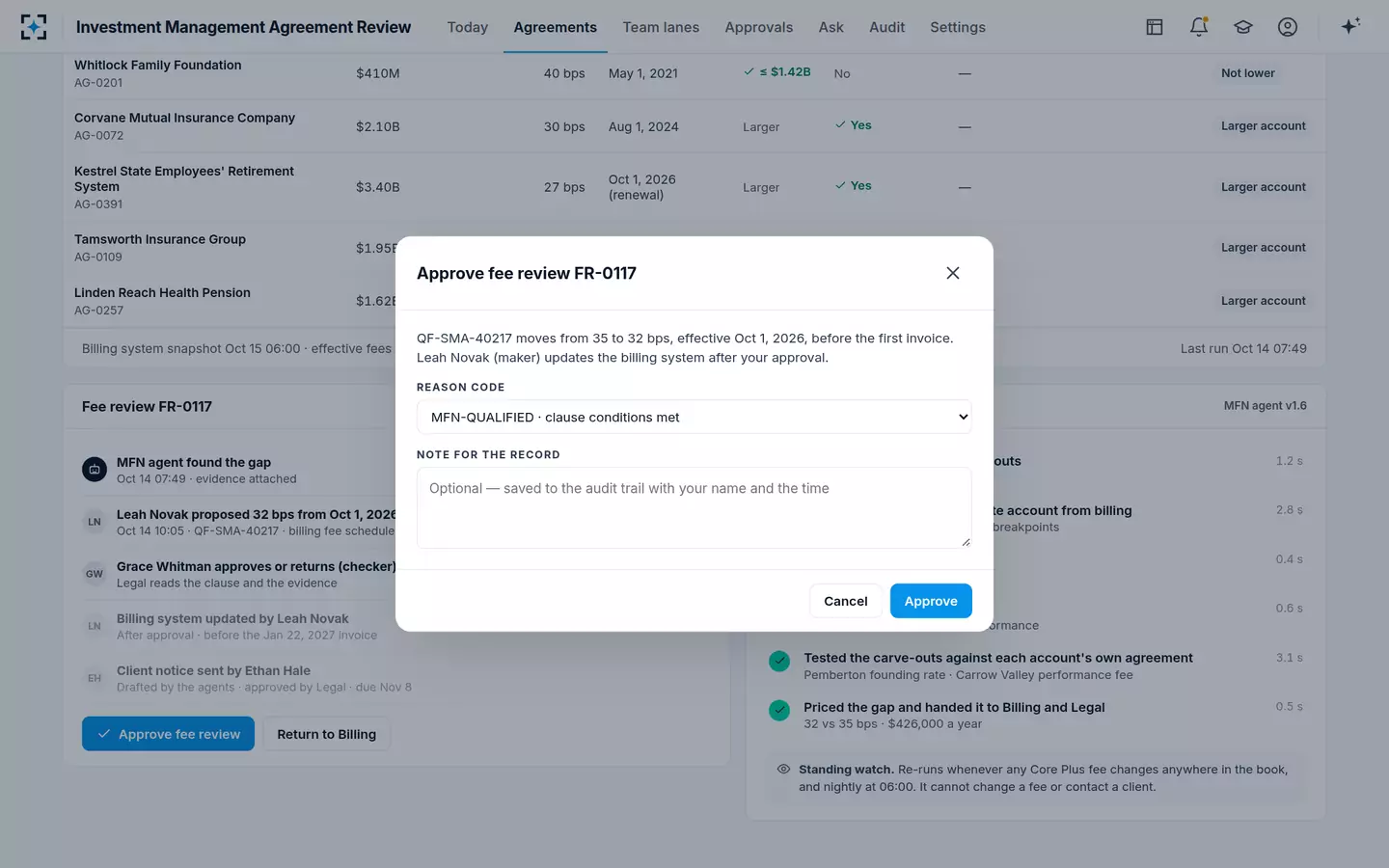
A fee change in Investment Management Agreement Review, maker and checker, before the first invoice
The controls examiners saw working
The 2021 alert did more than list failures; it described practices at advisers with fewer errors. The staff "generally observed fewer errors" where advisers had written procedures specific to how fees are supervised, calculated, reviewed and billed, and fewer clients billed incorrectly where billing was centralized "rather than billing that was dispersed throughout the adviser" (SEC risk alert, 2021). It also pointed to checklists for reconciling fee calculations to client agreements, used consistently.
Fee controls, in the order a new agreement meets them
- Extract every fee term, with its page
Rate, base, exclusions, valuation, cycle, proration, householding, MFN, refund on termination, from the IMA, schedules, side letters and amendments.
- Have billing accept each term
Not a summary emailed to billing: the term itself, accepted by the billing lead, before the account's first invoice.
- Test the setup against the term
A first invoice re-computed from the clause, not from the system's copy of it.
- Watch for documents that change fees
Side letters, fee addenda, renewals and renegotiations: each one re-opens the fee terms it touches.
- Re-test MFN promises whenever any comparable fee moves
A test only at signing misses every later concession elsewhere in the book.
- Two people for every fee change
One proposes, another approves with a reason; the proposer never approves.
- Refunds on termination, by rule
If the agreement promises a refund of prepaid fees, it should not depend on the client asking.
Billing in advance, refunds and the prepayment line
Billing in advance creates a second promise: a refund of the unearned part when the client leaves mid-period. The 2021 alert found advisers obliged by their disclosures or contracts to refund unearned fees that refunded some clients and not others, or delayed refunds "sometimes for several years post termination", and others that refunded only on written request, so clients who terminated through their custodian kept nothing back (SEC risk alert, 2021). The June 2026 alert found the same failure again, including clients who had not asked in writing (SEC risk alert, 2026).
Prepayment also has a disclosure threshold. Form ADV Part 2A, Item 18, as the 2021 alert describes it, requires an adviser to disclose a financial condition reasonably likely to impair its ability to meet its commitments if, among other things, it requires or solicits prepayment of more than $1,200 in fees per client six months or more in advance. A mandate billed quarterly sits below that line, but the termination clause and the refund obligation still need an owner in billing, triggered by the termination notice rather than by the client's request.
Where Investment Management Agreement Review fits in the fee chain
The solution is not a billing system and does not calculate invoices. It sits upstream of billing, where the fee terms come from. The Extraction agent reads every fee term from the agreement, schedules and side letters with its quote and page; an independent Verification agent re-reads each one; the Routing agent sends the fee terms to the billing lane, where the billing lead accepts them on a three-business-day clock. The MFN agent tests every most-favored-nation clause against comparable accounts' billed fees and re-runs whenever any fee in the book changes.
Today: agreements in review, obligations waiting, and the MFN finding priced
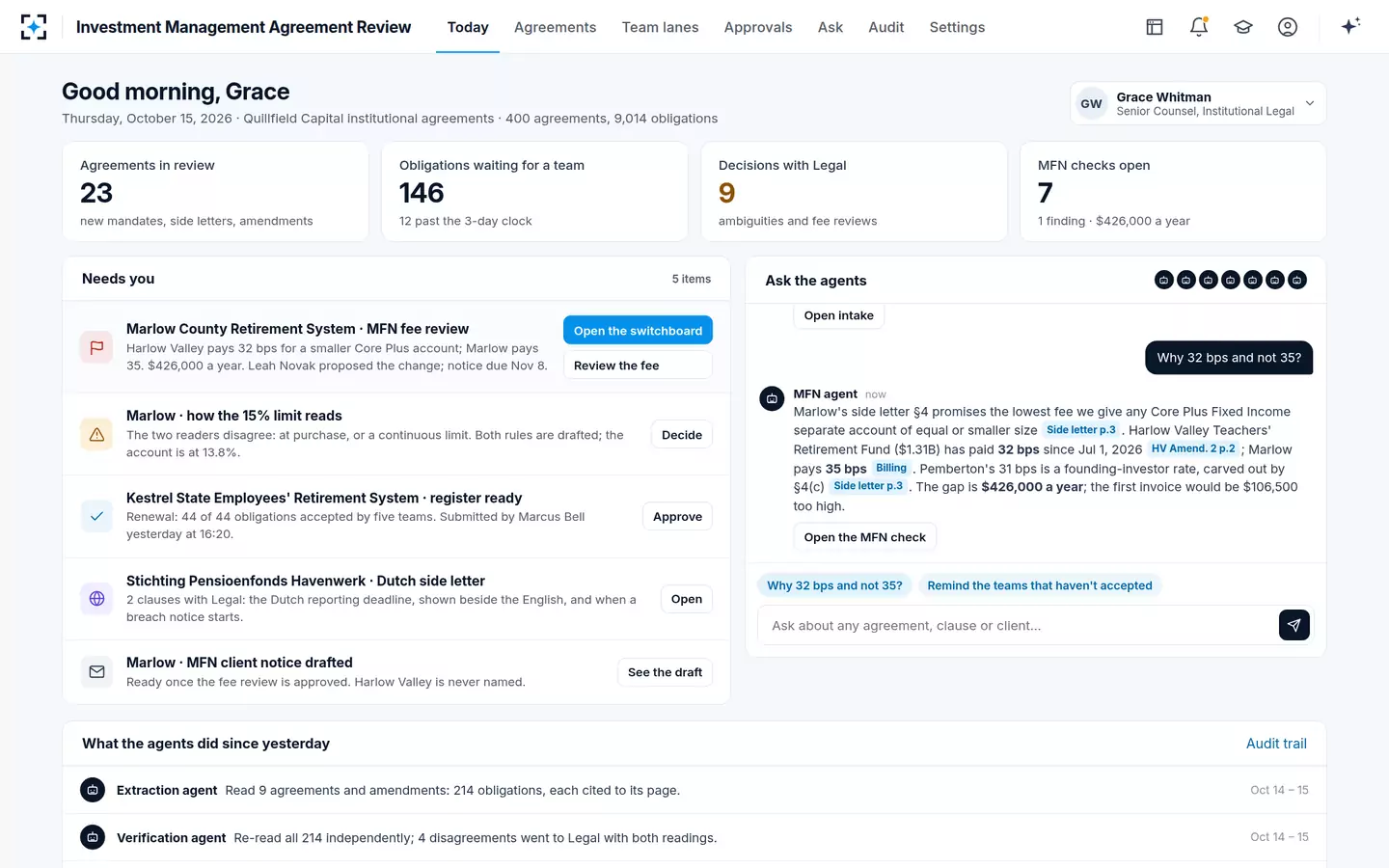
In the sample firm's new Marlow mandate, the agents found six fee terms among 41 obligations, routed them to billing, and found one MFN gap worth $426,000 a year before the first invoice; the billing manager proposed the fix and senior counsel approved it. The design target is that every MFN clause is checked against every comparable account before the next invoice. What stays with people is what should: billing proposes, counsel approves, and billing changes the system. To see the fee terms of your own agreements read out and routed, start from Investment Management Agreement Review; the other promises in the agreement are mapped in the IMA template guide.
Questions people ask
What is a typical investment management fee schedule?
Usually a tiered schedule of basis points on assets under management, stepping down at breakpoints, billed quarterly. No regulator publishes typical institutional rates; each SEC-registered adviser describes its own fees in Item 5 of its Form ADV Part 2 brochure.
How often are advisory fees charged?
Most often quarterly: the SEC's 2021 fee alert found that the typical examined adviser assessed fees quarterly and deducted them from client accounts. The agreement decides, including whether billing is in advance or in arrears.
Can an adviser charge fees on cash or assets it does not manage?
Only if the agreement includes them in the fee base. The September 2026 SEC order involved fees charged on a cash account not listed in the fee schedule or managed by the adviser, and the June 2026 risk alert lists fees charged on holdings an agreement specifically excluded.
Must an adviser refund prepaid fees when a client terminates?
If the agreement or disclosures say so, yes. The SEC's June 2026 risk alert describes advisers that did not refund clients billed in advance who terminated before the period ended, including clients who had not asked in writing.
What is the difference between a fee schedule and a fee structure?
The schedule is the table of rates and tiers, usually Schedule B; the structure is the schedule plus the terms around it: the fee base, exclusions, valuation, billing cycle, proration, householding and any MFN. Most billing errors the SEC describes are in the structure, not the rates.
Who should own fee terms after an IMA is signed?
Billing should own and accept each fee term; legal should approve any change and decide any term that reads two ways. In the sample firm, the billing manager proposes every fee change and senior counsel approves it, and the system blocks anyone from approving their own proposal.