The QPAM exemption requirements, under the Department of Labor's Prohibited Transaction Class Exemption 84-14 as amended in 2024, are that the manager be a bank, savings association, insurance company or SEC-registered investment adviser meeting size tests; that it acknowledge "in a ‘Written Management Agreement’ that it is a fiduciary with respect to each Plan that has retained the QPAM"; that the plan's investment decisions in the fund be its sole responsibility; that it notify the Department once that it relies on the exemption; and that neither it nor certain affiliates and owners be disqualified by a conviction or prohibited misconduct (DOL, 89 FR 23090, April 3, 2024). For a registered adviser the assets-under-management test steps from $101,956,000 to $118,912,000 for fiscal years ending by 2027 and to $135,868,000 by 2030. That is why a QPAM representation in an investment management agreement is a promise that can lapse on its own. Botminds' Investment Management Agreement Review reads it, and the ERISA section 3(38) acknowledgment beside it, as legal obligations with dates attached, so the firm re-checks what it promised each plan before the promise stops being true.
The exemption matters to a manager's plan clients because it lets the funds the manager runs for them trade with parties in interest, such as broker-dealers that also serve the plan, without a separate exemption for each trade. A manager that loses QPAM status can leave its plan clients with prohibited transactions they did not know they had. Examples of how the solution tracks the representation come from a fictional sample firm, Quillfield Capital.
The adviser's QPAM size tests step up twice before 2030
- FYE 2024–26 · $101,956,000$101.96M
- FYE 2027–29 · $118,912,000$118.91M
- FYE 2030 · $135,868,000$135.87M
- FYE 2024–26 · $1,346,000$1.35M
- FYE 2027–29 · $1,694,000$1.69M
- FYE 2030 · $2,040,000$2.04M
What are the QPAM exemption requirements?
The requirements fall into five groups: who may be a QPAM, what it must acknowledge, what decisions must be its own, what it must tell the Department, and what disqualifies it. Each group has a different clock. The size tests are measured at each fiscal year end. The acknowledgment is made in each plan's written management agreement, which in practice is the IMA. The independence condition applies to every transaction. The notice is once, unless the manager's name changes. Disqualification can arrive on the day a trial court enters a judgment against an affiliate.
PTE 84-14 for an SEC-registered adviser, as amended effective June 17, 2024
| Requirement | What it says | Where |
|---|---|---|
| Who may be a QPAM | A bank, savings association, insurance company or registered investment adviser meeting asset and equity thresholds | Section VI(a) |
| Fiduciary acknowledgment | Acknowledged in a written management agreement that it is a fiduciary with respect to each plan that has retained it | Section VI(a) |
| Independent decisions | The negotiations and commitments of plan assets must be the sole responsibility of the independent manager | Section I(c) |
| Notice to the Department | Notify by email within 90 calendar days of first relying on the exemption, or of a change of legal or operating name; a further 90 days, with an explanation, if missed inadvertently | Section I(k) |
| Ineligibility | 10 years after certain convictions, now including substantially equivalent foreign crimes, of the QPAM, an affiliate or a 5% owner, or after prohibited misconduct | Section I(g) |
| Transition year | If ineligible, one year of continued relief for existing plan clients, with notice within 30 days, penalty-free withdrawal and indemnification | Section I(i) |
| Records | Keep records showing the exemption's conditions were met for each transaction, for six years | Section VI(u) |
The independence condition is the exemption's premise. In the Department's words, it granted broad relief on the premise that "the commitments and investments of Plan assets and the negotiations leading thereto are the sole responsibility of an independent investment manager" (89 FR 23090). The 2024 amendment clarified Section I(c) on that point, which is worth reading against any IMA or side letter that gives the plan sponsor approval rights over particular trades.
What the 2024 amendment added: notice, ineligibility and a transition year
The amendment made four changes the Department lists itself: it "requires a QPAM to provide a one-time notice to the Department that the QPAM is relying upon the exemption", updates the crimes that cause ineligibility to include substantially equivalent foreign crimes, expands the circumstances that may lead to ineligibility, and provides a one-year transition period to help plans "avoid or minimize possible negative impacts of terminating or switching QPAMs" (89 FR 23090). It also raised the size thresholds in steps and added a six-year recordkeeping condition.
The QPAM population the Department counted
10,855
QPAMs the Department estimated for its 2024 analysis
5,702
of them found on 2020 Form 5500 Schedule C filings
90days
to notify the Department after first relying on the exemption, or after a name change
The notice is not registration, and the Department said so in answering comments: the list is meant to remind managers that the "QPAM" title "and status are tied to an administrative prohibited transaction exemption that requires compliance with the exemption's conditions". It is also easy to fall out of. A merger that renames the adviser, or a rebrand of the legal entity, is a name change that restarts the 90-day clock. The Department said inadvertent technical errors such as a late name-change notice generally do not amount to prohibited misconduct, particularly when promptly corrected, and gave a second 90-day window, with an explanation, for an inadvertent miss.
Why a QPAM representation in an IMA is an obligation, not a one-time statement
An IMA for an ERISA plan commonly has the manager represent that it is a registered adviser, that it is a fiduciary and an investment manager within ERISA section 3(38), and that it qualifies as a QPAM, often with a promise to notify the client if any of that stops being true. Each representation is true on the signing date. Each can stop being true later without anyone at the manager doing anything wrong in the client's account: assets fall below the next step, equity falls below its test, an affiliate is convicted abroad, the entity changes its name and the notice is late.
That turns the representation into three obligations a team must own. Legal owns the notice-to-client promise and its trigger list. Compliance or finance owns the annual size test against the threshold for that fiscal year. And someone must own the Department notice and its name-change trigger. In a firm whose plan IMAs sit in a folder and whose representations were summarized once, none of the three has an owner.
“Provided that such bank, savings and loan association, insurance company, or investment adviser has acknowledged in a ‘Written Management Agreement’ that it is a fiduciary with respect to each Plan that has retained the QPAM.”
DOL, Amendment to PTE 84-14, 89 FR 23090 (April 3, 2024), Section VI(a)
ERISA section 3(38) investment manager: the written acknowledgment
A 3(38) investment manager is a fiduciary, other than a trustee or named fiduciary, that has the power to manage, acquire or dispose of plan assets, is a registered adviser, a bank or a qualifying insurer, and has acknowledged in writing that it is a fiduciary with respect to the plan (29 U.S.C. 1002(38)). The written acknowledgment is the hinge for both ERISA and the QPAM exemption: without it, the manager is not a 3(38) investment manager and not a QPAM for that plan.
Two plan representations that often sit in the same IMA clause
ERISA §3(38) investment manager: A status under the statute: the fiduciary to whom a plan delegates management of its assets.
QPAM under PTE 84-14: A condition for relief from prohibited transaction rules for trades with parties in interest.
ERISA §3(38) investment manager: A registered adviser, a bank or a qualifying insurer, with power over plan assets.
QPAM under PTE 84-14: The same four kinds of institution, if they meet the size and equity tests.
ERISA §3(38) investment manager: Acknowledges in writing that it is a fiduciary with respect to the plan.
QPAM under PTE 84-14: Acknowledges in a written management agreement that it is a fiduciary for each plan that retained it.
ERISA §3(38) investment manager: Losing registration or the power over the assets.
QPAM under PTE 84-14: Falling below a threshold at fiscal year end, conviction or prohibited misconduct, or failing a condition.
ERISA §3(38) investment manager: Mostly static once signed.
QPAM under PTE 84-14: Fiscal year ends; 2027 and 2030 steps, then yearly adjustments; 90-day notices.
The 3(21) side of the line, an adviser who gives advice but does not hold the assets' management, is set out in Portfolio Management's 3(21) vs 3(38) fiduciary services. For an IMA review the point is narrower: a separate-account IMA for an ERISA plan should contain the written acknowledgment, and the obligation register should show where.
408(b)(2) disclosure: what the plan must receive before it signs
The ERISA service-provider rule adds a timing obligation to the same contracts. A covered service provider must disclose to a responsible plan fiduciary, in writing, a description of its services, a statement if it will act as a fiduciary within the meaning of section 3(21) or as a registered adviser, and its direct and indirect compensation; the disclosure is due reasonably before the contract is signed, extended or renewed (29 CFR 2550.408b-2(c)(1)(v)). Changes must be disclosed as soon as practicable, and no later than 60 days after the provider is informed of them; a good-faith error must be corrected within 30 days of learning of it.
Two of those clocks are triggered by events an IMA review sees first. A fee change under an MFN or a renegotiation is a change to the compensation disclosed; an amendment extending the mandate is an extension. Each should create a disclosure obligation for the owner of the 408(b)(2) process, at the moment the document arrives.
Which clients the QPAM promise reaches, and which it does not
The exemption addresses prohibited transactions under ERISA Title I and the Internal Revenue Code, and its preamble refers to plans and IRAs throughout. Governmental plans sit outside: ERISA's Title I provisions do not apply to an employee benefit plan that "is a governmental plan" (29 U.S.C. 1003(b)(1)), and church plans that have not elected coverage are excluded too. A county or state retirement system is usually a governmental plan, governed by state law and its own statutes.
That distinction belongs in the IMA review itself. The sample firm's new client, Marlow County Retirement System, is a US public pension, so its IMA's representations look to state law and the plan's own rules, not to PTE 84-14, while a corporate plan's IMA would carry the QPAM promise. A representation copied from one template into the other is wrong in one of them, and the place to catch that is the first reading, when each obligation is classified and routed.
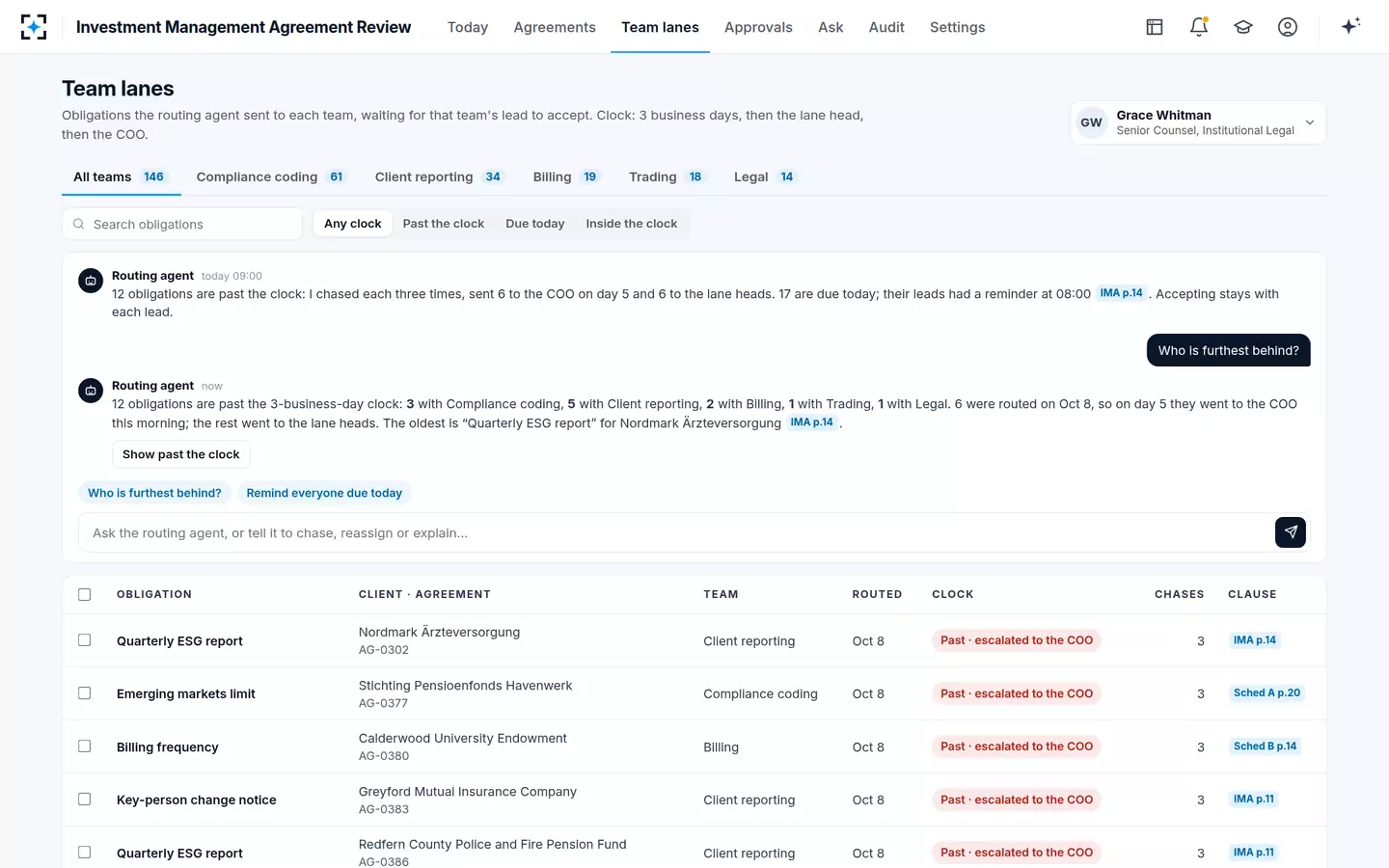
Team lanes in Investment Management Agreement Review: every obligation waiting for its owner
What a lapse costs the plan client, and the manager
A lapse moves cost from the manager's compliance budget to the client's portfolio. Without the exemption, a trade between a plan's fund and a party in interest can be a prohibited transaction, and the 2024 amendment's transition terms list what the Department expects an ineligible manager to make good: "losses and costs arising from unwinding transactions with third parties and from transitioning Plan assets to an alternative asset manager as well as costs associated with any exposure to excise taxes under Code section 4975" (89 FR 23090, Section I(i)).
The transition year limits the damage but sets its own obligations. Relief continues for at most one year, only for plans that already had a written management agreement with the manager on the ineligibility date, and only if the manager notifies the Department and each client plan within 30 days, does not restrict any plan's ability to terminate or withdraw, charges no exit fees beyond narrow exceptions, and agrees to indemnify plans for actual losses from the conduct behind the ineligibility. Each of those is a promise to every plan client at once, which means each needs the list of plan IMAs, their termination clauses and their notice addresses, ready before the day it is needed.
For the manager the larger cost is commercial. A plan's fiduciary that learns of ineligibility from the notice must decide whether to stay, and the Department's notice requirement asks for an objective description written in enough detail for that fiduciary to meet its own duties of prudence and loyalty. An IMA book where every plan client, every representation and every termination right can be listed in an afternoon is the difference between a managed transition and a scramble.
A QPAM calendar for the legal and compliance lanes
The checklist turns the exemption into dated obligations. Most firms already know the conditions; what they lack is the link from each condition to the agreements that promise it.
What to re-check, and when, for every plan IMA that promises QPAM status
- Each fiscal year end: the size tests
Assets under management and equity against the threshold for that year: the 2024 amounts until fiscal 2027, then the 2027 and 2030 steps, then the Department's yearly adjustment.
- Every legal or operating name change: the Department notice
Within 90 calendar days; a second 90 days only for an inadvertent miss, with an explanation.
- Every conviction or misconduct finding in the group: eligibility
Including affiliates, 5% owners and foreign crimes; ineligibility starts at the trial court's judgment, even under appeal.
- On ineligibility: the transition year
Notice to the Department and each client plan within 30 days; no exit fees beyond the narrow exceptions; indemnification for losses.
- Every new or amended plan IMA: the acknowledgment
The written fiduciary acknowledgment for 3(38) and the QPAM definition, and any client approval right that could compromise sole responsibility.
- Every fee or term change: the 408(b)(2) clock
Changes disclosed as soon as practicable, no later than 60 days.
- Every transaction relying on the exemption: the records
Kept six years, reasonably accessible for examination.
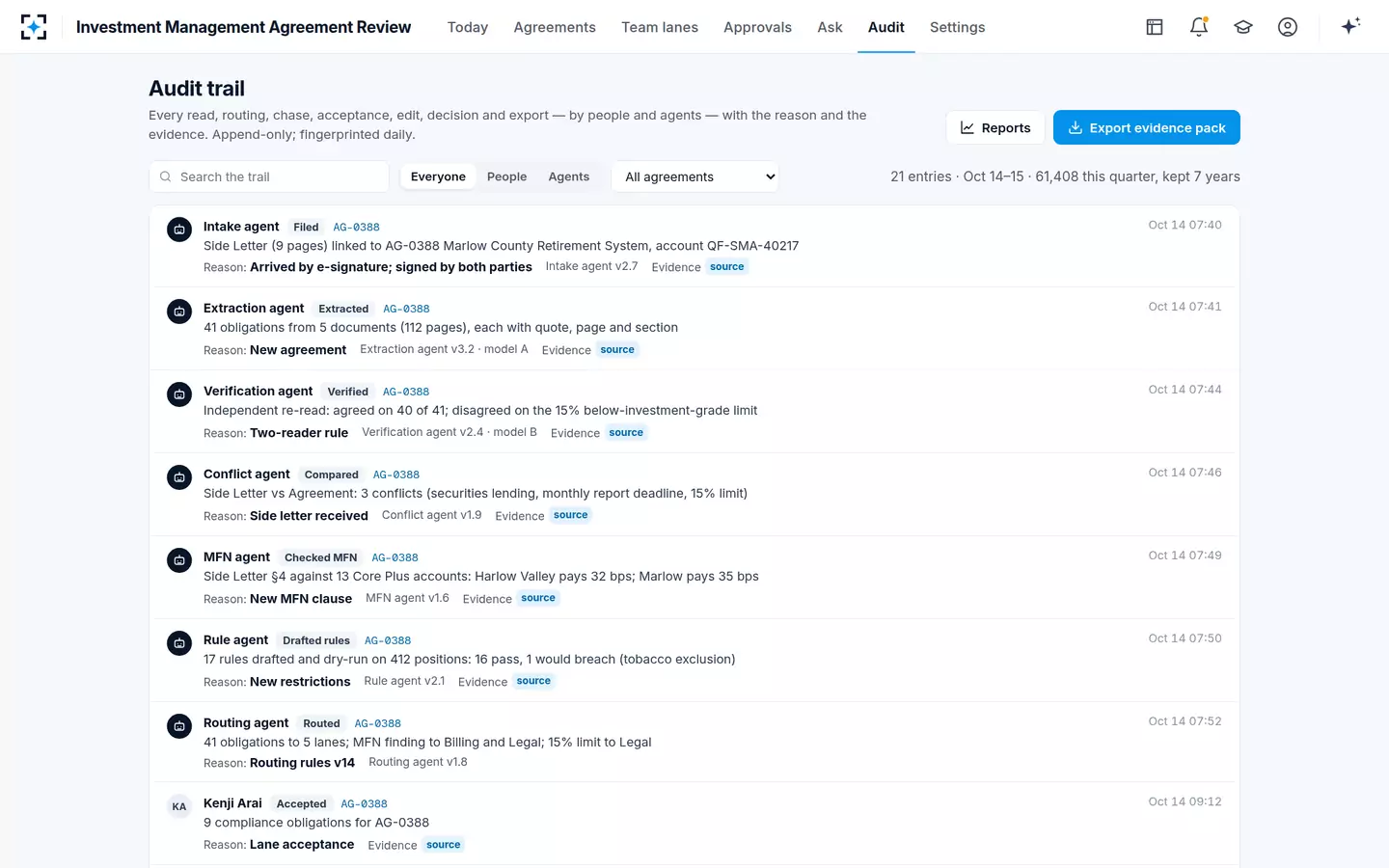
In Investment Management Agreement Review, each plan IMA's representations, notice promises and termination rights become legal obligations with their quote and page, routed to the lane that keeps them, and accepted by that lane's lead on a clock. Every reading and acceptance is on the audit trail, with its reason and evidence. The clause that sits beside these representations in most IMAs, the standard of care, is covered in how to test a hedge clause, and the anatomy of the whole agreement in the IMA template guide. For your own agreements, start from Investment Management Agreement Review.
The Investment Management Agreement Review audit trail: what each agent read and each person accepted
Questions people ask
What is the QPAM exemption 84-14?
Prohibited Transaction Class Exemption 84-14, first published by the Department of Labor in 1984, lets an investment fund managed by a qualified professional asset manager engage in a broad range of transactions with parties in interest to a plan, subject to conditions. The Department amended it in 2024, effective June 17, 2024.
Who qualifies as a QPAM?
A bank, savings and loan association, insurance company or SEC-registered investment adviser that meets the exemption's size tests and acknowledges in a written management agreement that it is a fiduciary for each plan. For a registered adviser the asset test is $101,956,000 for fiscal years ending through 2026, $118,912,000 from fiscal 2027 and $135,868,000 from fiscal 2030.
Do QPAMs have to register with the Department of Labor?
Not register, but notify: since the 2024 amendment a QPAM must email the Department within 90 calendar days of first relying on the exemption, and again after a change of legal or operating name. The Department keeps a list of managers that have notified it.
What happens if a QPAM is convicted?
A conviction of the QPAM, an affiliate or a 5% owner for a listed crime makes it ineligible for 10 years, from the date of the trial court's judgment even if appealed. A one-year transition period then applies, with notice to the Department and each client plan within 30 days, penalty-free withdrawal and indemnification of plans' actual losses.
Does the QPAM exemption apply to public pension plans?
ERISA's Title I does not apply to governmental plans, so a state or county retirement system's mandate does not depend on PTE 84-14; state law and the plan's own rules govern it. Its IMA should not carry a QPAM representation copied from a corporate plan template.
How often do the QPAM thresholds change?
The 2024 amendment set steps for fiscal years ending by December 31 of 2024, 2027 and 2030, after which the Department adjusts the equity, net worth and asset thresholds for inflation each year, by notice in the Federal Register no later than January 31.