A hedge clause in an investment adviser agreement is language that limits the adviser's liability to the client, typically saying the adviser "shall not be liable" for any act or omission except gross negligence, willful misconduct or bad faith. The SEC's view, set out in its 2019 interpretation of advisers' fiduciary duty, is that the duty itself cannot be waived; that whether a hedge clause violates the antifraud provisions depends on all the facts, including the client's sophistication; and that for retail clients there are "few (if any)" circumstances in which a clause relieving the adviser of liability the client cannot waive would be consistent with those provisions. Two settled SEC orders since 2024 show what failing clauses look like. Botminds' Investment Management Agreement Review reads each agreement's liability, indemnity and standard-of-care clauses as legal obligations and gives counsel the words, the client type and both readings where the text allows two, so every clause gets a decision, not an assumption.
This guide gives the test in five questions, using the SEC's own words and the clauses quoted in its orders. Examples of how the solution routes the decision come from a fictional sample firm, Quillfield Capital. Nothing here is legal advice; each clause needs counsel's reading of its client and its facts.
Retail and institutional agreements: the same clause, judged differently
Retail client: "Few (if any)" circumstances in which a hedge clause relieving liability for non-waivable claims would be consistent with the antifraud provisions.
Institutional client: Whether it violates the antifraud provisions "will be determined based on the particular facts and circumstances".
Retail client: Such a clause "generally is likely to mislead those retail clients into not exercising their legal rights".
Institutional client: Sophisticated clients with their own counsel can understand and negotiate liability terms.
Retail client: Does not cure it: the misleading effect stands "even where the agreement otherwise specifies" that non-waivable rights are kept.
Institutional client: Helps show what the client understood, but does not settle the question alone.
Retail client: The fiduciary duty may not be waived; a general waiver is inconsistent with the Act whatever the client.
Institutional client: The same, and a clause that creates a conflict must be addressed under the duty of loyalty.
What is a hedge clause?
A hedge clause is any contract language that narrows what the adviser can be held liable for. The SEC's orders define it as "liability disclaimer language, commonly referred to as a hedge clause" (SEC order, Release IA-6941). It may sit in a section called limitation of liability, standard of care, exculpation or indemnification, and it often appears more than once: a limit on the adviser's liability in one section, and an indemnity from the client in a schedule.
The clause is not unlawful as such. An adviser and an institutional client can agree what the adviser is responsible for, and the 2019 interpretation accepts that the adviser's duty applies "in a manner that reflects the agreed-upon scope of the relationship". What the law does not allow is a clause that waives the duty or misleads the client about rights the law gives it. The Advisers Act makes the first point itself: any provision "binding any person to waive compliance with any provision of this subchapter or with any rule, regulation, or order thereunder shall be void" (15 U.S.C. 80b-15(a)).
Hedge clause examples from SEC orders
The clearest examples are the ones the SEC has already found misleading. Both orders below were settled, without admitting or denying the findings, and both involved advisers whose clients were mostly retail investors. The wording is typical of institutional templates too, which is why it travels.
Three hedge clauses the SEC quoted, and what made them misleading
| Clause, as quoted in the order | Where it sat | The SEC's finding |
|---|---|---|
| "[Respondents] shall not be liable to Client, its agents or representatives thereof, for any act, omission, or determination made in connection with this Agreement except for its willful misconduct or gross negligence. . ." | Advisory agreement, section R (FamilyWealth, 2017 to 2024 versions) | Read in its entirety, inconsistent with the adviser's fiduciary duty because it may mislead retail clients into not exercising their non-waivable legal rights |
| Client "shall defend, indemnify and hold harmless" the advisers against losses arising out of "any violation of federal or state securities, trust or insurance laws" by the advisers, or "any negligence, gross negligence, recklessness or willful or intentional misconduct" | Advisory agreement, Schedule A, section T, indemnification | Part of the improper limitation of liability; revised in 2024, while sections R and T stayed the same |
| "Except for gross negligence or willful malfeasance, or violation of applicable law, neither CCP, nor any of it's [sic] respective directors, employees, shareholders, officers or affiliates shall be liable hereunder for any action performed or omitted to be performed or for any errors of judgment in managing the Account." | Advisory agreement (ClearPath) | Purports to broadly limit liability; may mislead retail clients into not exercising non-waivable rights, despite a non-waiver statement |
The second row is the one reviewers miss. A limitation of liability says what the adviser will not pay for; an indemnity says the client will pay the adviser's costs, here including costs arising from the adviser's own violations of law and its own negligence. A reviewer who checks the liability section and stops has read half the clause.
What the SEC said in 2019, and why the Heitman letter is gone
Before 2019, advisers leaned on a 2007 staff no-action letter to Heitman Capital Management, which said whether a hedge clause violated the antifraud provisions depended on all the facts and circumstances. The Commission said that some commenters' descriptions of the letter suggested it "may have been applied incorrectly", that it "does not address the scope or substance of an adviser's federal fiduciary duty", and then replaced it with its own view: "the Heitman Letter is withdrawn" (84 FR 33669, footnote 31).
“In our view, however, there are few (if any) circumstances in which a hedge clause in an agreement with a retail client would be consistent with those antifraud provisions, where the hedge clause purports to relieve the adviser from liability for conduct as to which the client has a non-waivable cause of action against the adviser provided by state or federal law.”
SEC, Commission Interpretation Regarding Standard of Conduct for Investment Advisers, 84 FR 33669 (July 12, 2019)
The same passage gives the institutional rule, and the duty-of-loyalty rule that applies to everyone. Whether a hedge clause in an agreement with an institutional client violates the antifraud provisions "will be determined based on the particular facts and circumstances", and "To the extent that a hedge clause creates a conflict of interest between an adviser and its client, the adviser must address the conflict as required by its duty of loyalty." Earlier in the interpretation the Commission says a general waiver of the federal fiduciary duty, such as a statement that the adviser will not act as a fiduciary or a blanket waiver of all conflicts, is inconsistent with the Act whatever the client's sophistication.
Retail and institutional clients: where the line falls
The line falls on the client, not the document. A firm that uses one liability clause for a state pension plan and for an individual's account has one clause and two tests. The institutional test asks what this client, with its counsel and negotiating position, understood; the retail test starts close to a prohibition for any clause that reaches claims the client cannot waive.
That makes the client type an input to the clause review, and it is the input most likely to be wrong. A wealth client introduced through an institutional relationship, a small foundation, or a family office may be treated as institutional by the template and as retail by an examiner. The 2019 interpretation describes the range: "from retail clients with limited assets and investment knowledge and experience to institutional clients with very large portfolios and substantial knowledge, experience, and analytical resources". Where a client sits on that range is a judgment counsel should write down.
Why a savings clause does not rescue a hedge clause
Many hedge clauses end with a savings clause: "nothing herein shall in any way constitute a waiver or limitation of any rights which Client may have under any federal or state securities law". The 2019 interpretation already said that for retail clients a broad hedge clause is likely to mislead "even where the agreement otherwise specifies that the client may continue to retain its non-waivable rights". The 2024 order makes the point in so many words.
“This is true even if there is a disclaimer (sometimes known as a “savings clause” or “non-waiver” disclosure) stating that compliance with the state or federal securities laws is not waivable.”
SEC order, In the Matter of ClearPath Capital Partners, Release IA-6672, September 3, 2024
The reasoning is about what a client reads. A sentence that says the adviser is not liable for "any action or inaction" except gross negligence, followed by a sentence preserving rights under securities law, leaves a reader who is not a lawyer believing the first sentence. The fix is not a better savings clause; it is a liability clause that does not purport to reach what the client cannot waive.
SEC enforcement actions on hedge clauses, 2024 to 2026
Hedge clauses rarely stand alone in an enforcement action; they appear beside custody, compliance-program and contract failures. That pattern is itself the lesson: a firm whose agreements carry a misleading hedge clause usually has a review process that missed other required terms too.
Two settled orders, one pattern: the clause and the program around it
$65,000
civil penalty, ClearPath, September 2024: hedge clauses in advisory and private fund agreements, plus custody rule failures
$150,000
civil penalties, FamilyWealth's two advisers, January 2026: hedge clauses, missing consent-to-assignment, custody and compliance failures
5+years
the FamilyWealth hedge clause ran, from at least May 2019 through December 2024, across three agreement versions
The ClearPath press release carried a warning beyond retail clients. "In addition, all advisers, including private fund advisers, should be mindful about including hedge clauses in agreements," said the co-chief of the Enforcement Division's Asset Management Unit, adding: "Even for private fund advisers, in certain circumstances, such clauses could be misleading" (SEC press release 2024-113). In the FamilyWealth order, the firms' compliance manuals said their agreements "do not contain any hedge clauses"; the agreements did, and the SEC found a failure to implement policies under Rule 206(4)-7 (17 CFR 275.206(4)-7). Section 205's assignment clause, the other failure in that order, is set out in Investment Advisers Act Section 205.
Indemnities and ERISA: the same question in other clothes
An indemnity from the client, a cap on damages, a short time limit for claims and an exclusion of consequential loss are all ways of limiting liability, and each needs the same test. For plan clients there is a further rule, and it is blunter than the SEC's. ERISA section 410(a) says "any provision in an agreement or instrument which purports to relieve a fiduciary from responsibility or liability for any responsibility, obligation, or duty under this part shall be void as against public policy", while allowing fiduciary liability insurance (29 U.S.C. 1110).
An IMA for an ERISA plan therefore has two tests stacked: the Advisers Act antifraud test for whether the clause misleads, and ERISA's voidness rule for whether it can operate at all. Governmental plans, such as a county retirement system, sit outside ERISA's fiduciary rules and look to state law instead, which is one more reason the client's legal type must be known before the clause is read. The other promises an IMA makes to plan clients are covered in the QPAM exemption guide.
Specific beats general: what the SEC's reasoning implies for drafting
The 2019 interpretation explains why general waivers fail by quoting the Restatement (Third) of Agency, and the passage reads as drafting guidance. A broad release in advance "is not likely to be enforceable", because "a broadly sweeping release of an agent's fiduciary duty may not reflect an adequately informed judgment on the part of the principal", while "when a principal consents to specific transactions or to specified types of conduct by the agent, the principal has a focused opportunity to assess risks that are more readily identifiable" (84 FR 33669, footnote 29).
For an institutional IMA, that points away from a single liability sentence covering "any act or omission" and toward clauses that name what the client is accepting: losses from following the client's own written instructions, from the default of a custodian or broker the client chose, or from market movements on decisions made within the guidelines. A clause of that kind tells a sophisticated client exactly what it is giving up, which is the facts-and-circumstances test the SEC applies to institutional agreements. It still cannot reach the fiduciary duty itself, and for a retail client the same specificity does not change the starting point.
The drafting point has an operational twin. A specific clause creates specific obligations: if the adviser is not liable for losses from client-directed brokerage, someone must be able to show which trades were client-directed. A general clause creates none, which is part of why it fails. An IMA review that routes a liability clause to legal should also route the facts it depends on to the team that holds them.
How to test a hedge clause: five questions
The five questions below turn the SEC's guidance into a review a lawyer or a trained analyst can run on any agreement, and whose answer counsel can sign.
A five-question test for any liability clause in an advisory agreement
- 1. Who is the client?
Retail, institutional, ERISA plan, governmental plan or fund. The answer picks the test; write down why.
- 2. Does any clause waive the fiduciary duty generally?
A statement that the adviser is not a fiduciary, a blanket waiver of conflicts, or a waiver of a specific Advisers Act obligation is inconsistent with the Act for every client.
- 3. Does it reach claims the client cannot waive?
A limit to "gross negligence" or "willful misconduct" can reach negligence claims available under state or federal law. For a retail client, that is close to the end of the test.
- 4. Read every limiting clause together
Liability, indemnity, caps, time limits, exclusions. A savings clause does not cure a misleading whole.
- 5. Does it create a conflict?
A clause that benefits the adviser at the client's expense must be addressed under the duty of loyalty: disclosed for informed consent, or removed.
The third question is where reasonable lawyers differ, and where a review tool must not decide. "Gross negligence" in an institutional IMA governed by one state's law may be an ordinary negotiated standard; the same words in a form signed by an individual are the SEC's example of a misleading clause. A reading that turns on the client and the governing law should go to counsel with both readings written out, the way a contract review tool should handle a clause that reads two ways.
Testing a book of agreements, not one clause
The hedge clause cases share a second failure: the firms' policies said one thing and their signed agreements another, for years. The FamilyWealth advisers revised their template twice, used each version for new clients only, and did not ask existing clients to sign until December 2024, after an examination. Testing the template is not enough; the test has to run on every signed agreement, amendment and side letter, and the answer has to be kept.
Investment Management Agreement Review: one clause, two readings, and counsel's decision to make
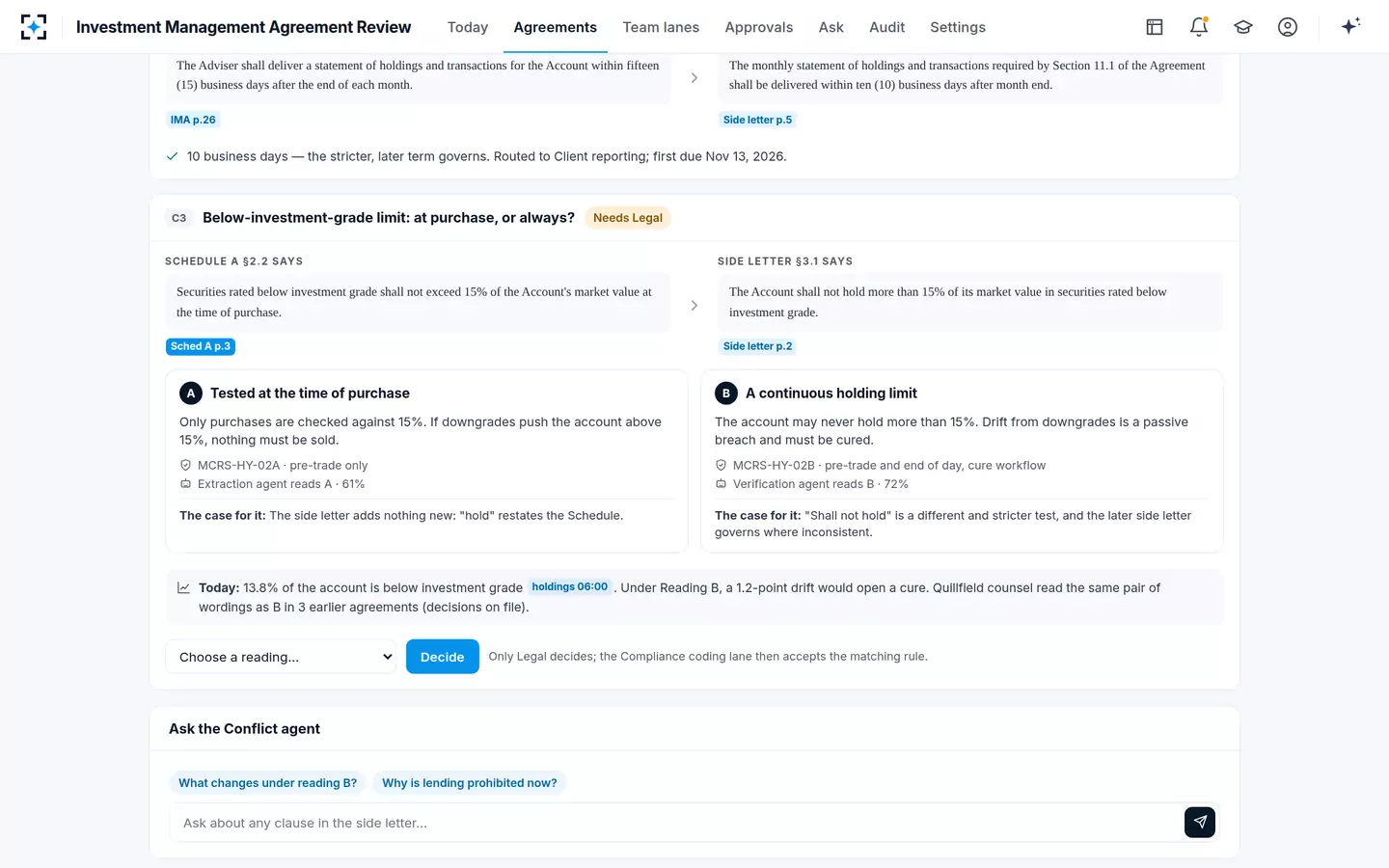
In Investment Management Agreement Review, the liability, indemnity and standard-of-care clauses of each agreement are legal obligations like any other: extracted with their quote and page, re-read by an independent second agent, and routed to Legal's lane. Where the text allows two readings the Conflict agent writes both; it never resolves an ambiguity itself. Counsel decides with a reason code, and the decision is on the audit trail for the next examination or the next template change.
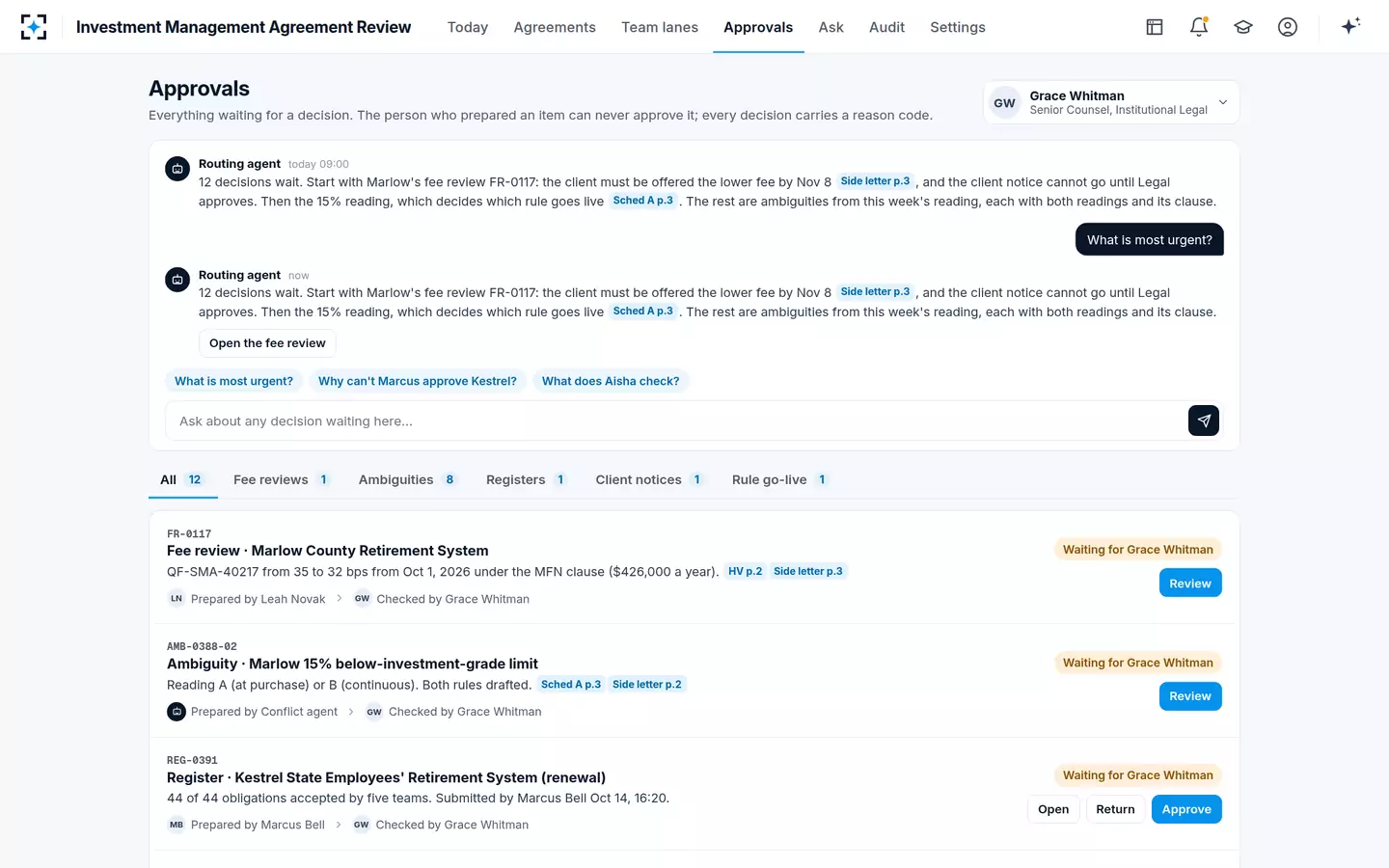
Approvals in Investment Management Agreement Review: every reading that waits for counsel
Questions people ask
Are hedge clauses illegal for investment advisers?
Not in themselves. A clause that waives the federal fiduciary duty, or misleads a client into thinking it has waived non-waivable rights, violates the Advisers Act; for retail clients the SEC sees few if any broad hedge clauses that would be consistent with the antifraud provisions. For institutional clients the answer depends on the facts and circumstances.
Can an institutional IMA limit liability to gross negligence?
It can, if the clause does not mislead that client about rights it cannot waive and does not waive the fiduciary duty generally; the SEC judges institutional clauses on their facts. For an ERISA plan, ERISA §410(a) separately voids any provision relieving a fiduciary of liability for its ERISA duties.
Can a liability limit waive an adviser's fiduciary duty?
No. The SEC's 2019 interpretation says the federal fiduciary duty may not be waived, though its application may be shaped by agreement, and Section 215(a) makes void any provision binding a person to waive compliance with the Act.
What is a savings clause in an advisory agreement?
A sentence saying nothing in the agreement waives rights the client has under securities law. The SEC's 2024 ClearPath order said a hedge clause can be misleading even with such a disclaimer, so a savings clause does not cure a clause that otherwise misleads.
Do existing agreements need to be fixed when the template changes?
A new template binds only those who sign it. In the January 2026 FamilyWealth order the advisers used revised agreements only for new clients; their later remediation, which the SEC took into account, included sending the revised agreement to every existing client and asking each to sign it.
Do hedge clause concerns apply to private funds?
They can. The ClearPath order covered hedge clauses in private fund partnership and operating agreements as well as advisory agreements, and the SEC's enforcement official said that even for private fund advisers such clauses could be misleading in certain circumstances.