A most favored nation clause, or MFN, in an investment management agreement is the manager's promise that if it gives another comparable client a lower fee, it will offer the same fee to this client. Most favored nation clause examples in separate-account IMAs differ in four things: which accounts count as comparable (usually by strategy and by size), which fees are carved out, from what date the lower fee applies, and what notice the manager must give. Those four inputs decide whether a fee cut for one client in March reprices another client's account in April. Botminds' Investment Management Agreement Review reads each MFN clause into those four inputs, tests it against every comparable client's billed fee, re-runs the test whenever any fee in the book changes, and prices any gap for billing and legal before the next invoice.
The examples below are illustrative wordings written for this guide, plus one clause from a fictional sample firm, Quillfield Capital, whose new client, Marlow County Retirement System, has an MFN in its side letter. Private-fund MFNs, which let investors elect terms from other investors' side letters, are a different exercise, covered in MFN elections in private equity.
One MFN clause on one sample account in Investment Management Agreement Review, priced
3bps
gap between a smaller comparable account's fee and the new client's: 32 against 35
$426,000
a year at 3 bps on the $1.42 billion account
$106,500
too high on the first quarterly invoice, if it went out at 35 bps
What is a most favored nation clause in investment management?
In investment management an MFN is a fee promise, not a trade term. The manager agrees that the client's fee will be no higher than the fee charged to other clients that meet a definition in the clause, usually same strategy and equal or smaller size, and that if a lower fee is granted, the manager will tell the client and offer it. The client is buying protection against negotiating worse than someone else.
For the manager it is an open-ended obligation. Each later fee concession, renewal discount or new relationship price is a possible trigger for every client whose MFN covers that strategy. No rule requires an MFN, and no regulator publishes how many separate-account IMAs carry one, but once one is signed it is a contract term, and the SEC's examiners test whether fees follow contract terms.
Six most favored nation clause examples for separate accounts
The six wordings below cover the patterns most separate-account MFNs follow. The first is the fictional sample firm's clause; the others are written for this guide to show how small changes in wording change the test billing must run.
Six MFN wordings, and what each makes billing test
| Pattern | Example wording | What billing must test |
|---|---|---|
| 1. Strategy and size | "If the Adviser has agreed or agrees to an effective annual management fee lower than the Client's for a separate account managed in the Core Plus Fixed Income strategy with assets equal to or less than the Client's, the Adviser shall notify the Client within thirty (30) days and offer the lower fee from the date it was granted." | Every account in the strategy at or below the client's size; effective fee after breakpoints; the grant date of any lower fee; a 30-day notice clock |
| 2. Strategy only | "The fee shall be no higher than the lowest fee charged to any other separate account client in the Strategy." | Every account in the strategy, whatever its size; a far wider set of comparables |
| 3. Fee schedule, not effective rate | "…no less favorable than the fee schedule offered to any client with a comparable mandate." | Schedules tier by tier, not the blended rate; a lower first tier can trigger even when the effective rate is higher |
| 4. Relationship assets | "…clients whose aggregate assets with the Adviser across all mandates are equal to or less than the Client's." | Aggregated relationships, not single accounts; householding across mandates |
| 5. Carve-outs | "…excluding founding-investor rates, performance-based fees, pooled vehicles and accounts of affiliates." | Whether each lower-fee account falls into an excluded class, read from that account's own agreement |
| 6. Prospective only | "…the lower fee shall apply from the first day of the calendar quarter following the Client's acceptance." | No look-back; the clock starts at the client's election, not at the other grant |
The difference between rows 1 and 3 is the one most often missed. A clause about an "effective annual management fee" compares what each client actually pays after breakpoints; a clause about a "fee schedule" compares the schedule itself, so a competitor's offer with a cheaper first tier can trigger it even if the client pays less overall. Billing systems hold effective fees; few hold a comparison of schedules. The wording decides which data the test needs.
The four inputs every MFN test needs
Whatever the wording, an MFN test cannot be run without four inputs, and each lives in a different place. The strategy and size definitions come from the client's own clause. The comparable accounts' fees come from the billing system. The carve-outs depend on each comparable account's agreement, not the client's. The dates come from both: when the lower fee was granted, and when the client's clause and notice clock started.
Inputs for one MFN test, and where each comes from
- Scope: which strategy, which vehicles
From the client's clause. "Separate account managed in the Core Plus Fixed Income strategy" excludes the strategy's pooled fund unless the clause says otherwise.
- Size test: equal or smaller, and measured how
From the clause, applied to assets in the billing system on the relevant date. Larger accounts fail it, however low their fee.
- Carve-outs, read from each comparable account
Founding-investor, performance-fee, affiliate or legacy rates are excluded only if the other account's agreement shows it fits the class.
- Dates: grant, signature and notice
When the lower fee started, when the client's MFN started, and how many days the manager has to notify.
Carve-outs: where MFN readings go wrong
Carve-outs are exceptions, and exceptions are where machine and human readers both slip. Research on contract reading by machine supports the point: the ContractNLI study, which built a corpus of 607 annotated contracts and asked models whether each contract supports, contradicts or is silent on a statement, found that features of contract language such as negation through exceptions help explain why the task is hard, and that existing models fail badly on it (Koreeda and Manning, Findings of EMNLP 2021). An MFN with three carve-outs is three negations by exception, each depending on facts in another client's file.
A carve-out also needs evidence from a document the client never sees. In the sample firm's test, one account paid 31 basis points, lower than both Marlow's 35 and the 32 that ultimately qualified. It was excluded because its rate was a founding-investor rate, and Marlow's side letter §4(c) excludes "founding-investor fees" and "performance-based fees". That exclusion holds only if the founding-investor status is shown in that account's own agreement; the agent cites it, and counsel confirms the reading before it is final. A carve-out applied from memory is an MFN tested on hope.
A worked MFN example: 32 basis points against 35
Take the sample firm's new mandate as it runs through the solution. Marlow's side letter, dated October 9, 2026, promises the lowest fee Quillfield gives any Core Plus Fixed Income separate account of equal or smaller size. The MFN agent tested it against 13 comparable accounts in the billing system at 07:49 on October 14, the morning the side letter arrived.
Thirteen comparable accounts; one qualifies, two are carved out, larger ones fail the size test
One account qualified: Harlow Valley Teachers' Retirement Fund, $1.31 billion, paying 32 basis points since July 1, 2026. The gap is 3 basis points, $426,000 a year on Marlow's $1.42 billion, and the first quarterly invoice, to be issued on January 22, 2027, would have been $106,500 too high at 35. The clause requires notice within 30 days of the side letter, which put the deadline at November 8, 2026. None of that required judgment except the carve-outs and the reading of "equal or smaller"; all of it required data from three places.
The MFN check in Investment Management Agreement Review: clause, test inputs and the priced finding
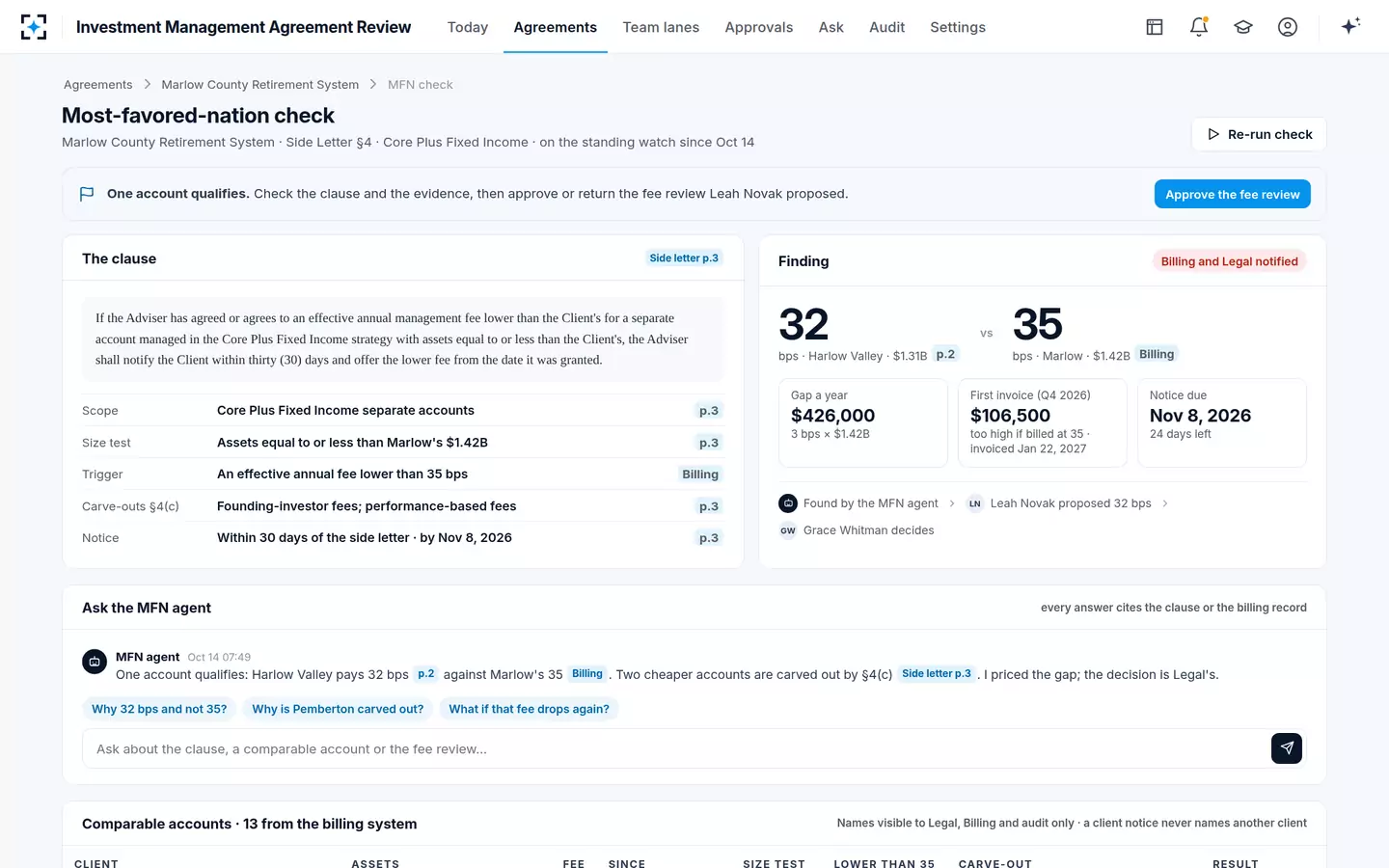
When does an MFN clause trigger?
An MFN triggers whenever the condition in the clause becomes true, which can happen on a day nobody on the client's team is watching. Three moments matter. At signing, the manager must test the new client against every existing comparable account, as Quillfield did for Marlow. When any comparable account's fee falls, through a renewal, a new negotiation or a breakpoint, every client whose MFN covers that strategy must be retested. And when a comparable account's size or status changes, a fee that was carved out or failed the size test can come into scope.
That is why the sample firm's MFN agent runs as a standing watch: it re-runs whenever any Core Plus fee changes anywhere in the book, and nightly. It cannot change a fee or contact a client. The design target is that every MFN clause is checked against every comparable account before the next invoice; a clause tested only at signing is a clause that fails on the first renewal discount anywhere else in the book.
What examiners find when agreed fee terms are not applied
No SEC rule addresses MFN clauses as such, but the Commission's examiners have repeatedly found fees that did not follow the terms clients negotiated. The 2021 fee risk alert, summarizing about 130 examinations focused mainly on retail advisers, cites a 2017 settled order "alleging that the adviser violated Advisers Act Section 206(2) by charging clients advisory fees that did not reflect negotiated discounts" (SEC risk alert, November 10, 2021). An MFN is a negotiated discount whose amount depends on other clients' fees.
The June 2026 alert reaches the same point from the documents' side, listing fee calculations not aligned with "the terms in written advisory agreements", including "renegotiated fee arrangements" and "fee addenda to advisory agreements" (SEC risk alert, June 9, 2026). A side letter MFN is a fee addendum by another name. The cost of getting it wrong, once found, is the subject of what a billing error costs.
Who tests the MFN: billing proposes, legal decides
An MFN finding moves money, so it needs two people. Billing knows the fees and proposes the change; legal reads the clause and the carve-outs and approves it; the relationship manager sends the client the offer that legal approved. In the sample firm, agents do the reading, the comparison, the pricing and the drafting, and the system blocks the person who proposed a fee change from approving it.
How one MFN finding becomes an approved fee and a client notice
Agent
Extraction agentReads the MFN clause into scope, size test, carve-outs, trigger and notice, each cited to its page.
Never: Paraphrases without the quote
Agent
MFN agentTests the clause against every comparable account's billed fee, checks carve-outs in each account's own agreement, prices the gap and drafts the client notice.
Never: Changes a fee, or names another client in a notice
A person decides
Billing managerProposes the fee change as maker: in the sample, 32 bps from October 1, 2026.
A person decides
Senior counselReads the clause and evidence, confirms any carve-out reading, and approves with a reason code, or returns it.
A person decides
Billing managerUpdates the billing system after approval, before the next invoice.
A person decides
Relationship managerSends the client notice Legal approved, by the clause's deadline.
Fee review, maker and checker: counsel approves the change with a reason code
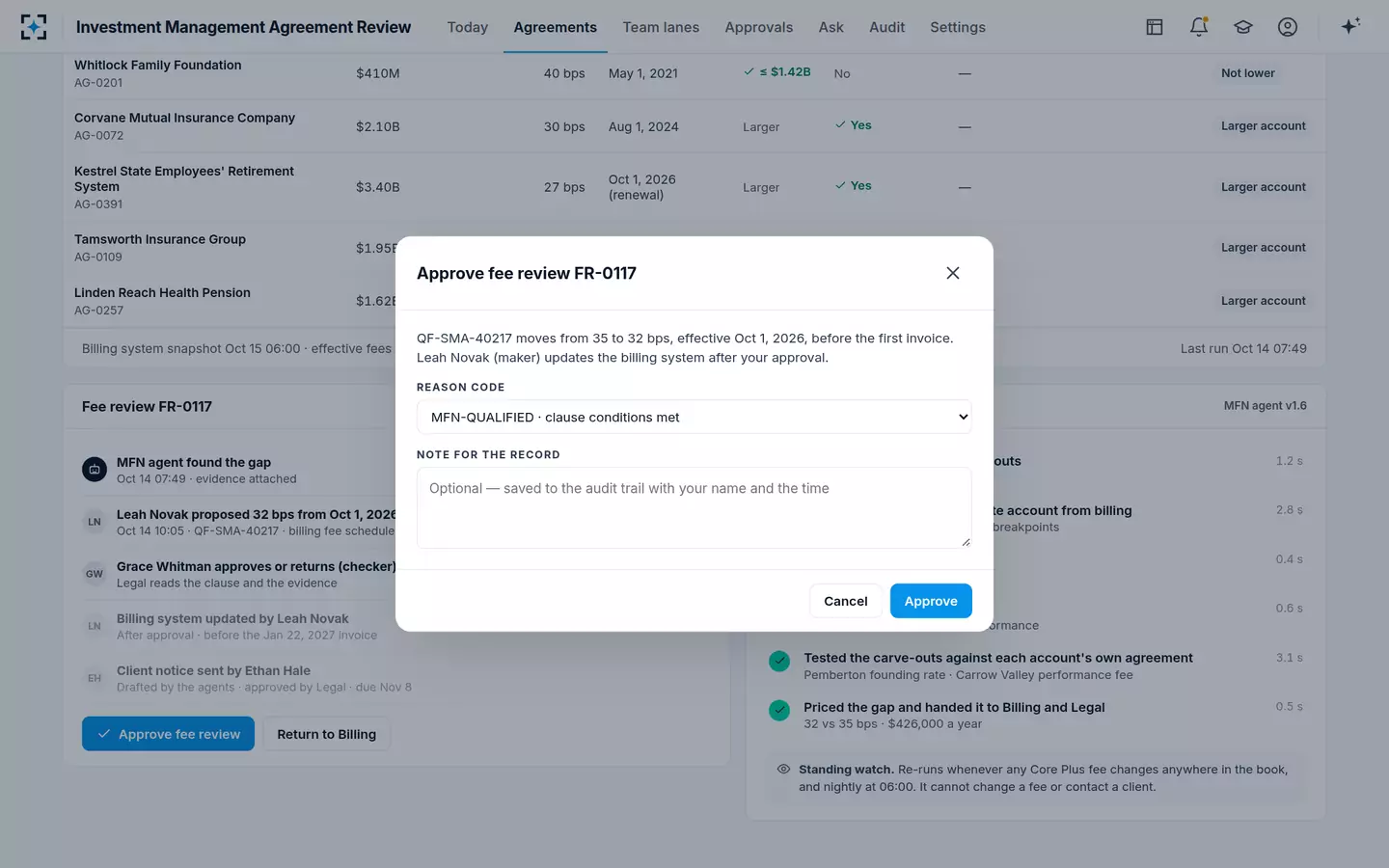
Writing an MFN clause that billing can test
Most MFN disputes start in the drafting, not the billing. A clause that billing can test names its comparison set, its fee measure, its exclusions and its dates in words that map to data the firm actually holds. A clause that says "comparable clients" without defining comparable hands the definition to whoever reads it next, usually years later and under pressure.
Six drafting choices that decide whether an MFN can be tested
- Define the comparison set by data the firm holds
Strategy name as it appears in the billing system, vehicle type (separate accounts only, or pooled funds too), and the size measure.
- Say which fee is compared
Effective annual fee after breakpoints, or the schedule tier by tier. They give different answers.
- List every carve-out by class
Founding-investor, performance-based, affiliated, legacy, sub-advisory, or pooled. Anything unlisted is in.
- Fix the measurement date
Size and fee measured on the date the other fee was granted, the client's signing date, or each quarter-end.
- Set the notice and election mechanics
Days to notify, days for the client to accept, and what happens if it does not reply.
- Say what the client is told
The fee and its effective date, not the other client's identity or terms, which its own agreement may keep confidential.
The last item is where the client notice comes from. In the sample firm the MFN agent drafts the notice from the clause and the finding, it never names the other client, Legal approves it, and the relationship manager sends it. A clause that defines what the client must be told makes that letter a template; one that does not makes it a negotiation every time.
Separate-account MFNs and fund MFN elections are different exercises
A separate-account MFN compares one client's fee with other clients' fees, continuously; a private-fund MFN usually gives investors a one-time election, after final close, among terms granted to other investors in the same fund, limited by commitment size and carve-outs. The fund version is a season with a compendium and election forms; the separate-account version is a standing test against the billing system. Tools and controls built for one rarely serve the other, and Private Markets' most favored nation clause in private equity covers the fund side.
The separate-account version also overlaps with a fee feature billing already handles: breakpoints and householding. An MFN measured on relationship assets, row 4 in the table, requires the same aggregation as a householded breakpoint, and the SEC has found errors in both. The guide to what a missed breakpoint tier costs covers the aggregation side. For the clause itself, the place to start is the wording: which of the six patterns it follows decides the data the test needs. To see the MFN agent on your own agreements, start from Investment Management Agreement Review.
Questions people ask
What does MFN mean in finance?
Most favored nation: a promise that a party will receive terms at least as good as those given to others in a defined group. In a separate-account investment management agreement it is usually a fee promise: the client's fee will be no higher than the fee charged to comparable accounts.
Is an MFN clause retroactive?
Only if it says so. The sample firm's clause offers the lower fee "from the date it was granted", which looks back to the other client's grant date; a prospective-only clause starts at the client's acceptance. The wording, not the practice, decides what billing must refund.
Do performance fees count in an MFN comparison?
Usually not, because most clauses carve them out: an account on a performance fee pays a different kind of fee that cannot be compared basis point for basis point. In the sample firm's test, an account on a performance fee was excluded by the clause's carve-out.
Must the manager tell the client which other client pays less?
Usually not, and often it may not, if the other client's terms are confidential under its own agreement. The client needs the fee and the effective date, not the name; the sample firm's notices never name the comparable client.
How often should an MFN clause be re-tested?
Whenever a fee in its scope changes, and before each invoice. A test only at signing misses every later concession granted to another account. The sample firm's MFN agent re-runs whenever any fee in the strategy changes, and nightly.
What is the difference between an MFN and a breakpoint?
A breakpoint lowers a client's own rate as its assets grow, under its own schedule; an MFN lowers its rate when someone else's fee is lower. Both are negotiated discounts, and the SEC's 2021 fee alert cites a settled case about fees that did not reflect negotiated discounts.