An MFN election in private equity is an investor's choice, after the fund's final close, of which terms granted to other investors in their side letters it will take under its own most-favored-nation (MFN) clause. Its value depends on what the clause lets it reach. Research on US public pensions finds that investors in the same fund routinely pay different fees, and that size and bargaining power explain much of who gets the better tier. An MFN clause can narrow that gap for an investor that is no smaller than the one that received a term, but a clause can carve fees and carried interest out, as the sample investor's does, and then what an election wins is information, protections and rights rather than price. Botminds' Side Letter Management works on the manager's side: it gives each investor a ballot of exactly the terms it may elect, with the excluded ones shown and explained, and checks every call twice, so an investor receives what it is owed on time.
Fee differences inside private funds, measured
61%
of funds showed two tiers of net-of-fee returns among their public pension investors; 36% showed one
83bp
dispersion of management fees between investors within the average private equity fund
$4.3per $100
capital forgone by investors outside the best fee tier, an upper-bound estimate
$19B
forgone in total across the sample, on the same basis
What is an MFN election in private equity?
It is the moment an investor's MFN right turns into terms. The right sits in the investor's side letter; it promises access to rights granted to certain other investors, within limits. After final close the manager offers each MFN investor the terms its clause reaches, and the investor elects those it wants within the window its clause sets, 30 days from receipt in the sample fund. Elected terms become part of its arrangement for the life of the fund.
For a closed-end private equity fund this happens once, after the fundraising ends, because only then is the full set of side letters known. The MFN election process covers the season from the manager's side; this guide is about what the investor gets.
Do all LPs pay the same fees?
No. The best evidence comes from Juliane Begenau and Emil Siriwardane, who reconstructed net-of-fee cash flows for 218 US public pensions across 2,400 private market funds. If every investor in a fund paid the same fees, their net returns would match; instead, in most funds investors' returns clustered into groups, which the authors read as fee tiers. Their abstract states the core result plainly: "Some investors consistently pay lower fees relative to others within their funds" (NBER working paper 29887).
The size of the gap varies by strategy. Dispersion in management fees within the average fund was about 91 basis points across all asset classes, about 83 in private equity and 42 in venture capital; for carried interest, about 3.3 percentage points in private equity and 0.5 in venture capital, the latter not statistically different from zero. Venture managers, and managers in high demand, are much less likely to tier their investors at all.
Management fee dispersion between investors in the same fund
What is a fee tier?
A fee tier is a group of investors in one fund paying the same fee terms, different from another group's. Tiers can be written into the fund documents, as share classes with different rates, or created through side letters that grant fee breaks for size, an early close or a strategic relationship. In Begenau and Siriwardane's data most funds with more than one tier had two.
A fee tier is not the same as an MFN tier, though the two often line up. MFN tiers group investors by commitment so each can see which side letter terms its size unlocks; in the sample fund in Side Letter Management, five MFN tiers run from under $25 million to $300 million and above. Whether a fee break sits inside those MFN tiers, open to election, or outside them, carved out, is decided by each investor's clause.
Why do large investors get better terms?
Because they are worth more to the manager, and because some negotiate better. The research finds both. Pensions that are large in overall size were 14 to 17 percentage points more likely to be in the lowest-fee tier of the average fund, and committing a larger share of a fund made the best tier more likely too. But size did not explain everything:
“unobservable traits related to negotiation and contracting skill materially impact the fees that investors pay in private market funds”
Begenau and Siriwardane, NBER working paper 29887 (2022)
The pattern is persistent. The authors found that the 95th-percentile pension was in the better-performing tier in 67% of its funds, while the 5th-percentile pension was there in only 13%. Managers' circumstances matter as well: managers without an established record, defined as fewer than three funds, were 13 percentage points more likely to tier their investors, and undersubscribed funds 12 points more likely, consistent with fee breaks used to draw in capital when it is scarce.
How often a pension sits in its funds' better-performing tier
Can an MFN election lower my management fee?
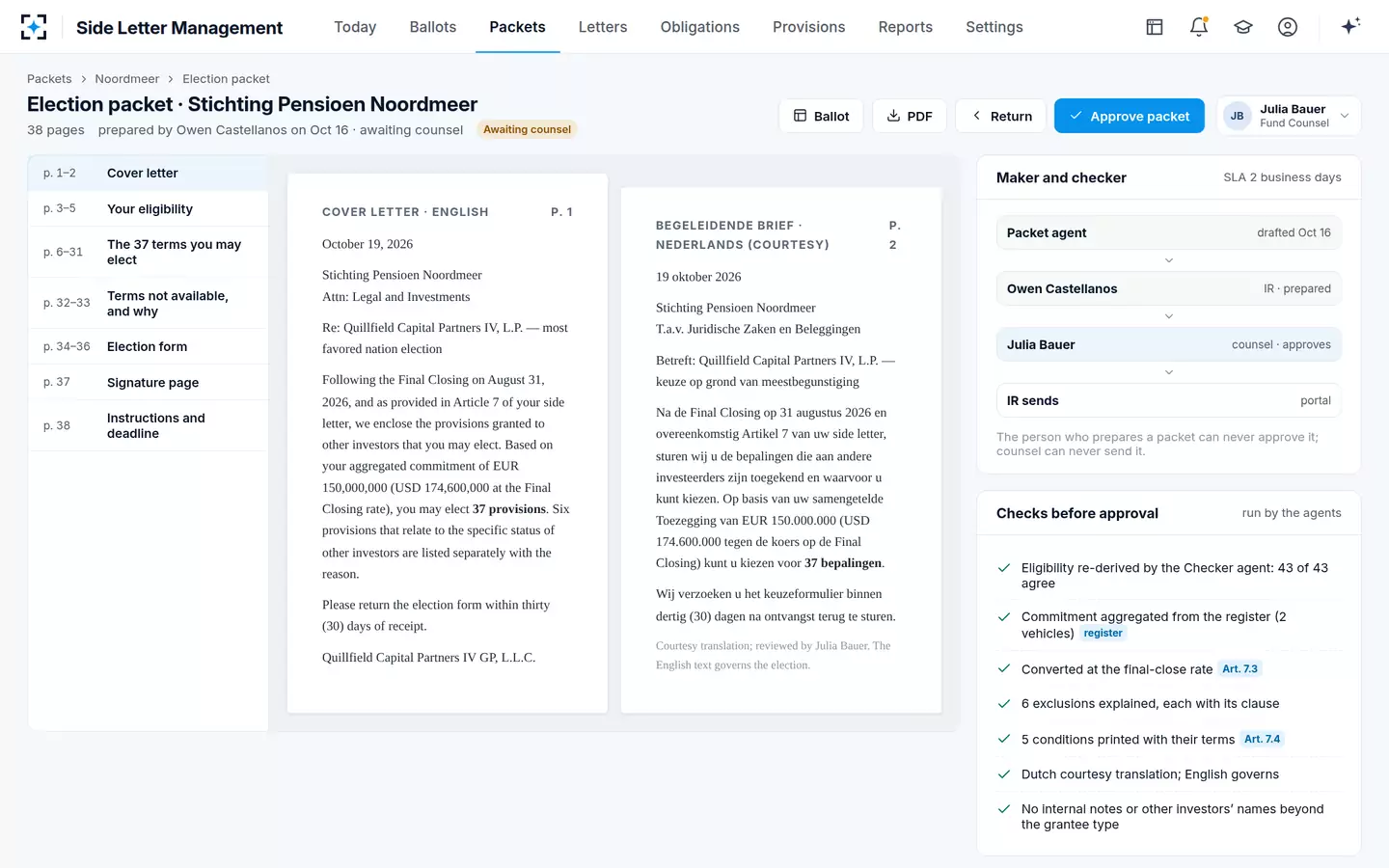
Only if your clause reaches economic terms. An MFN clause can carve out management fees, carried interest and other economic terms, because those are often the price the manager paid for a large or early commitment. The sample investor in Side Letter Management, a Dutch pension fund with $174.6 million committed, has exactly that carve-out, and its election shows what remains within reach.
What one investor's MFN clause reaches, of 171 terms in the compendium
Roughly a fifth of the terms are open to it. Of the 43 on its ballot, the largest groups are tax and regulatory terms, reporting and ESG data; only three fall under fees and expenses. Where a clause does not carve out economic terms, the arithmetic changes: a fee break granted to an investor no larger than yours becomes electable, and the election is worth the difference in fees for the rest of the fund's life. That is why the carve-out deserves the closest reading of any line in an MFN clause, and why an investor should know before signing which side of it fee terms fall.
How much do side letters save investors?
No regulator or independent study measures side letter savings directly, because the letters are confidential. The closest measure is the cost of being outside the best fee tier, and the working paper puts a number on it.
The authors estimate that "the aggregate amount of forgone capital due to fees in our sample equals $4.3 per $100 invested or $19 billion in total" (NBER working paper 29887). They treat the figure as an upper bound: it counts every source of return differences between investors in a fund, not only fees, and they call the exercise "suggestive". Read as an order of magnitude, it says that for a $100 million commitment, being in the worse tier can be worth a few million dollars over a fund's life, and that much of it is won or lost when the side letter is negotiated, not when the MFN is elected.
What does a late or wrong MFN election cost an investor?
A late election costs the investor the term for the months it was not in force; a wrong one costs it the term altogether, or costs both sides a correction. Neither shows up as a fee line, which is why both are easy to underrate.
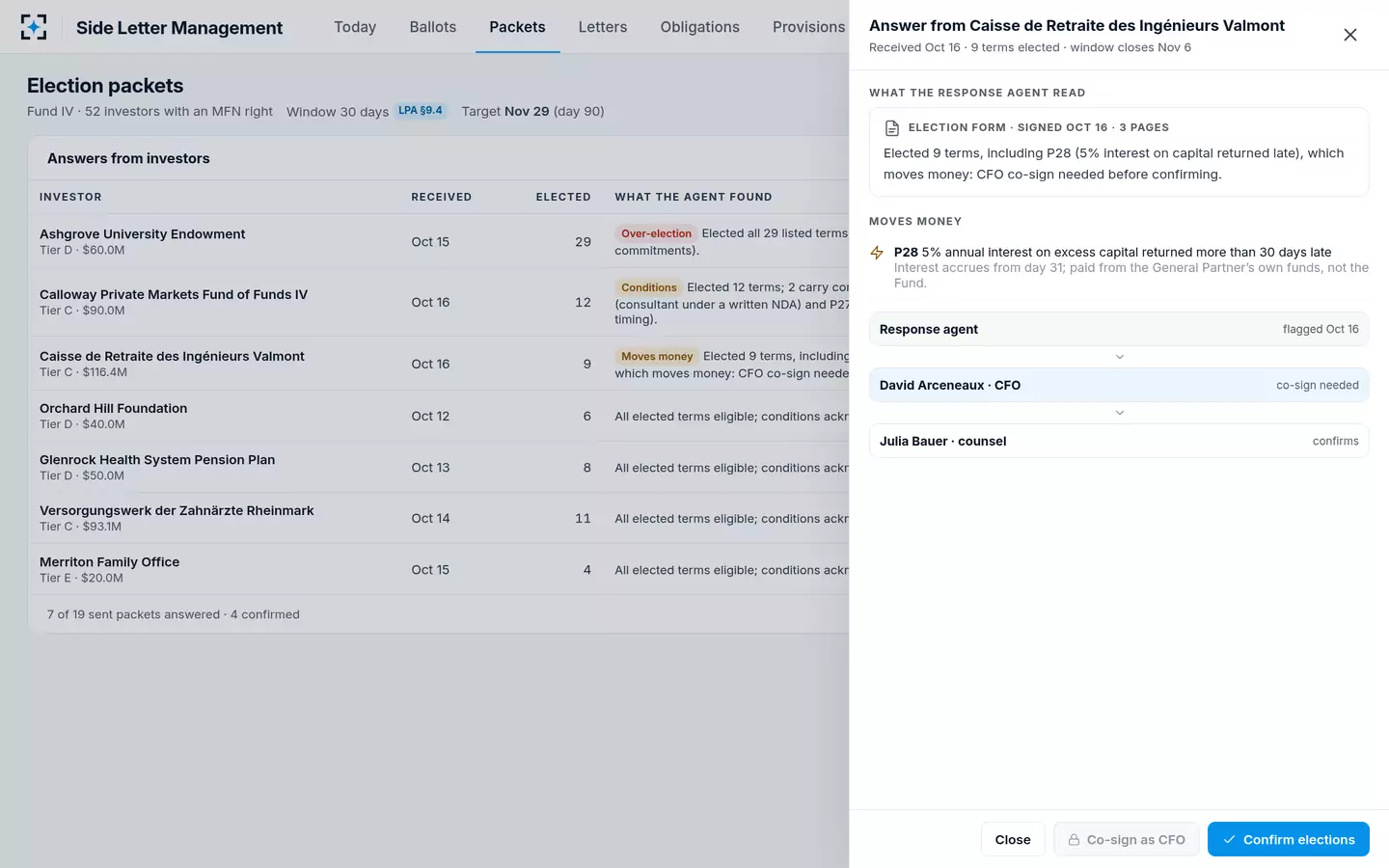
The costs are concrete once listed by term. An excuse right elected late is not in force for a deal that signs in the meantime, so the investor's capital may go into a tobacco or thermal-coal company its policy forbids. A reporting term elected late means quarters of data in the manager's format rather than the investor's, re-keyed by its own staff. An ESG data term elected late leaves an EU investor short of figures for its own regulatory reporting. A money term, such as interest on capital returned late, protects the investor only from the date it is confirmed. In the sample season, one investor elected nine terms including exactly such an interest term, paid from the general partner's own funds; it took effect once the CFO co-signed and counsel confirmed.
A wrong call costs more. A term wrongly excluded is a term the investor was owed and may never ask about; a term wrongly offered must be withdrawn after the investor relied on it. The manager's defence against both is a ballot that shows every exclusion with its reason, which is also the investor's best tool for checking it. The tests behind each MFN call are set out separately.
One investor's election packet: 37 terms it may elect, and the six it may not
Why smaller investors have the most at stake
Smaller investors have the least bargaining power to win terms directly, so the MFN is often their main route to terms larger investors negotiated. The SEC said as much in 2023, noting "a trend of rising interest in private funds by smaller investors with less bargaining power, who may be particularly impacted by these practices, including where advisers grant preferential terms to larger investors" (88 FR 63206, September 14, 2023). The rule that release adopted to address preferential treatment was vacated by the Fifth Circuit on June 5, 2024 (No. 23-60471), so in the US the protection is contractual: the MFN clause the investor negotiated, and the manager's duty not to mislead it about what others received.
The equal-or-smaller test cuts against small investors by design: a Tier E investor can elect only terms granted to investors no larger than itself, which are few. Its strongest moves are therefore at signing: negotiating a clause that covers the terms it cares about, including reporting and ESG data, and a window long enough to elect them carefully.
What to check on your MFN ballot
Check the inputs before the terms: a wrong commitment or a missing reason undermines every call that follows it. An investor's counsel can test a packet in an hour if it shows its arithmetic and its exclusions.
Seven checks for an investor receiving an MFN election packet
- Is your commitment right?
Every affiliated vehicle counted, at the exchange rate your clause fixes, with the date shown.
- Are excluded terms listed with reasons?
A packet that omits them gives you nothing to check.
- Do the status exclusions name the status?
“Applies only to ERISA plans” can be checked; “status-specific” cannot.
- Are the carve-outs the ones in your clause?
Not the manager’s standard list, if your letter says something different.
- Are conditions printed with each term?
You elect the term with its conditions; know what you are accepting.
- Does any term near your size line look locked by a small margin?
Ask for the arithmetic; a fixed rate or a missed affiliate can move it.
- When does the window close, and how do you confirm receipt?
A date, not a period, and a confirmation that your form arrived.
Returned forms read for over-election, conditions and money terms
Where Side Letter Management fits for investors
The solution is a manager's tool, but its output is the investor's ballot. It reads every letter in its signed language, aggregates each investor's commitment at the fixed rate, works out every call, has a second agent re-derive each one, and drafts a packet that lists what the investor may elect in full and what it may not, with the reason. Counsel approves; IR sends; the CFO co-signs anything that moves money. Its design target is every election closed within 90 days of final close. It does not negotiate fees or decide which terms a manager grants. Checking that the fees an investor is actually charged match its elected terms and the LPA is the job of Botminds' LPA Compliance. To see the ballots your investors would receive, start from Side Letter Management.
Questions people ask
Is it worth negotiating an MFN clause at all?
For an investor below the largest tier, usually yes: it is the cheapest way to receive terms others negotiated. Its worth depends on the carve-outs; an MFN that excludes economic terms is still valuable for reporting, ESG data, notices and excuse rights.
Should I elect every term I am offered?
No. Each term comes with conditions and sometimes costs, such as an observer seat at your own expense or information shared only under a non-disclosure agreement. Elect the terms you will use, and read the conditions before ticking.
Do first-close investors get better fees?
Sometimes, and first-closing terms are a class some MFN clauses carve out, as the sample investor's does, so that later investors cannot elect them. The SEC described in 2023 how managers use MFN provisions and early-investor terms to encourage early commitments.
Can a smaller investor elect a larger investor's fee break?
Not under an equal-or-smaller test, which reserves a term for investors at least as large as its recipient. Under a clause without that test and without an economic-terms carve-out, it could.
Does an MFN election change the fund's overall returns?
Only marginally, unless the elected terms change fees or costs. Most elected terms move information, rights and protections, which change what each investor knows and can do rather than the fund's gross returns.