A side letter matrix is a grid of every term in a fund's side letters against every investor: who received each term, who may elect it under a most-favored-nation (MFN) clause, who elected it, and what it obliges the fund to do. How quickly one can be built, by hand or with software, is set by its inputs: the limited partnership agreement's MFN section, every side letter as signed and in its own language, and an investor register that records commitments by vehicle, which vehicles are affiliates and each investor's legal, tax and regulatory status. Botminds' Side Letter Management builds the matrix from those documents, citing every term to its clause, so the practical question for a fund counsel or legal operations lead planning a rollout is what to gather. This guide is that inventory, and the minimum set that is enough to start.
The examples come from a fictional firm run through the solution: 40 funds, 900 side letters, some signed in Dutch, German, French or Japanese, and a newest fund, Quillfield Capital Partners IV, with 63 letters and 52 investors holding an MFN right.
What one firm's side letter matrix is built from
900
side letters across 40 funds, read in English, Dutch, German, French and Japanese
412
provisions in the newest fund’s 63 letters, each cited to clause and page
0.90
confidence below which a reading goes to a legal operations analyst
4,118
ongoing obligations the matrix feeds, each with an owner and a date
What is a side letter matrix?
A side letter matrix is the internal, investor-by-investor view of a fund's side letter terms: rows for terms, columns for investors, and in each cell whether the investor holds the term, may elect it, elected it or is excluded from it, and why. It is the working tool behind two outward documents: the anonymised side letter compendium offered to MFN investors, and the obligation register that tracks what the fund must deliver.
Its value is the cells, not the rows. A list of terms is easy; knowing, for 52 investors and 171 terms, which of nearly 9,000 combinations are open, closed or carved out, and on what clause, is the work. Every cell depends on the inputs below, which is why go-live speed is set by what the firm brings.
What information do you need to manage side letters?
Seven inputs, of which three are essential and four can follow. The essential three are the LPA's MFN section, the side letters as signed and the investor register; without any one of them no eligibility call can be made. The rest make the season and the obligations that follow it work end to end.
The seven inputs Side Letter Management builds a side letter matrix from
1
The LPA, with its MFN section and every amendment
The rules every election follows: tiers, the equal-or-smaller test, affiliates, the exchange rate, the window
Signed PDFs
2
Every side letter, as signed, in its own language
Each investor’s terms and its own MFN clause with its carve-outs
Signed PDFs or scans; English, Dutch, German, French, Japanese
3
Side letter amendments and prior elections
What each investor already has, so it is not offered twice
Signed PDFs; last season’s confirmations
4
The investor register
Commitments by vehicle, affiliated vehicles, and each investor’s legal, tax and regulatory status
Export from the fund administrator
5
Final-close exchange rates
The rate each MFN clause fixes for comparing commitments
One line per currency, with the date
6
Owners for each kind of obligation
Who delivers reporting, ESG data, notices and excuse rights once terms are confirmed
A list of teams and named people
7
Where packets go out and forms come back
The investor portal and e-signature route, so delivery and receipt are evidenced
Existing portal; no new system
The LPA's MFN section and each letter's MFN clause
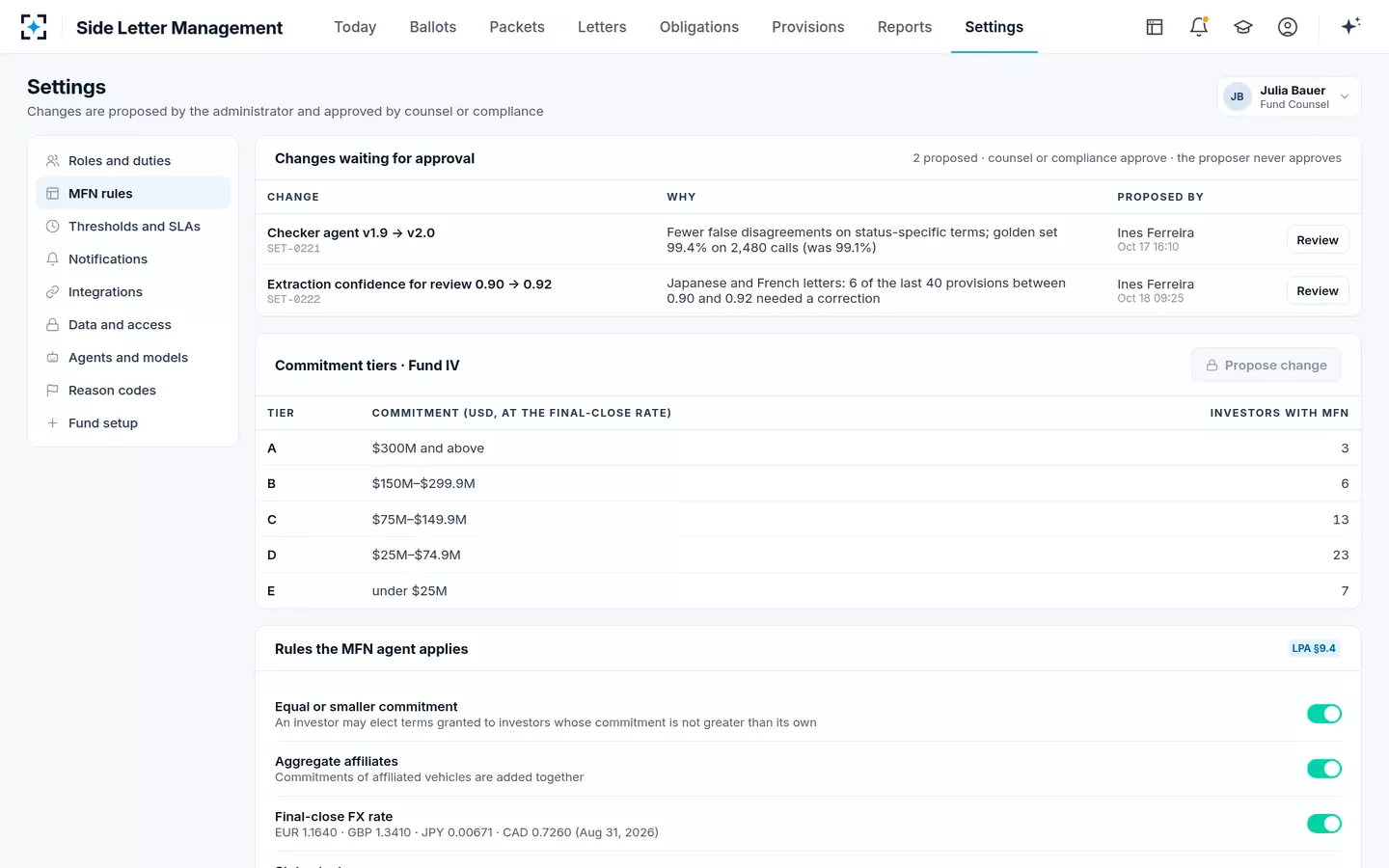
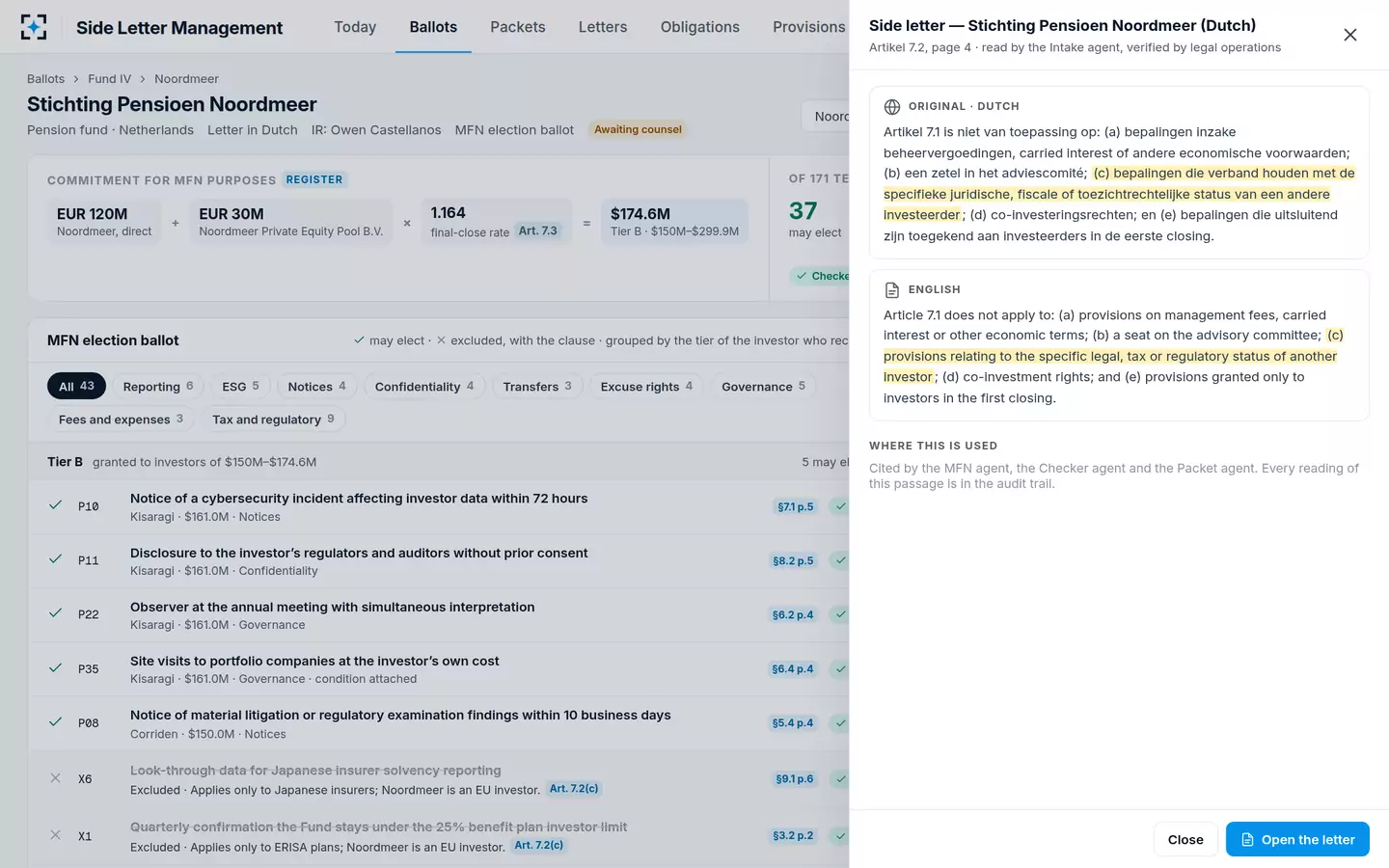
The MFN rules come from two places, and both are needed. The LPA often sets the framework that applies to every election: the window, how commitments are compared, whether affiliates are aggregated, which exchange rate applies. In the sample fund those rules sit in LPA §9.4. Each investor's own right, and its carve-outs, sits in its side letter; a Dutch pension fund's, for example, is Article 7, which carves out economic terms, an advisory committee seat, status-specific terms, co-investment and first-closing terms.
Bring both as signed, with every amendment. A summary of the MFN section prepared for the last fund is not a substitute: the tests run on the words, and a summary that says "equal or smaller commitment" without the clause's own definition of commitment will produce calls nobody can defend.
The MFN rules loaded from the LPA in Side Letter Management
How do you handle side letters in other languages?
Read them in the language they were signed in, and treat any translation as a rendering. A European pension fund's letter signed in Dutch, or a Japanese insurer's in Japanese, governs in that language; an English summary prepared by a junior lawyer is the most common place for a condition or a carve-out to go missing.
For the matrix, that means bringing the signed originals, not translations, and expecting the reading to show both. In the solution, the Intake agent reads letters in English, Dutch, German, French and Japanese, shows the original beside the English for every provision, and sends anything it reads below the confidence threshold to a legal operations analyst. Election packets then carry a courtesy translation of the cover letter in the investor's language, with English governing the election.
A Dutch side letter clause, original above the English
The investor register: commitments, affiliates and status
The register is the input most often incomplete, and it fails quietly. Administrators record commitments by legal holder, which is what they need for capital calls; MFN clauses compare investors as families of affiliated vehicles, with a status that the register may not hold at all. A pension fund investing directly and through a pooled vehicle appears as two holders; an insurer's regulatory status may sit only in its subscription documents.
Bring the register as the administrator exports it, and plan to add two things the first time: which vehicles are affiliates for MFN purposes, and each investor's legal, tax and regulatory status as its letters assume it. In the solution, the Investor agent matches each letter to the register and adds affiliated vehicles; where a status or an affiliate is missing it holds the investor's packet rather than guessing, because a wrong commitment changes every call on that investor's ballot.
What goes wrong when an input is missing
| Input missing or wrong | What the matrix gets wrong | Who notices, and when |
|---|---|---|
| An affiliated vehicle not linked | Commitment under-counted; terms the investor is owed shown as locked | The investor’s counsel, after the packet, if at all |
| A status not recorded | Status-specific terms offered to investors who cannot use them, or withheld from those who can | The investor, or an examiner reading the ballot |
| Exchange rate of the wrong date | Investors near a size line fall on the wrong side of it | Rarely anyone, until a dispute |
| A side letter amendment left out | Terms offered that were already changed, or missed | IR, when the investor replies |
| Last season’s elections left out | Terms offered again to investors that already hold them | The investor, with a question about care |
| No owner for an obligation type | Confirmed terms with nobody to deliver them | Compliance, at the first missed date |
How do you digitise side letters?
Digitising side letters means turning signed documents into provisions that can be tested, each cited to its letter, clause and page. Scanning is the easy part. The work is splitting each letter into its provisions, classifying them, keeping conditions with the terms they belong to and recording the clause references the MFN tests need.
Three choices make it reliable. Use the best available copy of each signed letter, since a clean PDF reads better than a faxed scan. Keep the original language as the source. And set a confidence threshold below which a person verifies the reading, then measure it: in the sample firm a proposal to raise the threshold from 0.90 to 0.92 cites the evidence, 6 of the last 40 provisions read between the two needed a correction. Re-keying letters into a spreadsheet is the alternative, and it produces a summary that drifts from the text with every amendment.
What is the minimum you need to start managing side letters?
The minimum is one fund's LPA with its MFN section, that fund's signed side letters and its investor register. With those three, the matrix, the eligibility calls and the ballots for a season can be produced; the rest can be added as the season runs.
The minimum set for a first season, and what can follow
- Start: the LPA, its amendments and the MFN section
As signed; not a summary.
- Start: every side letter for the fund, in its signed language
Including amendments to letters, and any prior elections.
- Start: the investor register export
Commitments by vehicle; affiliates and statuses added in the first week if they are not there.
- Start: the final-close exchange rates
With their date; the rules apply them for the whole season.
- Follow: owners for each obligation type
Needed when the first elections are confirmed, not before.
- Follow: portal and e-signature connections
Packets go out through your existing investor portal; connecting it records delivery and receipt as evidence.
- Follow: other funds’ letters
One fund first, then the rest, so the obligation register covers the firm.
How long does a side letter project take?
No regulator or independent study publishes how long it takes to digitise side letters or stand up a matrix, and vendors' own figures depend on their customers' inputs, so the honest answer is a method. Time is driven by the number of letters, the number of languages, the condition of the register and how many decisions counsel must make on ambiguous clauses. The fastest way to estimate it is to run a sample: a dozen letters, the MFN section and the register for one fund, and count the readings that needed a person, the investors held for a missing affiliate or status, and the questions that went to counsel.
That is how Botminds starts with a firm: the solution is run on a sample of the firm's own side letters and its fund's MFN clause before anything is planned around it. The solution's design target, once running, is every MFN election closed within 90 days of final close; the firm's own inputs decide how soon its first season can be held to it.
What software tracks side letters?
Firms use four kinds of tool, often together: document management for the signed letters, spreadsheets for the matrix and compendium, the fund administrator's portal for sending and receiving, and purpose-built side letter software for the eligibility calls and obligations. The first three hold documents and lists; only the fourth applies the MFN tests and tracks the promises with evidence.
Purpose-built software should work with the first three rather than replace them. The solution reads letters from the document repository, takes commitments and statuses from the administrator's register, sends packets through the existing investor portal and e-signature, and pushes obligations to the compliance calendar. What to ask any vendor is set out in the side letter tracker guide and, for the checks on the calls themselves, in side letter compliance with a second model.
The data you are handing over, and how it should be held
Side letters are among the most confidential documents a manager holds, so the inventory comes with conditions. Letters should be readable on a need-to-know basis; in the sample firm, deal teams see excuse rights only as anonymised restrictions and the platform administrator cannot read side letter text. Where investors' terms require it, their letters should stay in their region; the solution can hold data in the US, the EU or Singapore, and keeps EU investors' letters in the EU region.
Retention should meet the longest rule that applies. The SEC's books-and-records rule sets a minimum of five years, starting when the fiscal year of a record's final entry ends (Rule 204-2(e)(1)); the sample firm keeps everything for the fund's term plus seven years, with legal hold. The EU's fair-treatment rule frames why the structure matters as much as the data:
“The AIFM shall ensure that its decision-making procedures and its organisational structure, referred to in Article 57, ensure fair treatment of investors.”
Commission Delegated Regulation (EU) No 231/2013, Article 23(1), Fair treatment of investors in the AIF
A matrix built from the signed documents, with every call cited and approved, is that organisational structure in practical form. To see it built from a sample of your own letters, start from Side Letter Management.
Questions people ask
Is a side letter matrix the same as a side letter compendium?
They share their inputs but face different readers. The matrix is internal and names investors; the compendium is the anonymised list of grantable terms offered to MFN investors. A well-built matrix produces the compendium for each season.
Can we start with one fund?
Yes, and it is the sensible start: the fund with the next MFN season. Its LPA, letters and register are enough for a first season; other funds' letters can be added after, so the obligation register grows to cover the firm.
Do we need to clean up the investor register first?
Not entirely. Commitments by vehicle are what an administrator already keeps for capital calls; what is often missing is affiliate links and statuses, which can be added for the MFN investors first. Investors with gaps are held, visibly, rather than given a wrong ballot.
What about side letters for funds already past their MFN season?
They still matter for the obligations. Loading them builds the register of promises the fund must keep, and shows which terms existing investors already elected, which a later transfer or a new side letter may need.
Who on our side needs to be involved?
Fund counsel to approve the MFN rules and rule on ambiguous clauses, legal operations to verify uncertain readings, investor relations for the packets, compliance for the obligation owners, and the fund administrator for the register export.