A side letter tracker is the register in which every promise a fund made in its side letters, including every term investors elected under their most-favored-nation (MFN) rights, becomes an obligation with an owner, a due date, how often it repeats and the evidence that will prove it was kept. Most trackers start as spreadsheets that list terms, and that is where they fail: a term without an owner and a date is not tracked, and a promise marked "done" without proof cannot be shown to an investor or an examiner. Botminds' Side Letter Management builds the register from the letters themselves: its Obligation agent turns each confirmed term into a dated obligation, checks the team responsible can actually deliver it, escalates before the date, and drafts a cure notice for counsel when a date is missed.
The figures come from a fictional firm run through the solution: 40 funds, 900 side letters and 4,118 ongoing obligations, including 268 for its newest fund, Quillfield Capital Partners IV.
One firm's side letter promises, on a Monday in October
4,118
ongoing obligations across 40 funds and 900 side letters
74
deliverables due this week
9
obligations at risk, each already escalated
1
missed by one business day, with a cure notice drafted
What is a side letter tracker?
A side letter tracker is a register of obligations, not a list of documents. Its unit is the promise: "deliver the quarterly report in our template within 45 days", "notify us within ten business days of a regulatory examination finding", "excuse us from tobacco deals and tell us ten business days before signing". Each promise has someone who must do something, by a date, and something that proves it was done.
The difference from a compendium is purpose. A side letter compendium answers "which terms exist, and who may elect them?" once per fund, after final close. A tracker answers "what do we owe, to whom, by when, and did we deliver?" every day for the life of the fund. The compendium feeds the tracker: every MFN election confirmed adds obligations, sometimes to dozens of investors at once.
What obligations do side letters create?
Side letter obligations fall into a handful of kinds, and each lands on a different team. That spread is the core difficulty: legal signs the letters, but the administrator, the deal team, the ESG team and fund finance deliver them, often without having read them.
The kinds of side letter obligation, with an example and who delivers it
| Type | Example from the sample firm | Owner | Repeats |
|---|---|---|---|
| Reporting | Monthly capital account statement in Excel, within 15 days of month end | Fund administrator | Monthly |
| Reporting | Quarterly report in the ILPA reporting template to 41 investors | Fund finance | Quarterly |
| Excuse rights | Excuse notice for a tobacco distribution deal, 10 business days before signing | Deal team | Per deal |
| ESG | SFDR principal adverse impact data to six EU investors | ESG team | Quarterly |
| Notices | Notice of a serious ESG incident within 10 business days | ESG team | Per event |
| Transfers | Response to a transfer request within 10 business days | Legal | Per event |
| Tax and regulatory | Look-through data for a Dutch investor’s central bank reporting, within 45 days | Fund finance | Quarterly |
| Reporting | Capital call notice with a Japanese courtesy translation | Investor relations | Per call |
Three of these deserve extra care. Excuse rights touch the deal team, which should know a restriction exists without reading an investor's letter; in the sample, deal teams see excuse rights only as anonymised restrictions, the form in which a screen can test them as private equity investment criteria. Event-driven notices have no calendar date until something happens, so they are the easiest to miss. And regulatory data for an investor's own supervisor, such as look-through data for a Dutch pension fund's central bank reporting, has a date set by someone else's rules.
How do you track side letter obligations? The seven fields of an obligation
You track side letter obligations by giving each one seven fields and refusing to call it delivered without the evidence its rule names. Fewer fields, and the obligation cannot be owned or escalated; vaguer evidence, and "done" means only that someone ticked a box.
One side letter obligation, field by field
The promise
What it holdsThe term as signed, cited to letter, section and page
SampleOctober capital account statement in Excel, within 15 days of month end (Section 4.3)
Investor and fund
What it holdsWho is owed it, and under which fund
SampleLakemont County Employees’ Retirement System · Capital Partners III
Owner
What it holdsThe one team or person who delivers it
SampleFund administrator
Due date and recurrence
What it holdsThe next date, and the rule that produces the dates after it
SampleOctober 16; monthly
Evidence rule
What it holdsWhat proves delivery, set before the first date
SampleThe statement sent, with the portal delivery receipt
Inputs
What it holdsWhat the owner needs, from whom, by when
SampleThe administrator’s month-end file
Status and escalation
What it holdsOn track, at risk or missed, and who has been told
SampleMissed by one business day; escalated to the general counsel
The evidence rule is the field most trackers lack and the one that matters most when an investor asks. "Sent" is a claim; the statement attached with a delivery receipt is evidence. Setting the rule before the first date also settles arguments about what counts, such as whether a report posted to a portal is "delivered" on posting or on the investor's notification.
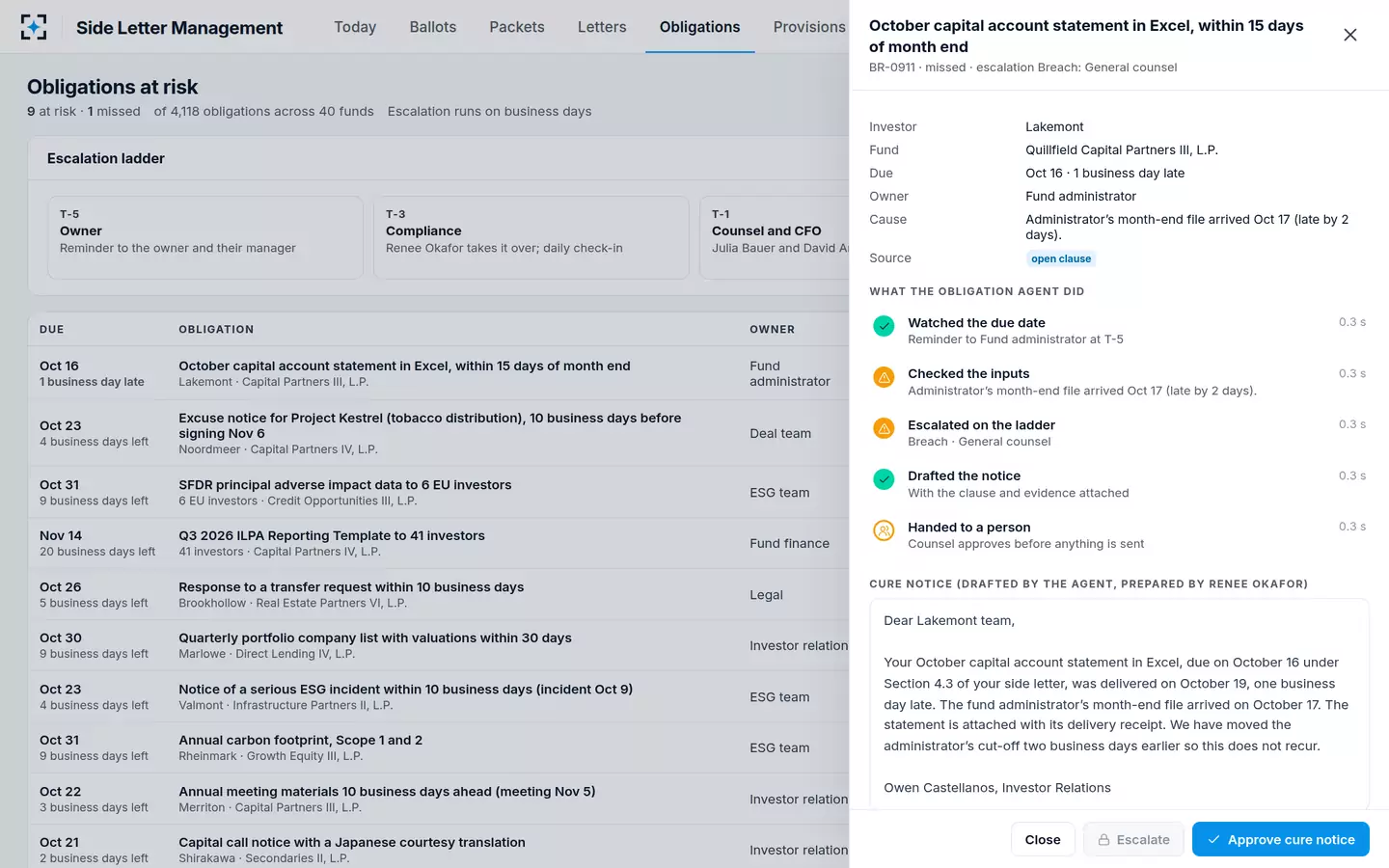
The inputs field is the second most often missing. In the sample, the Lakemont statement was missed not because anyone forgot it but because the administrator's month-end file arrived on October 17, a day after the statement was due, and the statement went out on Monday, October 19, one business day late. A tracker that knew the input and its usual arrival date would have flagged the risk at the first reminder rather than at the deadline.
Can the team actually deliver it? Checking before the first date
A promise the delivering team cannot meet is a breach scheduled in advance. Side letters are negotiated by counsel and IR during fundraising, often without asking whether the administrator can produce a statement in an investor's own Excel format by day 15, or whether every portfolio company reports Scope 1 and 2 emissions. The time to find out is when the obligation is created, not when it first falls due.
In the solution, the Obligation agent checks each new obligation against what the administrator or portfolio team already delivers: whether a data source exists, whether its usual timing fits the date, and who owns it. Where it does not fit, the gap goes to compliance with the clause attached, while there is still time to change the process, agree a different format with the investor or accept the cost.
Who is responsible for side letter compliance?
Fund compliance owns the register, and each obligation has one delivering owner. That split works only if both are written down. In the sample firm, compliance owns every obligation's status and takes over at risk; the delivering team owns the deliverable; fund counsel approves any communication to an investor about a miss; and the CFO co-signs anything that changes what the fund pays or charges.
An examiner or an investor's auditor will look for exactly that structure. In the Harbinger case, a hedge fund matter the SEC settled in 2013 with admissions, the consent judgment required an independent monitor to "ensure compliance with side letters and other obligations to investors to ensure fair and equitable treatment of all investors in the Harbinger Funds" (SEC v. Falcone, S.D.N.Y., final consent judgment). A court-ordered monitor is the extreme case; the job it describes is the one a tracker exists to do every day. The compliance programme rule, Rule 206(4)-7, asks every registered adviser for written policies and procedures and an annual review of how well they work; a register with owners, dates and evidence is what that review can test.
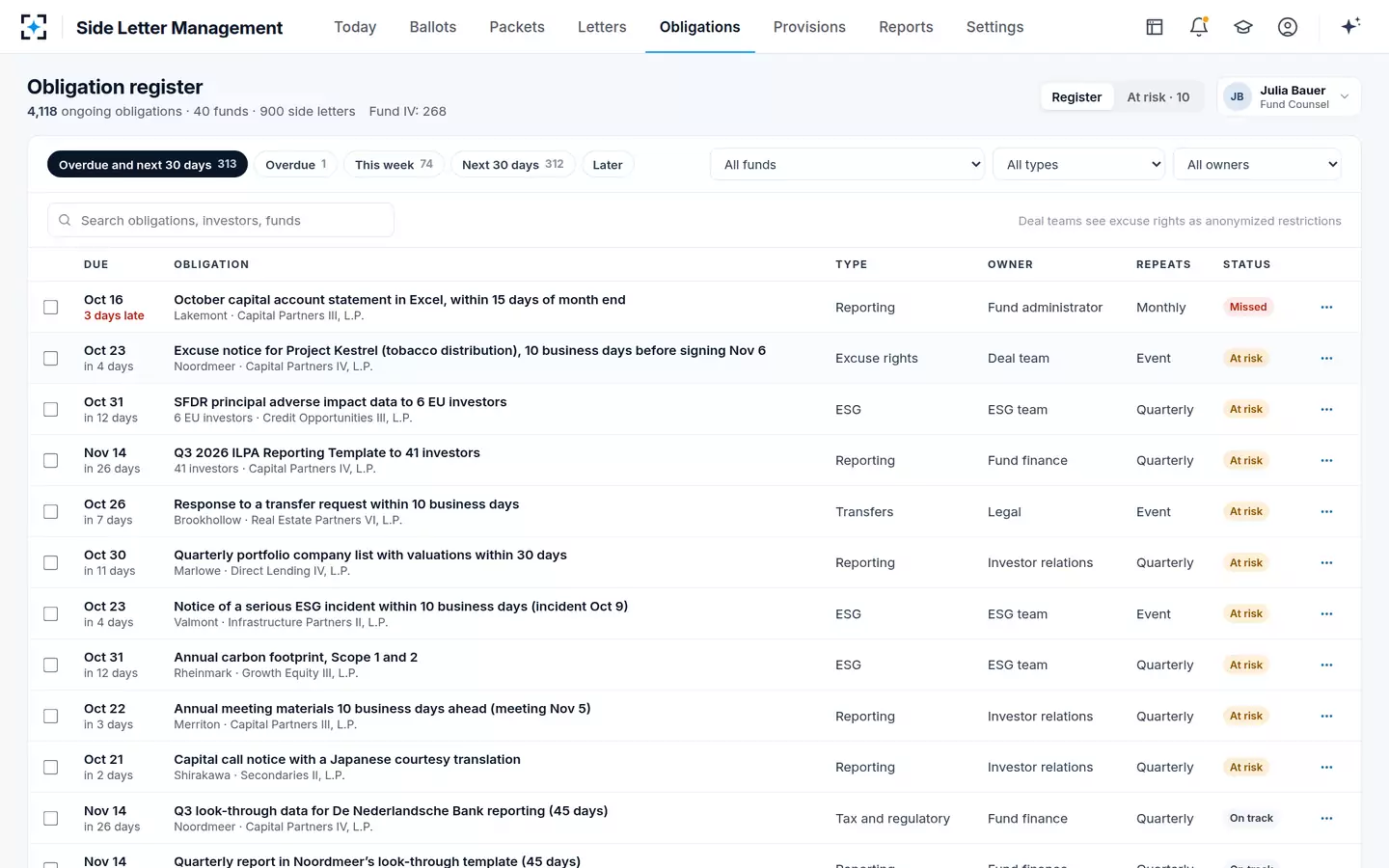
The obligation register across 40 funds in Side Letter Management
How far ahead should a side letter deadline escalate?
Far enough ahead that someone other than the owner can still act. The sample firm's ladder runs on business days: the owner and its manager are reminded at five days before the date, compliance takes the obligation over with a daily check-in at three, fund counsel and the CFO are told at one, and the general counsel at breach. The steps are settings, and changing one is approved like any other rule change; the proposal that moved the three-day step from the owner's manager to compliance is on the audit trail.
The next 30 days of side letter deadlines, by urgency
The numbers explain why escalation has to be automatic. Seventy-four deliverables in a week, across eight teams, cannot be held in one person's head, and the one that slips is often the one whose input depends on somebody else. An escalation that waits for the owner to raise a hand arrives after the date.
What happens when a side letter obligation is missed?
A missed side letter obligation is a breach of contract with that investor, and the right response is to say so promptly, cure it and fix the cause. The point is to tell the investor first, rather than let it find the gap in its own records. The cure notice should state what was due and under which clause, when it was delivered, why it was late, the evidence, and what changes so it does not recur.
In the sample, the Obligation agent drafted the Lakemont notice with the clause and the delivery receipt attached; compliance prepared it, and counsel approves it before anything goes to the investor. The fix stated in the notice is concrete: the administrator's cut-off moved two business days earlier. The FCA's October 2026 review makes the timing point for conflicts disclosures in general: weaker firms "relied on quarterly reporting cycles rather than timely event-driven communication" (FCA multi-firm review, 23/10/2026). A breach found in October and reported in the year-end letter is that weakness in miniature.
A missed obligation escalated and a cure notice drafted for counsel
What examiners and investors test in a side letter tracker
They test whether a promise can be followed from the letter to the proof. An examiner sampling side letters will ask for the letter, the obligation it created, the delivery and the evidence; an investor's auditor asks the same of its own letter. The books-and-records rule makes an adviser hold its records for at least five years, running from the end of the fiscal year in which each was last updated (Rule 204-2(e)(1)), and the sample firm keeps side letter evidence for the fund's life plus seven years. The FCA's review sets the same expectation in plainer words: "Sufficient records should be maintained to show compliance with policies, procedures and regulatory obligations" (FCA, 23/10/2026).
The results matter as much as the trail. Over the last 12 months the sample firm delivered 99.4% of side letter deliverables on time, 3,941 of 3,964, and all 23 late deliveries were cured with a notice counsel approved. Those are figures on fictional sample data; the useful measure for a real firm is the same one, on its own register.
What should side letter tracking software do?
It should start from the letters and end at the evidence, and it should leave decisions and investor communications with people. The questions below separate a register that will hold up from a calendar with clause numbers in it.
Ten questions to ask any side letter tracker vendor
- Does every obligation cite its clause and page in the signed letter?
A re-keyed summary drifts from the text; a citation can be checked.
- Can it read letters in the language they were signed in?
And send uncertain readings to a person, with the original beside the translation.
- Do confirmed MFN elections create obligations automatically?
Elections are where most new obligations come from after final close.
- Does each obligation have one owner, a recurrence and an evidence rule?
And can it be marked delivered only with that evidence?
- Does it check deliverability when the obligation is created?
Whether the data exists, who owns it and whether its timing fits.
- Does escalation run on business days, before the date?
With steps you can change, and changes approved by someone other than the proposer.
- Does it draft cure notices without sending them?
Counsel approves every investor communication.
- Can deal teams see restrictions without seeing letters?
Excuse rights as anonymised restrictions; letters on a need-to-know basis.
- Where is the data held, and for how long?
EU investors’ letters in the EU if required; retention at least as long as your record rules.
- Can you export the trail for an examiner or auditor?
Who did what, when, why and with what evidence.
Where Side Letter Management fits, and where it does not
The solution covers the register end to end: reading the letters, creating obligations from signed terms and confirmed elections, checking deliverability, escalating, drafting cure notices and keeping the trail. It works with the systems the promises already depend on, such as the document repository, the administrator's investor register, the compliance calendar and the investor portal, rather than replacing them.
It does not produce the deliverables themselves: the administrator still prepares the statement and the ESG team still collects the data; the solution tracks them and holds the proof. It does not negotiate letters. And for a manager with a handful of letters and no MFN rights, a disciplined spreadsheet with the seven fields above may be enough; the case for software grows with the number of letters, languages and MFN investors. The rest of the work, the MFN season that feeds the register, is set out in the MFN election process. To see your own letters as a register, start from Side Letter Management.
Questions people ask
Is a side letter tracker the same as a contract management system?
No. A contract management system manages agreements through negotiation and signature; a side letter tracker manages what the fund must do after signing, investor by investor, for the life of the fund. Some firms use both: the first for drafting, the second for keeping the promises.
How many obligations does a side letter create?
It depends on the letter. In the sample firm, 900 letters across 40 funds produce 4,118 ongoing obligations, about four or five per letter on average, and a single MFN election can add a dozen more to one investor's list.
Should excuse rights be shared with the deal team?
The restriction should be; the letter should not. The deal team needs to know that a tobacco deal triggers a notice to some investors ten business days before signing, not which investors or what else their letters say.
Do side letter obligations survive a transfer of the investor's interest?
That depends on the letter and the transfer documents. Some side letter rights are drafted as personal to the original investor and lapse on transfer, while others pass with the interest, so a tracker should flag every obligation owed to a transferring investor for counsel to confirm.
How often should a side letter tracker be reviewed?
Its status daily, by the agents and the owners; its design at least once a year as part of the compliance programme review, and whenever a fund closes, a letter is amended or MFN elections are confirmed.