Private equity investment criteria are the rules a fund applies to decide which companies it may and wants to buy: sector, size, geography, profitability, leverage and exclusions, plus the firm's judgment on the business and the price. They come in two kinds that are often mixed up. Some are restrictions in the fund's limited partnership agreement (LPA) or side letters, promises to investors that the general partner cannot set aside on its own. Others are the firm's investment committee guidelines, which a partner may override with a reason. Screening goes wrong when the two are treated alike. Botminds' Private Equity Deal Screening reads each fund's LPA, side letters and committee guidelines into versioned tests, applies them to every CIM with the page that decided each result, and tells a restriction only the fund's investors can waive from a guideline a partner can override.
The fund and deal in this guide are fictional sample data in the solution: Quillfield Capital Partners V, a $6.8 billion control buyout fund investing in North America and Western Europe, and Project Atlas, a CIM for a Rotterdam valve maker. The research, rule text and regulators' findings are linked where they appear.
What a fund's criteria have to carry
6tests
applied to every CIM at the sample buyout fund, each tied to a clause
2kinds
of limit: LPA restrictions only investors can waive, and guidelines a partner can override
Last
rank of fit with the fund among the factors surveyed investors use to choose deals
What are private equity investment criteria?
Investment criteria are the written answer to two questions: what this fund is allowed to own, and what this firm wants to own. The first comes from the fund's documents. A typical buyout LPA states the strategy and then limits it: a range of company sizes, a cap on how much of the fund one deal may take, limits on concentration in a single country or outside the target regions, limits on leverage, and exclusions such as weapons or tobacco, often widened by side letters. The second comes from the firm: preferred sectors, a minimum margin, a target return, a view on management.
The firm's preferences are what its marketing calls its criteria, and what searchers usually find on a sponsor's website: sector focus, an EBITDA range, control or minority. The limits in the LPA are what a deal team must not get wrong, because breaking them is breaking a promise to the fund's investors. A good screen tests both, but it keeps them apart.
Why fit with the fund ranks last when investors choose deals
When private equity investors rank what decides an investment, the fund's own limits come last, and that is the clue to how criteria should work. In the survey of 79 investors, "The most important factor in choosing an investment is the business model / competitive position of the company", followed by the management team, the firm's ability to add value and the valuation. Then: "The industry or market of the company and the fit with the PE investor’s fund are of least importance" (Gompers, Kaplan and Mukharlyamov, NBER Working Paper 21133).
Our reading is that fit with the fund ranks last because it is not weighed at all: it is a filter applied before the weighing starts. A deal that does not fit the fund never reaches the question of whether its business model is strong. That has a practical consequence. The fit tests should be pass or fail, applied first, cheap to run and impossible to forget, so that the people whose judgment matters spend it on the factors that rank first.
What are LPA investment restrictions?
LPA investment restrictions are the limits on what a fund may invest in, written into its limited partnership agreement and disclosed to investors before they commit. In the EU the disclosure is a legal duty: a manager must give investors "a description of the investment strategy and objectives of the AIF", the types of assets it may hold, "any applicable investment restrictions", the circumstances and sources of leverage and "the maximum level of leverage which the AIFM are entitled to employ on behalf of the AIF", and "a description of the procedures by which the AIF may change its investment strategy or investment policy, or both" (Directive 2011/61/EU, Article 23(1)(a) and (b)).
In the United States there is no equivalent list in a rule, but the SEC's examiners test advisers against what they told investors. In a 2022 risk alert, the staff reported private fund advisers "that did not comply with investment limitations in fund disclosures", including advisers that "implemented an investment strategy that diverged materially from fund disclosures" and others "that caused funds to exceed leverage limitations detailed in fund disclosures" (SEC Division of Examinations, Risk Alert, January 27, 2022). A risk alert is a staff statement, not a rule, but it shows what an examination will look for: evidence that each investment was tested against the limits the fund disclosed.
The six tests at the sample buyout fund, each with its clause and who can waive it
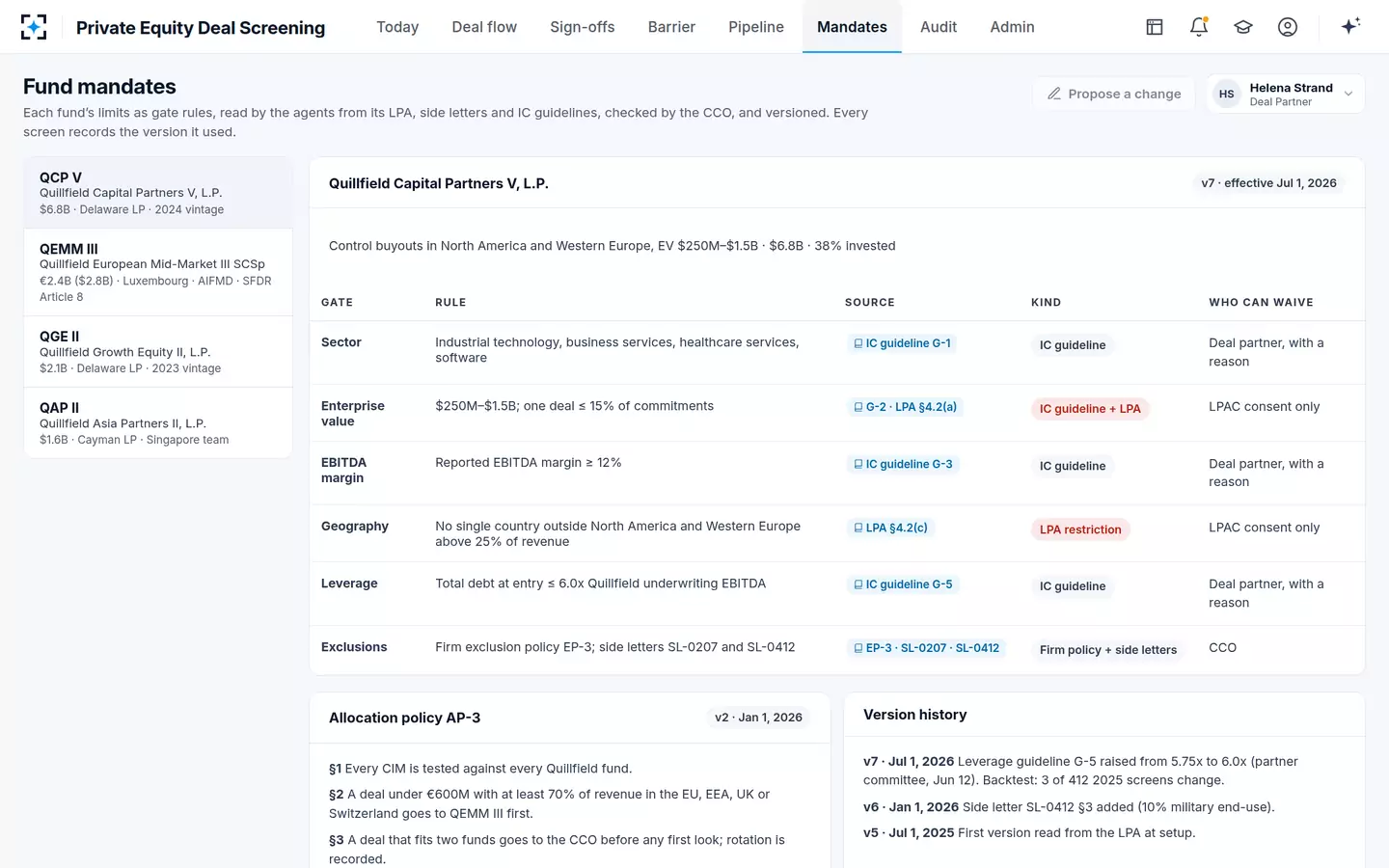
| Test | Rule | Source | Kind | Who can waive |
|---|---|---|---|---|
| Sector | Industrial technology, business services, healthcare services, software | IC guideline G-1 | Committee guideline | Deal partner, with a reason |
| Enterprise value | $250M–$1.5B; one deal at most 15% of commitments | G-2 and LPA §4.2(a) | Guideline and LPA restriction | LPAC consent only |
| EBITDA margin | Reported EBITDA margin at least 12% | IC guideline G-3 | Committee guideline | Deal partner, with a reason |
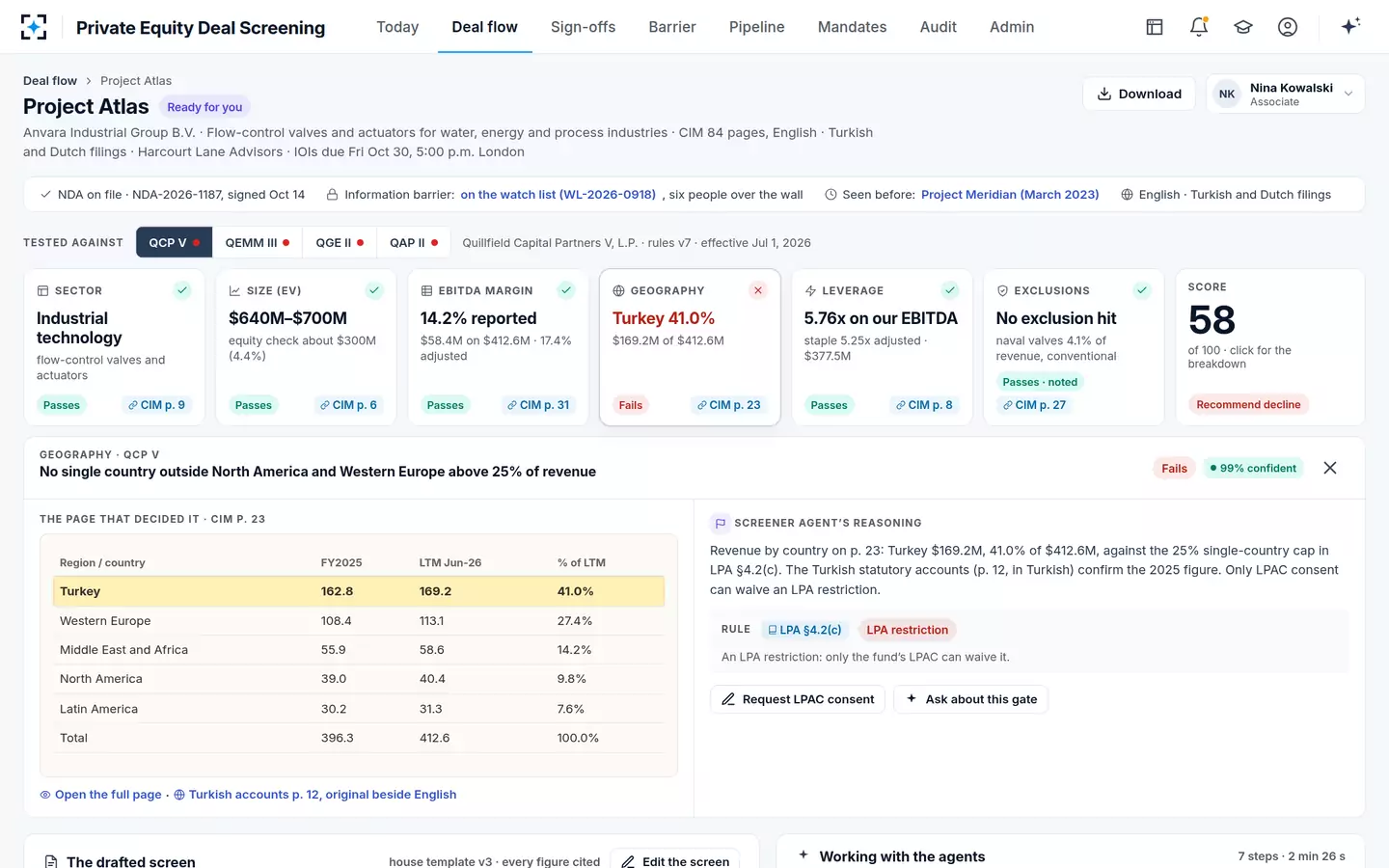
| Geography | No single country outside North America and Western Europe above 25% of revenue | LPA §4.2(c) | LPA restriction | LPAC consent only |
| Leverage | Total debt at entry at most 6.0x the firm’s underwriting EBITDA | IC guideline G-5 | Committee guideline | Deal partner, with a reason |
| Exclusions | Firm exclusion policy EP-3; side letters SL-0207 and SL-0412 | Policy and side letters | Firm policy and investor promises | Chief compliance officer |
Can an LPA restriction be waived?
Usually only with the consent of the fund's investors, most often through its limited partners' advisory committee (LPAC), and only as the LPA allows. A partner's conviction that a deal is excellent does not change a promise made to the investors. The same 2022 risk alert describes what goes wrong around consent: advisers that never took conflicts to the committee their documents required, and others that asked only after the transaction, or on incomplete information. What LPAC consent means covers the committee and those findings in detail.
For screening, the practical rule is that a failed LPA restriction recommends a decline whatever the deal's other merits, and the screen says so plainly. At the sample firm, Atlas fails the geography restriction: Turkey is $169.2 million of $412.6 million of revenue, 41.0%, against a 25% single-country cap in LPA §4.2(c). The screen recommends a decline and offers to request LPAC consent rather than assume it; it does not let a partner override the result, as it would for a committee guideline.
Three kinds of limit in a fund's criteria, and how each behaves at the screen
LPA restriction or side letter: The fund’s partnership agreement or a side letter: a promise to investors
Investment committee guideline: The firm’s own committee: a policy it sets and can change
LPA restriction or side letter: The LPAC or investors, as the LPA provides; never the deal team
Investment committee guideline: A deal partner, with a written reason
LPA restriction or side letter: Recommends a decline whatever the score; the screen can offer to request consent
Investment committee guideline: Lowers the score and asks for judgment; the partner may override
LPA restriction or side letter: Did every investment comply with the limits disclosed to investors?
Investment committee guideline: Were overrides made by the right person, for a stated reason?
LPA restriction or side letter: Geography: no single country outside North America and Western Europe above 25% of revenue
Investment committee guideline: Leverage: total debt at most 6.0x the firm’s underwriting EBITDA
Writing a criterion so it can be tested
A criterion is testable when two people applying it to the same CIM must reach the same answer. Most written mandates fall short of that, not because they are vague about the strategy but because they leave out the details that decide borderline cases. Six elements make a criterion testable.
First, the measure: revenue, EBITDA or assets, and whose definition. Second, the threshold and its direction: at most 25%, at least 12%. Third, the period: last fiscal year, last twelve months, or at entry. Fourth, the denominator: a country's share of consolidated revenue or of external revenue. Fifth, the source: the clause it comes from, so that a reader can check it. Sixth, the authority: who may waive it. Quillfield's geography test names all six. The Atlas CIM gives Turkey's revenue for both periods: 41.1% of FY2025 revenue on our arithmetic and 41.0% of the last twelve months, so the result does not depend on the choice; a share of 26% on one period and 24% on the other would, and the rule must say which governs.
One failed test, the page that decided it and the clause it breaks
How do you score a deal once it passes?
Score only what is left to judge, and never let a score outvote a limit. Once a deal passes the fund's restrictions, a score helps the team rank its time: which CIMs deserve a first look this week. At the sample firm the score has four parts, weighted 40 for fit with the mandate, 25 for financial quality, 15 for quality of earnings and 20 for risk, and three bands: 75 or more recommends a first look, 50 to 74 asks for judgment, below 50 recommends a decline.
How the sample firm weights a screening score, out of 100
Score weights
- Fit with the mandate · 40%
- Financial quality · 25%
- Quality of earnings · 15%
- Risk · 20%
Atlas shows why the override matters. It scored 58, inside the judgment band: five of its six tests passed, its margin and leverage on the firm's own EBITDA were acceptable, and a team scanning scores would have put it in front of a partner. The geography restriction ends the discussion before the score is read. The score is still useful afterwards: if the seller later offers the company without its Turkish business, a perimeter in which geography would pass, the rest of the score says whether that version is worth a look.
How do private equity firms allocate deals between funds?
Firms with more than one fund test each deal against every fund, then apply a written allocation policy when more than one fits. Allocation is a conflict regulators watch closely. The SEC's examiners have reported advisers that "preferentially allocated limited investment opportunities to new clients, higher fee-paying clients, or proprietary accounts" without adequate disclosure (OCIE Risk Alert, June 23, 2020). The FCA's October 2026 review drew the same line between stronger and weaker practice: stronger firms "had clearly documented allocation frameworks supported by predefined allocation criteria", while in weaker ones "investment teams exercised broad discretion when allocating opportunities between competing mandates" (FCA multi-firm review).
At the sample firm, the policy is three lines. Every CIM is tested against every Quillfield fund. A deal under €600 million with at least 70% of revenue in the EU, EEA, UK or Switzerland goes to the European mid-market fund first. And a deal that fits two funds goes to the chief compliance officer before any first look. For Atlas the Allocation agent tested all four funds and none fits: the European fund needs 70% of revenue in Europe and Atlas has 27.4%; the growth fund needs 20% revenue growth and Atlas has 6.1%; the Asia fund needs 60% in Asia-Pacific and Atlas has none. Another deal the same week, a German test-and-measurement maker, fits two funds, so the compliance officer decides before anyone looks further.
Changing the criteria: version every rule and backtest it
Criteria change: a committee raises a leverage guideline, a new side letter adds an exclusion. Each change should be a new version with a date, a reason and a test of what it would have changed. Without that, a screen run in March and a screen run in September cannot be compared, and nobody can say which rules a declined deal was tested against.
The sample fund's rules are on their seventh version. Version 7, effective July 1, 2026, raised the leverage guideline from 5.75 times to 6.0 times the firm's EBITDA after a partner committee decision on June 12; a backtest found that 3 of the fund's 412 screens in 2025 would have come out differently. Version 6, on January 1, 2026, added a side letter's 10% limit on military end-use to the exclusions. Every screen keeps the version it used, so the answer to "why did we pass on this in 2025?" is the rule as it stood then. A pilot on deals you already declined uses the same idea to test a new tool.
Each fund's mandate as versioned tests, with the clause behind each and who can waive it
Turning criteria into tests is only half of screening; the other half is reading the CIM that the tests are applied to. How to read a CIM covers that, and whether two screeners reach the same answer covers the judgment the tests leave over. Private Equity Deal Screening shows the full sample deal.
Questions people ask
What screening criteria do private equity firms use?
Most use a mix of hard limits from the fund documents (company size, the share of the fund one deal may take, geography, leverage and exclusions) and the firm's own preferences (sector, margin, growth, return targets). In the survey of 79 investors, the business model and competitive position ranked first among the factors that decide an investment, followed by management, the ability to add value and valuation.
What is a fund mandate?
A fund mandate is the investment strategy and limits a fund has agreed with its investors: what it may buy, where, at what size and with how much leverage. For an EU alternative investment fund, the manager must describe the strategy, the investment restrictions and the maximum leverage to investors before they invest, under Article 23 of the AIFM Directive.
What is the difference between an LPA restriction and an IC guideline?
An LPA restriction is a promise to the fund's investors in its partnership agreement, so the deal team cannot set it aside; waiving it usually needs the investors' advisory committee. An investment committee guideline is the firm's own policy, which a deal partner can override with a written reason. A screen should show which kind each test is.
How do you score a private equity deal?
Apply the hard limits first as pass or fail, then score the rest. The fictional sample firm weights fit with the mandate at 40, financial quality at 25, quality of earnings at 15 and risk at 20, recommending a first look at 75 or above and a decline below 50, with any failed LPA restriction recommending a decline whatever the score.
Do private equity firms publish their investment criteria?
Many publish their preferences, such as sectors, deal size and EBITDA range, to attract deal flow from bankers and brokers. The binding limits in each fund's LPA and side letters are confidential to the fund's investors, which is why a screen must be built from the documents, not from the website.