Private equity screening software takes the CIMs and teasers a deal team receives, reads them, tests them against the fund's investment limits and drafts a first screen, so that associates spend their time on judgment rather than extraction. The category ranges from deal CRMs that track the pipeline, to market-data platforms used for sourcing, to document tools that read the CIM itself. The question a buyer should ask of any of them is the one a bank asks of a payment: who checks the work, and are they independent of whoever did it? A screen is safe to rely on when one reader applies the fund's limits, a second, separately built reader rebuilds the earnings from the target's own filings without seeing the first one's conclusion, and people sign the decision. That is how Botminds' Private Equity Deal Screening is built.
Examples come from fictional sample data in the solution, a buyout firm called Quillfield and its CIM for Project Atlas. Research and regulators' statements are linked where they appear; the benchmark study cited is a preprint, not peer reviewed.
Why a screen needs a second reader and a trail
81%
of questions about public-company filings a 2023 model with retrieval got wrong or refused, in one benchmark
52%
of firms in the FCA’s first phase said internal audit had a role in reviewing their conflicts framework
2models
at the sample firm: one tests the fund’s limits, an independent one rebuilds EBITDA without seeing the score
What is private equity screening software?
It is software that turns an incoming opportunity into a screening decision faster and more consistently than an associate working alone. In practice three kinds of tool are sold under the name, and they do different jobs. A buyer that knows which job it is buying for will ask better questions.
Three kinds of tool sold as screening software, and the job each does
| Kind of tool | What it does well | What it does not do | Questions it answers |
|---|---|---|---|
| Deal CRM and pipeline tracker | Logs opportunities, bankers, stages and reason codes; reports the funnel | Read the CIM or test it against the fund’s limits | What came in, where is it, who owns it? |
| Market and company data platform | Finds companies, ownership, financials and comparables for sourcing | Check a seller’s adjusted figures against the target’s own filings | Which companies fit our thesis, and who owns them? |
| Document reading and screening agents | Read the CIM and filings, test each limit with its page, rebuild EBITDA, draft the screen | Replace the CRM or the data platform; decide | May this fund own it, and are the seller’s numbers credible? |
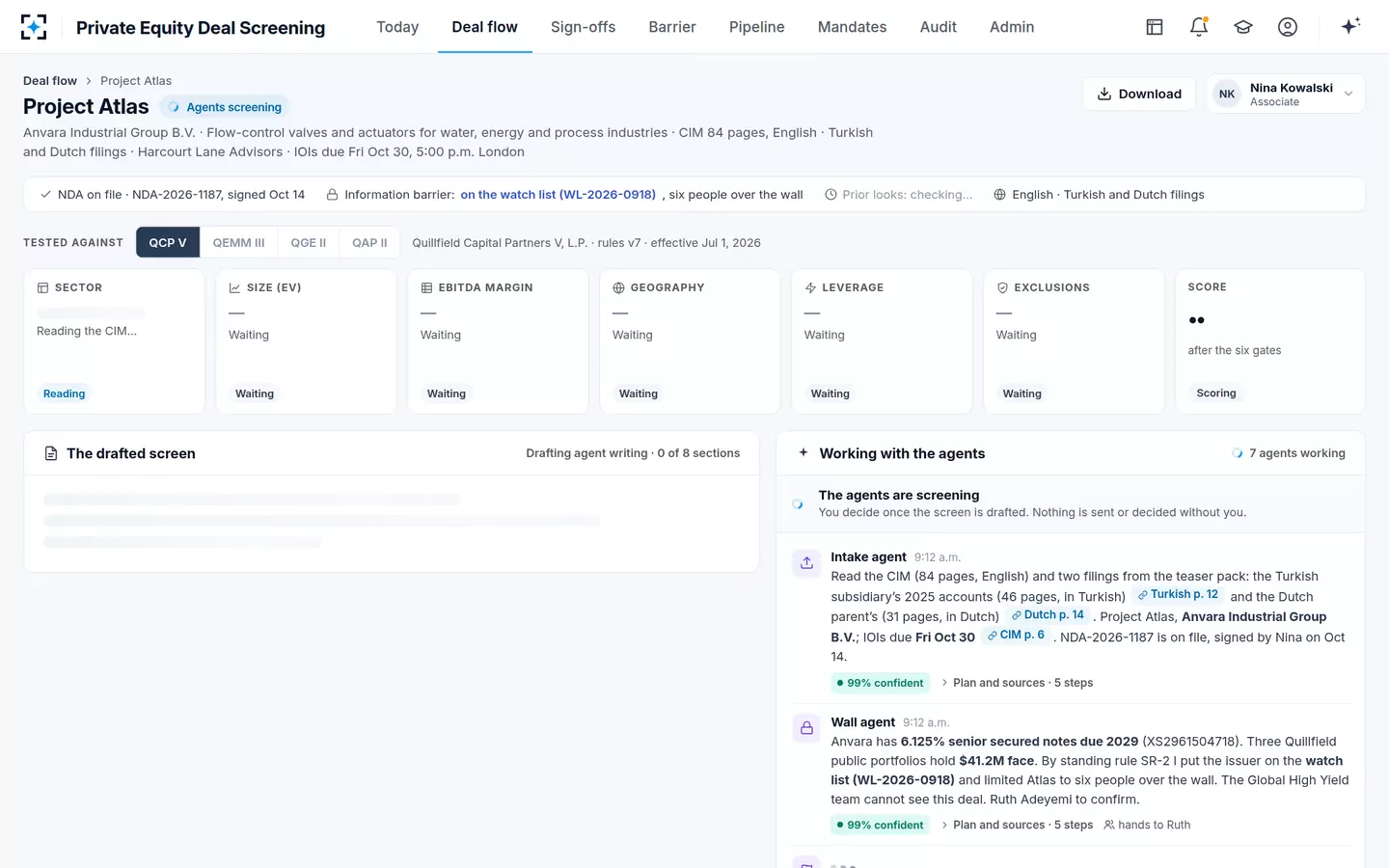
Most firms already own the first two. The gap the third fills is the first pass on the document: reading an 84-page CIM in English and the statutory accounts in Turkish, applying six limits per fund, sorting a dozen add-backs and writing it up. That is the part of the screen that is both laborious and checkable, which is what makes it suitable for agents and also why their output must be checked.
Can AI screen a CIM?
AI can read a CIM and its filings, extract the figures, apply written tests and draft a screen, provided every figure carries its page and a second reader checks the numbers that decide. What it should not do is decide on its own. The reason is reliability on exactly this kind of document. In FinanceBench, a 2023 benchmark built from questions about public companies' filings, one of the strongest models of the time used with a retrieval system answered 81% of a 150-question sample incorrectly or refused to answer; the authors found that all the models examined showed weaknesses such as hallucination (Islam et al., arXiv 2311.11944, not peer reviewed). Models have improved since, but the lesson for design stands: an unsupported figure from a model is a claim, not evidence.
Citations change that. When every figure in a screen links to the page it came from, the associate can check the handful of figures that decide the screen in minutes, instead of trusting or redoing the whole read. At the sample firm, the Atlas screen's six results each cite a CIM page, the decisive one (Turkey at 41.0% of revenue, page 23) is confirmed against the Turkish statutory accounts, and the Screener agent hands any test it is less than 90% confident about to a person.
The agents at work, each stating what it read, how sure it is and who decides next
Why the reader should never be the checker
Because a reader that checks itself repeats its own mistakes. If one model reads the CIM, extracts EBITDA, judges the add-backs and recommends a decision, an error in its reading of page 38 flows straight into the recommendation, and asking the same model to review its answer mostly returns the same answer. The control that works in finance is separation of duties: the maker prepares, an independent checker verifies, and neither can do the other's job.
A single-pass AI screen and a maker-checker screen, side by side
One model reads, judges and recommends: The same model that scored the deal, having seen its own score
Separate readers, then people: A second, independent model that cannot see the score until it finishes
One model reads, judges and recommends: The CIM, usually in English
Separate readers, then people: The CIM and the target’s statutory accounts in their original language
One model reads, judges and recommends: Trust the summary, or redo the work
Separate readers, then people: Open the cited page behind each figure
One model reads, judges and recommends: Often implied by the tool’s recommendation
Separate readers, then people: The associate with a reason code; a vice president confirms; a partner approves first looks
One model reads, judges and recommends: A confident answer either way
Separate readers, then people: Below a confidence threshold the test goes to a person
People need the same separation. At the sample firm the associate proposes a decline and a vice president confirms it, and the software will not let the proposer confirm their own decline. The UK regulator's October 2026 review of private markets firms points at the same principle one level up: only 52% of firms in its first phase said internal audit had a role in reviewing their conflicts framework, and the FCA asked firms to consider whether their oversight was effective enough (FCA multi-firm review). A screening process needs a maker, a checker and, above both, someone who audits how the two worked.
How does AI rebuild adjusted EBITDA?
By starting from the seller's bridge, tying each line to evidence and classifying it. A rebuild worth relying on does four things: it reads reported EBITDA from the historical financials; it takes each add-back from management's bridge with its page; it looks for each one in the statutory accounts and notes, in their original language; and it labels each accept, question or reject with a reason and recomputes margin and leverage on the result. The associate then overrules any line with a reason, and the totals recompute.
On Atlas, management bridges $58.4 million of reported EBITDA to $71.9 million with $13.5 million of add-backs, 23.1% of reported. The Skeptic agent accepts $7.1 million (a restructuring that matches a note in the Dutch accounts, fees to the selling family that end at closing, a settled dispute), questions $4.1 million (a hyperinflation accounting loss and currency losses that recur every year) and rejects $2.3 million of plant savings planned for 2027 and not yet made. Underwriting EBITDA: $65.5 million. The same $377.5 million of staple debt is 5.25 times management's figure and 5.76 times the firm's, inside its 6.0 times guideline either way, but the margin of safety is very different. How to read a CIM walks the bridge line by line.
The maker-checker chain on one CIM in Private Equity Deal Screening
Agent
Screener agentTests each of the fund’s limits against the CIM and scores the deal, citing a page for every result.
Never: Waives a limit, or settles a test it is less than 90% sure of
Agent
Skeptic agentOn an independent second model, rebuilds EBITDA from the CIM and the statutory filings and classifies each add-back.
Never: Sees the Screener’s score before it finishes, or changes the CIM’s numbers
Agent
Drafting agentWrites the one-page screen and the banker note, every figure cited.
Never: Sends anything, or writes inside information into a banker note
A person decides
AssociateChecks the cited pages, overrules any line with a reason, and proposes a decision with a reason code.
A person decides
Vice presidentConfirms or returns every decline on a scored deal; can never confirm their own.
A person decides
Deal partnerApproves every first look and any override of an investment committee guideline.
Who approves an AI screen?
A person, every time, and the firm stays responsible for the decision whichever tool prepared it. Europe's securities regulator put the principle plainly in a 2024 statement on AI in retail investment services: a firm's management body is answerable for its decisions whether people or AI tools made them (ESMA public statement, May 30, 2024). The statement addresses firms under MiFID II rather than private equity managers, but its logic carries over to any regulated firm that lets a tool prepare a decision.
In a screening process that means three things a buyer should insist on. The software must not be able to decline, advance, send a note or allocate a deal by itself. It must show who decided and on what evidence. And its own settings, the thresholds, weights and limits it applies, must be changed only through the same kind of control: at the sample firm the administrator proposes a change and a second person checks it, and nothing in the settings can decide a deal.
What the agents may do, and what only a person may do, at the sample firm
| Action | Agents | People |
|---|---|---|
| Read the CIM and filings in any language | Yes, citing each page | Check the cited pages that decide |
| Put an issuer on the watch list | Yes, by the firm’s standing rule | The compliance officer confirms or reverses |
| Remove a name from a list, or wall-cross a person | No | The compliance officer only |
| Test the fund’s limits and score the deal | Yes, proposing only | The associate accepts or overrules with a reason |
| Waive a limit | No | A deal partner for a committee guideline; the LPAC for an LPA restriction |
| Decline or advance a deal | No | The associate proposes; a vice president confirms declines; a partner approves first looks |
| Send a note to the banker | No; drafts it only | Sent after the vice president confirms |
| Allocate a deal between funds | No; proposes under the written policy | The compliance officer, where two funds fit |
What a screen must leave behind for an examiner
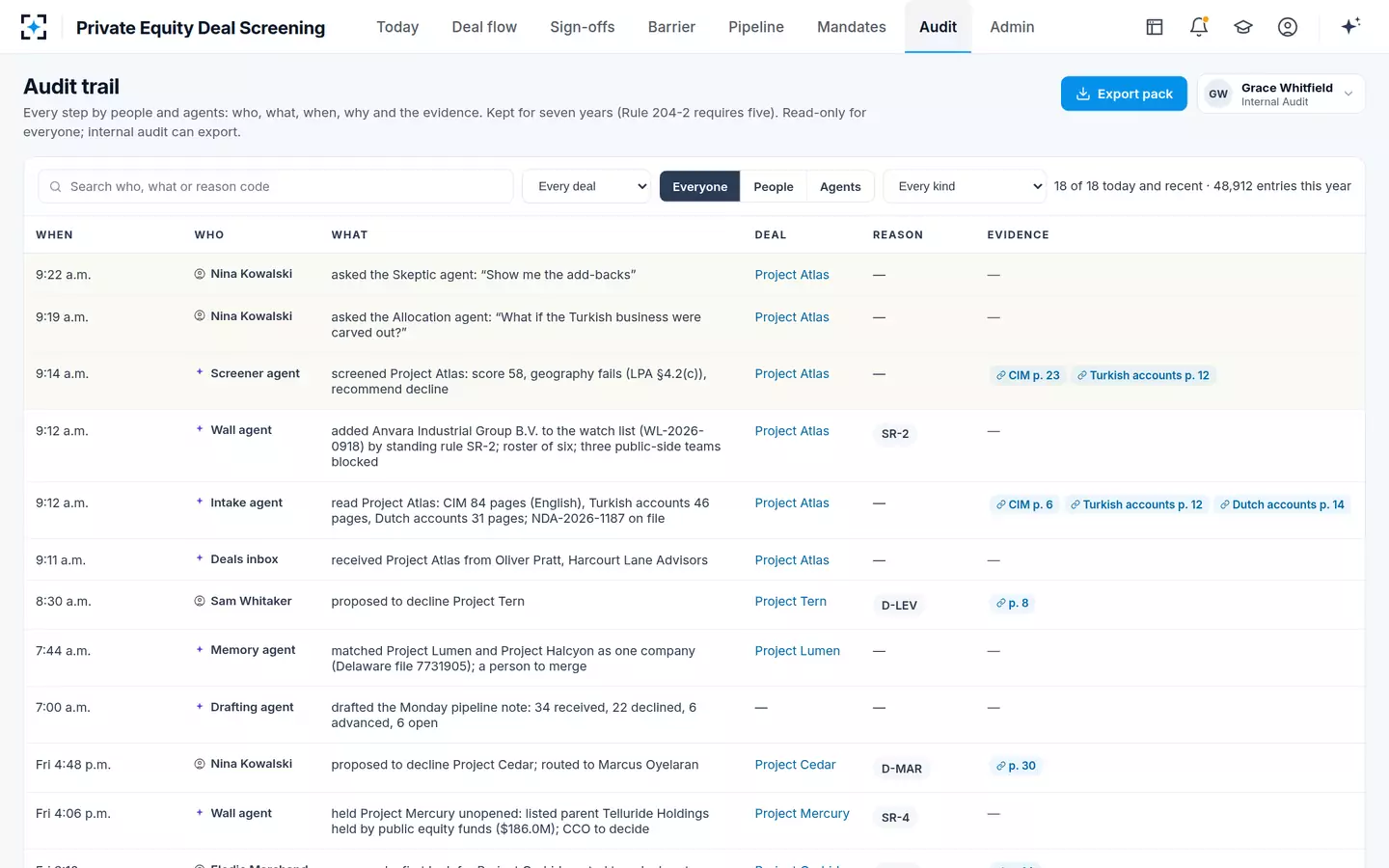
A screen is a decision about a recommendation, and an adviser must keep the written communications it receives and sends about the recommendations it makes or proposes, for at least five years under Rule 204-2 (17 CFR 275.204-2). Software that drafts screens should therefore keep the screen, the evidence each finding rests on, every override with its reason and every signature, in a form the firm can export.
It should also make the firm's annual review of its compliance procedures easier, not harder. The compliance rule requires each registered adviser to check, at least once a year, that its policies and procedures are adequate and that they work in practice (17 CFR 275.206(4)-7(b)). A trail that shows, for a year of screens, how often agents handed a test to a person, how often associates overruled the Skeptic and how often the vice president returned a decline is exactly the evidence of effectiveness that review needs. The sample firm keeps its screens, decisions and barrier entries for seven years.
The audit trail: every step by people and agents, with the reason and the evidence
Where Private Equity Deal Screening fits, and where it does not
The solution is built for one job: the first pass on every CIM and teaser, from the barrier check to a confirmed decline or a partner-approved first look, for a firm whose funds have written limits and whose people must sign. It fits best where a firm receives more CIMs than its associates can screen carefully, runs more than one fund, receives documents in several languages, or shares a roof with public funds whose holdings make the barrier a daily question.
It is not a deal CRM, and it does not replace one: it reads stages and banker contacts from the firm's CRM and writes back the stage and the reason code. It is not a sourcing database. It does not do confirmatory due diligence, build the investment committee's model or value the portfolio; those belong to other tools and other teams, and private credit screening, where a lender's tests differ, has its own solution, Private Credit Deal Screening. And it needs the firm's own documents to work: the LPAs, side letters and committee guidelines become its tests only after the compliance officer has checked each one. A pilot on deals you already declined is the way to see whether it fits yours, and what one CIM costs to screen frames the return.
Questions to put to any private equity screening software vendor
- Does every figure in the screen link to the page it came from?
Including figures from filings in other languages, shown in the original.
- Who checks the earnings rebuild, and can it see the recommendation?
An independent second reader that is blind to the score is the control to ask for.
- Can the tool decline, send or allocate anything by itself?
The answer should be no, enforced by the software, not by policy.
- What happens when the tool is unsure?
Ask for the threshold, and where the case goes below it.
- Does it check the information barrier before anyone opens the CIM?
Target, parent and every security, against the lists and the firm’s public holdings.
- Can it tell an LPA restriction from a committee guideline?
And show who may waive each, without letting a partner override a restriction.
- How are the fund’s limits loaded, checked and versioned?
Each rule should cite its clause, and each screen should keep the version it used.
- What does the trail contain, and can internal audit export it?
Who, what, when, why and the evidence, for agents and people alike.
- Can we test it on our own past screens before we sign?
With pass marks agreed in advance, on declines whose reasons we know.
Questions people ask
What platforms do private equity firms use to screen deals?
Most firms combine a deal CRM for the pipeline, market-data platforms for sourcing and company information, and spreadsheets and documents for the screen itself. Document-reading and screening agents are a newer layer that does the first pass on the CIM and writes its result back to the CRM, rather than replacing either of the other two.
What is a maker-checker control?
It is a separation of duties in which one person or system prepares a piece of work and a different, independent one verifies it before it takes effect, and neither can do both. In screening it means the associate who proposes a decline cannot confirm it, and the model that scores a deal does not rebuild its earnings.
Is AI screening software allowed under SEC rules?
No SEC rule forbids using software to prepare a screen; the adviser's existing obligations apply whatever tool it uses, including its compliance procedures, reviewed at least annually under Rule 206(4)-7, and its books and records under Rule 204-2. The firm must also describe its use of AI accurately: in March 2024 the SEC settled charges against two advisers for misleading claims about their use of AI.
Can screening software read CIMs in other languages?
Good tools should, because statutory accounts are filed in the local language. In the fictional sample deal, the agents read Turkish and Dutch accounts behind an English CIM and tied the Turkish revenue line, TRY 6,412.5 million, to the CIM's $162.8 million at the 2025 average exchange rate, showing the original beside the English.
How long does it take to set up screening software?
The time goes into the firm's own rules: reading each fund's LPA, side letters and committee guidelines into tests, having the compliance officer check them, and connecting the CRM, the restricted-list system and the holdings feed. A backtest on past deals before going live shows whether the tests reproduce the firm's own decisions.