Private equity AI tools are now used across the deal cycle: to read CIMs and screen deals, to review data-room documents, to draft investment memos and to monitor portfolio companies. The question for a firm that has shortlisted one is not whether AI works in general but whether this tool reaches the right answer on this firm's deals, under this firm's rules, with a trail an examiner can follow. The quickest way to find out is a pilot on deals the firm has already decided: replay last year's screens through the tool, compare its results with the decisions and reasons on file, and judge it against pass marks agreed in advance. Botminds' Private Equity Deal Screening includes exactly that backtest in its setup, and this guide uses it as the worked example.
Sample figures come from fictional data in the solution, a buyout firm called Quillfield. The regulatory statements are the SEC's own words, linked where they appear; the SEC's examination priorities are staff views, not rules.
Three numbers behind a careful AI pilot
$400K
in penalties for two advisers that misrepresented their use of AI, March 2024
3of 412
past screens at the sample fund that a single rule change would have decided differently
30days
for a pilot that replays past screens and then runs in parallel with the team
What AI tools do private equity firms use?
Private equity firms use AI tools in four places, each with its own risk. At the top of the funnel, tools read CIMs and teasers, test them against the fund's limits and draft a screen. In diligence, they review data-room contracts and financial files. Before the investment committee, they draft memos and check the figures in them. After closing, they read portfolio companies' monthly reporting and flag changes; which portfolio monitoring tasks move to tools covers that end. Across all of them sit general assistants used for research and drafting.
The SEC's examiners describe the same spread across the industry. In their priorities for fiscal year 2027, announced on October 23, 2026, they noted that firms are building "super intelligence (SI)" into their businesses, and listed where generative SI tools now turn up: in research and drafting, in code, in client messages, in advice and portfolio decisions, and in compliance surveillance (SEC Division of Examinations, Fiscal Year 2027 Examination Priorities). "Super intelligence" is the Division's own term in that document.
How are private equity firms using AI in deal screening?
In screening, AI does the first pass a deal team cannot do carefully on every CIM: reading the document and its filings, applying the fund's written limits, rebuilding the earnings and finding earlier looks at the same company. The decision stays with people. At the sample firm, seven agents prepare each screen; the associate decides with a reason code, a vice president confirms each decline, a partner approves each first look and the chief compliance officer decides the information barrier.
The value is consistency as much as speed. On the sample deal, Project Atlas, the agents tested six limits for the flagship fund with the page behind each, found that Turkey was 41.0% of revenue against a 25% cap in the fund's partnership agreement, rebuilt EBITDA at $65.5 million against management's $71.9 million, and matched the company to a decline under another code name in 2023. Why the reader is never the checker describes the controls between the agents and the people.
What does the SEC say about AI?
The SEC's position is that existing obligations apply to AI unchanged, and that what a firm says about its AI must be true. In the fiscal 2027 priorities, the Division of Examinations says it is studying how the technologies shape outcomes and whether firms still meet the duties they already had, which apply whatever the technology, and that firms' policies and procedures for monitoring their own use of SI will be an examination priority. Where it reviews automated investment tools and algorithms, the document lists three questions: whether what the firm says about the tool is fair and accurate, whether the tool runs as investors were told it does, and whether its output stays consistent with each investor's profile or the strategy the firm stated.
For a screening tool, the third point translates directly: does it apply the fund's stated strategy and limits? A pilot that measures that on past deals produces the evidence an examiner would ask for. The first point is about marketing. In March 2024 the SEC settled charges against two investment advisers, Delphia and Global Predictions, for false and misleading statements about their use of AI, with $400,000 in combined penalties; the then Chair warned advisers against claiming to use an AI model they did not actually use (SEC Press Release 2024-36). A firm that adopts a screening tool should describe to its investors what the tool does and does not do, no more.
Why pilot on deals you already declined
Because the answers are known, the reasons are on file, and nothing is at stake. A pilot on live deals measures the tool against a moving target, with the team's attention divided and a risk that its output leaks into a real decision before anyone trusts it. A replay of past screens measures it against the firm's own judgment, case by case, and every disagreement can be investigated at leisure.
Declines are the right core of the sample for the reason the funnel gives: most screens end in one. They also carry reason codes and, if the firm's screens are any good, the page that decided them, which is exactly what the tool's output can be compared with. Add the few deals the firm advanced, so the test includes yeses, and the handful the team regrets in either direction, because those are where a tool could add the most. The research is a reminder to include unusual companies too: a working paper found that venture investors who adopted data technologies became less likely to back the rare outliers, because their tools favoured companies resembling past ones (Bonelli, SSRN working paper, 2023).
What data do you need to test an AI screening tool?
Five sets: past CIMs and teasers with the screens and decisions made on them; the fund documents the limits come from; a snapshot of the restricted and watch lists and public holdings for the barrier test; the deal CRM's history for the prior-look test; and the firm's allocation policy if it runs more than one fund. The table sets out how much of each a 30-day pilot needs.
The data a 30-day screening pilot needs, and why
| Data | How much | What it tests |
|---|---|---|
| Past CIMs and teasers, with the screens and decisions | 40 to 60 from the last 12 months: mostly declines with reason codes, about ten advances, a few regrets | Agreement on limits, reason codes and the decision |
| Fund documents: LPAs, side letters, committee guidelines | Every fund the sample deals were tested against, in the versions then in force | Whether the tool reads each limit correctly, with its clause |
| Restricted and watch lists, public holdings | Snapshots as of the dates the sample CIMs arrived, including any known barrier cases | Whether the barrier check fires before the CIM is opened |
| Deal CRM history | Every screen and stage since the firm started keeping them | Whether earlier looks are found under other code names |
| Allocation policy | The written policy and any deals that fitted two funds | Whether the tool proposes the fund the policy points to |
One constraint needs counsel's attention before the pilot starts. Some NDAs ask a buyer to return or destroy a CIM if it does not proceed, while Rule 204-2 requires an adviser to keep the written communications behind its recommendations. How a firm reconciles those is a legal question for its own counsel; for the pilot, the practical rule is to use only what the firm already holds under its retention policy, and to note where a past screen survives but its CIM does not.
The 30-day pilot, week by week
Four weeks: load the rules, replay the past, read the differences, then shadow live deal flow. The order matters. A tool that has not been given the firm's limits cannot be judged on them, and a tool that has not passed the replay should not see a live CIM, even in shadow.
A 30-day pilot of an AI screening tool on past deals
- Load and check the limitsDays 1–7
- Replay past screens blindDays 8–14
- Read every disagreementDays 15–21
- Shadow live CIMs, then decideDays 22–30
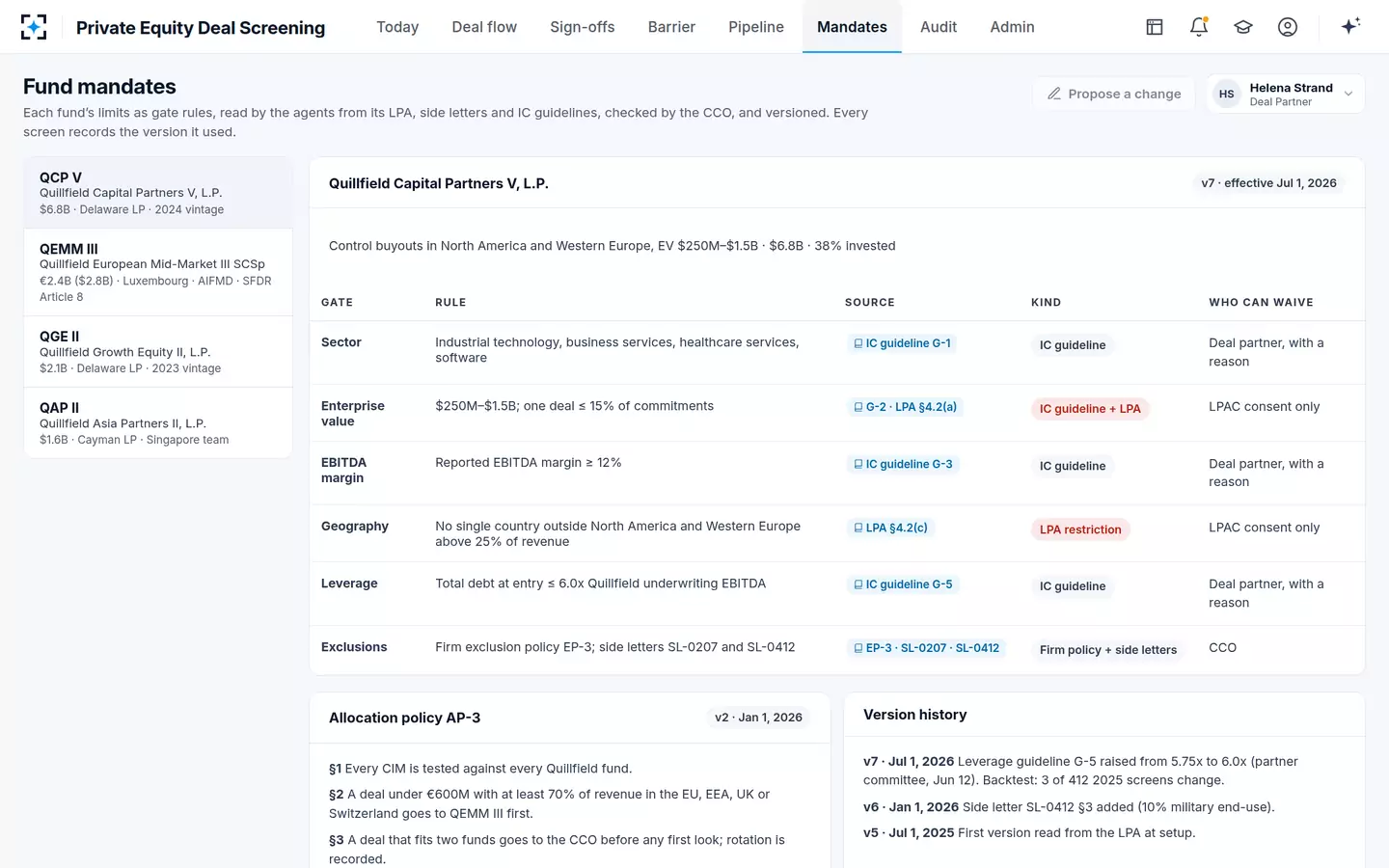
In the first week, the fund documents become tests. Each limit is written with its measure, threshold, period and clause, and the compliance officer checks every one; at the sample firm, each fund's rules are versioned, so the replay can use the version that applied when each past CIM arrived. In the second week the tool screens the sample without seeing the original decisions. In the third, the team compares decisions, reason codes, rebuilt EBITDA and barrier timing, and reads every disagreement: an ambiguous rule, a misread page, a genuine judgment call or a past mistake. In the fourth, the tool shadows the live queue so that the team sees it on documents nobody has screened yet, and the pass marks decide the outcome on day 30.
Set the pass marks before you start
Agree what success means before the replay, in writing, with the deal partner, the compliance officer and the head of the screening desk. Without that, every result can be argued either way after the fact. Some marks are absolute: the barrier must fire on every past barrier case before the CIM would have been opened, and the tool must not be able to decide or send anything. Others are comparative, and the team sets the level.
A pilot scorecard: each measure with its pass mark
| Measure | Pass mark | How it is measured | What a fail means |
|---|---|---|---|
| Barrier cases caught before opening | Every one | Past CIMs about issuers then held by public funds or on the lists | Not ready for live use |
| Results on the funds’ written limits | Same result as the firm on every unambiguous limit | Each limit on each past screen, with its page | A misread page or rule: fix and retest |
| Every finding cited to a page | Every one | Spot checks on each screen | Findings cannot be checked; not ready |
| Earnings rebuild | Set by the team, for example within a stated range of the associate’s figure | Rebuilt EBITDA against the associate’s, line by line | Read the add-back classifications that differ |
| Decisions and reason codes | Set by the team; read every disagreement | Agreement corrected for chance, and reason codes compared | Each disagreement is classified, not averaged away |
| Earlier looks found | Every known duplicate in the sample | Companies the firm saw under two code names | Matching keys need work |
| Actions without a person | None possible | Attempt each forbidden action in the pilot environment | Not acceptable at any level |
The rules a pilot replays, versioned, with the backtest of each change
What the pilot must leave behind
A pilot is itself a piece of the firm's compliance history and should be kept as one. Under Rule 204-2 an adviser must keep the written communications it sends and receives about any recommendation or advice, given or only proposed, for five years or longer, two of them on site (17 CFR 275.204-2(a)(7) and (e)(1)). Whether a given pilot output falls within that is for the firm's counsel; the safer course is to keep the scorecard, the disagreements and their resolution with the same care as the screens themselves.
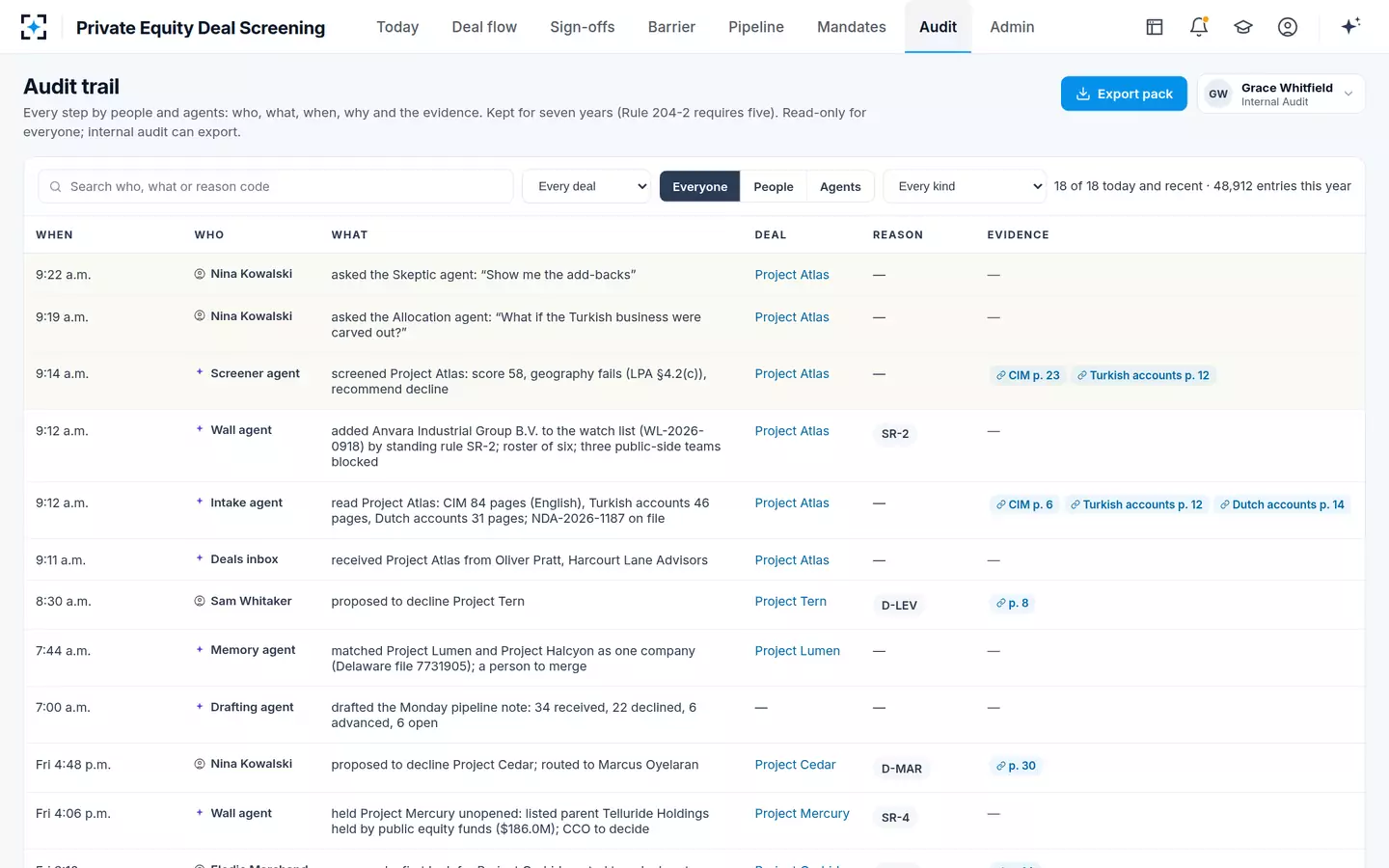
Going live then rests on that file, not on impressions. At the sample firm the setup includes a backtest on past deals and the chief compliance officer approves go-live. After go-live, the same measures continue on the audit trail: how often the agents hand a test to a person, how often associates overrule them, how often vice presidents return a decline. That is the evidence for the firm's annual review of its compliance procedures, and the answer to an examiner who asks whether the tool's operations are consistent with what investors were told.
Every step by people and agents on one trail, ready to export
Before you sign: what a pilot should have shown
- The barrier fired on every past case before the CIM would have been opened
Target, parent and bonds as well as shares.
- Every limit was read with its clause, and the compliance officer checked each one
LPA restrictions kept apart from committee guidelines.
- Results on the written limits matched the firm’s, or each difference was explained
A difference traced to an ambiguous rule is a rule to rewrite.
- Every disagreement on decisions and earnings was read and classified
Misread page, judgment call, ambiguous rule or past mistake.
- The tool could not decide, send or allocate anything
Tested by trying, not by reading the brochure.
- The trail can be exported for internal audit and an examiner
Who, what, when, why and the evidence, for agents and people.
- The firm can describe the tool to investors accurately
What it does, what it does not, and who decides.
Questions people ask
How long does an AI pilot take?
Thirty days is enough for a screening tool if the firm's documents are ready: a week to load and check the funds' limits, a week to replay 40 to 60 past screens, a week to read the differences and nine days to shadow the live queue. A firm with many funds, or rules never written down, should expect the first week to stretch.
What is AI washing?
AI washing is claiming to use artificial intelligence, or claiming more for it, than is true. In March 2024 the SEC settled charges against two investment advisers for false and misleading statements about their use of AI, with penalties of $225,000 and $175,000. For a private equity firm it means describing a screening tool to investors exactly as it is used.
Can a pilot use CIMs the firm has declined?
Only those the firm still holds and may use internally. Some NDAs ask for a declined CIM to be returned or destroyed, while advisers keep certain communications under Rule 204-2, so counsel should confirm what the pilot can use. Where a CIM is gone but the screen and its reason code survive, the screen can still test the tool's reading of the limits on similar documents.
Should the pilot include deals the firm advanced?
Yes, about ten of a 40 to 60 sample, plus any the team regrets. A sample of declines alone cannot show whether the tool would have stopped a deal the firm wanted, and the advances are where a wrong "no" costs the most.
Do the SEC's examination priorities apply to private equity firms?
They describe what the Division of Examinations intends to focus on across registered advisers, including advisers to private funds, and they are staff views rather than rules. The fiscal 2027 document says examinations will look at policies and procedures for monitoring the firms' use of what it calls super intelligence, and at whether representations about automated tools are fair and accurate.