Private equity screening methods fall into three families: pass-or-fail tests against the fund's limits, a weighted score for what is left to judge, and a quick valuation, almost always an internal rate of return and a multiple of invested capital rather than a discounted cash flow. Every firm uses some mix of them, and every firm assumes its associates apply them the same way. That assumption is rarely tested. Give two associates the same CIM and one may advance it while the other declines, for reasons neither wrote down. Measuring how often that happens, on your own past screens, is the most useful test of any screening method, human or automated. Botminds' Private Equity Deal Screening is built to make the testable part identical every time, cited to the page, so that people disagree only where judgment is genuinely needed.
The examples come from fictional sample data in the solution, a buyout firm called Quillfield and its CIM for Project Atlas; one worked example of agreement arithmetic is illustrative, not data, and is labelled as such. The research is linked where it appears, with working papers marked as not peer reviewed.
What the research says about screening, in three numbers
94.8%
of deals, on average, are evaluated with a multiple of invested capital; 92.7% with a gross IRR
~10%
of deals are evaluated with a discounted cash flow, either APV or WACC-based
255
business angels compared with a machine-learning algorithm; only the most experienced, least biased beat it
What methods do private equity firms use to screen deals?
At the screening stage, three methods do most of the work, and they answer different questions. Tests answer "may this fund own it?", a score answers "is it worth a first look this week?", and a quick valuation answers "could we pay what the seller wants and still make our return?". Problems start when one method is asked to do another's job, typically when a high score is allowed to soften a failed limit, or a valuation is run before anyone checked whether the fund can own the company.
The tests come from the fund's limited partnership agreement, side letters and investment committee guidelines; turning investment criteria into pass-or-fail tests covers how to write them. The score weighs what the tests cannot: business quality, earnings quality, risk. The valuation at this stage is rough by design: an entry multiple, a leverage assumption, an exit multiple and five years of management's forecast, cut by the team's own judgment.
How private equity investors evaluate deals: the share of deals each method is used on
Do private equity firms use DCF to screen deals?
Rarely. In the survey, a discounted cash flow was used on about one deal in ten, whether built on adjusted present value (9.3% of deals) or a weighted average cost of capital (10.9%), while multiples of invested capital and gross IRR were used on more than nine in ten. The authors asked directly how investors calculate a cost of capital and concluded that at least 55% "appear not to use WACC at all" (NBER Working Paper 21133).
For screening this is less a weakness than a fact to design around. The returns a deal team computes depend on a handful of inputs it chooses: the entry EBITDA, the leverage, the exit multiple and the forecast haircut. Two associates using the same model can reach different returns because they used different EBITDA, one management's adjusted figure and one their own. The method is consistent only if those inputs are, which is why the screen should state every input with its page.
How consistent is deal screening?
No regulator or independent study publishes how often two private equity screeners agree, so a firm has to measure it on its own screens. The reasons to expect disagreement are concrete. Criteria are often written without a period or a denominator, so a borderline share passes for one reader and fails for another. Add-backs are judgment calls, and one associate's accepted line is another's rejected one. Memory fills gaps: one associate remembers the firm looked at the company two years ago, the other does not. And fatigue: the eighth CIM of the day is read differently from the first.
The same survey shows how much room judgment has even on one input. Asked how far they discount management's EBITDA forecasts, the 44 investors who gave a number reported a median and average of 20%, and 11 more said the discount depends on the deal. Within one firm, an unwritten "it depends" becomes two associates applying two haircuts to the same forecast.
How do you measure agreement between two screeners?
Take a sample of past CIMs, have two people screen each one independently, and compare their decisions with a statistic that corrects for chance. Raw agreement flatters screeners, because most deals are declines: two people who declined everything would agree on most of the sample without reading anything. Cohen's kappa, introduced in 1960 as a coefficient of agreement for categories, subtracts the agreement chance alone would produce (Cohen, Educational and Psychological Measurement, 1960). It is 1 when two raters always agree, 0 when they agree only as often as chance would predict.
Illustrative arithmetic: two associates screen the same 60 past CIMs
| Associate B advances | Associate B declines | Total | |
|---|---|---|---|
| Associate A advances | 6 | 5 | 11 |
| Associate A declines | 5 | 44 | 49 |
| Total | 11 | 49 | 60 |
The example shows the trap. Two associates who agree on 83% of CIMs sound consistent. But with 49 of 60 deals declined by each, chance alone would produce 70% agreement, and the kappa of 0.44 says that their real agreement beyond chance is less than half of what is possible. The disagreements sit exactly where they matter: of the 11 deals each wanted to advance, they agreed on only 6.
Two refinements make the test more useful. Compare reason codes as well as decisions, because two declines for different reasons are a disagreement about the company. And split the comparison: on the fund's limits, agreement should be close to perfect, and any disagreement there points to a badly written criterion; on judgment items such as earnings quality, some disagreement is healthy, and the question is whether it is explained.
Can an algorithm screen deals better than an investor?
In early-stage investing, sometimes, and the research is specific about when. A peer-reviewed study compared the returns of an algorithm with those of 255 business angels on an investment platform and found that "investors only outperformed the algorithm when they had extensive investment experience and managed to suppress their cognitive biases" (Blohm et al., Entrepreneurship Theory and Practice). A working paper, not peer reviewed, gave 111 venture capital professionals and a gradient-boosted tree model the same ten one-page company summaries and reported that the algorithm "outperforms the median VC by 25% and the average VC by 29%"; its author recommends an augmented approach in which algorithms narrow the top of the funnel rather than replace people (Retterath, SSRN working paper, 2020).
A third paper, also an SSRN working paper, adds the warning. Venture capitalists that adopted data technologies became better at screening start-ups that resemble those in historical data, but "become concurrently less likely to finance innovative startups that achieve rare major success" (Bonelli, SSRN working paper, 2023). A model trained on the past is good at recognising the past.
What the research does not show
None of these studies tests buyout screening, and none should be read as saying software will pick better private equity deals. They study early-stage companies, where the screen is a prediction of a start-up's success from thin information. A buyout screen is mostly something else: applying a fund's written limits to a document full of numbers, checking those numbers against filings, and recognising a company seen before. That work is less about prediction and more about consistency and evidence, which is where the case for tools is strongest and the risk of the Bonelli effect is smallest.
The research does support two design choices. Bias and inexperience hurt people most, so the parts of a screen that can be made mechanical should be, leaving experienced judgment for the rest. And a model's view of what a good deal looks like should not decide anything on its own, because its blind spot is the unusual company. In Private Equity Deal Screening the agents propose and cite; they never decide, and below 90% confidence on any test they hand it to a person.
Two halves of a screen: what should be identical every time, and what should be judged
Tests: should never differ between screeners: Size, geography, margin, leverage and exclusions against the fund’s written limits
Judgment: may differ, but must be explained: Business quality, management, earnings quality, risk, price
Tests: should never differ between screeners: The criterion is ambiguous or a page was misread: fix the rule
Judgment: may differ, but must be explained: Different views of the company: discuss, and keep the reasons
Tests: should never differ between screeners: Applied the same way to every CIM, with the page that decided it
Judgment: may differ, but must be explained: The associate, checked by a vice president, with a written reason
Tests: should never differ between screeners: The Screener agent tests six limits per fund and cites each page
Judgment: may differ, but must be explained: The associate scores, can overrule any line with a reason, and decides
How do you reduce bias in deal screening?
Separate the people who build a view from the people who check it, and make the checker blind to the conclusion. Anchoring is the bias screening invites most: an associate who has read the investment highlights first reads the add-backs in their light, and a reviewer who sees a score of 86 before the bridge reads the bridge expecting it to hold. Three practices reduce it, and none needs new technology.
First, read the pages that can end the deal before the narrative; how to read a CIM sets out the order. Second, rebuild the earnings independently, by someone who has not seen the recommendation; in the solution the Skeptic agent runs on a second, independent model and cannot see the Screener agent's score until it finishes. Third, require a reason code for every decline and a second signature from someone who did not propose it, so that each decision has to survive another person reading its evidence.
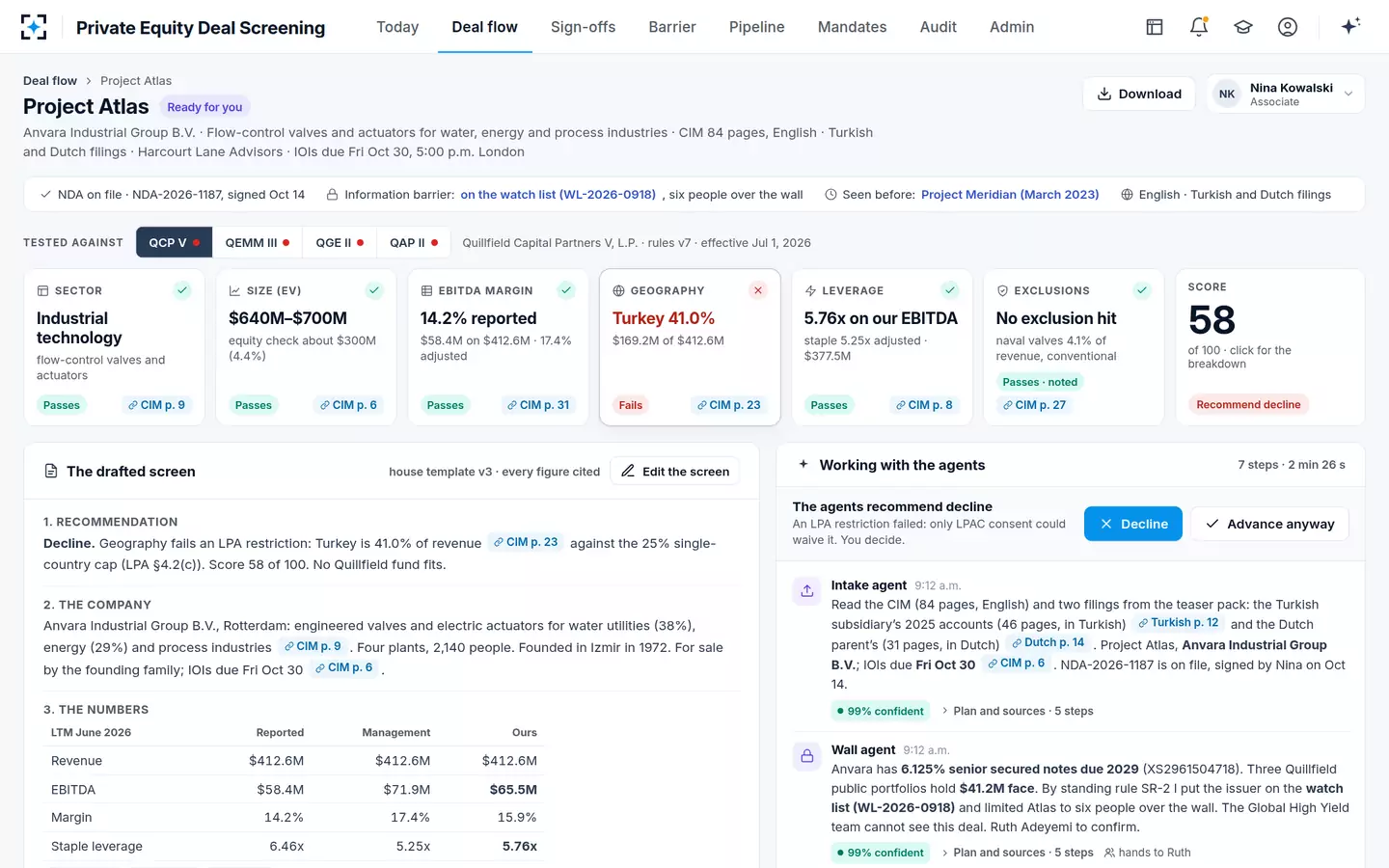
One CIM tested the same way every time: six limits, each with its page, then the score
A method for testing screening on your own back book
The test of any screening method, a new associate, a revised rubric or a piece of software, is the same: run it on screens whose answers you already know. Pick 40 to 60 CIMs from the last year, mostly declines with a few advances, and include some the firm regrets in either direction. Have two people, or a person and the tool, screen each one independently without seeing the original decision. Compare decisions with kappa, reason codes line by line, and EBITDA rebuilds figure by figure.
Then read the disagreements, which is where the value is. Each one is either an ambiguous criterion (rewrite it), a misread page (find out why), a genuine judgment difference (keep both reasons) or a case the original screen got wrong (learn from it). A 30-day pilot on deals you already declined turns the same method into a plan for evaluating software.
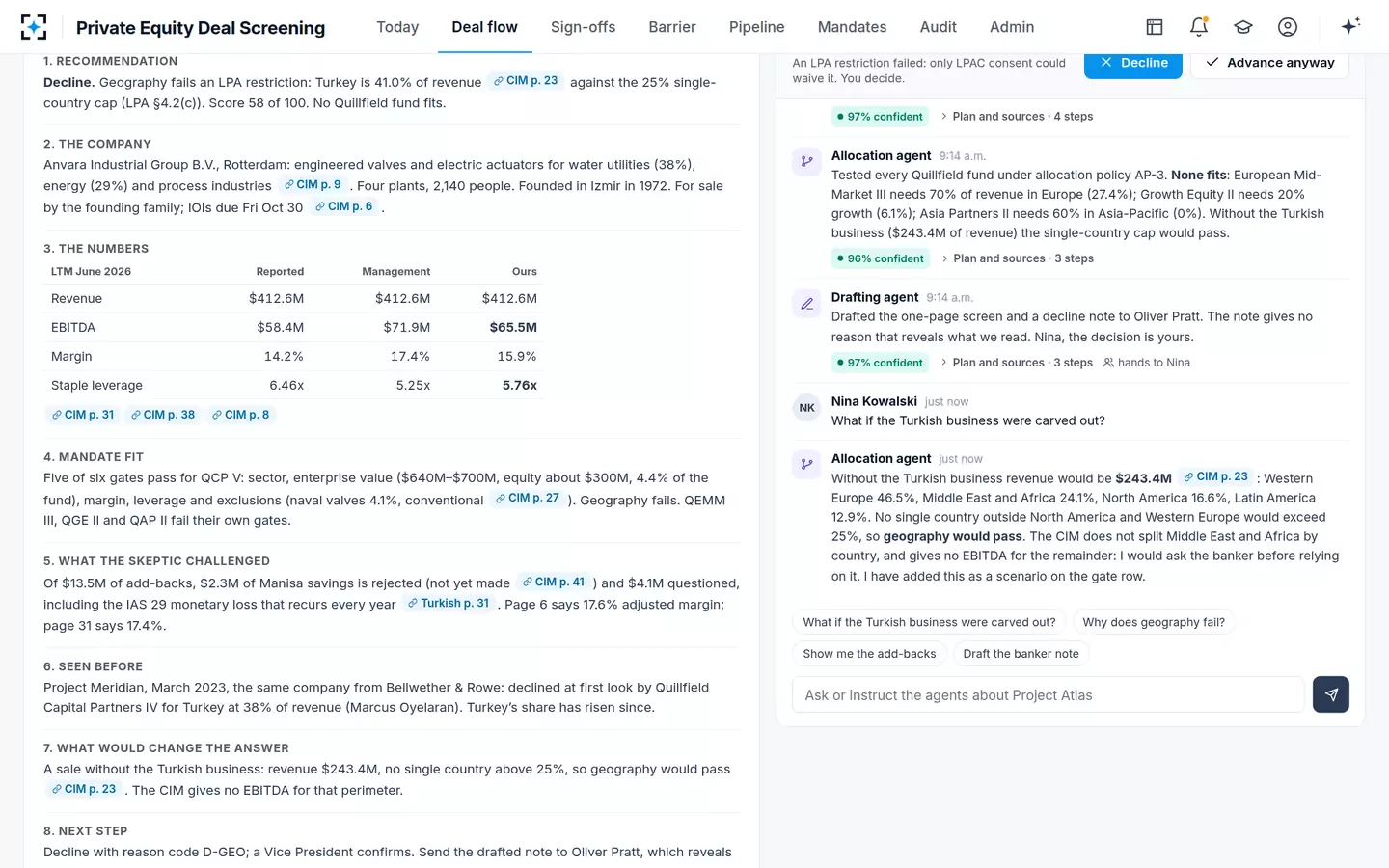
Testing what would change the answer, with the page and a question for the banker
Questions people ask
What is Cohen's kappa?
Cohen's kappa is a statistic, introduced by Jacob Cohen in 1960, that measures agreement between two raters on categories after removing the agreement chance alone would produce. A kappa of 1 is perfect agreement and 0 is agreement no better than chance. In the illustrative example on this page, 83% raw agreement on screening decisions corresponds to a kappa of 0.44, because most deals are declines.
How many past CIMs do you need to test screening consistency?
No standard exists; it depends on how many advances the sample holds, because those are where disagreement matters most. A sample of 40 to 60 CIMs with at least ten advances gives enough cases to see patterns in reason codes and rebuilt EBITDA, and the disagreements are read one by one rather than only counted.
Is a screening score the same as a recommendation?
No. A score ranks deals that pass the fund's limits; it should never outvote a failed limit. At the fictional sample firm, Project Atlas scored 58, inside the band that asks for judgment, but the screen recommends a decline because it fails a restriction in the fund's partnership agreement.
Should two associates screen every CIM?
Usually not; it doubles the cost of the stage that handles the most deals. A second, independent reading is most valuable on the earnings bridge and on any deal near a limit or advancing to a first look, and a periodic double-screening of a sample tells the firm how consistent its single screens are.
Do algorithms pick better deals than people?
In early-stage studies, an algorithm beat most business angels except the experienced ones who controlled their biases, and in a working paper it outperformed the median venture capitalist by 25% on one-page summaries. A separate working paper found that venture capitalists using such tools backed fewer rare breakout successes. None of the studies covers buyout screening.