The cost of screening one CIM is the associate's hours on the first pass, times what an hour of that associate costs, plus the vice president's time to check the decline, plus a share of what goes wrong when a screen misses something. Multiply by the CIMs and teasers a firm receives in a year and you have the budget any private equity screening tool has to beat. No regulator or independent study publishes that figure, and vendors do not publish their prices, so the honest way to evaluate a tool is to build the number yourself from your own hours and public wage data. This guide does it step by step, using the Bureau of Labor Statistics for pay and Botminds' own estimate of the hours in a first pass, and then shows how to test whether Botminds' Private Equity Deal Screening, or any alternative, earns its place.
The volumes and deals in the examples are fictional sample data from the solution, a buyout firm called Quillfield. Hour figures are Botminds' estimate, not a measured result. The wage figures are from the BLS, and every multiplication on this page is our arithmetic, shown so that you can replace each input with your own.
The three inputs to the cost of a screen
6hours
for an associate’s first pass on a mid-size buyout CIM by hand, in Botminds’ estimate
$124,370
median annual pay of financial and investment analysts in the securities and investments industry, May 2025
94in 100
opportunities a private equity firm considers do not close, on survey averages
How much does it cost to screen a deal?
Somewhere between a few hundred dollars of associate time per CIM by hand and a fraction of that with good tools, before the cost of mistakes, which can dwarf both. The range is wide because the inputs are firm-specific: how long your associates take, what they cost, how many CIMs you receive, and how often a screen goes wrong. The method is the same for any firm, and it has four terms.
The first is the associate's first pass: hours per CIM times the loaded hourly cost. The second is the check: the vice president's minutes to confirm or return each decline. The third is volume: CIMs and teasers a year, remembering that a teaser declined on a hard limit costs far less than a CIM. The fourth is error: the expected cost of a decline for a wrong reason, of a limit missed, or of a CIM opened before the information barrier was checked. The rest of this guide prices each.
How many hours does a CIM review take?
No published study measures it for buyout CIMs, so measure your own; until you have, here is the estimate Botminds uses for the first pass on a mid-size buyout CIM, by hand and with the solution, including the associate's own review. It totals about six hours by hand and just under one hour with the agents.
Where an associate's hours on one CIM go, by hand and with Private Equity Deal Screening
| Task | By hand | With the agents | What changes |
|---|---|---|---|
| Logging the CIM and NDA, clearing it with compliance | 0.5 h | 0.05 h | The barrier check runs on arrival; compliance confirms |
| Reading the CIM and the target’s filings | 2 h | 0.25 h | The associate reads the cited pages that decide, in any language |
| Testing the LPA, side letters and committee guidelines | 1 h | 0.1 h | Each limit is tested with its page; the associate reviews |
| Rebuilding adjusted EBITDA and leverage | 1.5 h | 0.25 h | A second model classifies each add-back; the associate overrules with reasons |
| Searching for prior looks and duplicates | 0.5 h | 0.05 h | Earlier screens matched on registry numbers and addresses |
| Writing the screen and the banker note | 0.5 h | 0.25 h | Drafted with every figure cited; the associate edits and signs |
| Total | 6.0 h | 0.95 h |
Two features of the estimate matter for pricing. Reading and rebuilding EBITDA are the largest tasks, three and a half of the six hours, and they are where tools differ most: a tool that summarises a CIM without citing pages saves little reading, because the associate must still check everything. And the "with the agents" column is not zero: the associate still reads the pages that decide and signs the screen, which is the point. How to read a CIM describes those pages.
Pricing an hour of screening from public wage data
The Bureau of Labor Statistics has no occupation for private equity associates; the nearest is financial and investment analysts. Across all industries, their median annual wage was $102,740 in May 2025; in the securities and investments industry the median was $124,370, and the highest-paid 10% of the occupation earned more than $180,860 (BLS Occupational Outlook Handbook). The BLS does not separate out private equity associates, whose pay, bonus included, can differ widely from these medians, so treat them as reference points and use your own payroll if you can.
Dividing by 2,080 hours, a standard full-time year, gives an hourly wage of about $49 at the all-industry median, $60 at the industry median and $87 at the 90th percentile, before benefits, bonus and overhead. Multiplied by six hours, a first pass by hand costs about $296, $359 or $522 in wages alone; at 0.95 hours with the agents, about $47, $57 or $83. Add your own loading for benefits, bonus, office and the vice president's check, which on these figures is the smaller term.
Wage cost of one first pass, by hand and with agents, at three BLS pay levels
The cost sits in the declines
Because most opportunities do not close, nearly all screening cost is spent on companies the firm will not buy. In a survey of 79 private equity investors, an average of 6.1 of every 100 opportunities considered closed (Gompers, Kaplan and Mukharlyamov, NBER Working Paper 21133). If every one of the 100 received a six-hour first pass, about 563 of the 600 hours would go on deals that never closed. The cost per deal closed, on the screening stage alone, is the cost per CIM multiplied by about sixteen.
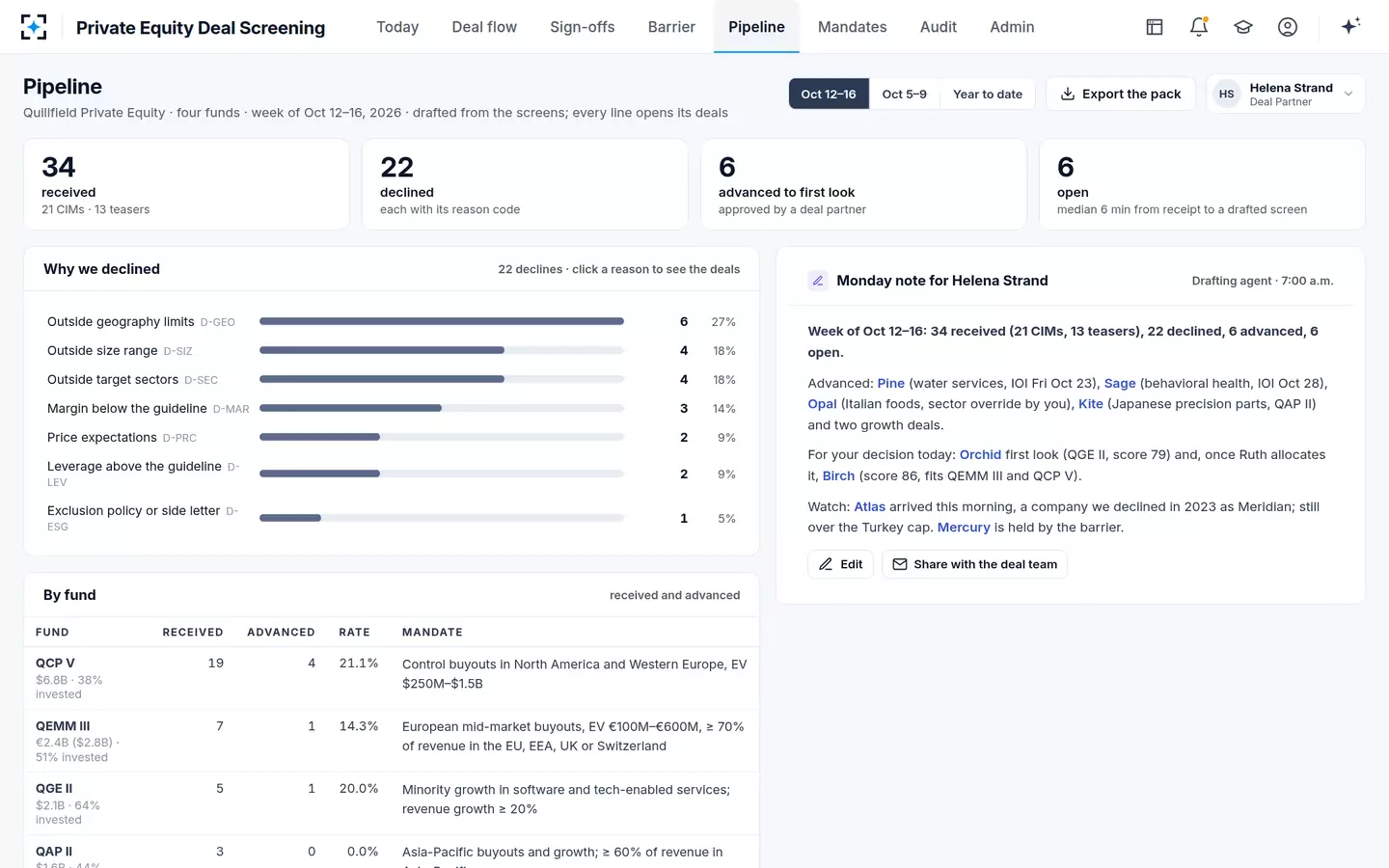
Volume makes the point concrete. At the sample firm, the four funds received 34 opportunities in one week of October 2026, 21 CIMs and 13 teasers. At that pace for 50 weeks, about 1,700 a year, a full six-hour first pass on each would take 10,200 associate hours, nearly five full-time years. Teasers declined on a hard limit take far less than a CIM, so a real figure is lower; the table shows the range at three volumes so that you can place your own firm.
A year of first passes at three volumes, wages only, at the industry median
| Opportunities a year | Hours by hand | Wage cost by hand | Hours with agents | Wage cost with agents |
|---|---|---|---|---|
| 500 | 3,000 | $179,000 | 475 | $28,000 |
| 1,700 (the sample firm’s pace) | 10,200 | $610,000 | 1,615 | $97,000 |
| 3,000 | 18,000 | $1,076,000 | 2,850 | $170,000 |
A week of deal flow at the sample firm: what came in, what was declined, and why
The cost you do not see: a wrong decline and a missed barrier
The largest screening costs are not hours but mistakes, and they are rare, which is why they are left out of most business cases. Two matter. A decline for a wrong reason, a limit misread or an add-back misjudged, loses a deal that should have reached a partner; it leaves no trace unless the company sells to someone else, and no one can price it in advance. A barrier missed, a CIM opened by a team whose public funds hold the target's bonds, is a compliance failure.
Regulators have priced the second kind. In December 2023 the SEC fined a private equity adviser $4 million for failing to maintain and enforce policies to prevent the misuse of material non-public information, without alleging any insider trading (SEC, In the Matter of OEP Capital Advisors). That case was about information flowing out of the firm, not a CIM flowing in, but it shows what weak MNPI procedures can cost even when no one trades. The barrier check before page one sets out the control. A tool that runs that check on every CIM, and keeps proof that it did, removes a cost that hours alone do not show.
What tools do private equity firms use for screening?
Most firms screen with a deal CRM for the pipeline, market-data platforms for company information, a spreadsheet for the earnings rebuild and a word processor for the screen. The newer tools read the CIM itself. They differ less in what they claim than in what they can prove: whether every figure links to its page, whether an independent reader checks the earnings, and whether the tool can decide anything on its own. Why the reader is never the checker sets out the questions to ask any vendor.
Private Equity Deal Screening is a set of seven agents for the first pass: intake, the information barrier, the fund's limits, an independent earnings rebuild, prior looks, allocation between funds and the drafted screen. It works with the firm's CRM, restricted-list system, holdings feed and document repository rather than replacing them, and people decide every step.
Is deal screening software worth it? Working the return
It is worth it when the hours it saves, valued honestly, plus the errors it prevents, exceed what it costs to license, set up and review. Write the return as a sum and fill each term with your own figures. The savings term is the easiest to estimate and the least important to get exactly right; the error and setup terms decide most cases.
The return on a screening tool, term by term
Associate hours released
CIMs a year × (hours by hand − hours with the tool) × loaded hourly cost
At the sample firm’s pace and the BLS industry median: 8,585 hours, about $513,000 in wages
Deal team, from a month of timed first passes
Errors avoided
Expected cost of wrong declines, missed limits and barrier failures × reduction
Rare and large; estimate from your own near misses, not from averages
Compliance officer and deal partners
Faster decisions
Days from receipt to a decision × the value of time in an auction
A decline in minutes frees the days before an IOI for the deals that pass
Deal partners
Licence, setup and review
Annual fee + loading the fund documents and connections + associate review time
Vendors do not publish prices; ask for them per fund and per year
COO and compliance officer
Read the first term carefully. Released hours are worth their cost only if they go somewhere useful: a firm that frees four full-time years of associate time and then hires at the same pace has saved nothing in money, though it may have gained in the quality of its screens and the time its associates spend on the deals that advance. The honest business case says which of those the firm wants.
What to measure when you trial a screening tool
Measure the same things on a sample of your own past CIMs before and after, with targets agreed in advance. The table lists the measures, how to take each and what Private Equity Deal Screening is designed to reach; its figures are design targets or sample results, not customers' measured results. A 30-day pilot on deals you already declined turns this into a plan.
Measures for a screening tool trial, and the solution's targets
| Measure | How to take it | Private Equity Deal Screening |
|---|---|---|
| Associate hours per CIM | Timed first passes, split by task, for a month before and during | Under 1 hour, Botminds’ estimate including review |
| Receipt to a cited first screen | Timestamps from arrival to the drafted screen | Target: within 15 minutes; 6-minute median in the sample week |
| Share of CIMs tested against every LPA restriction | Check each screen for a result on each limit, with its page | Target: 100%, each result cited |
| Agreement with past decisions | Decisions and reason codes on declines whose answers you know | Measured in the firm’s own backtest before go-live |
| Barrier checks before page one | Time of the barrier check against the first time the CIM was opened | Design: every CIM checked on arrival, before anyone opens it |
| Overrule and return rates | How often associates overrule the agents and VPs return declines | Kept on the audit trail for the annual compliance review |
Questions people ask
How do you measure the ROI of screening tools?
Compare the cost of the first pass on a sample of your own CIMs, by hand and with the tool, using timed hours and your loaded hourly cost, then add the errors avoided and subtract the licence, setup and review time. At the illustrative pace of 1,700 opportunities a year and the BLS industry median wage, cutting a first pass from 6.0 to 0.95 hours releases about 8,585 associate hours a year.
How much do private equity associates earn?
The BLS does not publish pay for private equity associates as such. Its nearest occupation, financial and investment analysts, earned a median $102,740 in May 2025, or $124,370 in securities and investment firms, and the top 10% earned more than $180,860. Pay at a particular private equity firm, bonus included, can differ widely from these figures, so a business case should use the firm's own payroll.
Do screening tools cost less than hiring another associate?
It depends on volume and price, and vendors do not publish prices. On the illustrative arithmetic in this guide, a firm screening 1,700 opportunities a year by hand spends about 10,200 associate hours, nearly five full-time years, on first passes; a tool that cuts that to about 1,600 hours releases the equivalent of four people's screening time, which is the figure to set against the licence.
Does a screening tool replace associates?
No. It removes the mechanical half of the first pass, reading, extracting and drafting, and leaves the associate to check the cited pages that decide, judge the earnings and sign. On Botminds' estimate the associate still spends just under an hour on each CIM with the agents, against about six by hand, and every decline still needs a vice president's confirmation.
Are teasers cheaper to screen than CIMs?
Yes, usually much cheaper: a teaser is a short anonymous summary and is often declined on a single hard limit such as sector or size. At the fictional sample firm, teaser declines that failed a hard limit may be confirmed by the vice president in a batch, while every scored CIM decline is confirmed one at a time.