MNPI in private equity, material non-public information, arrives most often in a CIM: a confidential document that names a company for sale, its numbers and its plans. For a firm that only buys private companies that is a confidentiality question. For a manager that also runs public bond or equity funds, it is an insider-information question, because the target or its parent may have listed shares or traded bonds that those funds hold or could buy. Section 204A of the Investment Advisers Act requires every adviser to keep written policies, fitted to its business, that prevent misuse of such information, and the cases show the weak point is when the check happens. Botminds' Private Equity Deal Screening checks every CIM's target, parent and securities against the restricted and watch lists and the firm's public holdings before anyone opens it, and the chief compliance officer decides what happens next.
The example in this guide is fictional sample data: Quillfield, a manager with private equity funds and public high-yield funds, receives a CIM for Anvara Industrial Group, a company whose bonds three of its public portfolios hold. The law and findings quoted are the statute, an SEC order, an SEC staff risk alert and the UK Financial Conduct Authority's October 2026 review, each linked where it appears.
What weak MNPI controls have cost a private equity adviser
$4M
civil penalty for a private equity adviser that did not maintain and enforce its MNPI policies
4years
of failures the SEC found, from at least 2019 through 2022
0
insider trades alleged in the order: the case was about policies and their enforcement
Is a CIM material non-public information?
It can be, and a manager with public funds should treat it as if it is until compliance has decided. A CIM is non-public by design: it is released under a non-disclosure agreement and describes a sale process the market does not know about. Whether it is material depends on the securities involved. If the target is wholly private and has no traded debt, there may be no security for the information to be material to. If the target or its parent has listed shares, or bonds that trade, news that the company is for sale, and the numbers that come with it, may be exactly what a reasonable investor in those securities would want to know.
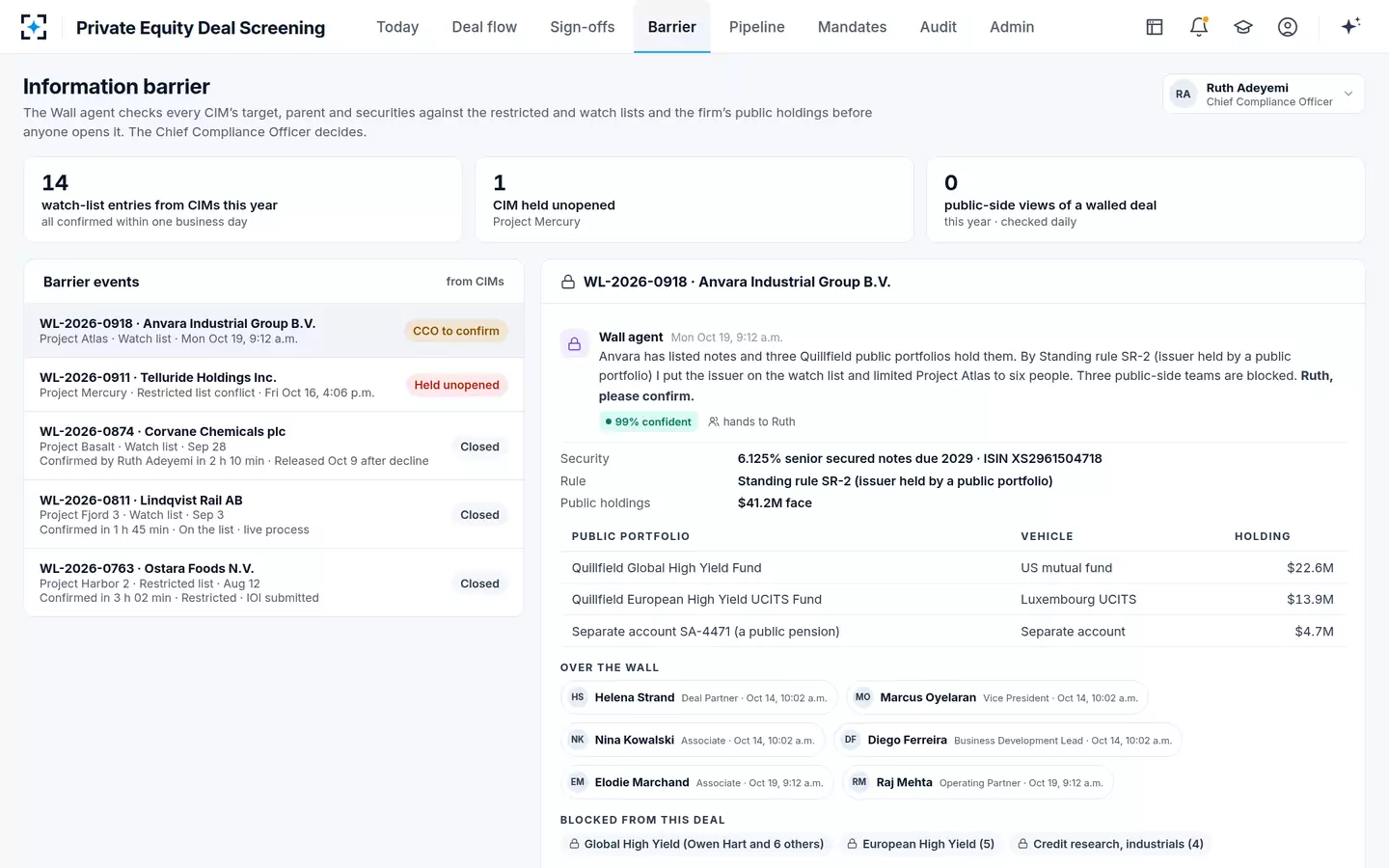
The trap is that the bonds are easy to miss. Anvara is a private company, owned by a family. But it has 6.125% senior secured notes due 2029 outstanding, and three of Quillfield's public portfolios hold $41.2 million face value of them: $22.6 million in a US mutual fund, $13.9 million in a Luxembourg UCITS fund and $4.7 million in a pension fund's separate account. Nothing in the teaser said so. A deal team that opened the CIM first and asked later would already have been over the wall without anyone deciding it should be.
What does section 204A require of a private equity adviser?
Section 204A requires policies, and their enforcement, not a particular design. Added to the Advisers Act in 1988, it obliges every adviser subject to section 204 to keep, and enforce, written policies fitted to its own business that are reasonably designed to stop the misuse of material, nonpublic information in breach of the Advisers Act or the Securities Exchange Act (15 U.S.C. 80b-4a). The phrase that does the work for a private equity firm is "the nature of such investment adviser’s business". A manager whose business includes receiving CIMs about companies its public funds may hold needs policies that start where the CIMs arrive.
Alongside it sits the code of ethics rule, which requires a registered adviser to adopt a code that covers its personnel's own trading, with reporting by "access persons" (17 CFR 275.204A-1). The restricted and watch lists most firms run are the working link between the two: a security goes on a list when the firm may hold inside information about its issuer, and the list then controls what the public side may trade and what staff may buy for themselves.
An NDA is not an MNPI policy: what the OEP case shows
The SEC's December 2023 order against OEP Capital Advisors, a private equity adviser with about $10.7 billion under management, turned on a habit many firms share: treating a signed NDA as if it settled the question. OEP's own policies allowed MNPI to be disclosed only where "necessary for legitimate business purposes". The SEC found that its personnel "used NDAs in the course of providing MNPI without always following the firm’s existing policies and procedures", policies which "remained applicable whether or not an NDA was used". The firm paid a $4,000,000 civil penalty (SEC, In the Matter of OEP Capital Advisors, IA-6514).
On numerous occasions, OEP senior personnel did not comply with OEP’s policies and procedures in disclosing merger-related MNPI to current investors, potential investors, and industry contacts.
SEC, In the Matter of OEP Capital Advisors, L.P., Advisers Act Release No. 6514, December 26, 2023 (settled; findings neither admitted nor denied)
The order alleges no insider trading. It was about policies that existed on paper and were not enforced, which is the shape of most section 204A cases against private fund advisers. OEP's information flowed outwards, to investors and contacts; a CIM flows inwards. But the lesson is the same in both directions: an NDA governs what the counterparty may do with information, and the adviser's MNPI policy governs what the adviser must do. A screen that relies on the first has not done the second.
Where SEC examiners found the gaps
The SEC's examination staff have listed MNPI as one of three main areas of deficiency at private fund advisers, alongside conflicts of interest and fees and expenses (OCIE Risk Alert, June 23, 2020). The gaps they described are procedural. Advisers "did not address risks posed by their employees who periodically had access to MNPI about issuers of public securities, for example, in connection with a private investment in public equity." And on the lists themselves, the staff "observed advisers that had codes of ethics that provided for the use of restricted lists, but did not have defined policies and procedures for adding securities to, or removing securities from, such lists."
That second finding is the one a screening process can fix directly. A list without a rule for adding to it depends on someone remembering to add. A standing rule, such as "an issuer whose securities a public portfolio holds goes on the watch list when a CIM about it arrives", turns the addition into a step that happens every time and can be shown to an examiner. The removal belongs to a person, and at the sample firm it is the compliance officer's alone. The risk alert is a staff statement, not a rule, but it is the clearest public description of what examiners test.
What is an information barrier in private equity?
An information barrier, or wall, is the set of controls that keeps inside information on the private side of a firm away from people who make public-market investment decisions. In private equity it matters wherever one firm runs strategies across the capital structure: buyout funds beside credit, high-yield or listed equity funds. The FCA's 2026 review of private markets firms explains the risk: "Weak information controls can allow material non-public information to flow between deal teams, trading desks, or affiliated businesses, potentially influencing investment decisions or trading activity" (FCA, Conflicts of interest and fair customer treatment in private markets).
Weaker and stronger information barriers, as the FCA found them in October 2026
Weaker practice: "formal conflict assessments not being consistently undertaken before NDAs were signed, resulting in greater reliance on investment professionals’ judgement at the outset"
Stronger practice: "Legal and Compliance were often engaged before NDAs were signed."
Weaker practice: "relied heavily on training, informal zoning of teams, and little monitoring"
Stronger practice: "clear physical, organisational and system-based separation through information barriers"
Weaker practice: Checks led by the deal team, on its own knowledge of the firm
Stronger practice: "Checks were wide-ranging, covering existing investments across all asset classes (even where there were information barriers)"
Weaker practice: Controls depended on individual judgement and staff awareness, with limited second-line assurance
Stronger practice: "active compliance involvement in monitoring and surveillance"
The common thread on the weaker side is that the barrier is a matter of people remembering, and on the stronger side that the system enforces it and compliance can see that it did. The review adds that the issue was "particularly relevant where firms operated multiple strategies across the capital stack", which describes any manager whose buyout team can be sent a CIM about a company its credit or high-yield funds hold.
When should compliance see a CIM?
Before anyone on the deal team opens it, and ideally before the NDA is signed. The FCA found that firms with stronger arrangements assessed potential conflicts "at the earliest stages of deal origination through conflict screening, active deal lists, non-disclosure agreement (NDA) stage reviews", which "enabled potential conflicts to be identified, challenged and mitigated before opportunities progressed further." At the NDA stage, compliance can check the name in the teaser or the NDA itself against the firm's holdings. Once the CIM arrives, the check repeats with the full picture: the legal entity, its parent, its subsidiaries and every security any of them has issued.
At the sample firm, the check runs automatically on arrival. When the Atlas CIM landed at 9:11 a.m., the Wall agent read the target, its parent and its securities, found the notes in three public portfolios, put the issuer on the watch list under the firm's standing rule, limited Project Atlas to six named people and blocked three public-side teams, all by 9:12, before the Screener agent tested a single limit. The compliance officer, Ruth Adeyemi, was asked to confirm. Where a CIM conflicts with the restricted list rather than the watch list, the agents hold it unopened until she decides; the same morning, a CIM called Project Mercury, whose listed parent is held by the firm's public equity funds, was waiting for her.
The barrier check on one CIM, from arrival to a confirmed roster
Agent
Intake agentIdentifies the target, its parent, the banker, the deadline and the NDA from the CIM and its filings.
Never: Opens a CIM before the barrier check
Agent
Wall agentMatches the target, its parent and every security they have issued against the restricted list, the watch list and the public holdings.
Never: Removes a name from a list
Agent
Wall agentAdds the issuer to the watch list by standing rule, names the people over the wall and blocks the public-side teams.
Never: Wall-crosses a person
A person decides
Chief compliance officerConfirms the entry and the roster, or decides a restricted-list conflict; the CIM stays unopened until then.
Agent
Screener agentOnly now tests the fund’s limits against the CIM.
A person decides
Chief compliance officerReleases the watch-list entry once the deal is declined or closed, and the process is over.
The information barrier view: the CIM, the holdings behind it and the people over the wall
What is wall crossing in finance?
Wall crossing is the deliberate act of bringing a person from the public side of a firm over the information barrier, so that they can help on a deal, after which they are restricted from trading or advising on the affected securities until the information is public or stale. It is a compliance decision, documented with the person's name, the time and the reason, and it should never happen by accident, as it does when a public-side analyst is copied on an email with a CIM attached.
That is why, in the solution, no agent wall-crosses anyone. The Wall agent builds the roster from the people already on the private side, blocks named public-side teams from the deal by entitlement, and leaves any request to bring someone over to the compliance officer. Across the sample firm's year so far, 14 CIMs created watch-list entries and the count of public-side views of a walled deal stands at zero, checked daily.
A barrier check for every CIM, before page one
- Run the check at the NDA, and again when the CIM arrives
The teaser or NDA names the company; the CIM adds the parent, subsidiaries and securities.
- Match the legal entity and its whole group
Target, parent and subsidiaries, by registry numbers and security identifiers, not by the project name.
- Include every security, bonds as well as shares
A private company with traded notes is a public issuer for this purpose.
- Check the firm’s own public holdings, not only the lists
A holding in any public fund or separate account can make the CIM inside information for that portfolio.
- Add to the watch list by a written standing rule
The SEC staff found lists with no defined procedure for adding or removing securities.
- Fix the roster before anyone reads
Name the people over the wall and block the public-side teams by system entitlement, not by memo.
- Hold a restricted-list conflict unopened
The compliance officer decides; the deal team waits.
- Release only by a person, with a reason
At decline, close or when the information is public; the release is part of the trail.
What the decline note to the banker must not say
A decline is also a disclosure. The note that tells a banker the firm will not bid travels outside the firm, and anything in it that came from the CIM is information leaving under the NDA. The OEP order is a reminder of how easily that happens in routine correspondence: much of the disclosure the SEC described was in informal update emails.
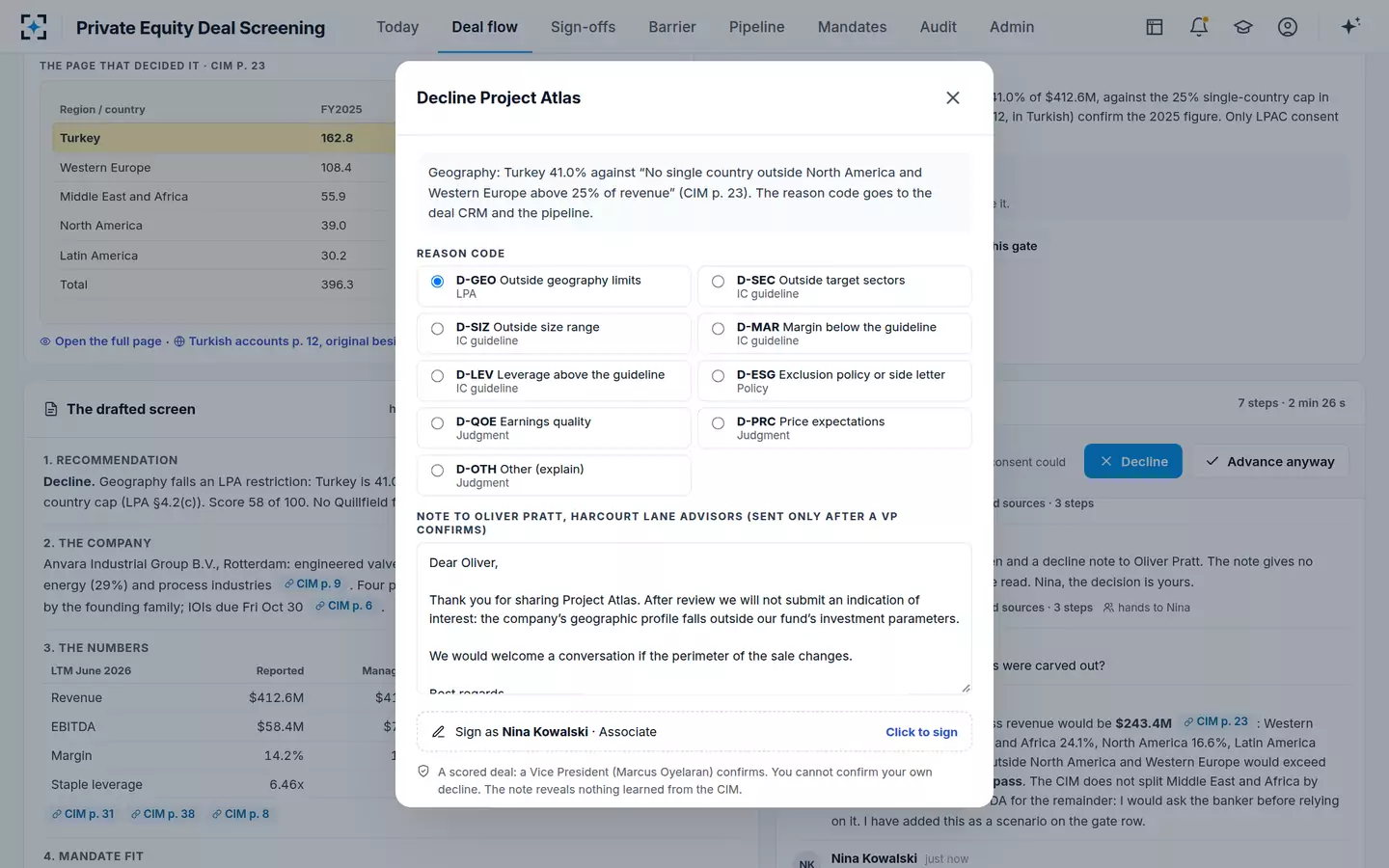
At the sample firm, the drafted decline note for Atlas thanks the banker, says that the company's geographic profile falls outside the fund's investment parameters, and offers a conversation if the perimeter of the sale changes. It does not mention Turkey, 41%, or any figure from the CIM. The note is sent only after a vice president confirms the decline, and the Drafting agent is barred from writing MNPI into a banker note at all.
A decline with a reason code, and a banker note that reveals nothing from the CIM
The barrier is the first of several controls on a screen. Who decides each step of a screen places the compliance officer's seat among the others, and what to ask of screening software covers how the separation between agents and people is built. Private Equity Deal Screening shows the full sample deal.
Questions people ask
What happens if a private equity firm misuses MNPI?
The SEC can bring charges under section 204A for failing to maintain and enforce adequate policies even where no trading is alleged, as it did against OEP Capital Advisors in December 2023 with a $4,000,000 civil penalty, a censure and a cease-and-desist order. Trading on the information is a separate and more serious matter under the anti-fraud provisions of the securities laws.
Does an NDA protect a firm against MNPI risk?
No. An NDA limits what the recipient may do with the information, but it does not replace the adviser's own MNPI policies. In the OEP order the SEC described firm policies that "remained applicable whether or not an NDA was used", and found that personnel had used NDAs without following them.
What is a restricted list?
A restricted list names securities the firm's staff and funds may not trade, usually because the firm holds or may hold inside information about the issuer; a watch list is a confidential list compliance monitors without restricting trading openly. The SEC's 2020 risk alert criticised advisers whose codes of ethics used restricted lists without defined procedures for adding or removing securities.
Do private equity firms without public funds need an information barrier?
The section 204A duty applies to every adviser subject to section 204, fitted to the nature of its business. A firm with no public-side business has less to separate, but its staff still receive MNPI about listed companies, for example in a take-private or a deal involving a listed buyer or seller, and its personal-trading rules under the code of ethics still apply.
Who decides whether a CIM goes on the watch list?
The compliance officer, under the firm's written policy. Agents or systems can apply a standing rule and raise the entry instantly, as the Wall agent does at the sample firm, but confirming the entry, holding a conflicted CIM and releasing the name afterwards are decisions for a person.