Deal screening is the first pass a private equity firm makes on every CIM and teaser it receives: testing the company against the fund's investment limits, checking the seller's numbers and deciding to decline or take a first look. At most firms it passes through four seats. An associate reads and writes the screen, a vice president signs off the decline, a deal partner approves anything that goes further, and the chief compliance officer decides what the firm may look at in the first place. The hard part is rarely the reading; it is that each seat waits on the one before it. Botminds' Private Equity Deal Screening puts agents in front of those four seats so each one starts from a cited, drafted screen, and keeps every decision with the person who signs it.
The people and deals in this guide are fictional sample data in the solution: Quillfield Private Equity, four funds with $13.3 billion of commitments, an associate called Nina Kowalski, her vice president Marcus Oyelaran, deal partner Helena Strand and chief compliance officer Ruth Adeyemi. Wage and survey figures come from the Bureau of Labor Statistics and peer-reviewed research, linked where they appear.
The screening desk in three numbers
$124,370
median pay of financial and investment analysts in the securities and investments industry, May 2025
61.8of 100
opportunities reach a review with the partner group or investment committee, on average
1day
for each sign-off at the sample firm before it escalates to the deal partner
What is deal screening in private equity?
Deal screening is the stage between receiving an opportunity and committing real diligence money to it, and its output is a decision with a reason: decline, or advance to a first look. It is narrower than due diligence and earlier than an indication of interest. A screen asks three questions. Can this fund own this company at all under its limited partnership agreement, side letters and investment committee guidelines? Are the seller's numbers credible enough to be worth pricing? And has the firm seen this company before?
Most of the answers are no. In a survey of 79 private equity investors, the average investor closed about 6 of every 100 opportunities it considered, so screening is mostly the craft of declining well; the deal process in numbers walks the funnel stage by stage. A good decline is fast, cites the page that decided it, says nothing to the banker that the firm learned from the CIM, and leaves enough behind that the next person to see the company knows why.
Who screens deals at a private equity firm?
Associates screen; vice presidents check; partners decide what goes further; compliance decides what may be read. Titles vary by firm, and at a smaller sponsor one person may hold two seats, but the four functions are almost always there, because each answers a different risk: missing a good deal, declining for a wrong reason, spending diligence money on a weak one, and mishandling inside information.
Four seats on every screen, and what each one's week holds before and after
Today
Reads every CIM and teaser in the queue, tests the fund’s limits from memory, rebuilds EBITDA in a spreadsheet, searches the CRM for prior looks and writes a one-page screen.
With agents
Opens a screen already drafted, with every finding cited to its page; checks the pages that matter, overrules any line with a reason, and decides with a reason code.
Still theirs: The decision and the signature on it
Today
Reads the associate’s screen and, if the reason looks thin, re-opens the CIM to check it.
With agents
Confirms or returns each decline from one list, with the reason code, the deciding figure and the clause in the line.
Still theirs: The second signature on every decline
Today
Asks on Monday what came in, what was passed on and why, and hears it from the team.
With agents
Starts the week from a drafted pipeline note in which every line opens its deals.
Still theirs: Every first look and any override of a committee guideline
Today
Learns of a CIM on an issuer the public funds hold from an email, sometimes days later.
With agents
Sees each watch-list entry the moment a CIM arrives, with the holdings, the people over the wall and the teams blocked.
Still theirs: Every barrier decision and every allocation between funds
What does a private equity associate do on a screen?
The associate turns a long selling document into a one-page answer. In practice that is six tasks: logging the CIM and the NDA and clearing it with compliance; reading the CIM and the target's filings; testing the fund's limits; rebuilding adjusted EBITDA and leverage on the firm's own number; searching for earlier looks at the same company; and writing the screen and, if the answer is no, the note to the banker. How to read a CIM sets out the reading itself.
The seat is well paid and stretched. BLS has no occupation for private equity associates; the nearest, financial and investment analysts, had a median wage of $102,740 a year in May 2025, and $124,370 in the securities and investments industry (BLS Occupational Outlook Handbook). At the sample firm, Nina carries twelve to fifteen CIMs a week across two funds. When every first pass is done by hand at that volume, the limits get checked from memory and the add-backs get skimmed, because the queue does not wait.
Where an associate's first pass on one CIM goes, by hand and with the agents
By hand · about 6 hours
- Log, clear and search for prior looks · 17%
- Read the CIM and filings · 33%
- Test the fund’s limits · 17%
- Rebuild EBITDA and leverage · 25%
- Write the screen and note · 8%
With the agents · under 1 hour
- Log, clear and search for prior looks · 11%
- Check the cited pages · 26%
- Review the tests · 11%
- Review the add-backs · 26%
- Edit and sign · 26%
The vice president: a second signature on every decline
The vice president's job on a screen is to make sure the firm never declines for a wrong reason. A missed good deal costs more than a wasted afternoon, and a decline built on a misread page cannot be undone once the banker has moved on. At Quillfield the rule is plain: the associate proposes, a vice president confirms every decline on a scored deal, and the person who proposed a decline can never confirm it. That is a maker-checker control, the same separation of duties a bank applies to a payment.
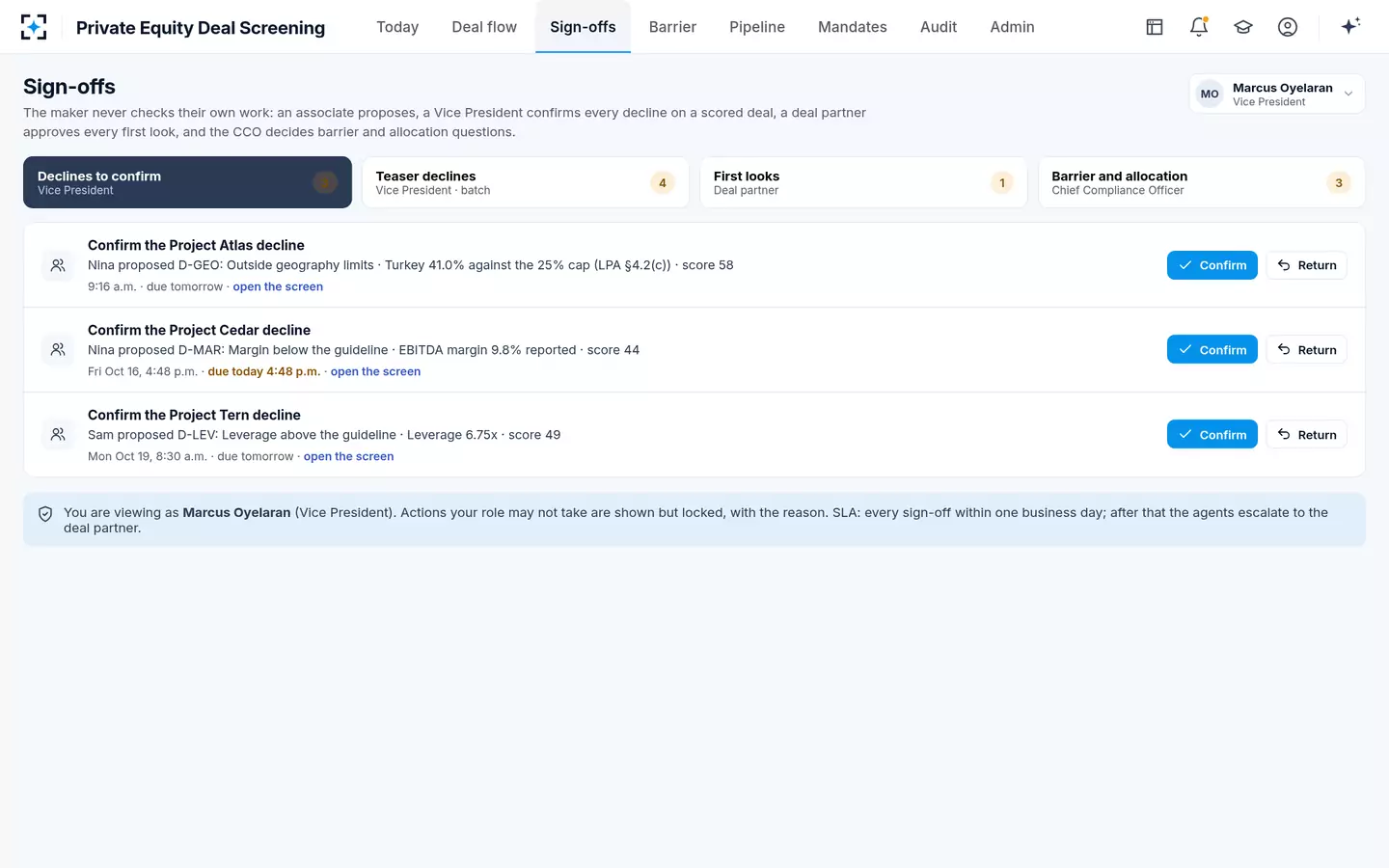
The check only works if the checker can see the evidence without redoing the work. On the sample firm's sign-off list, each decline arrives as one line: Atlas, proposed by Nina, reason code D-GEO, Turkey 41.0% against the 25% cap in the partnership agreement, score 58. Cedar: margin below the guideline, 9.8% reported EBITDA margin, score 44. Tern: leverage above the guideline at 6.75 times, score 49. The vice president confirms or returns each one with a reason; a returned decline goes back to the associate, not to the agents.
The vice president's sign-offs: each decline with its reason, figure and clause in one line
The deal partner: the first look and the weekly pipeline
The deal partner owns the decision to spend money on a company, so every first look needs the partner's approval, and so does any override of an investment committee guideline. Partners see more of the funnel than the word "approval" suggests. In the survey of 79 private equity investors, an average of 61.8 of every 100 opportunities reached a review with the partner group or investment committee, more than reached a management meeting (52.8) or limited due diligence (49.1) (Gompers, Kaplan and Mukharlyamov, Table 19). Most of that review is the weekly pipeline meeting, where a partner hears the list of what came in and why most of it was declined.
That meeting is where a screening desk is judged, and it depends on a list someone has to assemble. At the sample firm, Helena Strand starts Monday from a note drafted overnight: in the week of October 12 to 16, 34 opportunities received (21 CIMs and 13 teasers), 22 declined, 6 advanced and 6 still open, each line opening its deals. Below it sit the decisions only she can make: a first look on a growth deal scoring 79, and one deal that fits two funds and waits on the compliance officer's allocation before anyone looks further.
The chief compliance officer's seat comes first, not last
On a screen, the compliance officer acts before anyone reads, not after the decision. The rule that creates the seat is short: a registered adviser must name one of its supervised persons to run the compliance policies and procedures it adopts (17 CFR 275.206(4)-7(c)). At a manager that also runs public funds, those policies include the firm's information barrier, and a CIM naming a company whose bonds the public funds hold is exactly the event they exist for.
The UK regulator's 2026 review of private markets firms describes the seat in practice: "Second-line compliance teams were sometimes extensively involved in running conflicts identification and handling processes for new deals, much like an investment bank’s control room." It also notes the cost, and how better firms handled it: they "kept teams involved in operating compliance processes (’control room’ compliance staff) sufficiently separate from those responsible for providing independent second-line assurance" (FCA, Conflicts of interest and fair customer treatment in private markets, October 2026). The person who clears a deal should not be the person who later checks whether clearing was done right.
One CIM through the four seats, with the agents' steps between them
Agent
Intake agentLogs the CIM, the filings, the banker, the deadline and the NDA on file.
Never: Screens no file it could not read in full
Agent
Wall agentChecks the target, its parent and its securities against the lists and public holdings; builds the roster.
Never: Wall-crosses no one and removes no name from a list
A person decides
Chief compliance officerConfirms the watch-list entry and the roster, or holds the CIM unopened.
Agent
Screener and Skeptic agentsTest each limit with its page; rebuild EBITDA on a second model; draft the screen.
Never: Decide, decline or waive a limit
A person decides
AssociateChecks the cited pages, decides with a reason code and signs.
A person decides
Vice presidentConfirms or returns the decline; cannot confirm a decline they proposed.
A person decides
Deal partnerApproves any first look and any override of an investment committee guideline.
How long does it take to screen a deal?
Elapsed time, not effort, is what most screens lose, and it is lost between seats. No regulator or independent study publishes how long a private equity screen takes, so measure your own: from the CIM's arrival to the compliance clearance, to the drafted screen, to the associate's decision, to the second signature. A first pass that takes an associate an afternoon can still take a week to reach a banker if the clearance waits on an email and the sign-off waits on a meeting.
The sample firm sets each wait as a rule. A CIM is to be screened within one business day of receipt, after which the agents escalate to the vice president; every sign-off is due within one business day, after which they escalate to the deal partner. On the sample deal, the CIM arrived at 9:11 a.m., the barrier check was done at 9:12, the screen was drafted by 9:14 and Nina proposed her decline at 9:16, four minutes after the agents started. The vice president's confirmation was due the next day. Across that week's pipeline, the median time from receipt to a drafted screen was six minutes.
Each wait in a screen, who owns it, and the sample firm's rule for it
| Wait | Owner | What decides how long it takes | Rule at the sample firm |
|---|---|---|---|
| Receipt to barrier clearance | Chief compliance officer | Whether compliance hears of the CIM at once, or from an email | Watch-list entries raised on arrival; all confirmed within one business day this year |
| Clearance to drafted screen | Associate | Queue length; reading, testing and EBITDA work | Screened within one business day, then escalated to the vice president |
| Drafted screen to decision | Associate | Whether the evidence is cited or must be re-found | A proposal with a reason code; no reason, no decline |
| Decision to second signature | Vice president | Whether the checker can see the deciding page without redoing the work | Within one business day, then escalated to the deal partner |
| Signature to banker | Associate | Drafting a note that reveals nothing from the CIM | Sent only after the vice president confirms |
What changes in each seat with Private Equity Deal Screening
The solution removes the mechanical half of the associate's first pass and leaves every judgment where it was. Seven agents work beside the screen: Intake, Wall, Screener, Skeptic, Memory, Allocation and Drafting. They read, test, rebuild, search and draft; they never decide, decline, send, allocate, wall-cross or waive a limit. Each seat therefore starts from a different place, not from nothing.
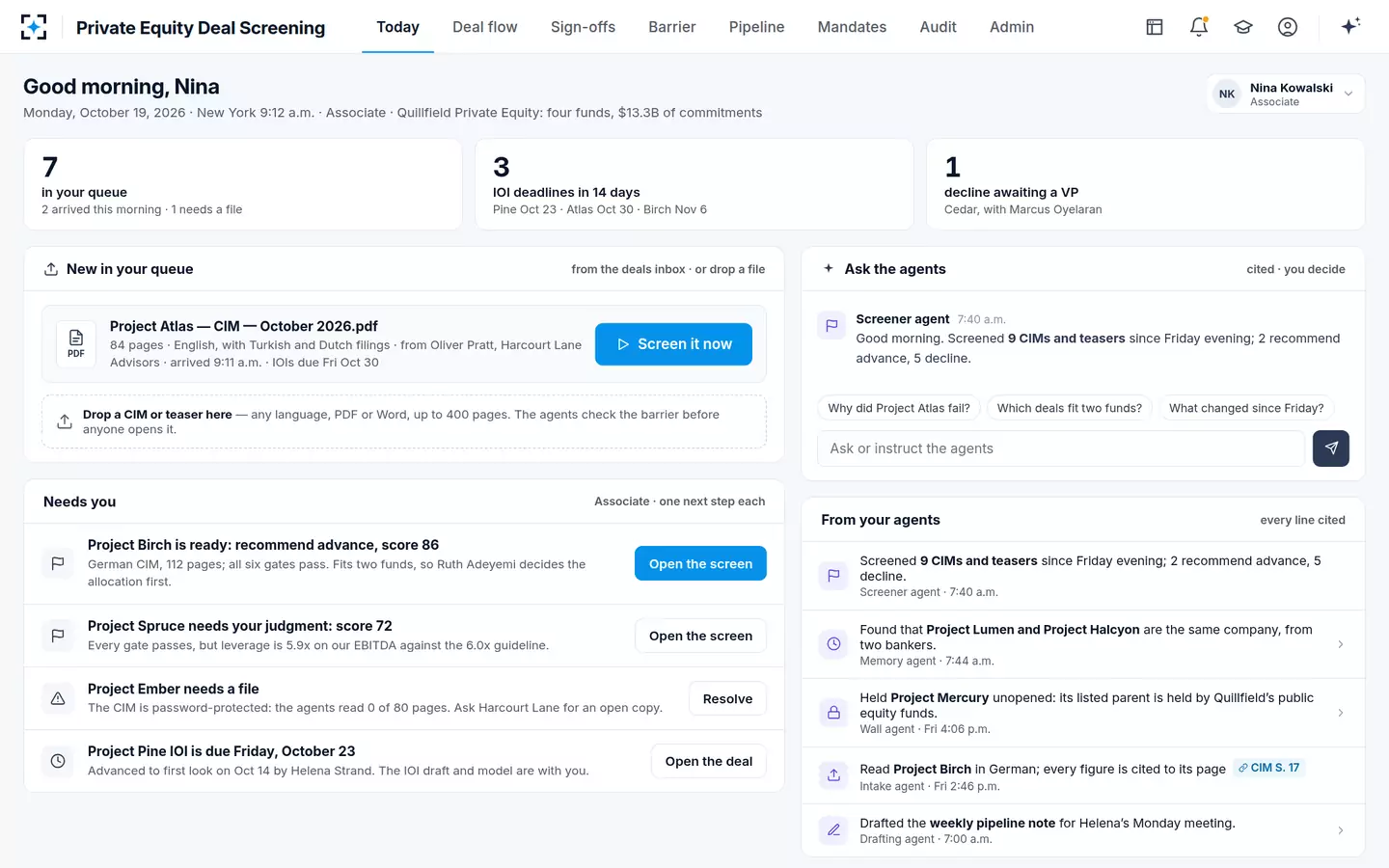
The associate's morning starts from a queue with the next step on each deal: a German CIM ready to advance at a score of 86 but fitting two funds, so the compliance officer allocates first; a deal needing judgment because leverage is 5.9 times on the firm's EBITDA against a 6.0 times guideline; a password-protected file the agents could not read, with a request to the banker for an open copy. The vice president's day starts from a list of declines, the partner's week from a drafted note, the compliance officer's from the watch-list entries raised overnight. Why the reader is never the checker sets out the controls between agents and people in more detail.
The associate's Today page: three numbers, the next step on each deal and what the agents did
Questions people ask
What is the deal screening process?
It is the sequence from receiving a CIM or teaser to a decline or a first look: compliance clearance, a first read, tests against the fund's limits, a rebuilt view of earnings, a search for prior looks, a written screen and a signed decision. At the sample firm a decline needs two signatures, the associate's and a vice president's, and a first look needs a deal partner's.
Who approves a first look at a private equity firm?
Usually a deal partner or the partner group, because a first look commits the firm's time and money to a company. In the survey of 79 private equity investors, an average of 61.8 of every 100 opportunities reached a review with the partner group or investment committee, which shows how much of the funnel partners see in some form.
What is a deal screening memo?
It is the one-page write-up of a screen: the recommendation, the company, the key numbers on the firm's own EBITDA, how the deal fits each fund limit, what the review of earnings challenged, any earlier look at the same company, and what would change the answer. In Private Equity Deal Screening a Drafting agent writes it in the house template with every figure cited; the associate edits and signs it.
What is a deal screening committee?
Some firms route screens through a small committee, often the partners of a sector team meeting weekly, before anything reaches the full investment committee. Whatever it is called, it does the deal partner's job described here: it approves first looks and hears why the rest were declined, which is why a reason code on every decline matters.
Does the compliance officer need to see every CIM?
Compliance needs to know of every CIM that names a company, because any company or parent with listed shares or bonds can create a barrier question for a manager that also runs public funds. Under the Advisers Act compliance rule, a registered adviser must designate a chief compliance officer to administer its policies, and the barrier is one of them.