The deal sourcing process is how a private equity firm finds companies to buy and gets them into its funnel: its own outreach to owners, introductions from its network, and the CIMs and teasers that investment banks and brokers send when a company is put up for sale. Sourcing is usually discussed as a hunt for new opportunities, but a large part of what arrives is not new. Companies that failed to sell come back a year or two later; carve-outs return under a new perimeter; two banks pitch the same business to the same firm. Each time, the project has a new code name. A firm that cannot see that "Project Atlas" is the company it declined as "Project Meridian" three years earlier repeats the work and risks a decision that contradicts the first. Botminds' Private Equity Deal Screening searches every earlier screen and the deal CRM for each new CIM, matching on registry numbers and addresses rather than names, and shows the earlier look with who decided it and why.
The research figures come from peer-reviewed surveys of private equity and venture capital investors, linked where they appear. The firms, companies and people in the examples are fictional sample data from the solution.
Where private equity deals come from, in three numbers
33%
of closed deals were generated by investment banks, which run the auctions and name the projects
48%
of closed deals the surveyed investors considered proprietary in some way, a figure they could not verify
200
companies screened a year by the average venture capital firm, for four investments
What is the deal sourcing process?
Deal sourcing is the first stage of a private equity firm's deal process: generating and receiving investment opportunities, and getting each into a state where the firm can decide whether to pursue it. It has two halves. Origination is the outward work, building relationships with owners, intermediaries and executives so that opportunities come to the firm, ideally before a formal sale. Intake is the inward work: logging each opportunity, identifying the company, checking whether the firm has seen it before and routing it to screening.
The two halves are usually owned by different people, a business development lead and partners on origination, associates on intake, and they are joined by the firm's memory: the deal CRM, past screens, the reasons for past declines. When the memory is good, intake is fast and consistent; when it is fragmented across inboxes, spreadsheets and people who have left, the firm rediscovers its own history one deal at a time. The deal process in numbers follows what happens after intake.
How do private equity firms source deals?
Roughly a third by their own outreach and a third through investment banks, with the rest from brokers, networks, management and other firms. The private equity survey asked investors where the deals they actually closed had come from: "almost 36% of their closed deals are “proactively self-generated,” 7.4% are provided by management and 8.6% come from their executive network", while "33% are investment banking generated, 8.6% come from deal brokers and 4.3% come from other PE firms" (Gompers, Kaplan and Mukharlyamov, NBER Working Paper 21133).
Where private equity investors' closed deals came from
These are shares of closed deals, not of everything a firm receives. Intermediated opportunities are likely to be a larger share of the inbound flow than of the closes, because an auction sends the same CIM to many buyers and only one wins. Venture capital looks different: in the companion survey, over 30% of deals came through professional networks, 20% were referred by other investors, almost 30% were proactively self-generated and only 10% came inbound from company management (Gompers, Gornall, Kaplan and Strebulaev).
What is proprietary deal flow?
Proprietary deal flow means opportunities a firm gets outside a competitive auction, or ahead of one: an owner who calls the firm first, a company the firm has courted for years. Investors prize it, and claim a lot of it. In the private equity survey, investors "considered almost 48% of their closed deals to be proprietary in some way", but the authors add: "Unfortunately, we have no way of evaluating exactly what proprietary means nor can we validate the extent to which the deals truly are proprietary or advantaged."
Size changes the mix. The authors note that firms investing in large deals "are less likely to be able to generate proprietary deals given that their targets are probably more likely to be sold in an auction process". For a large firm, then, much of the funnel is banker-run auctions, which is exactly where code names, re-runs and duplicate pitches concentrate, and where a good memory of past looks is worth most.
Why the same company comes back
Companies return to a firm's inbox for ordinary reasons, and each one changes what an earlier decline means. A sale fails, because the price was not met or results weakened, and the owner tries again a year or two later with a new adviser. A seller narrows the perimeter, selling a division rather than the whole group, or the reverse. A business the firm declined for a fund limit grows into a later fund's range. Two banks are retained, or two brokers pitch the same company unasked. And sometimes the firm has simply forgotten: the associate who screened it has moved on, and the screen lives in a mailbox.
In every case the earlier look is valuable evidence: what the firm learned, why it declined, which numbers have moved since. Without it, the firm pays twice for the same reading, and its two decisions may contradict each other in ways that are hard to explain to a seller, to the firm's own investors or, if the deal raises questions later, to an examiner.
What is a project code name in M&A?
A project code name is the label a seller's adviser gives a sale process so that the company can be discussed without naming it: in teasers, emails, data rooms and internal meetings. It protects the seller's confidentiality before buyers sign NDAs, and it keeps the deal's existence out of casual conversation afterwards. Code names are chosen per process, not per company, so a new process, a new adviser or a new perimeter usually means a new name.
That is what makes code names useless as a key for a firm's memory. "Project Meridian" in 2023 and "Project Atlas" in 2026 share nothing a search would find; neither does a company's trading name, which may be translated, abbreviated or replaced by a holding company's name. The identifiers that survive a new process are the legal ones: the company's registration number, its legal entity identifier if it has one, the addresses of its sites, its officers, and the identifiers of any securities it has issued.
How do private equity firms track deals they passed on?
Most track them in a deal CRM, with a stage and, at better-run firms, a reason code for every decline; the screen itself usually lives in a document store or an inbox. The tracking matters beyond sourcing. An adviser must keep written communications relating to the recommendations it makes or proposes for at least five years under Rule 204-2 (17 CFR 275.204-2), and screens, with the documents behind them, may fall within that rule; the firm's counsel decides how. The UK regulator's October 2026 review of private markets firms likewise counted active deal lists among the tools stronger firms used to catch conflicts early. A firm that keeps its declines only as "pass" in a CRM field has neither a memory nor a trail.
At the sample firm every screen since 2019 is searchable, each with the fund it was tested against, the reason code, the pages that decided it and who confirmed it. The weekly pipeline note opens with what came in; when a returning company is among it, the note says so.
Matching on registry numbers, not names
To find a company the firm has seen before, match on identifiers the seller's adviser does not choose. The table ranks the common keys by how well they survive a new process. In practice the strongest match combines two independent keys, a registry number and a site address, for example, because either can be missing or wrong on its own.
Keys for recognising a company seen before, strongest first
| Key | Survives a new process? | Watch out for |
|---|---|---|
| Company registration number (e.g. a chamber of commerce or state file number) | Yes: assigned by the registry, not the seller | A new holding company above the old one; carve-outs into new entities |
| Securities identifiers of bonds or shares | Yes, for the life of the security | Only exists where the company has issued securities |
| Addresses of plants and offices | Usually: operations move slowly | Shared industrial parks; moved headquarters |
| Officers and owners | Often | Management changes are common before a re-run |
| Trading or legal name | Sometimes | Translations, rebranding, holding-company names |
| Project code name | No: chosen per process | Useful only within one process |
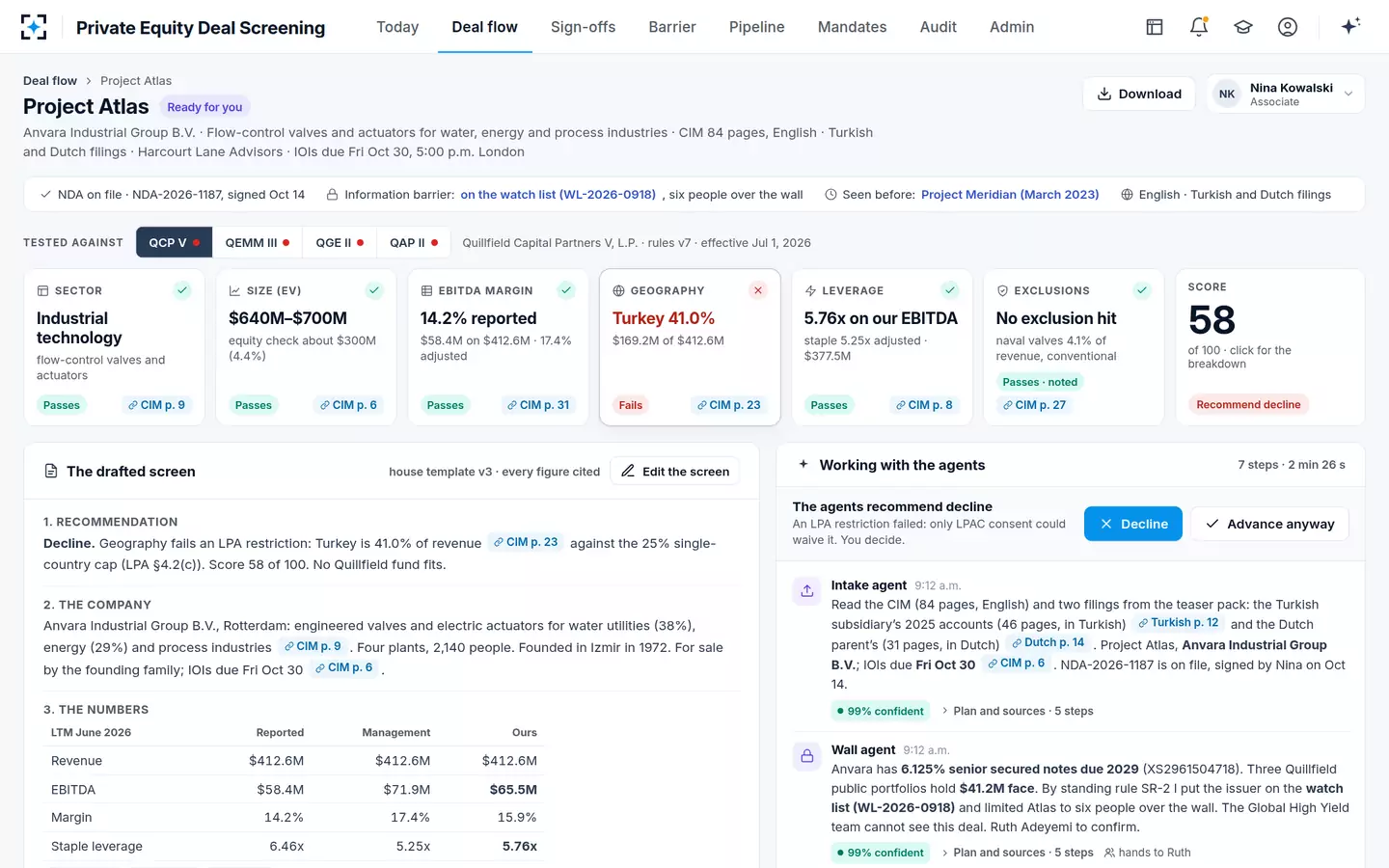
The screen's header shows the earlier look before anyone reads the CIM
A prior decline is evidence, not a verdict
Finding the earlier look is half the job; reading it correctly is the other half. A decline three years ago was a decision about that company, at that price, against that fund's limits. The question for the new screen is what has changed. At the sample firm, the Memory agent matched Atlas to Meridian on the chamber of commerce number and the address of the Izmir plant, and the comparison answers the question in one line: the reason has not gone away, it has grown.
One company, two code names: what the earlier look tells the new screen
Project Meridian, March 2023: Bellwether & Rowe
Project Atlas, October 2026: Harcourt Lane Advisors
Project Meridian, March 2023: Quillfield Capital Partners IV
Project Atlas, October 2026: Quillfield Capital Partners V
Project Meridian, March 2023: 38%
Project Atlas, October 2026: 41.0% of last-twelve-months revenue
Project Meridian, March 2023: Declined at first look for Turkish concentration; decided by Marcus Oyelaran
Project Atlas, October 2026: Declined: fails the 25% single-country cap in the LPA; confirmed by a vice president
Project Meridian, March 2023: —
Project Atlas, October 2026: Chamber of commerce number and the Izmir plant address, not the name
Project Meridian, March 2023: —
Project Atlas, October 2026: The reason for the earlier decline has grown; only a sale without the Turkish business would change the answer
Sometimes the earlier look points the other way. A company declined for size may now fit a larger fund; one declined on a committee guideline may pass after the guideline changed; at the sample firm, a July 2026 change to a leverage guideline would have changed the result of 3 of one fund's 412 screens from 2025. A memory that keeps the version of the rules each screen used can tell those cases apart from a company whose problem is still there. Turning investment criteria into versioned tests explains how.
Duplicates in the live queue: one company from two bankers
The same problem appears in the present tense when two intermediaries send the same company in the same season. Two associates may screen it in parallel under two code names, reach different answers, and send two different replies to two bankers. The firm looks disorganised at best, and its declines become hard to defend.
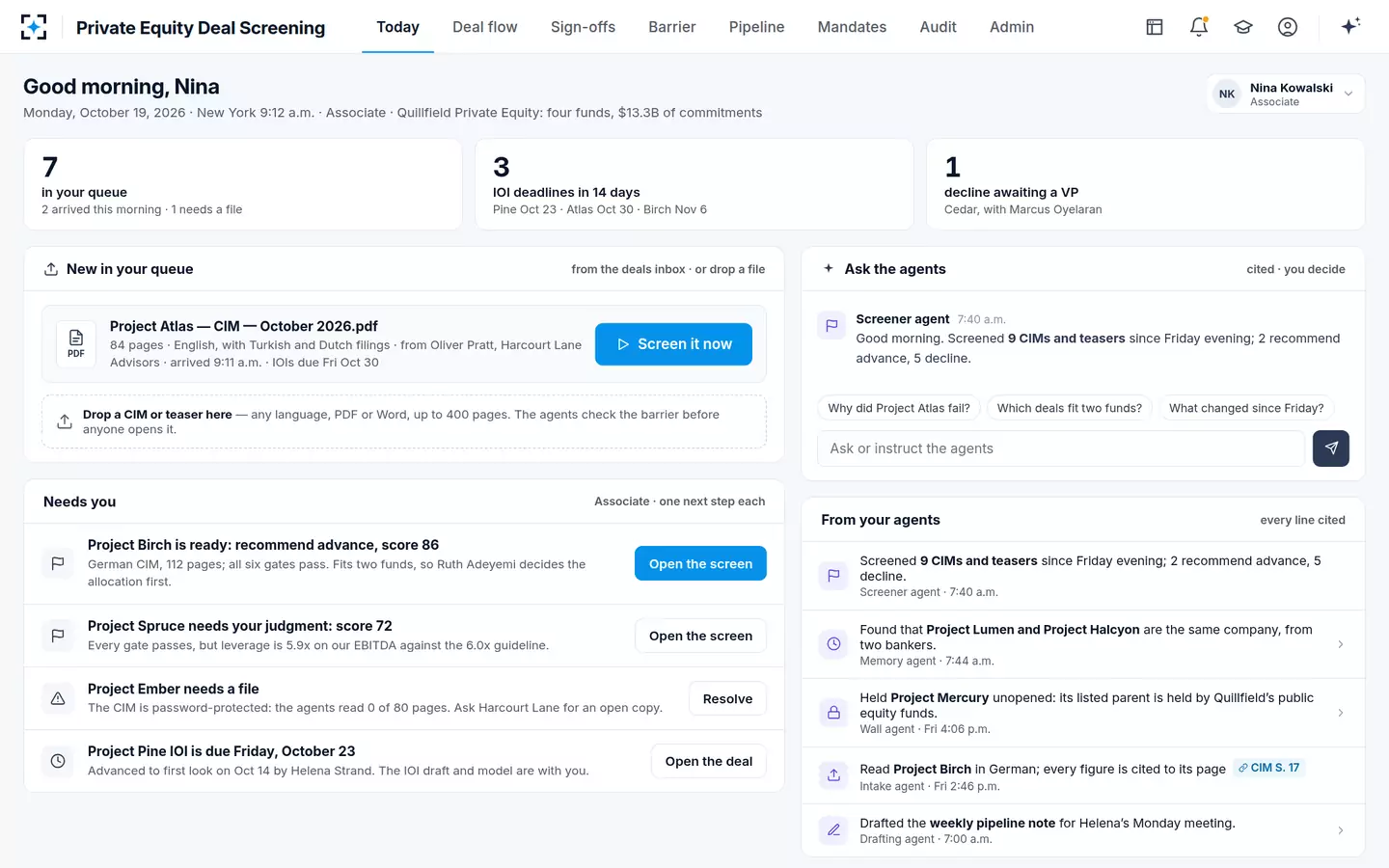
On the sample firm's Monday morning, the Memory agent reported that Project Lumen and Project Halcyon were the same company, sent by two bankers, matched on its Delaware file number. It did not merge them: merging is a person's action, and the agents never merge deals themselves. The associate saw both in one place, with one screen to write and two bankers to answer consistently.
The associate's morning, with a duplicate found across two bankers
Recognising returning companies is one of the quieter controls in a screening process, and one of the cheapest to get right. How to read a CIM covers the first read once the history is known, and Private Equity Deal Screening shows the whole sample deal, from the barrier check to the confirmed decline.
Questions people ask
What is deal flow?
Deal flow is the stream of investment opportunities a firm sees: CIMs and teasers from intermediaries, introductions from its network and deals it originates itself. In the venture capital survey, the average firm screened 200 companies a year to make four investments; private equity investors in the companion survey closed about 6 of every 100 opportunities they considered.
What is deal origination?
Deal origination is the outward half of sourcing: building relationships with business owners, intermediaries and executives so that opportunities reach the firm, ideally before or outside a formal auction. In the private equity survey, almost 36% of closed deals were proactively self-generated, roughly as many as came from investment banks.
How do you avoid duplicate deal reviews?
Check every incoming opportunity against all earlier screens and the CRM before anyone starts reading, using keys the seller's adviser does not choose, such as the company registration number and site addresses, and require a person to confirm any merge. A reason code on every decline makes the earlier look useful when it is found.
Is a deal declined once ever reconsidered?
Often, because what was true at the first look may have changed: the price, the perimeter, the company's size, or the fund's own rules. The new screen should start from the earlier one and ask what has moved; at the fictional sample firm, a company declined in 2023 with Turkey at 38% of revenue returned with Turkey at 41.0%, so the answer stayed the same.
Who owns deal sourcing at a private equity firm?
Partners and, at larger firms, a business development team own origination: the relationships that bring deals in. Associates usually own intake and the first screen. The firm's memory of past looks, the CRM and the screens, is shared, which is why it decays when nobody owns it.