The private equity deal process runs from a first look at an opportunity, through a review with the partners, a management meeting, limited and then deep due diligence, a term sheet and a signed letter of intent, to closing. Its defining feature is attrition: in a survey of 79 private equity investors, an average of only about 6 of every 100 opportunities considered ended in a closed deal. That makes the first stage, screening, the one a firm repeats most and the one where speed and consistency pay most. Botminds' Private Equity Deal Screening handles that first stage with agents that test each CIM against the fund's limits and draft a cited screen, so a deal team spends its hours on the few companies that can close.
The stage figures here are the survey's means unless marked as medians, from Gompers, Kaplan and Mukharlyamov's study of investors with combined assets under management of over $750 billion, published in the Journal of Financial Economics in 2016; most responses were collected in 2012. Venture capital figures come from a companion survey and are marked as such. Examples from the product use fictional sample data.
The funnel in four numbers
100
opportunities considered
23.7
reach deep due diligence
13.6
reach a signed letter of intent
6.1
close
What are the stages of a private equity deal?
A private equity deal moves through seven stages, and each one ends with a decision to spend more or stop. The early stages cost hours of a deal team's time; the later ones cost advisers' fees, financing commitments and the partners' attention. The table shows each stage, the share of opportunities that reach it, and what the firm is deciding there.
The seven stages of the private equity deal process, and what each one decides
| Stage | Reach it (mean) | Reach it (median) | What the firm is deciding |
|---|---|---|---|
| Opportunity considered | 100 | 100 | Whether the company can be owned by the fund at all, and whether it is worth a partner’s attention |
| Review with partner group or investment committee | 61.8 | 50.0 | Whether to engage: meet the company, bid, or decline |
| Meet management | 52.8 | 40.0 | Whether the plan and the team hold up when questioned |
| Limited due diligence | 49.1 | 40.0 | Whether the price the firm could pay is near what the seller wants |
| Deep due diligence | 23.7 | 20.0 | Whether to commit advisers, financing work and a binding offer |
| Offer term sheet, negotiate detailed terms | 22.5 | 19.0 | The terms the firm will sign |
| Sign letter of intent | 13.6 | 8.0 | Exclusivity and the final round of confirmatory work |
| Close | 6.1 | 4.0 | Completion |
The order is not fixed. Many firms review every opportunity with the partners at a weekly pipeline meeting before anyone meets management, which is why more deals reach that review than reach a management meeting. A proprietary deal may skip the auction's teaser and CIM altogether. But the shape is the same everywhere: wide at the top, narrow at the bottom, with two steep drops.
How many deals do private equity firms look at?
Roughly a hundred for every few they buy. The survey's authors put it in one sentence: "For every hundred opportunities, considered, the average PE investor deeply investigates fewer than 24, signs an agreement with fewer than 14 and closes on only 6." They draw the obvious conclusion, that private equity investors "devote considerable resources to evaluating transactions despite the fact that they will ultimately invest in only a very few" (NBER Working Paper 21133).
Out of 100 opportunities, how many reach each stage of the deal process
Venture capital funnels are wider still. In a companion survey of 889 venture capitalists at 681 firms, "The average firm in our sample screens 200 companies and makes only four investments in a given year", and for each deal closed the firm considers about 100 opportunities (Gompers, Gornall, Kaplan and Strebulaev, NBER Working Paper 22587; published in the Journal of Financial Economics in 2020). Buyout and venture differ in almost everything else, but both spend most of their evaluation effort on companies they do not buy.
Where 100 opportunities leave the funnel
Two drops dominate. More than a third of opportunities leave before they reach a partner, at the screen; and a quarter leave between limited and deep due diligence, the moment the firm must decide whether to spend real money. Between those two points, a team spends hours on meetings and models for deals that mostly will not close.
Where 100 opportunities leave the private equity deal process
100 opportunities considered
- Leave before partner review · 38%
- After partner review or a management meeting · 13%
- Before deep due diligence · 25%
- After deep diligence, before a signed LOI · 10%
- After the LOI · 8%
- Close · 6%
The first drop is the screening stage this guide is about, and it is the largest single exit. Its decisions are cheap one at a time and expensive in aggregate: 38 declines for every 100 opportunities, each needing someone to read enough of a CIM to know why. The second drop is where the costs change scale, because deep due diligence brings in accountants, lawyers and consultants. A firm that sends fewer weak deals into limited diligence saves more than associate hours.
Larger and older firms pass more deals through
The funnel's shape depends on the firm. The survey found that "larger and older private equity firms pass a greater fraction of their deals through to the next stage." Firms in the survey's lower assets-under-management group closed 4.0 of every 100 opportunities; those in the higher group closed 8.1. The authors offer two readings: such firms "may just have higher quality initial deal sourcing and hence do not need to weed out as many deals at all stages", or "the larger fund sizes may reduce the stringency of the deal funnel" (NBER Working Paper 21133).
Either reading has a lesson for screening. If a large firm closes more of what it sees because its sources are better, then the quality of its deal flow is an asset to protect, and a sourcing memory that recognises a company seen before is part of that asset; the deal sourcing process and the company that comes back twice shows how. If instead larger funds screen less strictly, the fund's written limits are the discipline that should not loosen with size, which is the argument for testing every CIM against them rather than recalling them.
How long does a private equity deal take?
No regulator publishes the length of a buyout process, and the private equity survey does not measure it. The best published figure is for venture capital: in the companion survey, the average deal took 83 days to close, and the average firm spent 118 hours on due diligence over that period and called 10 references. Those figures cover diligence on deals that closed, not the screening of the many that did not.
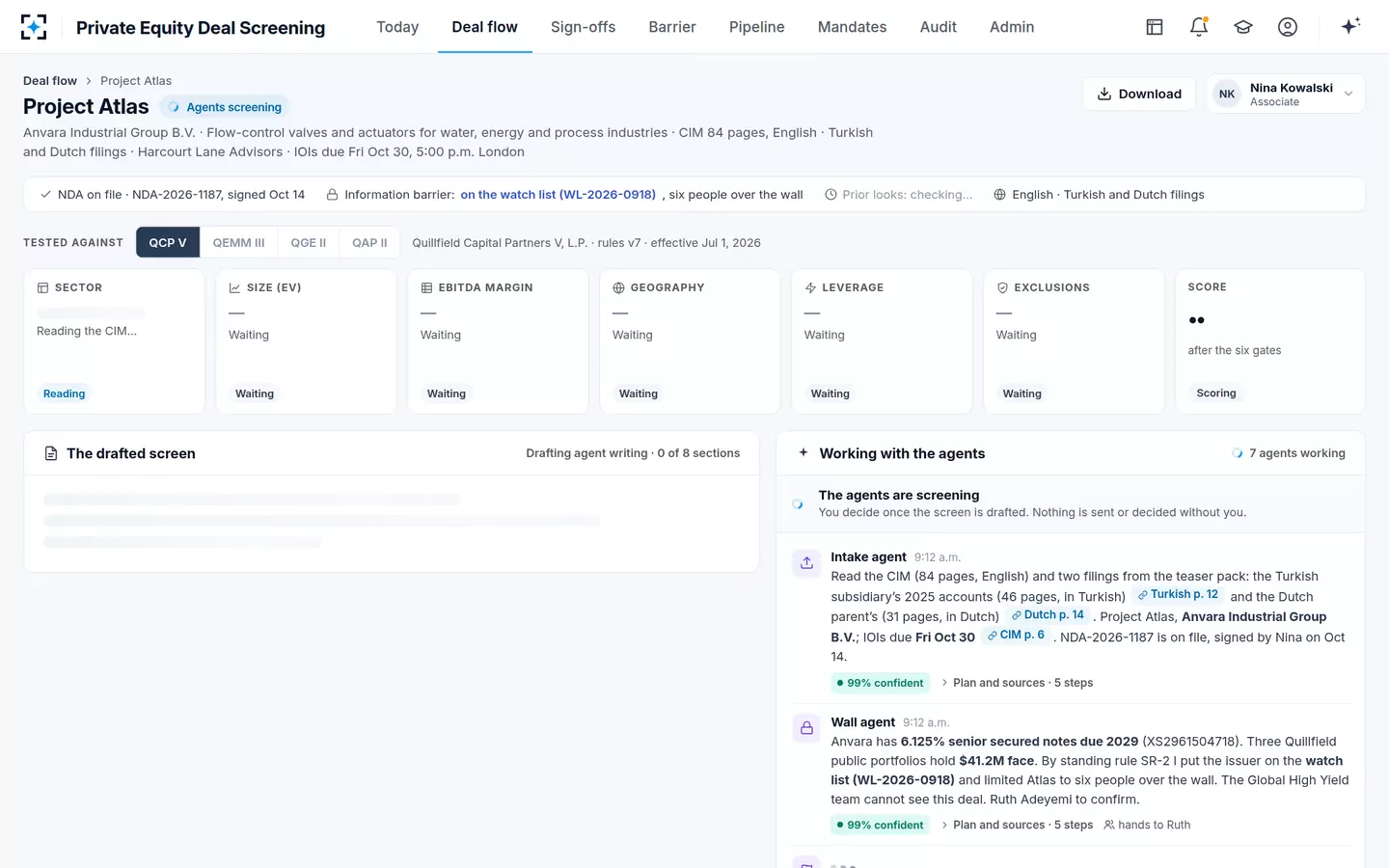
For an auction, the calendar is set by the seller. The sample CIM in this series, Project Atlas, arrived on Monday, October 19, 2026 with indications of interest due on Friday, October 30: eleven days, in which a firm must read, screen, meet internally and price, alongside every other CIM in its queue. A firm that takes three of those days to decide whether it can own the company at all has eight left to decide what to pay. At the sample firm, Atlas was declined four minutes after the agents started work, on a limit in the fund's partnership agreement, and the vice president's confirmation was due the next day.
A screen in progress: the barrier first, then each limit in turn
What happens after a LOI?
After a letter of intent is signed, the deal moves from selection to completion: the buyer usually gets exclusivity, finishes confirmatory due diligence, negotiates the purchase agreement, secures its financing and any approvals the deal needs, and closes. In the survey, 13.6 of every 100 opportunities reached a signed letter of intent and 6.1 closed, so on those averages more than half of signed letters still did not end in a completed deal. What fills the weeks after signing is set out in how long due diligence takes on a buyout, and the deals that survive go to committee on a memo built from an investment committee memo template.
That gap is a reminder of what the screen is for. Every deal that breaks after the letter of intent breaks on something diligence found or the parties could not agree; the screen's job is narrower and earlier: to make sure the deals that get that far are ones the fund can legally own, on numbers the firm has checked itself. A limit missed at the screen, such as a country concentration in the partnership agreement, is a deal the firm should never have spent diligence money on.
The arithmetic of declines
Because about 94 of every 100 opportunities do not close, almost all of a screening desk's output is declines, and the quality of the desk is the quality of its declines. Three properties matter. Speed, because the seller's calendar is fixed and a slow no crowds out the yes. A reason that can be checked, because a decline for a wrong reason is a lost deal that no one sees. And a trace, because the same company will come back, and a regulator may ask why the firm passed.
The arithmetic also says where effort pays. Suppose a desk screens 100 opportunities and each first pass costs an associate six hours by hand, Botminds' estimate for a mid-size buyout CIM: that is 600 hours to find six deals, and 564 of those hours go on companies the firm will not buy. Cutting the first pass on the 38 that never reach a partner is worth more than perfecting the memo on the six that close. What one CIM costs to screen prices those hours with public wage data.
What a fund's investors can learn from its funnel
For a limited partner judging a manager, the funnel is evidence of discipline. A manager that can say how many CIMs it received, how many it declined and for which reasons, and how many it advanced by fund, is showing that its investment limits are applied, not recalled. The SEC's private fund statistics show the scale such reporting would cover: 27,682 private equity funds reported on Form PF for the fourth quarter of 2025 (SEC Private Fund Statistics, Table 1.1).
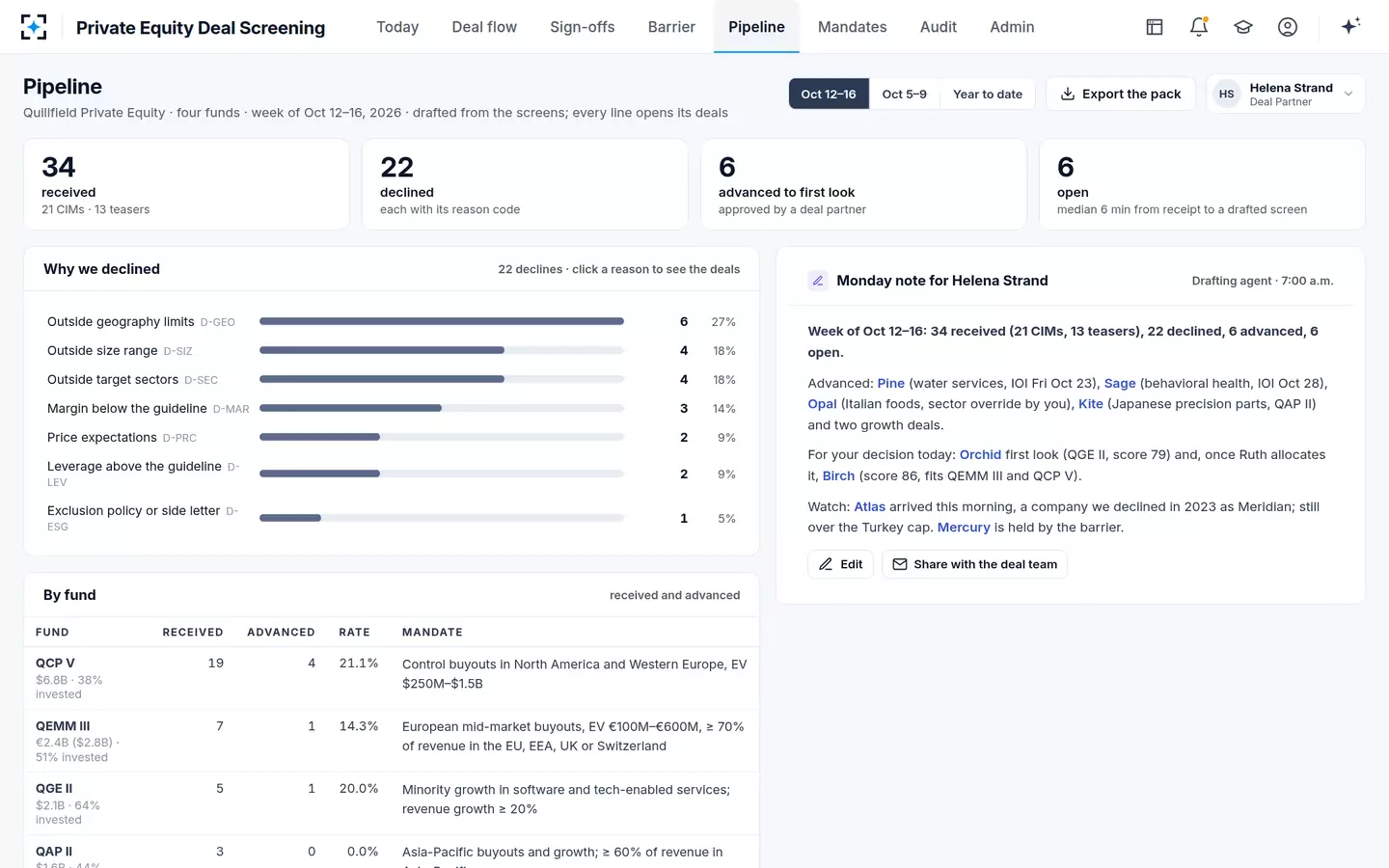
One week of the deal process at the sample firm, by reason and by fund
Where Private Equity Deal Screening sits in the deal process
The solution works at the top of the funnel, from the CIM's arrival to a confirmed decline or a partner-approved first look, and stops there. It checks the information barrier before anyone opens the CIM, tests each of the fund's limits with the page that decided it, rebuilds EBITDA on a second model, searches every earlier screen for the same company, tests every fund under the firm's allocation policy and drafts the screen and the banker note. People decide at every step: the associate with a reason code, a vice president on every scored decline, a deal partner on every first look and the compliance officer on the barrier and allocation.
Beyond the first look, the work belongs to diligence, the investment committee and the lawyers, and to other tools. The screen's contribution to those later stages is what it leaves behind: a cited first view of the company, the firm's own EBITDA with each add-back judged, and a clean trail of who saw the CIM and when. Who decides each step of a screen describes the seats in detail, and Private Equity Deal Screening follows one CIM through all of them.
Questions people ask
What percentage of private equity deals close?
In the survey of 79 private equity investors, an average of 6.1% of opportunities considered closed, and the median was 4%. Firms in the higher assets-under-management group closed more, 8.1 per 100 against 4.0 for the lower group. Of opportunities that reached a signed letter of intent, fewer than half closed on those averages.
What is deal flow in private equity?
Deal flow is the stream of investment opportunities a firm receives or generates: CIMs and teasers from bankers and brokers, introductions from its network, and deals it originates itself. Its volume and quality set the top of the funnel; in the same survey, 33% of closed deals were generated by investment banks and almost 36% were proactively self-generated by the firms.
How does a private equity deal work?
A private equity fund buys a company, usually a controlling stake funded with equity from its investors and debt, works to grow its value, and sells it after several years. In the survey, almost 96% of investors used a five-year forecast horizon to evaluate a deal, which reflects the typical holding period. The deal process described here is how the fund chooses the few companies it buys.
How many CIMs does a private equity associate read?
No published study counts it, and it varies with the firm's size, sector focus and the market. At the fictional sample firm in this guide, one associate carries twelve to fifteen CIMs a week across two funds, and the firm's four funds received 34 opportunities in a single week, 21 of them CIMs.
Why do private equity firms decline most deals?
Because most opportunities fail at least one test: the fund cannot own the company under its limits, the business or price does not fit, or diligence turns up a problem. At the sample firm, the most common decline reason in one week was a geography limit (6 of 22 declines), followed by size and sector (4 each).