Side letters in private equity are agreements between a fund's general partner and one investor that add to, or vary, the limited partnership agreement for that investor: more reporting, an excuse from certain deals, a fee arrangement, a notice right, a most-favored-nation (MFN) clause. They are legal in the US, the EU and the UK, and no regulator today forbids any particular term. What the rules govern is disclosure and fairness. In the US, the SEC's 2023 preferential treatment rule was vacated by the Fifth Circuit on June 5, 2024, so what remains is the anti-fraud rule for pooled vehicles, the duty to keep side letters as records, and the SEC's examinations and enforcement. In the EU, AIFMD requires fair treatment and a description of preferential treatment before investors invest; in the UK, the FCA's fund rules do the same and its October 2026 review sets out what it expects. Botminds' Side Letter Management keeps every letter, term, election and obligation with its source and evidence, so a manager can answer each of these regimes from one place.
Four dates that frame side letter rules in 2026
June 52024
the Fifth Circuit vacates the SEC’s private fund adviser rules, preferential treatment included
Nov 192024
the SEC removes the vacated text from the Code of Federal Regulations
Apr 162026
AIFMD II applies across the EU; its reporting changes follow from April 16, 2027
Oct 232026
the FCA publishes its review of conflicts and investor fairness in private markets
What is a side letter in private equity?
A side letter is a contract, signed alongside an investor's subscription, under which the general partner gives that investor rights or accepts duties that the limited partnership agreement does not give everyone. The Fifth Circuit, describing the practice in the case that struck down the SEC's 2023 rules, put it plainly: "Side arrangements are a common practice by which investors negotiate specialized terms that differ from those in the fund's governing documents" (Nat'l Ass'n of Private Fund Managers v. SEC, No. 23-60471, June 5, 2024).
The terms are mostly unglamorous: quarterly data in the investor's own template, notice of litigation within ten business days, an excuse from tobacco or thermal-coal deals, ESG data for an EU investor's regulatory reports, confidentiality carve-outs for a public pension subject to records law. A minority change money: a fee break for size, interest on capital returned late. And many investors also negotiate an MFN clause, which lets them elect terms others received. Why these promises sit in a side letter rather than an amendment is a question of its own.
Are side letters legal?
Yes, in the US, the EU and the UK. US fund law treats them as contracts; Congress itself named "side arrangements or side letters" among the records a private fund adviser must keep for the SEC (15 U.S.C. 80b-4(b)(3)(F), added in 2010). EU law permits preferential treatment explicitly, on condition that it is disclosed, and UK rules follow the EU text they were built from.
What makes a side letter unlawful is not its existence but what surrounds it: a term that harms other investors and is hidden from them, a promise that contradicts what the fund's documents say, or a disclosure that misdescribes what was granted. The rest of this guide is about those three failures, jurisdiction by jurisdiction.
What was the SEC preferential treatment rule, and why is it gone?
The preferential treatment rule was part of the private fund adviser rules the SEC adopted on August 23, 2023. It would have barred advisers from granting preferential redemption rights or portfolio information that they reasonably expected to have a material, negative effect on other investors, and required written disclosure of all other preferential treatment to prospective and current investors. The court summarised its reach in one sentence: "The preferential treatment rule sharply limits so-called 'side arrangements' investors can enter" (5th Cir. No. 23-60471).
The Fifth Circuit vacated the whole package on June 5, 2024, holding that neither section 211(h) nor section 206(4) of the Advisers Act gave the SEC the authority it claimed. On the anti-fraud theory the court was blunt: "Complying with the 'fund's governing agreements' is not fraud" (No. 23-60471). The SEC removed the vacated rules and the related amendments from the Code of Federal Regulations in a release published November 19, 2024 (89 FR 91252). The rule should be described only as vacated: the court set it aside before even the earliest compliance date, twelve months after publication for the largest advisers, had arrived, and no part of it applies today.
Side letter rules in private equity, by jurisdiction, in late 2026
| Question | United States | European Union | United Kingdom |
|---|---|---|---|
| Is there a rule on preferential terms? | No: the SEC’s 2023 preferential treatment rule was vacated (June 5, 2024). | Yes: AIFMD Article 12(1)(f) and Delegated Regulation 231/2013 Article 23. | Yes: FCA FUND 3.2.2R for full-scope UK AIFMs; a new regime is under consultation (CP26/28). |
| Must preferential treatment be disclosed? | No specific rule; omissions that mislead investors are fraud under Rule 206(4)-8. | Yes, to investors before they invest: AIFMD Article 23(1)(j). | Yes, before investors invest: FUND 3.2.2R(10) and (11). |
| Is there a fairness test? | Fiduciary duty runs to the fund; anti-fraud protects investors. | Preferential treatment may not cause an overall material disadvantage to other investors. | The FCA expects firms to assess the cumulative impact of preferential rights. |
| What must be kept or reported? | Side letters are records: Advisers Act section 204(b)(3)(F); Rule 204-2 (five years). | Whether investors have preferential treatment, and of what kind, is reported to the national regulator (Regulation 231/2013, Annex IV). | The FCA expects records sufficient to show compliance with policies and obligations (October 2026 review). |
| Who examines it? | SEC Division of Examinations; FY2026 priorities name side letters for advisers new to private funds. | National competent authorities. | FCA supervision; October 2026 multi-firm review. |
What still applies in the US after the vacatur
Three things, and none of them depends on the vacated rule. The first is the anti-fraud rule for pooled vehicles, Rule 206(4)-8, which makes it fraud for an adviser to a private fund to make a materially untrue or misleading statement, or a misleading omission, to any investor or prospective investor in the fund. The court's reasoning leaves it untouched: the opinion notes that the adviser's fiduciary duty runs to its client, and "The duty extends to the client alone, which is the fund, not the investors in the fund", but Rule 206(4)-8 reaches the investors directly.
The second is records. Side letters are among the records a private fund adviser must maintain and make available to the SEC under section 204(b)(3)(F), and the general books-and-records rule requires records to be kept for at least five years. The third is the compliance programme: Rule 206(4)-7 requires written compliance policies designed to stop Advisers Act violations, reviewed once a year or more. A manager whose disclosure documents describe how side letters and MFNs are handled must be able to show that its process does what the documents say. The same short list, with no SEC rule on top, now governs private equity reporting requirements too.
Do side letters have to be disclosed?
In the US there is no rule requiring each side letter, or each preferential term, to be disclosed to other investors; there is a rule against misleading them. Where the private placement memorandum or the LPA says how preferential terms are handled, or where a term could harm other investors, silence can become the misleading omission Rule 206(4)-8 prohibits. The SEC's examination staff described exactly that pattern in 2020: advisers "entered into agreements with select investors ('side letters') that established special terms, including preferential liquidity terms, but did not provide adequate disclosure about these side letters" (SEC Division of Examinations risk alert, June 23, 2020). Risk alerts are staff views, not rules, but they say what examiners look for.
In the EU the answer is a plain yes, and it comes before the investment. AIFMD Article 23(1)(j) requires managers to make available to investors before they invest "a description of how the AIFM ensures a fair treatment of investors and, whenever an investor obtains preferential treatment or the right to obtain preferential treatment, a description of that preferential treatment, the type of investors who obtain such preferential treatment and, where relevant, their legal or economic links with the AIF or AIFM" (Directive 2011/61/EU). The UK carries the same duty in its fund sourcebook, FUND 3.2.2R, items (10) and (11), for full-scope UK managers (FCA Handbook, FUND 3.2).
What does AIFMD say about preferential treatment?
AIFMD says three things: treat investors fairly, disclose preferential treatment, and never let it cause an overall material disadvantage to the others. The first two sit in the directive. Article 12(1)(f) requires managers to "treat all AIF investors fairly. No investor in an AIF shall obtain preferential treatment, unless such preferential treatment is disclosed in the relevant AIF's rules or instruments of incorporation" (Directive 2011/61/EU). The third is the delegated regulation's test, and it is the one with teeth:
“Any preferential treatment accorded by an AIFM to one or more investors shall not result in an overall material disadvantage to other investors.”
Commission Delegated Regulation (EU) No 231/2013, Article 23(2), Fair treatment of investors in the AIF
Read together, the three provisions ask a manager for more than a list of side letters. It must know what each preferential term does, have described the treatment and the types of investor receiving it before investors committed, and be able to show that the terms, taken together, did not leave the other investors materially worse off. The managers also report to their national regulator whether any investor has preferential treatment and of what kind, a question the side letter compendium should already answer. AIFMD II, applying from April 16, 2026, rewrote parts of Article 23 and changes the regulator reporting from April 16, 2027 (Directive (EU) 2024/927); the preferential treatment disclosure in Article 23(1)(j) quoted above remains.
Has the SEC charged an adviser over side letters?
Yes: the clearest case is the SEC's action against Philip Falcone and Harbinger Capital Partners, filed June 27, 2012 and settled with admissions in 2013. The final consent judgment records the SEC's allegation of "the undisclosed offering and granting of favorable redemption and liquidity terms to certain large investors in exchange for those investors' consent to restrict redemption rights of other fund investors, and the concealment of the preferential terms from both the fund's directors and investors" (SEC v. Falcone, 12 Civ. 5028 (S.D.N.Y.), final consent judgment).
Among the facts the defendants admitted: Harbinger signed two side letters with one large intermediary "providing preferential redemption rights not available to other investors", which were neither approved by the fund's board nor disclosed to other investors, and investors affiliated with that intermediary received about $65 million under them. The court entered the judgment on September 16, 2013; Falcone paid $6,507,574 in disgorgement, $1,013,140 in prejudgment interest and a $4 million penalty, the Harbinger entities a $6.5 million penalty, and Falcone was barred from association with brokers, dealers and investment advisers, with a right to reapply after five years (SEC Litigation Release 22831A, October 2, 2013). It was a hedge fund case about redemption rights, but its elements, a preferential term, a harm to other investors and concealment, are the elements Rule 206(4)-8 still reaches in any private fund.
One side letter case, in the court's numbers
2
side letters granting redemption rights not available to other investors
$65M
received by the favoured investors under the undisclosed agreements
$6.5M
penalty on the Harbinger entities, beside Falcone’s own $4M penalty
5years
before Falcone could apply to return to the industry
The examination record is more recent and more cautious. The SEC's fiscal 2026 examination priorities, published November 17, 2025, said examiners would review advisers that have not previously advised private funds for, among other things, "differential treatment of investors, including use of side letters" (FY2026 Examination Priorities). That wording is aimed at advisers new to private funds, not at every manager, and the fiscal 2027 priorities published October 23, 2026 do not repeat it; their private fund reviews look at disclosures of risks, allocations, fund-level lines of credit, affiliated service providers and the accuracy of fee and expense calculations (FY2027 Examination Priorities). Both documents state that they are staff views and not rules.
What does the FCA expect on side letters?
The FCA expects side letters and MFNs to be governed as part of a firm's conflicts and investor-fairness framework, not filed away as private contracts. Its multi-firm review of conflicts in private markets, published October 23, 2026, found stronger firms applying legal and compliance oversight to preferential rights. Of weaker firms it wrote that where preferential rights were granted, they "relied more heavily on fund-document disclosure and did not consistently demonstrate that they had systematically assessed their cumulative impact on other investors" (FCA multi-firm review, 23/10/2026).
The phrase "cumulative impact" is the practical test. One side letter rarely disadvantages anyone; forty, each granting reporting, excuse and transfer rights to the largest investors, may. A firm that can show, fund by fund, which terms it granted, to which types of investor, and what each costs the fund or the other investors, can answer the FCA's question. The FCA is also consulting on a new UK regime for alternative fund managers, with implementation "currently envisaged" for 2028 (CP26/28, first published 14/07/2026); until new rules are made, FUND 3.2.2R applies.
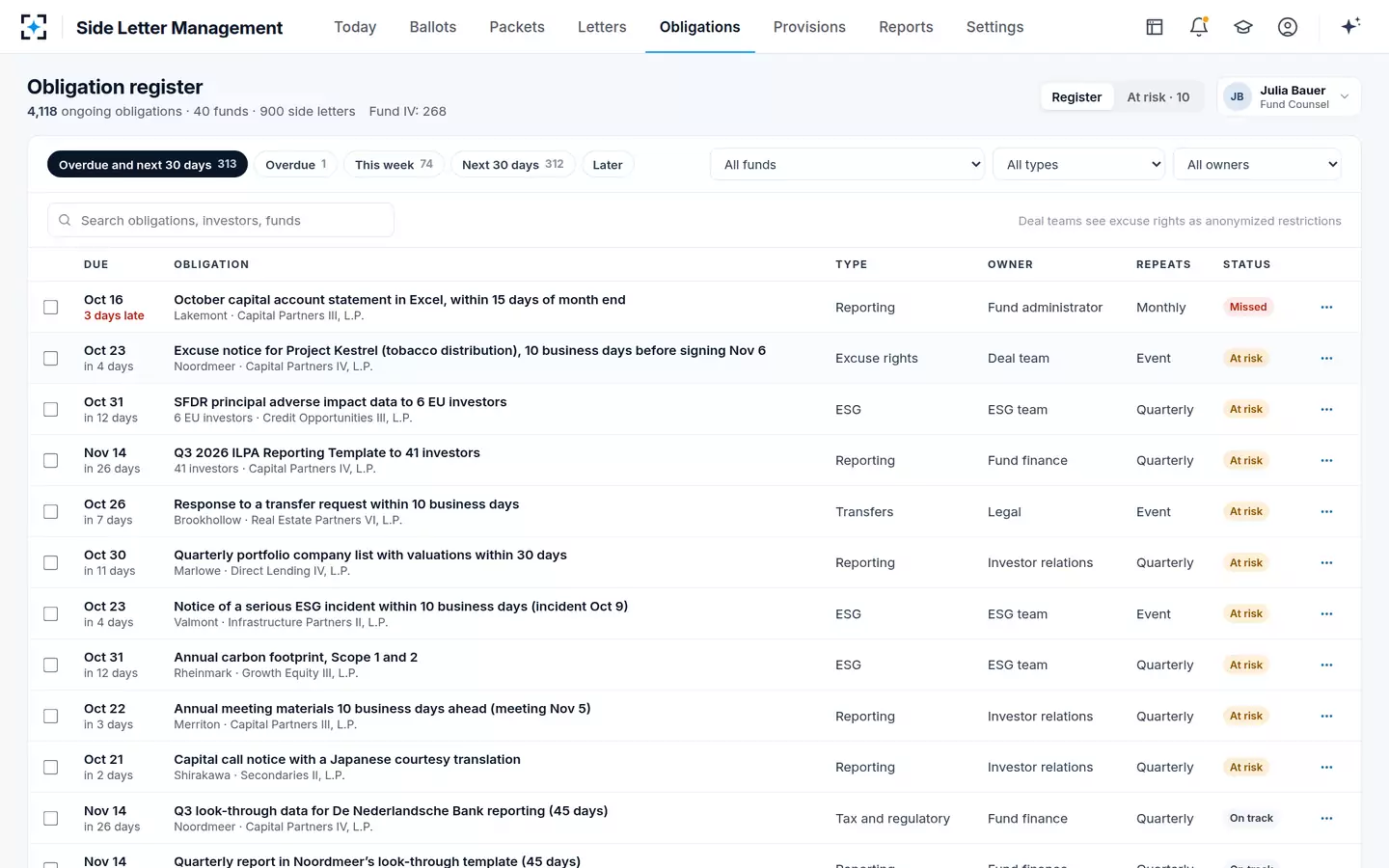
Every side letter promise with an owner and a date, in Side Letter Management
Are side letters enforceable?
Yes, as contracts between the parties who signed them, subject to the fund's governing law and its LPA. A side letter binds the general partner (and, where it signs, the fund) to the investor that holds it; it does not bind the other investors, who never agreed to it. That is the main legal difference between a side letter and an amendment to the partnership agreement, and the reason a promise that changes everyone's position belongs in an amendment. Delaware's partnership statute, under which many US private equity funds are formed, gives wide effect to whatever the partners agree; the provisions that matter are set out in side letter vs amendment.
Six questions any of the three regulators could ask about your side letters
- Which investors have preferential terms, and of what kind?
By fund, by type of investor, by category: reporting, liquidity, fees, other.
- Where were they described before investors invested?
The PPM or offering document passage, and its date, for the EU and UK disclosure duties.
- Do your documents describe the process you actually run?
If the PPM promises MFN elections within a period, show each season’s dates.
- What do the terms cost the other investors, taken together?
The cumulative-impact and overall-material-disadvantage tests.
- Is every promise being kept?
Each obligation with an owner, a due date and evidence of delivery.
- Where is each letter, and can you produce it?
Section 204(b)(3)(F) and Rule 204-2 in the US; Annex IV reporting in the EU; records that show compliance in the UK.
Where Side Letter Management fits
The solution does not decide what to grant or how to disclose it; counsel and compliance do. What it does is keep the evidence each regime asks for in one place: every letter read in its own language and cited to clause and page, every term classified by category and by the type of investor that received it, every MFN election with the ballot, the packet and counsel's approval, and every resulting promise as an obligation with an owner, a date and proof of delivery. From that, it generates an SEC examination file on preferential treatment and an export for regulators and auditors, with each action on a hash-chained audit trail.
Fee and expense terms are tested against what the fund actually charged by Botminds' LPA Compliance. To see how your own letters would look as evidence, start from Side Letter Management.
Questions people ask
Did the vacatur make side letters unregulated in the US?
No. It removed a rule before anyone had to comply with it. Advisers remain subject to section 206 of the Advisers Act and Rule 206(4)-8, must keep side letters as records, and must run a compliance programme under Rule 206(4)-7; the Harbinger case was brought under those provisions years before the 2023 rule existed.
Do other investors have a right to see my side letter?
Not to the letter itself, which is usually confidential. In the EU and UK they are owed a description of the preferential treatment and the type of investor receiving it before they invest; investors with an MFN right may also see the terms, anonymised, when they make their election.
Does AIFMD apply to a US manager?
Only where it manages an EU fund or markets a fund to investors in the EU; marketing under national private placement regimes brings disclosure duties under Article 23. A US manager raising from EU investors should assume the preferential treatment description is owed.
Are side letters common in hedge funds as well as private equity?
Yes, and the SEC's enforcement history on side letters comes mainly from hedge funds, where preferential liquidity matters most: the 2020 risk alert's side letter finding concerned preferential liquidity terms and the Harbinger case redemption rights. In private equity, where investors cannot redeem, the questions turn more often on fee terms, information rights and whether promises are kept.
Can a regulator see the side letters?
Yes. The SEC can require them as records of a private fund adviser, and EU and UK regulators can request them in supervision; managers also report to EU regulators whether preferential treatment exists and of what kind.