The MFN election process is the work that follows a closed-end fund's final close: the general partner tells every investor holding a most-favored-nation (MFN) right which terms, negotiated by other investors in their side letters, it may now take for itself, the investor chooses, and counsel confirms. It is hard because the answer differs for each investor. Its commitment, its affiliates, its legal and tax status and the wording of its own MFN clause decide what it may elect, and those details sit in dozens of letters, some in other languages. Botminds' Side Letter Management exists for that season: agents read every letter and work out each investor's ballot with the clause behind every call, a second agent checks each call independently, and fund counsel approves every packet before it is sent.
The worked example is a fictional fund run through the solution: Quillfield Capital Partners IV, L.P., which held its final close on August 31, 2026 at $6.2 billion from 118 investors, with 63 side letters and 52 investors holding an MFN right. Research and rules are linked where they appear.
One MFN election season in the sample fund, on day 49
52
investors with an MFN right, across five commitment tiers
412
provisions in 63 side letters, each read and cited to its clause
19of 52
election packets sent by Monday, October 19
90days
the solution’s design target from final close to every election closed
What is an MFN election?
An MFN election is an investor's choice, made once the fund has closed, of which terms granted to other investors it wants added to its own side letter. The right to make it comes from the MFN clause in that investor's side letter, and the clause also fences it in. In its 2023 rulemaking the SEC described the clause this way: "In an MFN clause, an adviser or its related person generally agrees to provide an investor with contractual rights or benefits that are equal to or better than the rights or benefits provided to certain other investors, subject to certain exceptions" (SEC final rule, 88 FR 63206, September 14, 2023).
That release is a description of market practice, not a rule in force: the Fifth Circuit vacated the whole 2023 private fund adviser package, including its preferential treatment rule, on June 5, 2024 (Nat'l Ass'n of Private Fund Managers v. SEC, No. 23-60471). No US regulation today sets how an MFN election runs. The process is what each fund's limited partnership agreement and side letters say, which is why two funds from the same manager can run it differently.
The "exceptions" are where the work sits. A common design lets an investor elect only terms granted to investors whose commitment is no larger than its own, and never terms that exist because of another investor's legal, tax or regulatory status, such as an ERISA plan's reporting or a public pension's records-law carve-out. The rules of the clause are covered term by term in making every most favored nation call defensible.
When do MFN elections happen, and how long does an MFN election take?
Elections happen after the fundraising ends, because only then is the full set of side letters known. The SEC's 2023 description again: "Closed-end fund investors are typically entitled to elect these rights or benefits after the end of the private fund's fundraising period, and open-end fund investors are typically entitled to elect these rights or benefits after the closing of their investment" (88 FR 63206; the rules it adopted were vacated in 2024). A private equity fund therefore has one main season, starting at final close; a hedge fund has a rolling one.
How long it takes is set by contract, and no regulator or independent study publishes a typical duration for the whole season. The closest evidence is how the agreements themselves set the election window. Begenau and Siriwardane read 91 limited partnership agreements from funds in their sample of US public pension investments, and found that tight windows were the exception, not the norm:
“Only 13% of LPAs required all LPs to be notified of side letters and given the right to opt into their terms, provided that elections were made within 20-60 days of the fund’s close.”
Begenau and Siriwardane, ‘How do Private Equity Fees vary across Public Pensions?’, NBER working paper 29887, March 2022
In the other 87%, the timing lives in each investor's side letter, if anywhere. That is the practical reason a manager needs a calendar of its own: a date for the packets to go out, an election window per investor counted from receipt, and a date by which counsel confirms. In the sample fund those dates are written into the MFN clauses: packets out by day 60, a 30-day window from receipt, and a design target of day 90 for every election closed.
The six stages of the MFN election process, and where the weeks go
The season has six stages, and most of the calendar goes to the first and the last: re-reading letters to build the compendium, and correcting elections that came back wrong. The middle stages, the arithmetic and the packets, are mechanical but slow because each investor's packet is different.
Where an MFN election's weeks go, by hand and with the agents
| Stage | By hand | With the agents | What changes |
|---|---|---|---|
| 1. Re-read letters, build the compendium | 8 weeks | 1 week | Letters read in their own language and cited; a person verifies uncertain readings |
| 2. Commitments and eligibility | 6 weeks | 1 week | Affiliates aggregated at the fixed rate; every call made and re-derived blind |
| 3. Draft packets | 6 weeks | 1 week | One drafted packet per investor; IR checks rather than builds |
| 4. Counsel review | 4 weeks | 1.5 weeks | Counsel reviews cited calls and rules only where the agents disagree |
| 5. Election window and chasing | 8 weeks | 4.5 weeks | The window is contractual; only chasing and late sending shrink |
| 6. Correct over-elections | 8 weeks | 2 weeks | Forms list only what each investor may elect, with conditions |
| Total, if run one after another | about 40 weeks | about 11 weeks |
1. The compendium. Counsel or a junior lawyer re-reads every side letter and lists each grantable term with its grantee, the grantee's commitment and the clause, often in a spreadsheet beside a Word summary. What each column of a side letter compendium must prove is a guide of its own.
2. Commitments and eligibility. Each investor's commitment is aggregated across its affiliated vehicles, converted at the rate its clause fixes, placed in a tier and tested against every term. In the sample, a Dutch pension fund committed EUR 120 million directly and EUR 30 million through a second vehicle; at the final-close rate of 1.164 that is $174.6 million, which puts it in Tier B.
3. Packets. IR drafts one packet per investor: a cover letter, the eligibility summary, the electable terms in full with their conditions, the terms not available and why, the election form and instructions.
4. Counsel review. Counsel checks the calls and signs off each packet. This is where the season stalls by hand, because the reviewer must reconstruct each call from the letters.
5. The window. Investors read, ask questions and return forms; IR chases. The window is contractual and the one stage no tool shortens much.
6. Answers and corrections. Returned forms are read for over-election, missing conditions and terms that move money, then confirmed and re-papered. The three ways forms go wrong are set out in the MFN election form and over-election.
Who runs the MFN election? Five desks, one season
Fund counsel owns the MFN election, but five desks carry it, and the season slows wherever two of them wait on each other. In the sample firm, as in many, counsel decides eligibility, investor relations owns the packets and the investor conversation, compliance owns what the fund has promised afterwards, the CFO signs anything that changes what the fund pays or charges, and a legal operations analyst handles the reading, especially letters in other languages.
The five desks in an MFN election, before and after the agents
Today
Re-reads letters against each MFN clause and corrects over-elections one round of letters at a time.
With agents
Approves calls with the clause beside each; only the calls where two agents disagree need a ruling.
Still theirs: Every eligibility ruling and every packet approval
Today
Builds election forms out of the compendium and chases answers by e-mail.
With agents
Checks a drafted packet per investor, sends approved packets and watches each window.
Still theirs: Sending, and the conversation with each investor
Today
Owns promises scattered across compendia and spreadsheets.
With agents
Owns one register where every confirmed term has an owner, a date and evidence.
Still theirs: The obligations, and cure notices for any miss
Today
Learns of a fee or interest term after it binds the fund.
With agents
Co-signs each elected term that moves money before counsel confirms it.
Still theirs: Every term that changes fees, expenses, interest or payments
Today
Letters in Dutch, German, French or Japanese wait for a lawyer who reads the language.
With agents
Verifies only provisions read below a confidence threshold, with the original beside the English.
Still theirs: The reading the agents are unsure of
The separation matters more than the headcount. In the sample firm the person who prepares a packet can never approve it, and counsel, who approves, can never send it. That is the four-eyes control applied to investor communications, and it is what lets an examiner or an investor's lawyer see who decided what. The checking half, a second model re-deriving each eligibility call, is described further down.
What is an MFN election packet?
An MFN election packet is the document set one investor receives: the offer, the evidence for it and the form to answer it. A good packet lets the investor's own counsel check every line without asking for the compendium. In the sample, the packet for the Dutch pension fund runs to 38 pages: a two-page cover letter in English with a Dutch courtesy translation, three pages on eligibility, the 37 electable terms in full over 26 pages, two pages of terms not available and why, the election form, a signature page and the instructions with the deadline.
A 38-page MFN election packet in Side Letter Management, waiting for counsel
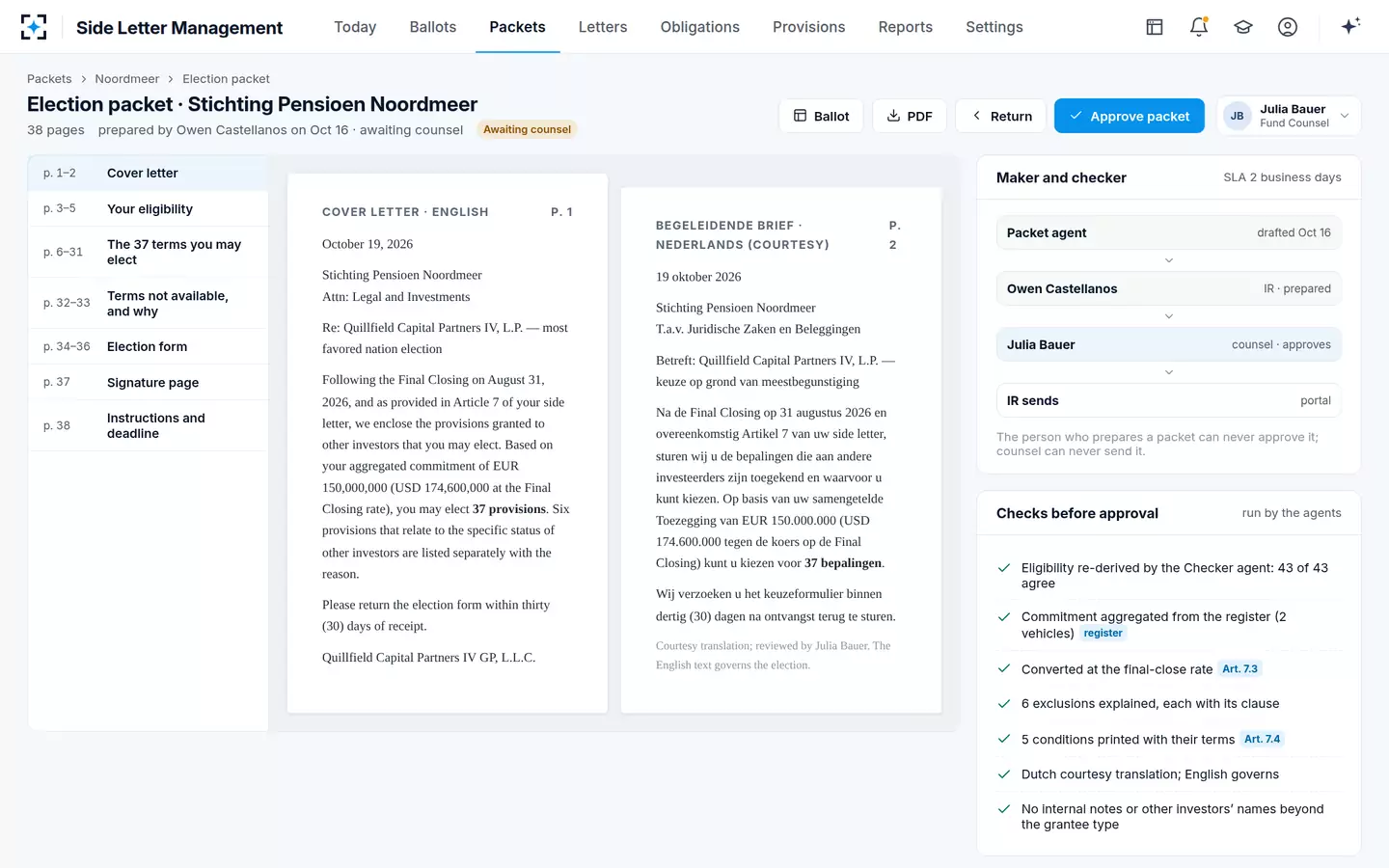
Two details in a packet cause most disputes later. The first is the excluded terms: a packet that simply omits them invites the question of what else was left out. Listing each with the clause that excludes it answers the question before it is asked. The second is conditions. Many side letter terms come with strings, such as an observer seat at the investor's own cost or information shared only under a non-disclosure agreement, and an election of the term is an election of its conditions. Printing the conditions with the term, and repeating them on the form, removes one of the commonest corrections in stage six.
The commitment arithmetic: aggregation, the exchange rate and a $0.4 million line
Eligibility usually turns on one comparison: is the investor's commitment at least as large as that of the investor who received the term? The comparison sounds trivial and is where by-hand seasons go wrong, because three inputs have to be right first.
Affiliates must be added together where the clause says so; under the sample fund's clauses, a pension fund investing directly and through a pooled vehicle counts as one investor. The exchange rate must be the one the clause fixes, in the sample fund the rate on the final-close date, not the rate on the day the packet is drafted. And the comparison must be on the exact commitment where the clause says "not greater than its own", even if the fund also uses tiers. In the sample, a corporate pension plan committed $175.0 million; the Dutch pension fund's two vehicles convert to $174.6 million at the final-close rate, so nine terms granted to the corporate plan stay locked by $0.4 million. At the rate on the day of the election it would pass, but the clause fixes the final-close rate.
The SEC's 2023 release noted the same design from the manager's side: managers use MFN rights to win early commitments, "offering earlier investors MFN provisions to convince them to commit to the fund early" (88 FR 63206, a release whose rules were vacated). The commitment line in the clause is the price of that bargain, and getting it exactly right is what makes the rest of the season defensible.
Where counsel's weeks go: re-reading and correcting
By hand, the largest blocks of counsel's time sit at both ends of the season: building the compendium from letters that have not been read since signing, and correcting elections that came back wrong. Both are rework. The compendium is often rebuilt because the one from the last fund was a summary, not a set of tests; the corrections happen because the forms did not stop an investor ticking a term it could not have.
That is where a second, independent check earns its place. In the sample season the solution's Checker agent re-derived every eligibility call on a ballot with a different model, blind to the first agent's answer, and held the packet wherever the two disagreed. On the Dutch pension fund it agreed with all 43 calls on the ballot. On a Japanese insurer it did not: the first agent had excluded a US insurer capital-data term as US-only, the second read the insurer's clause as testing the type of investor, not its country. That packet went to counsel with both readings and a question, rather than out to the investor with a wrong ballot.
The UK regulator has said what good looks like at the firm level. In its October 2026 review of conflicts in private markets, the FCA found that stronger firms treated MFNs and side letters as part of their investor-fairness frameworks, and that "Eligible investors were given opportunities to harmonise terms through MFNs where appropriate" (FCA multi-firm review, published 23/10/2026). A process that leaves eligible investors without a ballot, or with a wrong one, is the opposite of that finding.
How long the MFN election process ran in the sample firm's last four funds
Measured from final close to the last election confirmed, the sample firm's last four seasons with the solution ran between 58 and 71 days, inside the 90-day design target. Those are results on fictional sample data; a manager should measure its own last two seasons the same way before setting a target.
Days from final close to every MFN election closed, sample funds
What happens after an MFN election is confirmed?
Once counsel confirms an election, the elected terms become part of that investor's arrangement and every one of them is now a promise the fund must keep. A reporting term needs a report on a date; an excuse right needs a notice before a deal signs; an ESG term needs data from portfolio companies. Confirmation is therefore the start of the obligations, not the end of the work.
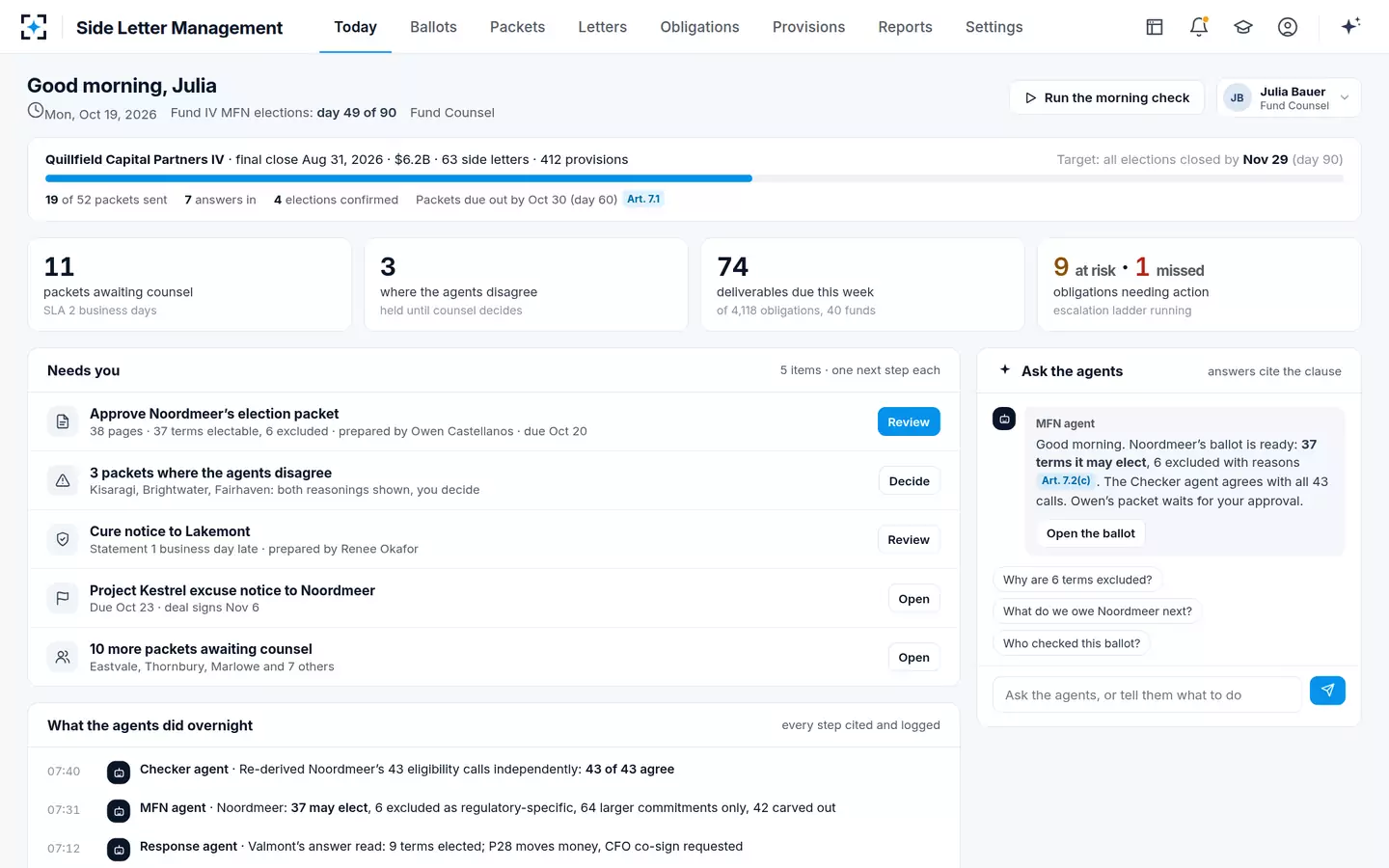
In the sample, each confirmed term becomes an obligation with an owner, a due date, how often it repeats and the evidence that proves delivery: the register holds 268 ongoing obligations for Fund IV and 4,118 across 40 funds. The first one due from the Dutch pension fund's own letter is an excuse notice for a tobacco distribution deal, 10 business days before signing. How such a register works is covered in the side letter tracker.
Fund counsel's day 49 in Side Letter Management: packets, disagreements and promises due
Where Side Letter Management fits in the MFN election process
The solution takes the mechanical stages: reading every letter in its own language, aggregating commitments, working out each call, drafting packets, reading answers and turning confirmed terms into dated obligations. People keep every decision that binds the fund: counsel approves each packet and every override with a reason, IR sends, the CFO co-signs terms that move money. It does not negotiate side letters, decide whether a term should have been granted, or replace counsel's reading of an ambiguous clause; when the clause is unclear, the agents put the question to counsel with both readings.
It is also not the fee engine. Testing the fund's fees and expenses against the LPA as amended by side letters is the job of Botminds' LPA Compliance, which reads elected terms as part of the governing set. To see the season end to end on your own letters, start from Side Letter Management.
Questions people ask
How does the MFN election process work?
After final close the manager compiles every grantable side letter term, works out which terms each MFN investor may elect under its own clause, sends each investor a packet with an election form, and confirms the elections that come back. Each confirmed term is then added to the investor's arrangement and kept like any other promise in its side letter.
Is there a legal deadline for MFN elections?
Not in US regulation: the SEC's 2023 preferential treatment rule, which would have required disclosure of preferential terms, was vacated in June 2024 and never set an election deadline anyway. Deadlines come from the fund's own documents, usually as a window counted from the day the investor receives its offer, so a manager that misses its own date has a contractual problem with that investor rather than a regulatory one.
Who receives an MFN election packet?
Every investor whose side letter grants an MFN right, and only those investors. In the sample fund that is 52 of 118 investors; the other 66 have no MFN right and receive no packet, though in the EU every investor must be told before investing how the fund handles preferential treatment, under Article 23(1)(j) of AIFMD.
Can an investor elect after the window closes?
Only if its clause or the manager allows it. A late election is a request, not a right, and accepting one for one investor can itself become a term others ask about, so a manager should decide the policy once and apply it to every investor alike.
Do open-end funds have an MFN election season?
No single season. As the SEC described in 2023, open-end fund investors are typically entitled to elect after the closing of their own investment, so elections arrive investor by investor, and the compendium has to stay current between them.