A side letter compendium is the list, prepared after a fund's final close, of every term the general partner granted to individual investors in side letters, with enough about each term for an investor holding a most-favored-nation (MFN) right to see whether it may elect it. Building one is hard because the terms sit in dozens of letters, signed months apart, some in other languages, and because a term is electable only after three tests that the compendium has to make possible: the grantee's commitment, the grantee's legal or regulatory status, and the classes the MFN clauses carve out. Botminds' Side Letter Management reads every letter in its own language, splits it into provisions cited to clause and page, and keeps the compendium as a set of tested terms rather than a summary, so each investor's ballot follows from it.
The examples come from a fictional fund run through the solution, Quillfield Capital Partners IV, L.P.: 63 side letters, 412 provisions, and a compendium of 171 grantable terms after final close on August 31, 2026.
From letters to a compendium in the sample fund
63
side letters signed before final close, some in Dutch and Japanese
412
provisions read and cited to clause and page
171
grantable terms in the compendium, each with its tests
52
investors whose MFN right the compendium serves
What is a side letter compendium?
A side letter compendium is a single document, or a structured table behind one, that gathers the grantable terms of all of a fund's side letters in one place. Managers prepare it for two readers. Internally, counsel uses it to work out each MFN investor's eligibility. Externally, a version of it, or an extract per investor, is what the investor's own lawyers read to decide what to elect.
It exists because the letters themselves are confidential to each investor and unreadable as a set. A fund with five dozen letters has hundreds of provisions, many saying the same thing in slightly different words. The compendium deduplicates them into terms, gives each a number, and holds the details the MFN clauses test. Done well, it also becomes the starting point for every promise the fund must keep after the elections, which is why it outlives the election season.
What is an MFN compendium, and how is it different from the side letters?
"MFN compendium" usually means the investor-facing version: the terms each MFN investor is offered, stripped of grantee names. It differs from the side letters in three ways. It is anonymised, so investor B learns that "a US public pension plan" received a term, not which one. It is normalised, so one notice term appears once even if several letters contain variants of it. And it is ordered by the tests the MFN clause applies, often by the commitment of the investor that received each term.
How an investor uses it depends on its clause. Begenau and Siriwardane, who read 91 limited partnership agreements from their sample, describe the range: some MFNs confer every other side letter's benefits automatically, while "Others give LPs the ability to opt into side letter provisions granted to LPs of a similar size and within a fixed window" (NBER working paper 29887, 2022; Journal of Finance, 2024). The second design, by far the more work for the manager, is the one a compendium has to serve: it must let each investor see which terms came from investors of its own size or smaller.
What goes in a side letter compendium: the columns, and what each must prove
A compendium needs one column for every test an MFN clause applies, plus the source and the conditions. Fewer columns, and every election season starts by re-reading the letters; more, and nobody keeps them current. The nine below are the set the sample fund's MFN clauses require, each with the question it answers.
Nine columns of a side letter compendium in Side Letter Management, and the test each carries
Term number and text
What it holdsThe provision in full, as signed, with a stable number (P28, X5)
What it must proveThat the investor elects the words, not a summary of them
Sample valueP28: 5% annual interest on excess capital returned more than 30 days late
Source
What it holdsLetter, article, page, and the language it was signed in
What it must proveWhere anyone can check the term; the original governs over a translation
Sample valueArtikel 7.2, page 4, Dutch original
Category
What it holdsReporting, notices, ESG, excuse rights, transfers, governance, fees, tax and regulatory
What it must proveWhich team will have to deliver it if it is elected
Sample valueExcuse rights
Grantee type
What it holdsThe kind of investor that received it, never its name
What it must proveConfidentiality kept while the reason for the term stays visible
Sample valueUS public pension plan
Grantee commitment
What it holdsAggregated across affiliates, at the rate the MFN clauses fix
What it must proveThe line each electing investor is compared against
Sample value$116.4M at the final-close rate
Status test
What it holdsWhether the term exists because of the grantee’s legal, tax or regulatory status, and which status
What it must proveWhich investors can never elect it, whatever their size
Sample valueERISA plan investors only
Carve-out class
What it holdsWhether the term falls in a class the MFN clauses exclude (economic terms, advisory committee seats, co-investment, first-closing terms)
What it must proveExclusions applied by rule, not by memory
Sample valueExcluded class (a): economic terms
Conditions
What it holdsWhat the electing investor must accept with the term
What it must proveThat an election carries its strings
Sample valueAt the investor’s own cost; under a written NDA
Money flag
What it holdsWhether the term changes fees, expenses, interest or payments
What it must proveWhich elections need the CFO before they bind the fund
Sample valueYes: interest paid from the general partner’s own funds
Two columns most compendia lack are the ones that cause the trouble. The status test is often a free-text note ("for ERISA investors"), which an IR analyst drafting forms at speed reads past. The money flag is often missing altogether, so a term that pays an investor interest out of the general partner's pocket is elected and confirmed before the CFO sees it. In the sample, one investor elected 9 terms including exactly such a term, and the solution held the confirmation for the CFO's co-signature.
Why the grantee's commitment column decides most calls
Under clauses that limit elections to terms granted to investors of equal or smaller size, the grantee's commitment is the column every call reads first. It has to be the right number: aggregated across the grantee's affiliated vehicles where the clause aggregates, converted at the rate the clause fixes, and frozen at that figure for the season.
An error in this column moves terms for every investor below the line. In the sample, a Japanese insurer committed JPY 24.0 billion, which at the final-close rate of 0.00671 is $161.0 million; terms it received are therefore open, subject to their status tests and carve-outs, to investors with commitments of $161.0 million or more, and closed to the rest. Record the insurer at today's rate instead and the line moves, along with the eligibility of every investor near it. The same test, run on electing investors, is worked through in the most favored nation clause in private equity.
The status column: carve-outs written as tests, not notes
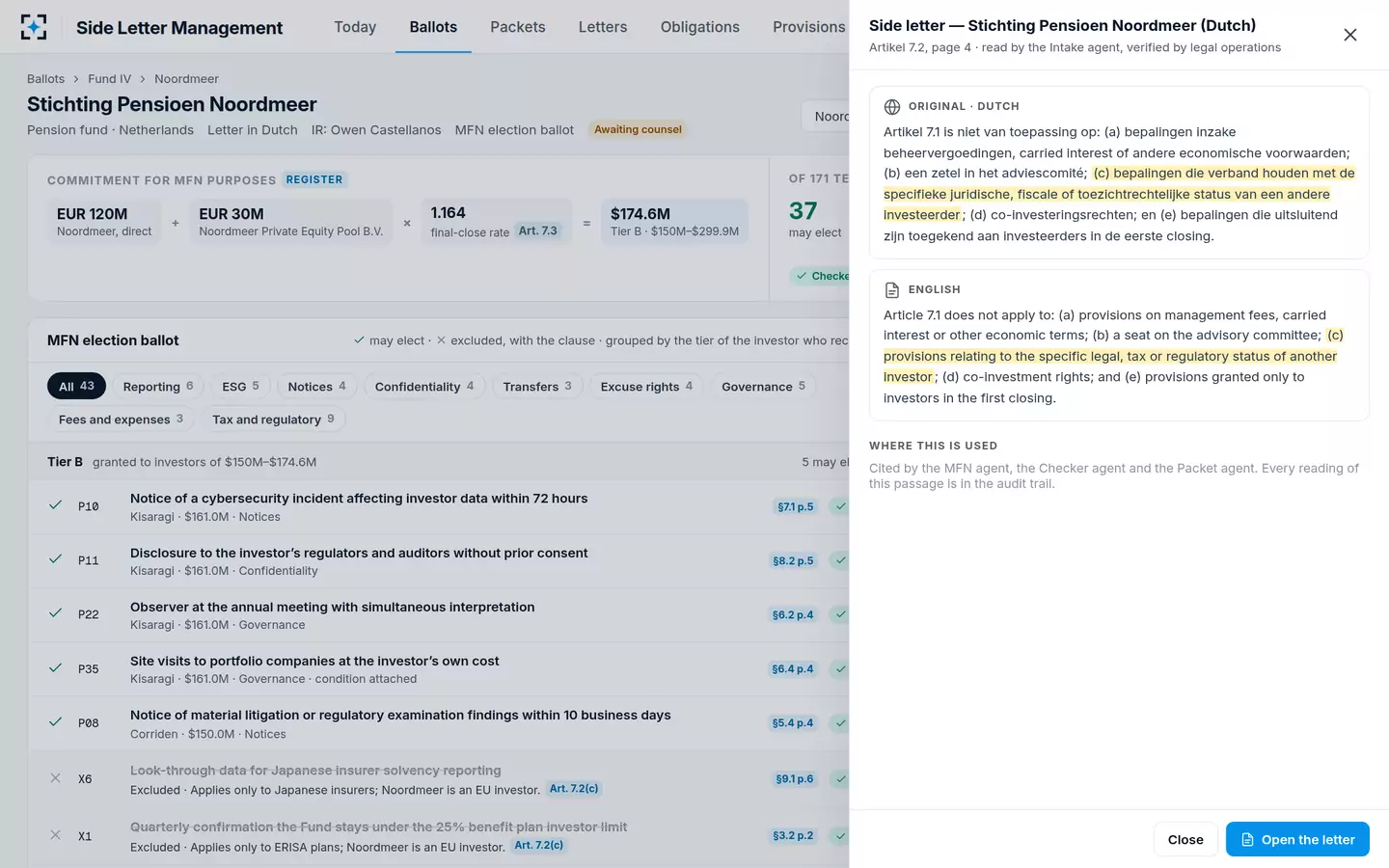
A status test says that a term exists because of who the grantee is, so only investors of the same kind may elect it. The sample investor's clause, Artikel 7.2 of a Dutch letter, lists five classes the MFN does not reach: provisions on management fees, carried interest or other economic terms; a seat on the advisory committee; provisions relating to the specific legal, tax or regulatory status of another investor; co-investment rights; and provisions granted only to investors in the first closing.
Written as a test, the status column names the status ("US insurer subject to risk-based capital reporting"), not just the topic. That precision matters at the edges. In the sample season, the two agents that work out eligibility disagreed over a term on US insurer capital data: one treated it as limited to US insurers, the other read a Japanese insurer's clause as testing the type of investor, not its country. A column that had said only "insurer data" would have hidden the question; one that said "US insurer" made it visible, and counsel decided it.
The clause behind a compendium term in Side Letter Management: Dutch original above the English
How many terms a compendium holds, and of what kinds
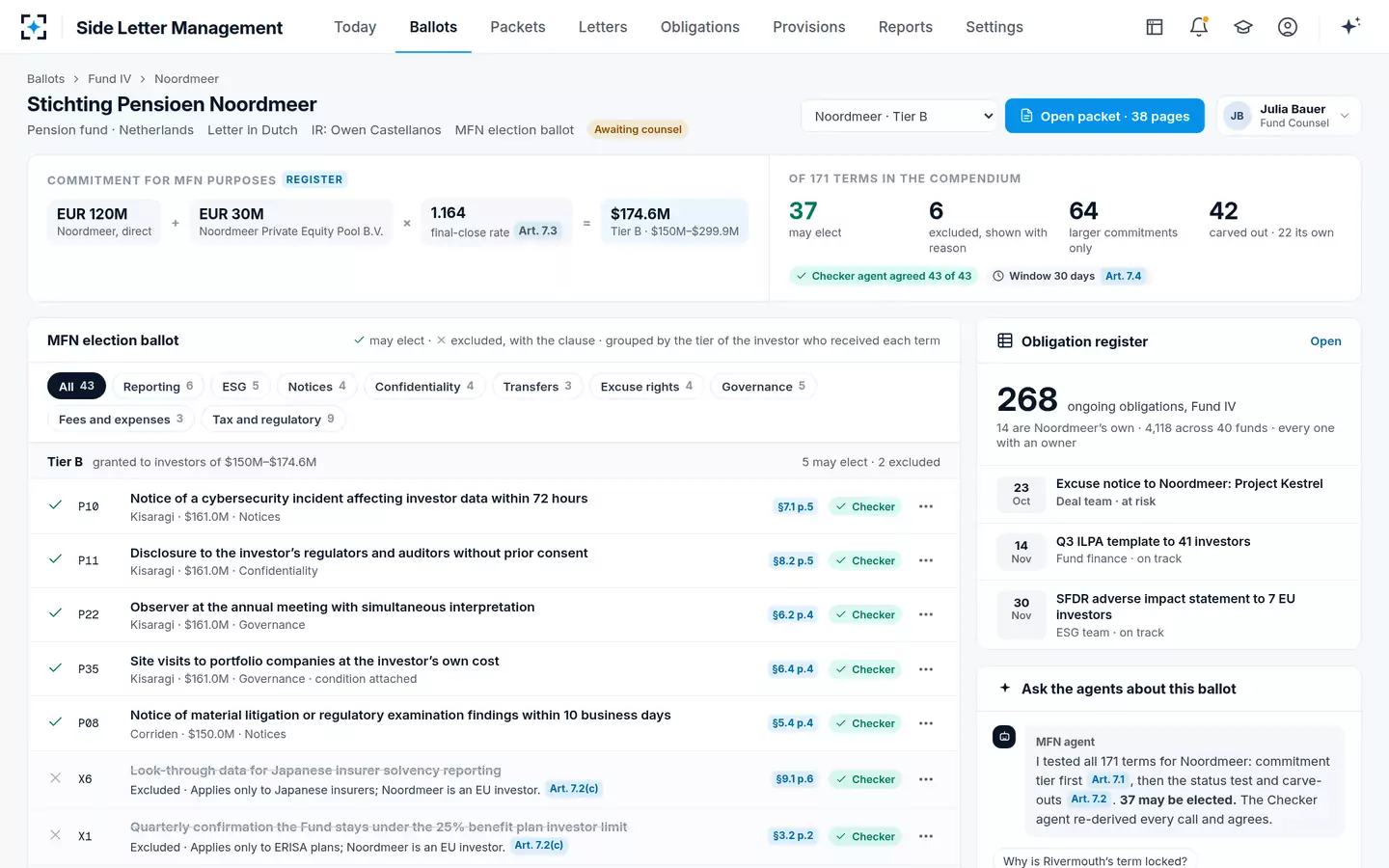
A compendium is smaller than the letters but rarely small. In the sample fund the 63 letters yield 171 grantable terms. For one Tier B investor, a Dutch pension fund with $174.6 million committed, 37 of them are electable, 6 are excluded because they depend on another investor's status, 64 were granted only to larger commitments, and the rest fall in carved-out classes or already sit in its own letter. The 43 terms on its ballot, the electable and the excluded together, spread across nine categories.
The 43 terms on one investor's ballot, by category
The shape shows what an MFN can and cannot move. Tax and regulatory terms are the largest group, and the most likely to carry status tests. Fees and expenses are the smallest: with management fees, carried interest and other economic terms carved out of the clause, parity on price is negotiated in the letter itself, not elected afterwards. What an MFN election is worth to an investor follows that consequence.
One investor's MFN election ballot, built from the compendium
Who prepares the side letter compendium?
Fund counsel owns the compendium, whether drafted in house or by the fund's outside counsel, because each column is a legal reading of a letter. The reading itself is often done by a junior lawyer or a legal operations analyst, and the commitment figures come from the fund administrator's investor register. That split is the source of most errors: the person reading the letter rarely holds the register, and the register rarely records which vehicles are affiliates for MFN purposes.
In the solution the split is kept but checked. The Intake agent reads each letter and cites each provision; any provision read below a 0.90 confidence threshold goes to a legal operations analyst, with the original language beside the English. The Investor agent matches each letter to the register, adds affiliated vehicles and converts at the final-close rate. Counsel approves every packet built from the compendium, and every reading of a cited passage, by a person or an agent, is kept on the audit trail.
Seven checks before a side letter compendium is released
- Every term cites its letter, article and page
A term without a source cannot be checked by the investor’s counsel, or by yours a year later.
- The signed language is the source
Where a letter was signed in Dutch or Japanese, the term is checked against that text; the English is a rendering.
- Grantee commitments match the register
Aggregated across affiliates and converted at the rate the clauses fix, with the rate and its date shown.
- Status tests name the status
“US insurer subject to risk-based capital reporting”, not “insurer data”.
- Conditions travel with each term
An observer seat at the investor’s own cost is a different term from an observer seat.
- Money terms are flagged
Fees, expenses, interest and payments need the CFO before any election binds the fund.
- No grantee is named
Grantee type only; check the investor-facing version for names left in conditions and footnotes.
Do investors see other investors' names in the compendium?
Usually not: the investor-facing compendium identifies each grantee by type, such as "a sovereign wealth fund" or "a US insurer", because side letters are confidential to the investor that signed them. The type is still necessary, since it is what explains a status test. A Dutch pension fund told only that a term is excluded "because of the grantee's status" cannot check the call; told that the grantee was an ERISA plan, it can.
Names leak in the details. A condition that refers to "the State Comptroller's annual request", or a reporting term built around one investor's own template, can identify the grantee as surely as a name. The sample packets therefore run a final check before approval: no investor names beyond the grantee type, in any term, condition or footnote.
What regulators expect a compendium to support
No regulation requires a document called a compendium, but three rules require what it holds. In the US, the Advisers Act lists among the records a private fund adviser must keep and make available to the SEC "side arrangements or side letters, whereby certain investors in a fund obtain more favorable rights or entitlements than other investors" (15 U.S.C. 80b-4(b)(3)(F)). That provision was added in 2010 and was not part of the 2023 rules the Fifth Circuit vacated in 2024.
In the EU, AIFMD requires a description of preferential treatment to every investor before it invests, and the reporting template every EU manager files with its national regulator asks the question directly:
“Are there any investors who obtain preferential treatment or the right to preferential treatment (e.g. through a side letter) and therefore are subject to disclosure to the investors in the AIF in accordance with Article 23(1)(j) of the AIFMD?”
Commission Delegated Regulation (EU) No 231/2013, Annex IV, AIF-specific information for competent authorities, item 23(c)
The next line of the template asks the manager to say whether that treatment concerns disclosure and reporting, liquidity terms, fee terms or something else, which is the category column by another name. The reporting article behind the template is rewritten by AIFMD II, with the new reporting applying from 16 April 2027 (Directive (EU) 2024/927, Article 3), so a manager should expect the template to change, not the question to disappear. In the UK, the FCA's October 2026 review found that stronger firms "maintained structured governance around preferential rights" (FCA multi-firm review, 23/10/2026); a compendium kept as tested terms, with versions and approvals, is what that looks like on paper.
The compendium is also where tracking side letter obligations should start, because every confirmed election adds terms to it. To see the compendium built from your own letters, start from Side Letter Management.
Questions people ask
When is the side letter compendium prepared?
After the final close, once no further side letters will be signed for the fund. A compendium drafted earlier has to be re-cut for every later letter, and an MFN investor's rights are often measured against all letters signed through the end of fundraising.
Is the compendium the same as a side letter matrix?
The words overlap in practice. "Matrix" often means the internal grid of terms against investors, showing who has what; "compendium" the list of grantable terms offered to MFN investors. Both draw on the same columns, and a well-kept set of tested terms produces either.
Does a compendium include terms from the LPA?
No. Terms in the limited partnership agreement already apply to every investor, so they are not offered by MFN. A side letter term that merely restates the LPA is left out; one that changes it for one investor goes in.
How often should the compendium be updated?
Whenever a side letter is amended, a new investor is admitted by transfer with its own letter, or an election is confirmed. Each change should create a new version, so the ballot any investor received can be reproduced on the day it was sent.
Can an investor ask to see the full compendium rather than its own ballot?
It can ask, and many managers send the whole anonymised list with the investor's own eligibility marked. A per-investor ballot is easier to answer correctly, but showing the excluded terms with their reasons is what lets the investor's counsel check that nothing was left out.