The difference between a side letter and an amendment is who is bound and who had to agree. An amendment changes the limited partnership agreement (LPA) itself, for every partner, and needs whatever consent the LPA's amendment clause requires, often a majority or supermajority of investors and sometimes every affected one. A side letter is a separate contract between the general partner and one investor, signed without the others' consent, that gives that investor rights or accepts duties the LPA does not give everyone. The choice matters long after signing: a side letter term can travel to other investors through their most-favored-nation (MFN) clauses, and in the EU and UK it is preferential treatment that must be described to investors before they invest. Botminds' Side Letter Management reads the LPA's MFN section and every side letter as one set, so each investor's terms, and what others may elect, follow from the documents as signed.
Four documents, and who each one binds
What is the difference between a side letter and an amendment?
An amendment rewrites the bargain for everyone; a side letter adds a bargain for one. Everything else follows from that. Because an amendment binds every partner, it needs the consent the LPA's amendment clause sets, and once made it applies without any election. Because a side letter binds only the general partner and its counterparty, the other investors need not agree to it, may never see it, and receive its terms only if their own MFN clause lets them elect them.
Side letter vs amendment, point by point
Side letter: The general partner (sometimes the fund) and one investor.
Amendment to the LPA: The partnership, under the LPA’s own amendment clause.
Side letter: Only the parties who sign it, within any limits the LPA sets on side letters.
Amendment to the LPA: Whoever the amendment clause names: often a majority or supermajority of investors, and every affected investor for listed changes.
Side letter: The general partner, to that investor.
Amendment to the LPA: Every partner, whether or not it signed.
Side letter: Usually confidential; others see the terms, anonymised, only through an MFN process or a disclosure.
Amendment to the LPA: Delivered to all partners as part of the governing documents.
Side letter: Its terms may become electable by other MFN investors, within their clauses.
Amendment to the LPA: Applies to all already; there is nothing to elect.
Side letter: Preferential treatment: described to investors before they invest (AIFMD Art. 23(1)(j); FUND 3.2.2R).
Amendment to the LPA: A material change to the fund’s terms, notified under the same disclosure rules.
Side letter: Reporting formats, notices, excuse rights, ESG data, confidentiality carve-outs, fee terms for size, an MFN clause.
Amendment to the LPA: Term extensions, investment limits, fee basis, key person provisions, structural changes.
Is a side letter part of the LPA?
Under Delaware law it can be, depending on how the documents are drawn. The Delaware Revised Uniform Limited Partnership Act defines the partnership agreement broadly, as any agreement among the partners, whether written, oral or implied, about the partnership's affairs and how its business is conducted (6 Del. C. § 17-101(14)). A side letter signed by the general partner and a limited partner about how the partnership will report to that partner, or which deals it may be excused from, is an agreement of partners about the partnership's affairs, and so may fall within that definition. Whether it does in a particular fund, and how it ranks against the LPA if they conflict, is for counsel, and the LPA often settles it. Begenau and Siriwardane describe the common position: the LPA's terms "are often superseded by additional agreements (so-called 'side letters') that are negotiated bilaterally between the GP and individual LPs" (NBER working paper 29887, 2022; Journal of Finance, 2024). In three-quarters of the 91 agreements they read, the general partner had sole discretion to sign one with any investor, a finding Botminds' LPA key terms guide sets out.
Does a side letter override the LPA?
For the investor that holds it, usually yes, because the LPA says so; for everyone else, no. A well-drafted LPA authorises the general partner to enter side letters and provides that a side letter governs over the LPA as between the general partner and that investor. It cannot, without an amendment, take away a right the LPA gives the other investors, because they never agreed to it.
That limit is where disputes start. A side letter that excuses one investor from a capital call for a type of deal is fine; one that lets an investor withdraw ahead of others, or that moves costs onto the fund, changes the other investors' position, and its terms may need their consent, an advisory committee's approval or, at minimum, disclosure. Delaware gives the agreement wide room as a matter of declared policy, favouring freedom of contract and the enforcement of partnership agreements as written (6 Del. C. § 17-1101(c)). Freedom of contract cuts both ways. It enforces what the partners agreed, including the LPA's own limits on side letters.
Who has to consent to an LPA amendment?
Whoever the LPA's amendment clause names, and nobody else, if the clause is complete. Delaware's rule is short:
“If a partnership agreement does not provide for the manner in which it may be amended, the partnership agreement may be amended with the approval of all the partners or as otherwise permitted by law”
6 Del. C. § 17-302(f), Classes and voting
Where the agreement does provide a manner, the same subsection says it may be amended only in that manner or as the law otherwise permits. The same section adds that limited partners vote only on matters the statute or an agreement specifies, or where the general partner chooses to seek their vote.
In practice, read the amendment clause for the three kinds of change it may distinguish: those the general partner may make alone (correcting errors, complying with new law), those needing a majority or supermajority in interest of the investors, and those needing every affected investor (reducing commitments returned, increasing an investor's obligations). Getting the class right matters more than getting the vote: an amendment passed by the wrong threshold is open to challenge by the investors whose consent was needed.
Side letter vs addendum, and side letter vs MOU
An addendum attached to the LPA and signed under its amendment clause is an amendment by another name; one signed only by the general partner and one investor is a side letter by another name. The label does not decide; the parties and the process do. A memorandum of understanding is different again: it usually records intentions and is often expressly non-binding, while a side letter is a binding contract.
Side letter, amendment, addendum, MOU: four documents people confuse
| Document | Who signs | Binding? | Effect on other investors |
|---|---|---|---|
| Amendment to the LPA | The partnership, under the LPA’s amendment clause | Yes, on every partner | Changes their terms too |
| Addendum | Depends on the process used | Yes | An amendment if made under the amendment clause; otherwise none |
| Side letter | The general partner and one investor | Yes, between them | None directly; its terms may be elected through MFN clauses |
| Memorandum of understanding | The parties to the discussion | Often expressly not | None |
When should a term go in the LPA instead of a side letter?
A term belongs in the LPA, by amendment if the fund is already formed, when it changes what other investors bear or receive, when it should apply to every investor, or when the fund's rules are where the law expects it to be disclosed. Under AIFMD, preferential treatment is permitted only where it is disclosed in the fund's rules or instruments of incorporation (Directive 2011/61/EU, Article 12(1)(f)), which pushes an EU manager to describe in the LPA how side letters and MFNs work, even when the terms themselves stay in the letters.
Five tests for side letter or amendment
- Does it change what other investors bear or receive?
Liquidity ahead of others, costs moved onto the fund, a different waterfall: amendment, consent or at least disclosure.
- Should every investor have it?
If the general partner would grant it to anyone who asked, put it in the LPA and save every MFN election.
- Is it tied to this investor’s status?
Records law, ERISA, insurer capital data: a side letter, with the status stated so MFN clauses can carve it out.
- Will regulators expect to see it in the fund’s rules?
Under AIFMD, the treatment must be disclosed in the fund documents; the description belongs there.
- Can the team that must deliver it see it?
A promise buried in one letter is the one most likely to be missed; record it as an obligation either way.
Four promises from the sample fund, and where each belongs
The tests are easier to apply to real terms than to principles. Four from the sample fund's letters show the range, and why the answer is not always the side letter.
An excuse from thermal coal. One pension fund's letter excuses it from investing in companies earning over 30% of revenue from thermal coal. It changes nothing for anyone else unless excused capital has to be made up, and it reflects that investor's policy, so it sits well in a side letter. The cost is downstream: once elected by others through their MFN clauses, it becomes an excuse notice the deal team must send before each relevant signing, and a promise that can be missed.
A quarterly confirmation under the 25% benefit-plan limit. A US plan's letter asks the general partner to confirm each quarter that the fund stays under the 25% benefit-plan investor limit. It exists because of that investor's ERISA status, so it belongs in its letter, labelled with the status, so that MFN clauses carving out status-specific terms exclude it cleanly.
Interest on capital returned late. Term P28 in the sample pays 5% annual interest on excess capital returned more than 30 days late, from the general partner's own funds. It is economic, it moves money, and it is the kind of term that spreads through MFN clauses that do not carve out economic terms. If the manager would grant it to anyone who asked, the LPA is the honest place for it; if not, the side letter should say so, and the MFN clauses should carve it out.
A term extension. Extending the fund's term changes every investor's position, often with fee consequences, so it is an amendment or a consent under the LPA's term clause, never a side letter. A side letter cannot give one investor a different fund life. How extensions are approved is covered in Botminds' fund term extension guide.
Why the choice decides who can elect a term under an MFN
Putting a term in a side letter does not keep it with one investor if others hold MFN rights; it makes the term a candidate for every MFN investor whose clause reaches it. A reporting format granted to one pension fund may be elected by twenty. A fee break granted for size may be elected by every investor of equal or larger commitment if the clause does not carve out economic terms. Drafting a side letter is therefore also drafting, in part, the next MFN season.
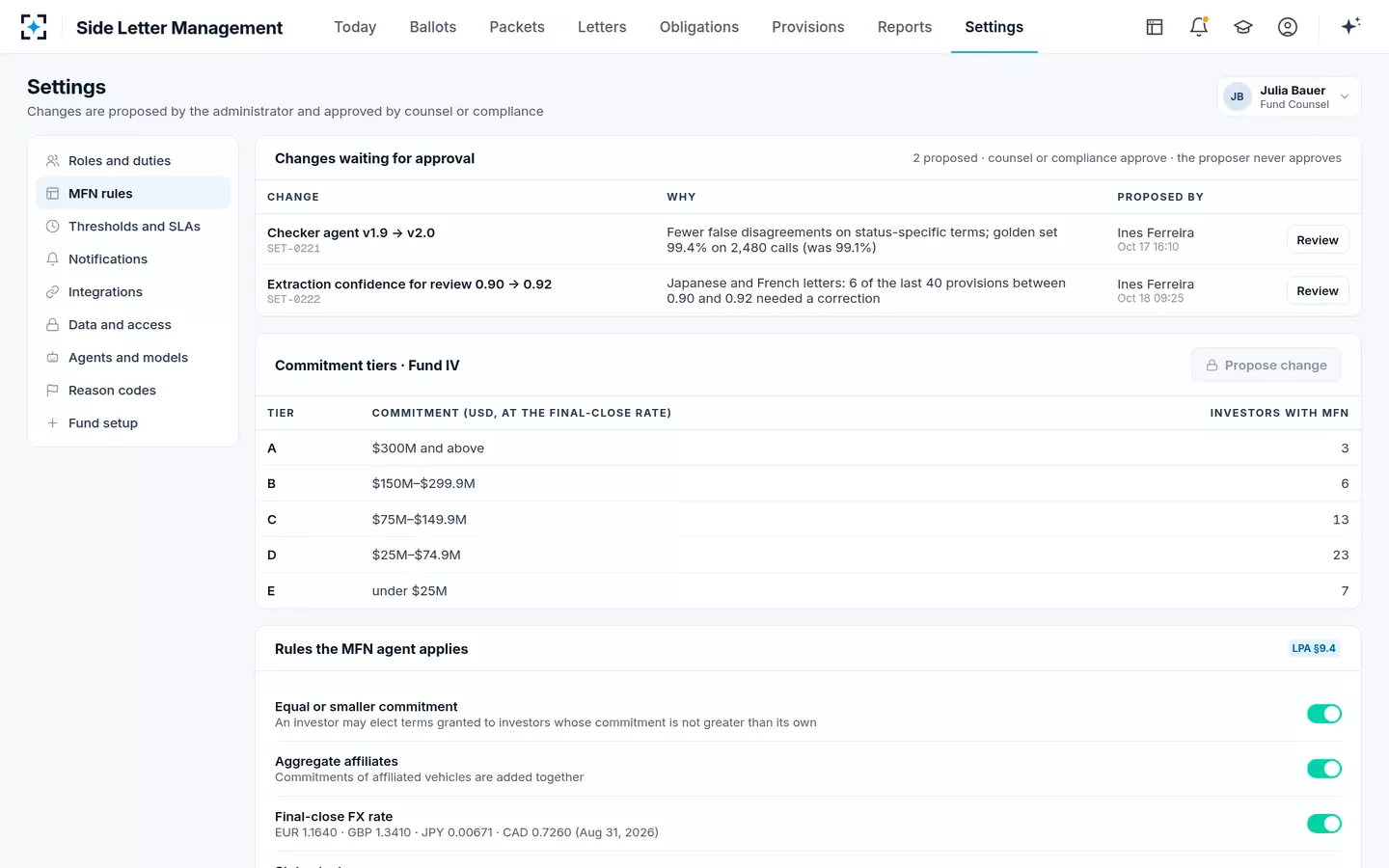
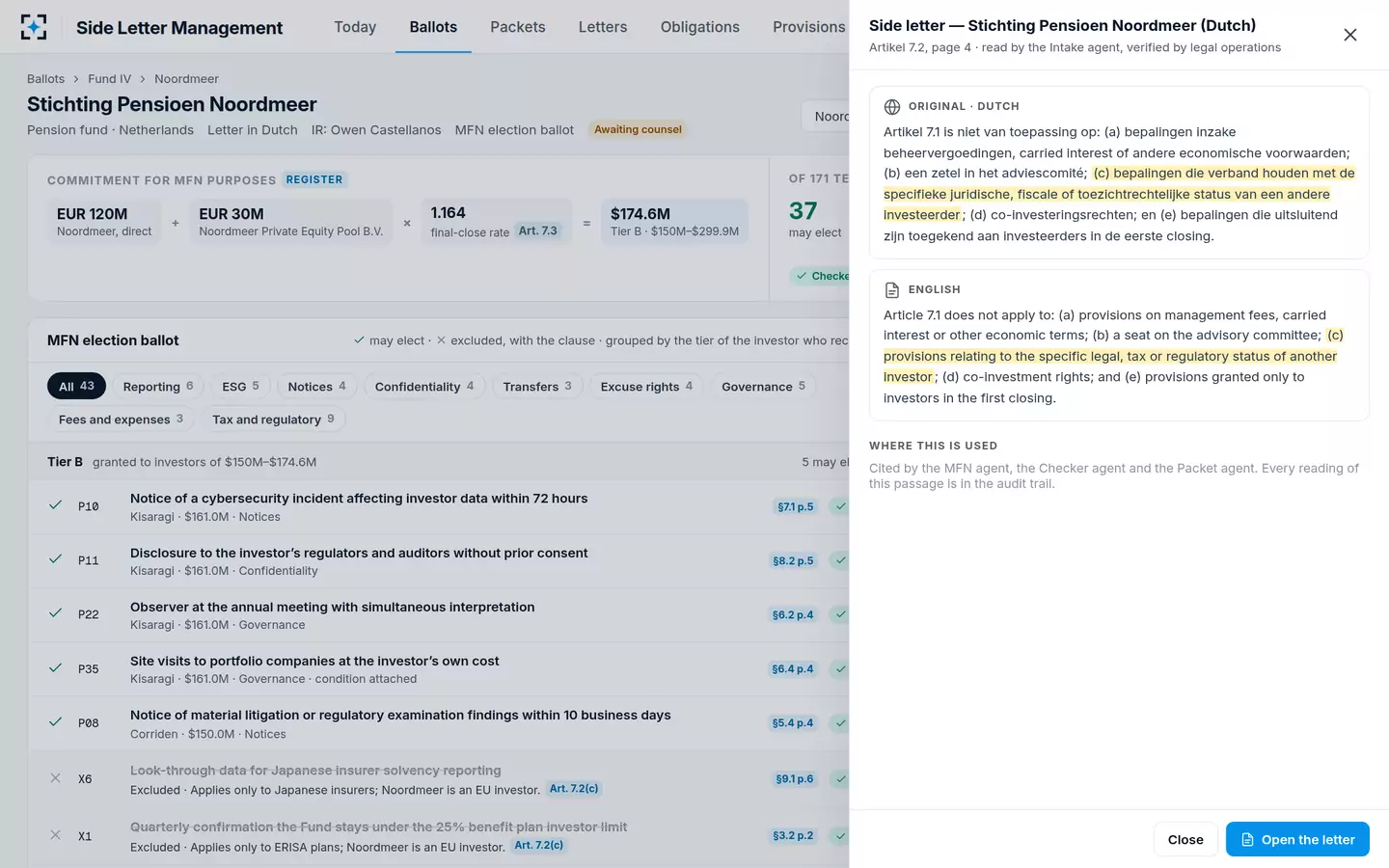
The sample fund in Side Letter Management shows both halves. Its MFN framework sits in the LPA, at §9.4, which sets the election window and the tests; each investor's own right sits in its letter, such as Article 7 of a Dutch pension fund's, which carves out economic terms, an advisory committee seat, status-specific terms, co-investment and first-closing terms. The agents read both: the LPA for the rules every election follows, the letter for what this investor may take. How each MFN call is tested covers the clause in detail.
The MFN rules the agents apply, from the LPA, in Side Letter Management
What each route must disclose
An amendment is disclosed by being delivered: every partner receives it. A side letter is disclosed, where it must be, by describing it. In the EU, the description of preferential treatment, the types of investor receiving it and their links to the fund or manager must be available before investors invest, under AIFMD Article 23(1)(j); in the UK, FUND 3.2.2R carries the same items for full-scope UK managers (FCA Handbook, FUND 3.2). In the US no rule requires the side letter itself to be disclosed, but anti-fraud law forbids misleading investors about it. Side letters in private equity: the rules sets out each regime.
The practical consequence is that a side letter leaves a trail an amendment does not: the letter, its description in the offering documents, any MFN elections it triggers, and the obligations it creates. Each has to stay consistent with the others for the life of the fund.
A side letter clause read in its signed language, in Side Letter Management
To see an LPA's MFN section and every side letter read together, start from Side Letter Management.
Questions people ask
Can a side letter be amended?
Yes, by the parties to it, under its own terms. An amended side letter may change what other MFN investors can elect, so a manager should treat each amendment as a new grant and check whether it re-opens elections under the MFN clauses already in force.
Do other investors have to approve a side letter?
Not unless the LPA requires it. Many LPAs authorise the general partner to sign side letters at its discretion; some reserve certain terms, such as those affecting other investors' economics, for advisory committee approval or investor consent.
Is a side letter confidential?
Usually, by its own terms. Confidentiality gives way to the law: regulators can require it, EU and UK rules require the preferential treatment to be described to other investors, and MFN processes share its terms, anonymised, with investors entitled to elect them.
Can the general partner amend the LPA without investors?
Only where the LPA allows it. Delaware permits an agreement to provide for amendments without a limited partner vote, and an LPA may let the general partner make administrative or legally required changes alone; anything else needs the consent the amendment clause sets.
What happens if a side letter conflicts with the LPA?
The LPA's precedence clause usually decides: for the investor holding it, the side letter governs; for other investors, the LPA stands. Where the LPA is silent, the conflict is a question of contract interpretation for counsel and, if it comes to it, a court.