A most favored nation (MFN) clause in private equity is a side letter provision under which the general partner agrees that an investor may take, after the fund's final close, terms granted to other investors in their side letters, subject to limits the clause sets, such as the size of the other investor's commitment, the legal, tax or regulatory status the term depends on, and whole classes of terms carved out. Every MFN election therefore rests on dozens of eligibility calls, one per term, and each can be disputed by an investor who thinks it was offered too little. A call holds up when it shows the clause, the commitment test, the status test, the carve-out and who approved it, the same tests a disputing investor or an examiner will apply. Botminds' Side Letter Management records exactly that for every call: the clause and page, the inputs, each test's result, an independent second check, and counsel's approval.
Six tests every most favored nation call must pass in Side Letter Management
- Entitlement: does this investor hold an MFN right, and is the window open?
From its own side letter and the LPA’s MFN section; a late election is a request, not a right.
- Commitment: was the term granted to an investor no larger than this one?
Commitments aggregated across affiliates and converted at the rate the clause fixes, compared exactly.
- Status: does the term depend on another investor’s legal, tax or regulatory position?
If so, only investors with the same status may elect it, as the clause defines “same”.
- Carve-outs: does the term fall in a class the clause excludes?
Economic terms, advisory committee seats, co-investment, first-closing terms, or whatever this clause lists.
- Conditions: what must the investor accept with the term?
Printed with the term and repeated on the election form.
- Approval: who decided, with what reason, and was it checked?
An independent second reading and a named approver with a reason code.
What is a most favored nation clause in private equity?
It is a promise of parity, with exceptions. The SEC's 2023 rulemaking described the investor's position this way: "An MFN investor may have, for example, subject to certain restrictions, the ability to receive substantially the same rights granted by the fund or the adviser in any side letter or similar agreement that are materially different from the rights granted to the MFN investor" (88 FR 63206, September 14, 2023). The rules that release adopted were vacated by the Fifth Circuit in June 2024; the description of practice stands as the SEC's account of how the clauses work.
Beyond that core, the clauses differ widely. Begenau and Siriwardane, who read 91 limited partnership agreements, put it in one line: "The nature of MFNs and carve outs that apply to them vary across LPAs" (NBER working paper 29887, 2022; Journal of Finance, 2024). Some confer every other side letter's benefits automatically. In the other design, the investor opts into terms granted to investors of similar or smaller size within a window, which creates far more work for the manager. That is the design the tests on this page apply to.
How do commitment tiers work in MFN clauses?
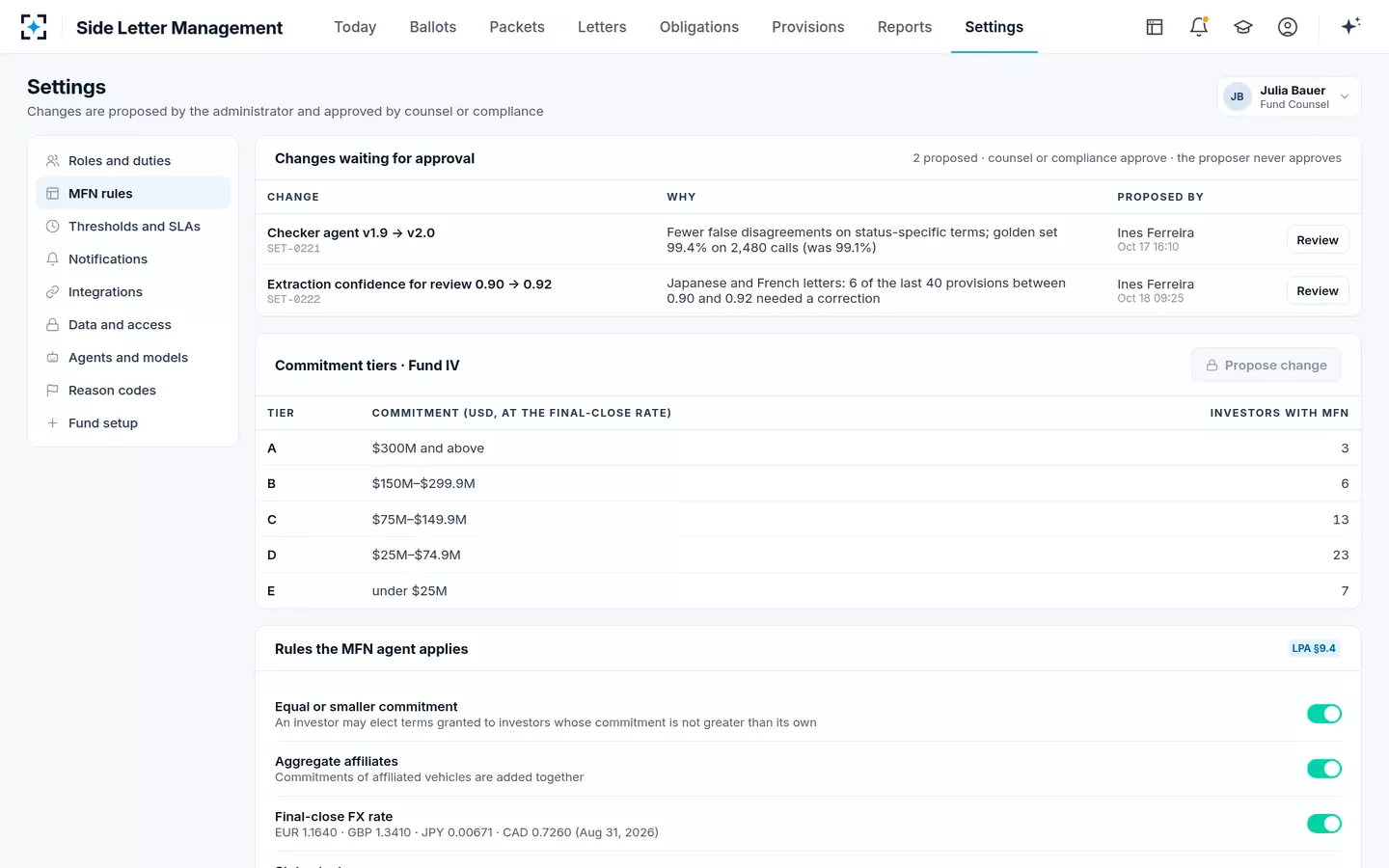
Commitment tiers group investors by size so that each can see which terms its size unlocks; the clause's own test then decides each term. The sample fund's MFN rules set five tiers in US dollars at the final-close rate, and 52 investors hold an MFN right across them.
Investors with an MFN right in the sample fund, by commitment tier
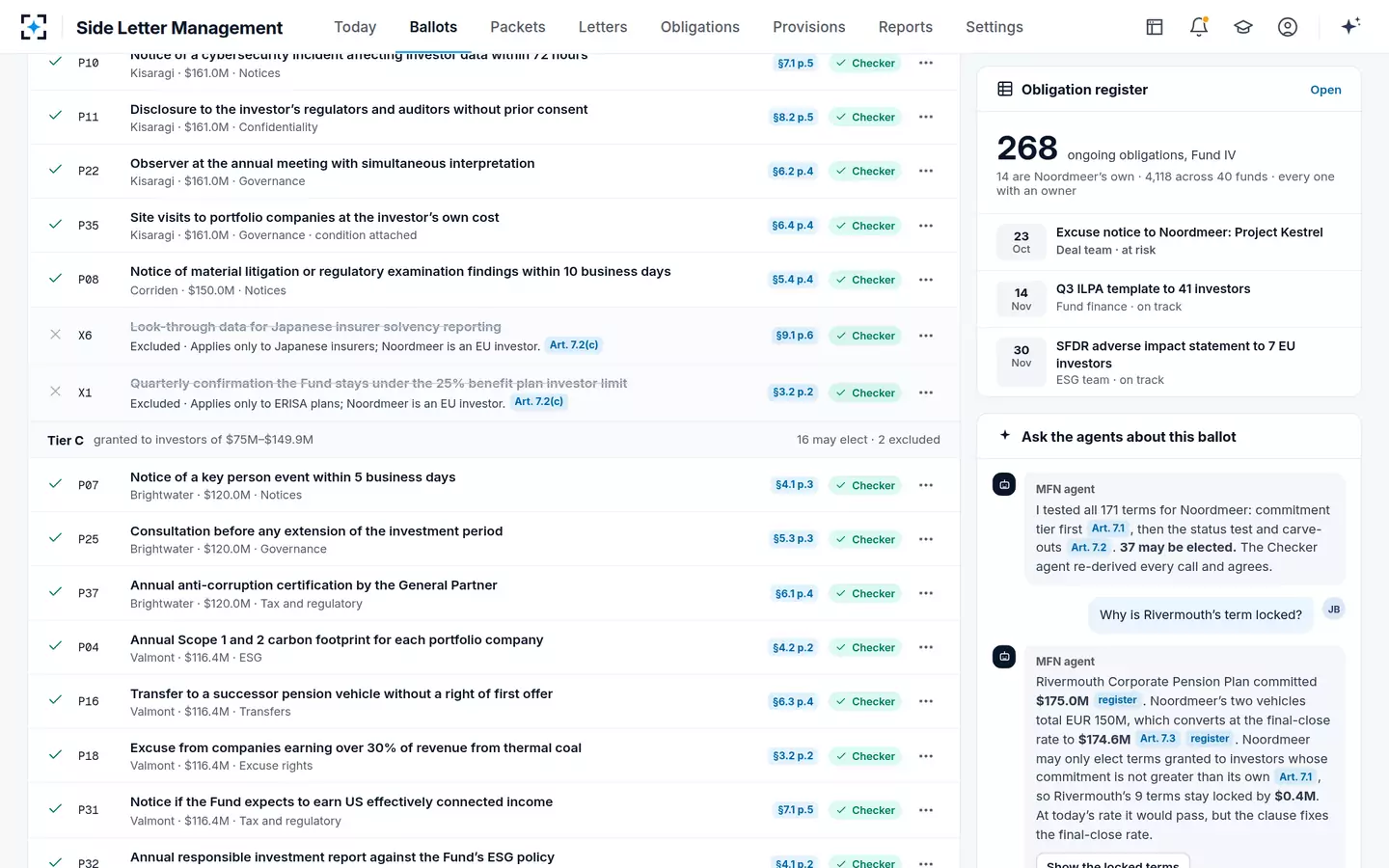
Tiers are a convenience, not the test. Where the clause says an investor may elect terms granted to investors whose commitment is "not greater than its own", the comparison is exact, and two investors in the same tier can be on opposite sides of it. In the sample, a Dutch pension fund's two vehicles total EUR 150 million, which at the final-close rate is $174.6 million; a corporate pension plan in the same tier committed $175.0 million, so the nine terms the plan received stay locked for the Dutch fund by $0.4 million. A ballot that grouped terms only by tier would have offered them.
How are affiliated investors' commitments counted for an MFN?
Together, where the clause aggregates affiliates, which the sample fund's does: the commitments of an investor's affiliated vehicles are added before the comparison. The Dutch pension fund committed EUR 120 million directly and EUR 30 million through a pooled vehicle it controls; counted separately, neither would reach Tier B. The aggregation decides its tier, and with it every term granted to investors with commitments between $139.7 million, its direct commitment converted, and $174.6 million.
The difficulty is knowing which vehicles are affiliates. Investor registers record legal holders, not MFN families, and a pension fund's pooled vehicle may be registered under a different name and administrator. In the solution, the Investor agent matches each letter to the register and adds vehicles the letter or the register links; if a status or an affiliate is missing, it holds the packet rather than guessing, because an under-counted commitment silently removes terms the investor is owed.
Which exchange rate applies to an MFN commitment test?
The one the clause fixes, which in the sample fund is the rate on the final-close date, August 31, 2026: EUR at 1.1640, GBP at 1.3410, JPY at 0.00671 and CAD at 0.7260 to the dollar. Fixing the rate keeps the test stable for the whole season. Without it, an investor's eligibility could change between the day its packet is drafted and the day it is answered.
The fixed rate cuts both ways, which is why it has to be applied consistently. The Dutch pension fund's $0.4 million shortfall against the corporate plan would disappear at the rate on the day of the election, but its clause fixes the final-close rate, so the terms stay locked. A call that used today's rate for one investor and the final-close rate for another would be indefensible to both.
A cited answer on a locked term, beside the ballot in Side Letter Management
What terms are usually excluded from an MFN?
No regulator or independent study counts which classes MFN clauses exclude, so the useful answer is the reasons behind each class. The sample investor's clause excludes five, and each has a rationale that explains why such classes appear in MFN clauses at all.
Five classes one MFN clause carves out, and why
| Class carved out | Why it is carved out | Sample example |
|---|---|---|
| Management fees, carried interest and other economic terms | Often the price paid for size or an early commitment; extending them would undo the bargain | A fee break granted for a large first-close commitment |
| A seat on the advisory committee | The committee has a fixed number of seats | An observer or member seat |
| Terms tied to another investor’s legal, tax or regulatory status | They make sense only for investors with that status | ERISA plan-asset reporting; insurer solvency data |
| Co-investment rights | Allocated deal by deal, under the firm’s allocation policy | A right to be offered co-investment |
| Terms granted only to first-closing investors | The reward for committing before the fund had momentum | A reporting or fee term for first-close investors |
What is a status-based carve-out?
A status-based carve-out excludes from the MFN any term that exists because of another investor's legal, tax or regulatory position. In the sample, six terms on a Dutch pension fund's ballot fall under it: ERISA plan-asset reporting, US public records law and pay-to-play representations, Bank Holding Company Act passivity, US insurer capital data and Japanese insurer solvency data. None applies to an EU pension fund, so all six are excluded and shown with the reason.
The carve-out is defined by words, and words leave room. The sample investor's clause excludes provisions relating to the "specific legal, tax or regulatory status of another investor"; a Japanese insurer's clause speaks of "same regulatory status". Whether a US insurer capital-data term is open to a Japanese insurer depends on whether that phrase means the same type of investor or the same regulator. The solution's two agents read it differently, and the call went to counsel. In the same season counsel overrode the opposite error, making electable a term an agent had excluded from a fund of funds' ballot as status-specific. Status calls are where a second reading earns most, which is set out in side letter compliance with a second model.
Can an investor dispute an MFN call?
Yes. An MFN clause is a contract term, and an investor that believes it was offered too few terms, or the wrong ones, can raise it like any other breach of its side letter. Under Delaware law the parties have wide freedom to shape their bargain, with one floor: duties can be expanded, restricted or eliminated by the agreement, but not the covenant of good faith and fair dealing that the law implies into it (6 Del. C. § 17-1101(d)). A call made on an undisclosed reading, or applied differently to different investors, is the kind of conduct an investor would test against that covenant.
The regulators' interest follows when the treatment of investors is unfair or concealed. Among the admissions in the SEC's 2013 settlement with Philip Falcone and Harbinger Capital Partners, a hedge fund case about preferential redemptions, was that the adviser "failed to honor Most Favored Nation ('MFN') provisions with certain investors" (SEC v. Falcone, S.D.N.Y., final consent judgment). The SEC's case rested on the concealment and harm to other investors, not on the MFN breach alone, but the admission shows how an unhonoured MFN appears once a regulator looks. In the UK, the FCA found stronger firms "considered the implications of preferential rights for investor fairness and used disclosure, LPAC engagement and escalation processes where appropriate" (FCA multi-firm review, 23/10/2026).
The file that makes an MFN call defensible
A call is defensible when someone who disagrees with it can follow it from the clause to the result without asking the person who made it. That means the clause and page, the inputs with their sources, the result of each test, the second check and the approval, kept together for each term and each investor.
One MFN call, as kept: a status exclusion on a Dutch pension fund's ballot
- Clause
- Article 7.1 (MFN right) and 7.2(c) (status carve-out), page 4 of the signed Dutch letter; English rendering beside it
- Inputs
- Commitment EUR 150M across two vehicles × 1.164 (final-close rate, Art. 7.3) = $174.6M, Tier B; status: EU pension fund
- Term
- X1: quarterly confirmation that the fund stays under the 25% benefit-plan investor limit; granted to an ERISA plan in Tier B
- Commitment test
- Passed: the grantee committed between $150M and $161M, not more than $174.6M
- Status test
- Failed: the term applies only to ERISA plans; the investor is an EU pension fund
- Carve-out
- Art. 7.2(c): provisions relating to the specific legal, tax or regulatory status of another investor
- Result
- Excluded, shown on the ballot greyed with the reason and the clause
- Second check
- Checker agent, different model, re-derived blind: agrees
- Approval
- Fund counsel, reason AP-01 (eligibility agrees with the MFN clause), with name and time
The excluded call is the one most worth keeping in full. An investor rarely disputes a term it was offered; it disputes one it was not. A ballot that shows the excluded terms greyed with their reasons answers the dispute before it starts, and a file like the one above answers it if it comes.
“Does ‘same regulatory status’ in §9.2 mean any insurer, or a US insurer?”
Fund counsel's question on a held ballot in the fictional sample season, Side Letter Management
Applying one reading everywhere: precedent
Once counsel decides what a clause means, the decision should bind every identical clause in the fund, and in later funds with the same words. Otherwise two investors with the same MFN clause get different ballots, which is the inconsistency a disputing investor looks for first.
In the solution, counsel's overrides carry a reason code, and one of them, OV-03, counsel's interpretation, is applied as precedent: the agents use that reading on every letter with the same wording and show it as counsel's ruling, with the date and the original call. Rules that apply to every election, such as the tiers, the equal-or-smaller test and the final-close rate, are settings drawn from the LPA, changed only when counsel or compliance approves a proposal, and never by the person who proposed it.
The MFN rules, from the LPA, as the agents apply them
What these calls are worth to the investors who receive them is the subject of MFN elections in private equity: what parity is worth. To see every call on your own clauses, start from Side Letter Management.
Questions people ask
Does an MFN clause give an investor the best terms in the fund?
Rarely. It gives the investor access to terms granted to investors no larger than itself, outside the carved-out classes and status-specific terms. The largest investors' economic terms are often out of reach where, as in the sample, the clause carves out economic terms.
Do MFN rights apply to terms in the LPA?
No. The LPA already applies to every investor. An MFN reaches terms granted to others outside the LPA, in side letters or similar agreements.
Can a general partner grant a new side letter after the MFN elections?
It can, for example to an investor admitted by transfer, but the new letter's terms may then be electable by existing MFN investors, depending on their clauses. Many managers schedule elections after final close precisely so that the set of terms is complete.
Is an MFN clause the same as a most favoured nation clause in trade law?
The idea is borrowed: a promise of treatment no worse than others receive. In a fund, it is a private contract term between a general partner and an investor, enforced as a contract, not a treaty obligation between states.
What happens if a call is found wrong after the election closes?
The manager should correct it with the investor, offer the term if it was wrongly excluded, and apply the corrected reading to every investor with the same clause. The file behind the original call shows what went wrong and who needs to be told.