An MFN election form is the page of an election packet on which an investor with a most-favored-nation right ticks the side letter terms it chooses, accepts the conditions that come with them and signs. Investors over-elect in three ways: they tick a term granted only to larger commitments, a term that exists because of another investor's legal, tax or regulatory status, or a term without the conditions attached to it. Each is visible from the compendium and avoidable on the form, yet each sends counsel back to re-paper after the window closes. Botminds' Side Letter Management drafts a form per investor listing only what it may elect, with conditions printed beside each term, and its Response agent reads every returned form for over-election, missing conditions and terms that move money before counsel confirms anything.
The examples come from a fictional fund run through the solution, Quillfield Capital Partners IV, L.P., in its October 2026 election season: 19 packets sent, 7 forms back.
The first seven forms back in the sample season
7of 19
packets answered by October 19, day 49 after final close
4
terms ticked by one investor that only larger commitments may elect
2
terms elected by another without the conditions attached to them
1
elected term that moves money and needs the CFO’s co-signature
What is an MFN election form?
An MFN election form is the investor's answer sheet: a list of the terms it may elect, a box against each, an acknowledgement of conditions, a signature by someone with authority to bind the investor, and the date. It sits inside a larger packet that explains the investor's eligibility, prints the electable terms in full and lists the terms not available with the reason. The form is the only part the investor sends back, so it is the part that has to be unambiguous on its own.
A good form carries six things: the investor's legal name and every vehicle whose commitment was counted; a numbered list of electable terms matching the packet; each term's conditions repeated on the line where the box is ticked; a statement that electing a term means accepting its conditions; which language governs if the packet included a courtesy translation; and the return date and channel. Everything else belongs in the packet, not on the form.
What can an investor elect under an MFN?
An investor may elect what its own MFN clause allows, and that is narrower than "every other side letter". Two limits recur. The first is size. The SEC, describing market practice in its 2023 rulemaking, wrote:
“These MFN rights can come with certain restrictions, such as not having the ability to receive any rights granted to an investor with a capital commitment in excess of the MFN investor’s commitment.”
Private Fund Advisers final rule, Federal Register vol. 88, p. 63206, published September 14, 2023; vacated in full on June 5, 2024
The second is status: terms that exist because of another investor's legal, tax or regulatory position are reserved for investors in the same position. Beyond those two, clauses may carve out whole classes, such as economic terms or an advisory committee seat, and some limit elections to investors the general partner deems comparable. That last design is the hardest to apply. Of the 91 LPAs Begenau and Siriwardane read, "32% indicated that side letter provisions would be offered to LPs who were deemed similar by the GP, though the definition of similar was generally vague" (NBER working paper 29887, 2022; Journal of Finance, 2024). A form built on a vague standard invites the investor to tick first and argue later.
What is an over-election? Three ways a form comes back wrong
An over-election is an election of a term the investor's MFN clause does not give it, or of a term without the conditions that come with it. It is rarely bad faith. Investors' counsel read a compendium, not the clause tests behind it, and a form that lists more than the investor may elect, or that separates terms from their conditions, makes the mistake easy.
The MFN election form as returned, and as the clause allows it
As returned: A Tier D endowment with $60.0M committed ticks 29 terms, four of them granted only to investors with larger commitments.
As the clause allows: The four are not electable under an equal-or-smaller test; 25 stand, and a correction goes back with the clause cited.
As returned: Suppose an EU pension fund ticked a quarterly confirmation that the fund stays under the 25% benefit-plan investor limit, granted to an ERISA plan.
As the clause allows: Excluded: the term applies only to ERISA plans. It belongs on the packet’s list of terms not available, with the reason.
As returned: A fund of funds elects 12 terms; for two, its form does not repeat the condition, such as sharing information only with a consultant under a written NDA.
As the clause allows: The term and its condition are one election. The confirmation states the condition, or the investor re-signs.
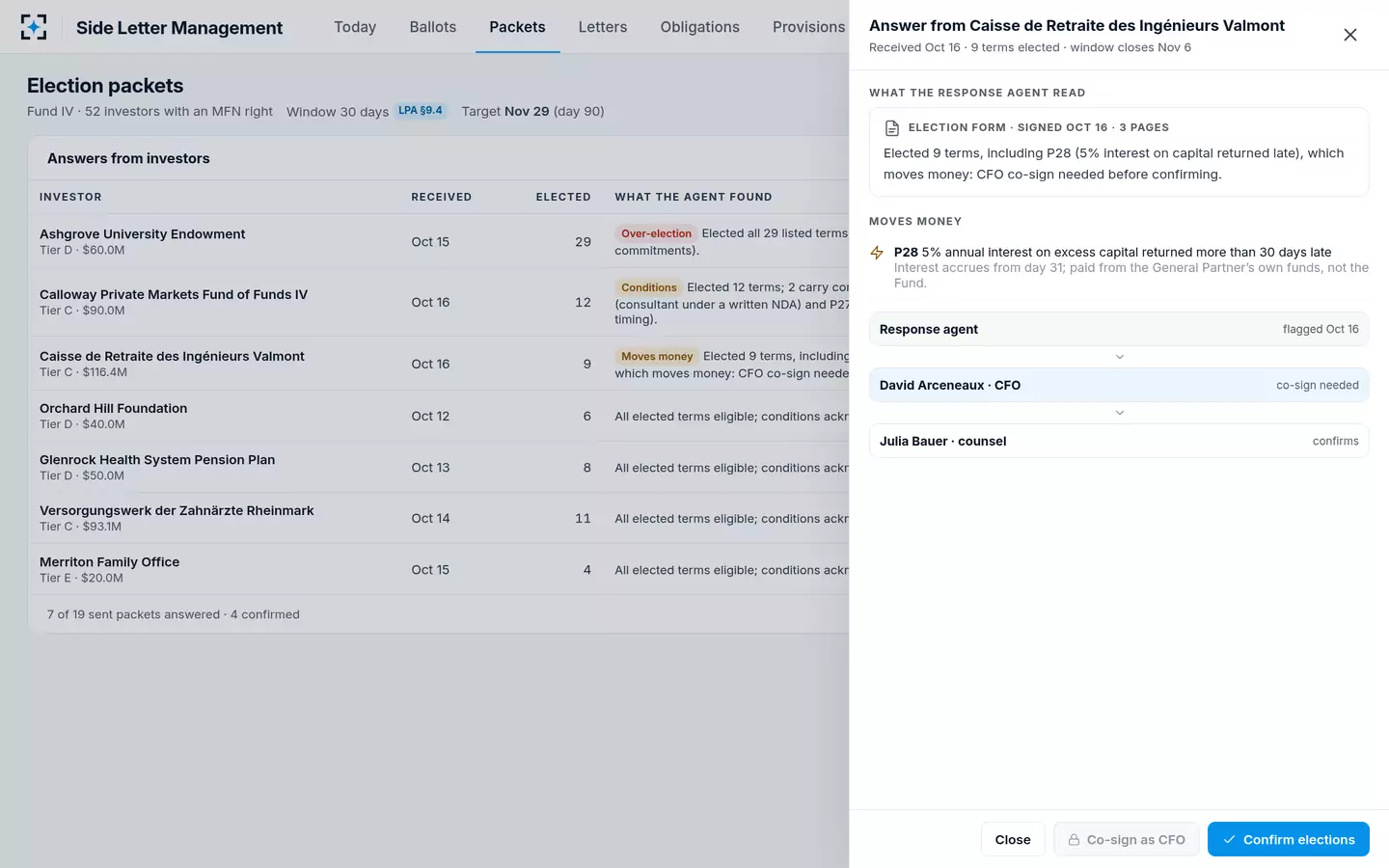
As returned: A pension plan elects 9 terms, including 5% annual interest on excess capital returned more than 30 days late.
As the clause allows: Electable, but it changes what the general partner pays, so the CFO co-signs before counsel confirms.
Over-election one: a term above the commitment line
The commonest over-election is the simplest: an investor elects a term that was granted to an investor larger than itself. It happens when the investor is sent the whole compendium rather than its own eligible list, or when the form groups terms by category instead of by the commitment of the investor that received them.
In the sample, Ashgrove University Endowment, with $60.0 million committed and in Tier D, returned a form electing 29 terms, four of which had been granted only to larger commitments. The fix is mechanical once the line is known: the four are struck, the correction letter cites the equal-or-smaller test in Ashgrove's clause, and the other 25 are confirmed. The line itself must be right first, which means commitments aggregated across affiliates and converted at the rate the clause fixes; how commitment tiers work in MFN clauses covers that arithmetic.
Over-election two: another investor's legal, tax or regulatory status
The second over-election is a term that only makes sense for a different kind of investor: an ERISA plan's plan-asset reporting, a US public pension's public-records or pay-to-play terms, a bank holding company's passivity undertakings, an insurer's capital or solvency data. MFN clauses with a status test reserve such terms for investors of the same status, because granting them to everyone would either be meaningless or impose costs nobody negotiated.
The sample investor, a Dutch pension fund, sees six such terms on its ballot, greyed out with the reason, for example: "Applies only to ERISA plans; Noordmeer is an EU investor." Excluding them is not always obvious. In the same season, counsel overrode an agent that had excluded a term from a fund of funds' ballot as status-specific, recording reason OV-01, the agent misread the clause. And on a Japanese insurer's ballot, two agents disagreed whether a US insurer capital-data term was limited by country or by type of investor; the packet was held until counsel decided. A status test is a reading of a clause, and a form should never be the place where it is first tested.
Over-election three: a term without its conditions
The third over-election is quieter: the investor elects the benefit and leaves out the burden. Many side letter terms carry conditions: an observer seat at the annual meeting at the investor's own cost, site visits to portfolio companies at its own expense, information that may be shared with a consultant only under a written non-disclosure agreement. An election of the term without its conditions is not the term the fund granted.
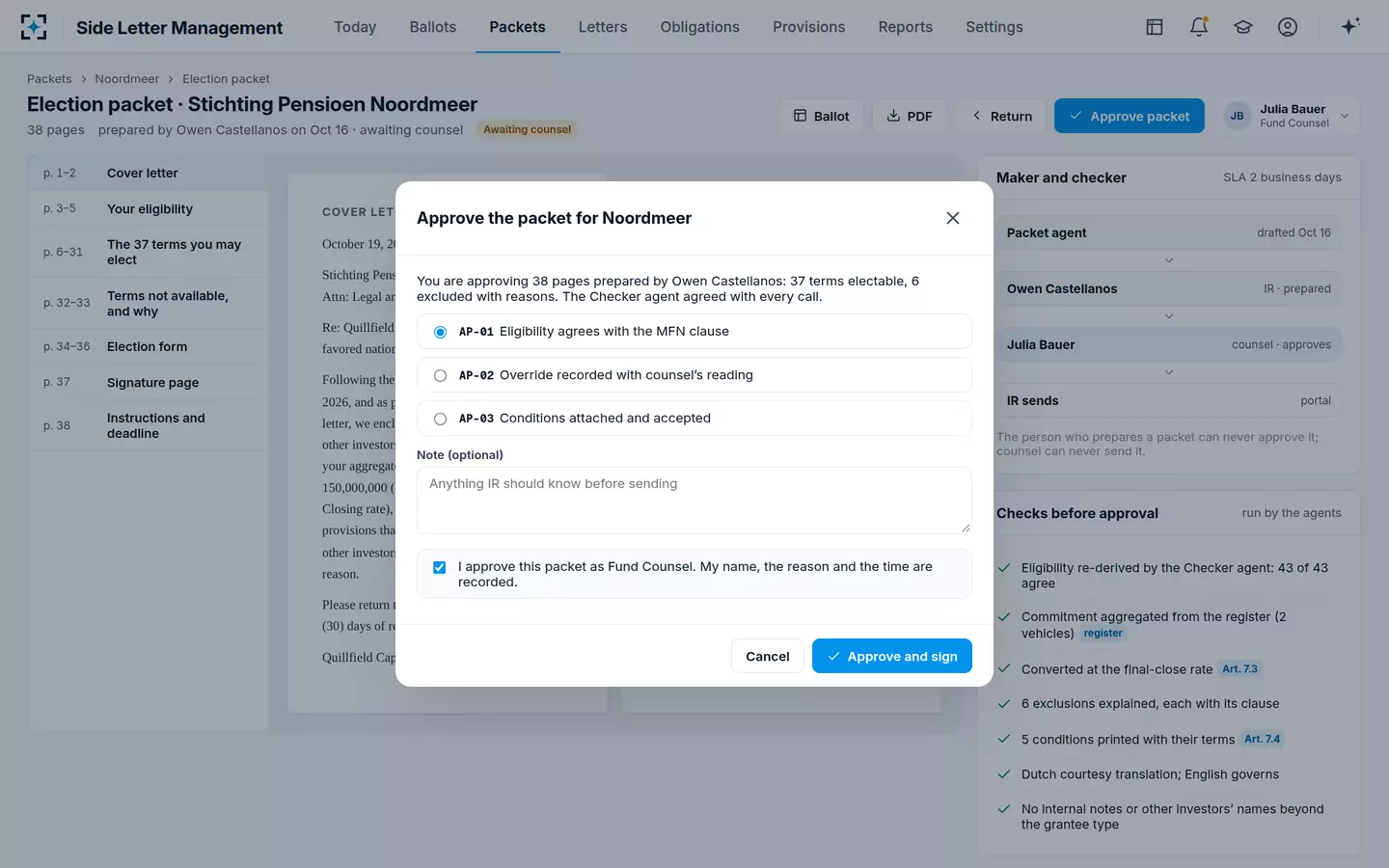
In the sample, Calloway Private Markets Fund of Funds IV elected 12 terms; for two, its form did not repeat the conditions. The cure is to confirm the election with the conditions stated, so the investor's acceptance is on paper, or to ask it to re-sign. The prevention is cheaper: print each condition on the line where the box is ticked, and state on the form that an election of a term is an election of its conditions. In the solution, an approval with conditions carries its own reason code, AP-03, conditions attached and accepted.
A fourth check: terms that move money
Some electable terms change what the fund or the general partner pays, and those deserve a second signature even when the election is valid. In the sample, Caisse de Retraite des Ingénieurs Valmont elected 9 terms, including P28: 5% annual interest on excess capital returned more than 30 days late, paid from the general partner's own funds. The election is valid; it is also a cost the manager now carries for one more investor.
The solution's rule is that any elected term changing fees, expenses, interest or payments waits for the CFO's co-signature before counsel can confirm it. It is a control on the manager, not on the investor, and it catches the term that slipped into a letter during fundraising without the finance team's attention. Checking fees actually charged against the LPA and the elected terms is a separate job, done by Botminds' LPA Compliance.
Returned MFN election forms read in Side Letter Management
Why are some terms excluded from MFN elections?
Terms are excluded either because they are tied to who the grantee is, or because the clause carves out their whole class. The sample investor's clause names five classes the MFN does not reach: provisions on management fees, carried interest or other economic terms; a seat on the advisory committee; provisions relating to another investor's specific legal, tax or regulatory status; co-investment rights; and provisions granted only to investors in the first closing.
Each class has a reason a reader can see. Economic terms are often the price the manager paid for size or an early commitment, and extending them to everyone would undo the bargain. An advisory committee has a limited number of seats. Co-investment is allocated deal by deal. First-closing terms reward investors who committed before the fund had momentum. A form that shows the excluded terms with the class that excludes them answers the investor's obvious question, why not, before it is asked.
How long do investors have to return an MFN election form?
As long as the clause says, usually a fixed number of days counted from the day the investor receives the packet. In the sample fund it is 30 days from receipt, so a packet sent on October 19 must be answered by November 18. No regulator sets the period. Where the fund's own agreement sets one, Begenau and Siriwardane found windows of 20 to 60 days after the fund's close, in the minority of LPAs that required notice and an opt-in at all (NBER working paper 29887).
The window is the one stage of the season nobody can compress, which is why the time saved has to come from the stages around it: sending packets sooner after final close, and confirming correct forms without a round of corrections afterwards. The MFN election process, stage by stage shows where those weeks sit.
Terms elected on the first seven forms in Side Letter Management, and which needed work
Who signs an MFN election form?
On the investor's side, a person with authority to bind the investor; a form signed by someone without that authority can be challenged by the investor itself later, so the packet should ask for the signatory's name and title. On the manager's side nobody signs the form, but someone must confirm it, and that confirmation is the decision that binds the fund. In the sample firm, fund counsel confirms every election, the CFO co-signs those that move money, and investor relations, who prepared the packet, can neither approve it nor confirm the answer.
Counsel approves a packet with a reason code before any form is sent
Designing an MFN election form that cannot be over-elected
Most over-elections are designed in. A form that lists only what the investor may elect, keeps every term with its conditions and shows the excluded terms separately leaves little room for any of the three errors.
Eight rules for an MFN election form
- List only this investor’s electable terms
Never the whole compendium; the excluded terms go on a separate page with the reason for each.
- Group terms by the commitment of the investor that received them
So the investor sees the size line its clause draws.
- Print each condition on the line where the box is ticked
And state that electing a term means accepting its conditions.
- Use the term numbers from the packet
The same P- and X-numbers everywhere, so a correction can cite the line.
- Name every vehicle whose commitment was counted
The investor can check the aggregation, and a missing affiliate surfaces now, not after confirmation.
- Say which language governs
A courtesy translation of the cover letter is welcome; the form should say the signed language controls.
- Flag terms that move money
Investors should know a term is costly to the manager; the manager’s CFO must see it before confirming.
- Give a return date, not a period
“By November 18” is harder to misread than “within 30 days of receipt”.
Once a form is confirmed, every elected term becomes a promise with a date, and the compendium changes with it. Tracking side letter obligations picks up from there. To see the forms drafted and read on your own letters, start from Side Letter Management.
Questions people ask
Is an MFN election form legally binding?
It is the investor's acceptance of an offer the general partner made under the investor's side letter, so once confirmed it amends that investor's arrangement on the terms elected. Whether it binds before confirmation depends on the clause; where the clause is silent, the manager's written confirmation is the cleanest point from which to treat the election as effective.
Can an investor change its MFN election after returning the form?
Before the window closes, a manager can accept a replacement form. After it closes, a change is a request the manager may refuse, and accepting it for one investor is a precedent others may cite, so the policy should be set once and applied alike.
What happens if an investor does not return its form?
Unless its clause says otherwise, nothing is elected: the investor keeps its own side letter as signed. A manager should still record the non-response, with the delivery receipt, so it can show the investor was offered its terms within the window.
Should excluded terms appear on the form?
Not as boxes to tick, but they should appear in the packet, each with the reason it is excluded. An investor's counsel who sees what was left out, and why, has fewer questions and less reason to elect beyond its rights.
Can an investor elect part of a term?
Generally no: a term is elected as granted, with its conditions. Where an investor wants a variant, that is a new side letter negotiation, and any new term it produces may itself be electable by other MFN investors in later rounds.