Institutional account opening documents are the papers an asset manager collects to open and fund an account for a pension fund, insurer, endowment or other institution: the registry extract and formation documents, the articles or deed, the board list, the signatory list and the resolution behind it, the signed investment management agreement (IMA) with its guidelines and fee schedule, tax forms, and settlement instructions. Collecting them is the easy part. The hard part is that they must agree with each other, come from the right source and be recent enough, and the file must show how every conflict between them was resolved. Botminds' Institutional Client Onboarding reads each document in its own language, cites every value to its page, checks the documents against each other and builds one complete file for an auditor or regulator.
The examples use the solution's fictional sample, Quillfield Capital's onboarding of Stichting Pensioenfonds Veldhaven, a Dutch pension foundation, whose file holds 17 documents in Dutch and English. The rules are quoted from the regulators.
Six claims an institutional account opening file must prove, and the documents behind each
The client exists, under this name
Documents that prove itRegistry extract; formation documents; regulator register entry; LEI record
What must agreeName and number agree in all of them; extract recent enough for your policy
These people control it
Documents that prove itArticles or deed; board list and appointments; ownership chart, or the reason no one owns 25%
What must agreeBoard in the articles matches the registry; the control person is named
These people may sign for it
Documents that prove itSigning rule in the registry or articles; signatory list; resolution or power of attorney; specimen signatures
What must agreeEvery listed signer has authority under the rule, alone or jointly as the rule says
We may manage the money this way
Documents that prove itExecuted IMA with guidelines and fee schedule; any side letter; for an ERISA plan, the fiduciary acknowledgment and the 408(b)(2) disclosure
What must agreeSigned by people who may sign; the custodian named matches the settlement instructions
This is its tax status
Documents that prove itThe tax forms your tax operations team requires
What must agreeForms agree with each other and with the entity documents; expiry dates recorded
The money goes here
Documents that prove itSettlement instructions; record of the call-back on an independent number
What must agreeSigned by an authorized signer; called back by one person, approved by another
What documents are needed to open an institutional account?
Enough to prove six things: that the client exists under its name, who controls it, who may sign for it, what the manager may do with its money, its tax status, and where money moves. Each manager's KYC policy turns those six into a document list for each client type, and a custodian or broker opening accounts for the same client will run its own.
The order of the list matters less than the age and source of each document. A registry extract pulled by the manager from the registry is stronger evidence than a copy the client attached to an email. In the sample firm's policy, an extract may be no more than three months old at account opening; older ones are re-pulled. For a company client the documents are much like a bank's corporate KYC file, which the neighbouring guide to corporate KYC documents maps field by field. Institutional clients add three complications: many are foundations, trusts or public bodies with no owners, many sign through boards that meet on a calendar, and their mandate comes with an agreement whose guidelines must be coded before trading.
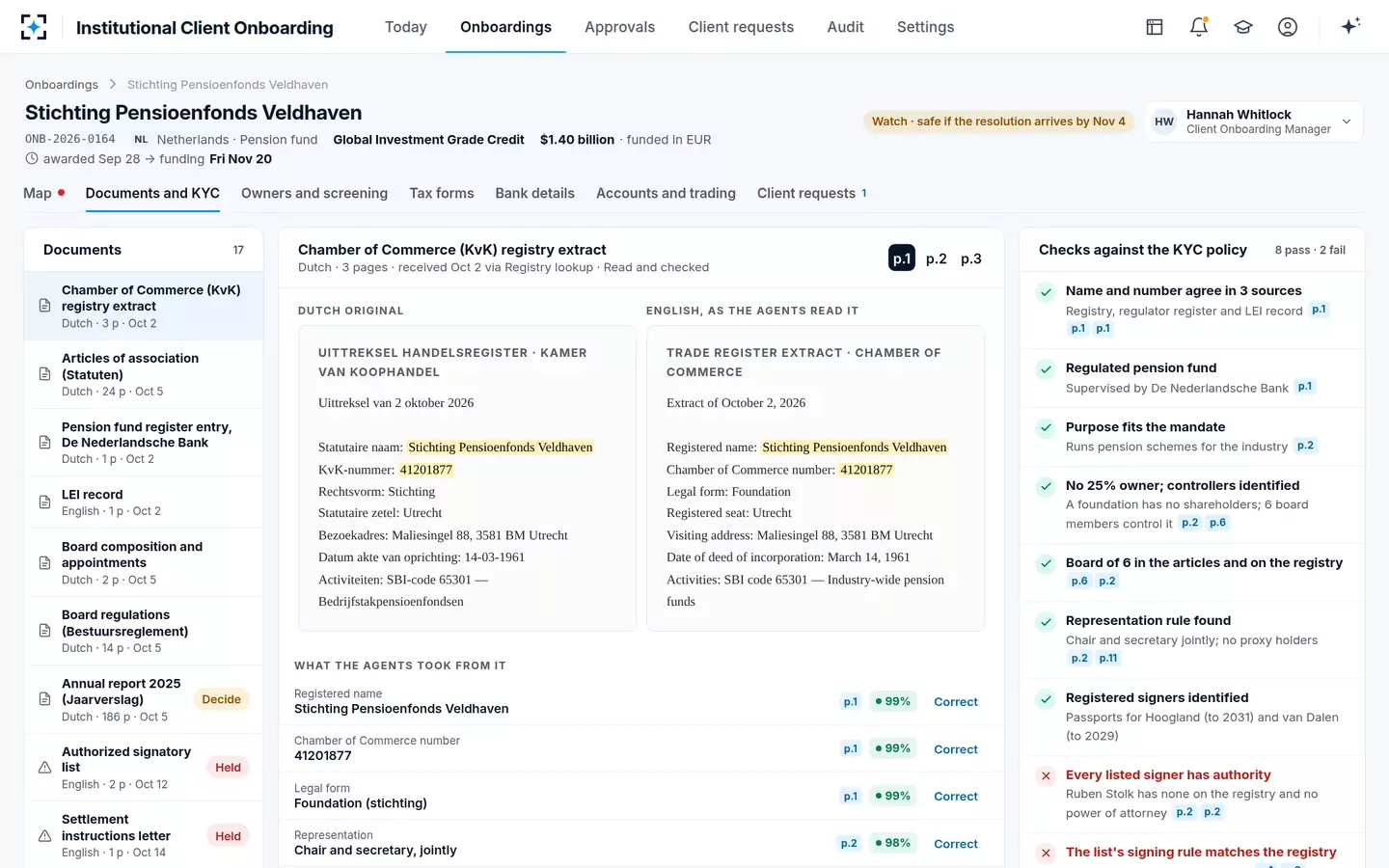
Seventeen documents, each value cited to its page, original beside English
Proving the entity exists: registry, formation documents and LEI
Start with an independent source the client did not produce. For most entities that is the official registry: a Chamber of Commerce extract in the Netherlands, a companies register or a state filing elsewhere. Add the formation documents, the regulator's register entry where the client is regulated, and the legal entity identifier (LEI) record.
The LEI is easy to dismiss and useful to check. GLEIF, the not-for-profit foundation that administers the system, describes it as "a unique 20-character alphanumeric code" built on the ISO 17442 standard (GLEIF). Its value in onboarding is that its reference data is a second source for the legal name, registration number and registered address, and for a mandate that may trade derivatives it is not optional: the CFTC requires each swap counterparty "that is eligible to receive a legal entity identifier" to obtain one and be identified by it (17 CFR 45.6). In the Veldhaven file the first KYC check is simply that the name and number agree in the registry, the regulator's register and the LEI record.
If an SEC-registered adviser one day has a customer identification program rule of its own, the minimum identity data will look familiar. FinCEN and the SEC proposed in May 2024 that an adviser obtain a customer's name, date of formation for an entity, a principal place of business and an identification number, and that a non-US entity without a number provide "alternative government-issued documentation certifying the existence of the person" (89 FR 44571, proposed). It remains a proposal; the guide to the investment adviser CIP rule tracks where it stands.
Proving who owns and controls the client
For a company the question is who owns 25% or more and who runs it; for most institutional clients the honest answer to the first half is no one. FinCEN's CDD rule, which binds banks, broker-dealers, mutual funds and futures firms, defines beneficial owners as each individual owning 25 percent or more of a legal entity customer, plus one individual with significant responsibility to control, manage or direct it (31 CFR 1010.230(d)).
The rule then removes most institutional clients from the ownership half. Registered funds, SEC-registered advisers, state-regulated insurers and US governmental bodies are outside the definition of a legal entity customer altogether, nonprofit corporations are subject only to the control test, and a trust is not a legal entity customer unless a filing with a state created it (31 CFR 1010.230(e); 81 FR 29398). The file therefore has to record which route applied and why, not just a blank where the owners would be. The full decision, client type by client type and in the UK as well as the US, is in who is the beneficial owner of a pension fund; trusts in general are covered by the neighbouring guide does a trust need beneficial ownership.
Proving who may sign
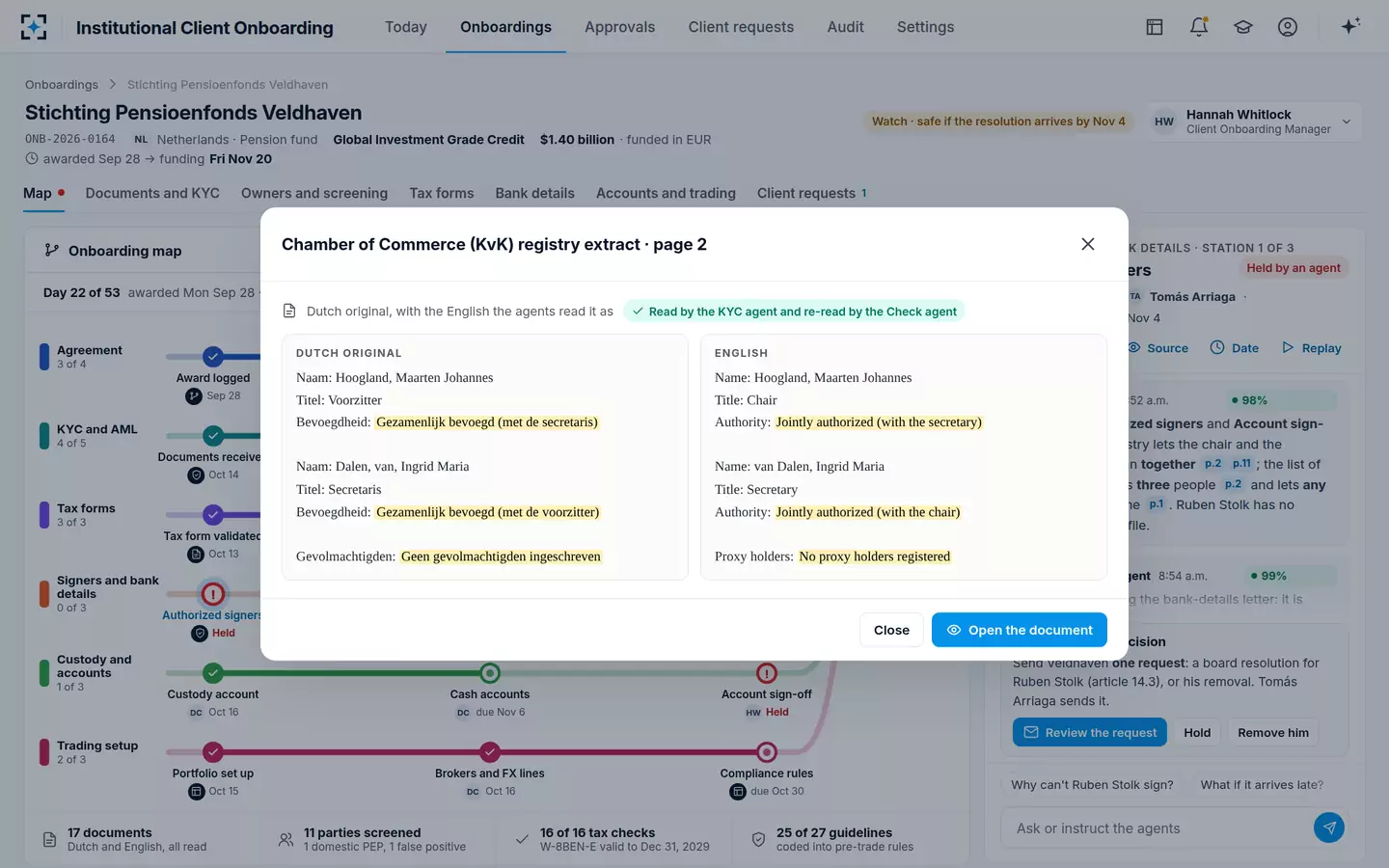
A signatory list proves only what the client claims. The proof is the signing rule in the registry or the articles, the resolution or power of attorney that gives anyone else authority, and specimen signatures that match. A list that names someone the rule does not authorize is the commonest reason a file is held.
In the Veldhaven file the registry says the chair and the secretary may represent the foundation only together, and lists no proxy holders; the fund's own list says any one of three people may sign alone. Two of the ten policy checks fail on that single conflict. English company law shows why the rule, not the list, decides: a company executes a document validly when two authorised signatories sign it, or one director signs before a witness who attests (Companies Act 2006, s.44). The guide to the authorized signatory list template sets out the fields and the mismatches field by field.
The registry's signing rule beside the English the agents read
The agreement, and what an ERISA plan adds
The executed IMA, its investment guidelines, its fee schedule and any side letter are account opening documents in their own right, because they say what the account may hold and how the bill is calculated. They must be signed by people the signing rule authorizes, and the custodian they name must match the bank on the settlement instructions.
An ERISA plan adds two documents. To act as the plan's investment manager under section 3(38), the manager must acknowledge in writing that it is a fiduciary of the plan, usually in the IMA itself (29 U.S.C. 1002(38)). And the DOL's service-provider rule requires a written disclosure of services, fiduciary status and compensation to the responsible plan fiduciary, delivered reasonably ahead of signing, and again ahead of any extension or renewal (29 CFR 2550.408b-2(c)(1)(v)). The file should hold the disclosure with its delivery date, so the sequence can be shown later. Clause-by-clause review of the agreement itself is a separate job, done by Investment Management Agreement Review.
Which account opening documents must agree with each other?
Six pairs catch most errors, and none of them is visible from any single document. The checks are mechanical, which is why they are skipped under time pressure and why they suit an agent that reads every page and a second that re-reads it.
Six cross-checks that catch what a document list cannot
| Compare | With | What a mismatch usually means |
|---|---|---|
| Signatory list | Signing rule in the registry or articles | A signer without authority, or "any one alone" where the rule says jointly |
| Signer on the settlement instructions | The authorized signers | Bank details that cannot be used until the right people sign or a call-back confirms them |
| Bank named on the settlement instructions | Custodian named in the IMA | A wrong account, or an instruction that did not come from the client |
| Name and number in the LEI record | Registry extract | A stale LEI record, or the wrong entity in a group |
| Board in the articles and appointments | Board on the registry | A board change not yet registered, or a document from before it |
| Figures in the annual report | Figures the client gave in its questionnaire | A reading error, or two figures that measure different things |
The last row is a reminder that a disagreement is not always an error. The KYC agent read the fund's 2025 pension assets as €38.6 billion and the Check agent read €39.4 billion, from different pages of the same report. Both readings went to the analyst, who decides which figure the file uses and notes why. That note is the part of the file an examiner reads most closely: the CDD rule requires covered institutions to record not just the documents relied on but how each substantive discrepancy was resolved (31 CFR 1010.230(i)).
Tax and settlement documents, and who owns them
Tax forms and settlement instructions are account opening documents, but each belongs to a specialist team with its own rules. Tax operations decides which forms a client must give and checks them against each other; operations proves each settlement instruction with a call-back on a number that did not come with it. The onboarding file needs the result of each, with its date and the person who approved it.
What onboarding adds is the link between them and the rest of the file. A settlement letter signed by a person who is not an authorized signer is not usable whatever the call-back says, and a tax form signed on behalf of the entity has the same signer question. In the sample, the Settlement agent refused the Veldhaven letter because one person signed it alone, and built the call-back for after the signer question was settled: Daniel Cho calls the fund's secretary on the number verified during the manager search, and Wen Li Tan approves as the second person.
A document list versus a file that holds up
A complete list: A copy of the registry extract, attached to the client's email.
A file that holds up: The extract pulled from the registry, dated, within the policy's age limit.
A complete list: The analyst typed the board members into the KYC system.
A file that holds up: Each value cited to its page, original beside English, re-read by a second reader.
A complete list: The signatory list was filed; the registry was filed.
A file that holds up: The conflict between them is recorded, with the request that fixed it and the resolution that arrived.
A complete list: The rating was approved.
A file that holds up: The rating was prepared by one person and approved by another, with a reason code and the evidence.
A complete list: Documents spread across email, a share drive and the CRM.
A file that holds up: One export with every document, value, disagreement, decision and signature.
How long must an adviser keep onboarding documents?
At least five years for the agreement, and longer for identity records where the AML rules apply. An SEC-registered adviser must keep its written client agreements for five years from the end of the fiscal year in which the last entry was made, the first two years in an appropriate office of the adviser (17 CFR 275.204-2(a)(10) and (e)(1)). Where the CDD rule applies, identification records are kept for five years after the account is closed, and verification records for five years after they are made (31 CFR 1010.230(i)(2)).
The retention clocks start at different moments
5 yrs
after the end of the fiscal year of the last entry: an adviser's client agreements
5 yrs
after the account closes: CDD identification records
5 yrs
after the record is made: CDD verification records
The practical point is that an adviser's onboarding file outlives the people who built it. Five years after a mandate ends, nobody will remember why the file used €38.6 billion rather than €39.4 billion, or who confirmed the bank details. The file has to say so itself. FinCEN and the SEC made a related point about timing in their 2024 proposal for adviser identity checks, noting that "verifications too far in advance may become stale" (89 FR 44571): the date of each check belongs in the file as much as its result.
One export: every document, decision and agent run, in order
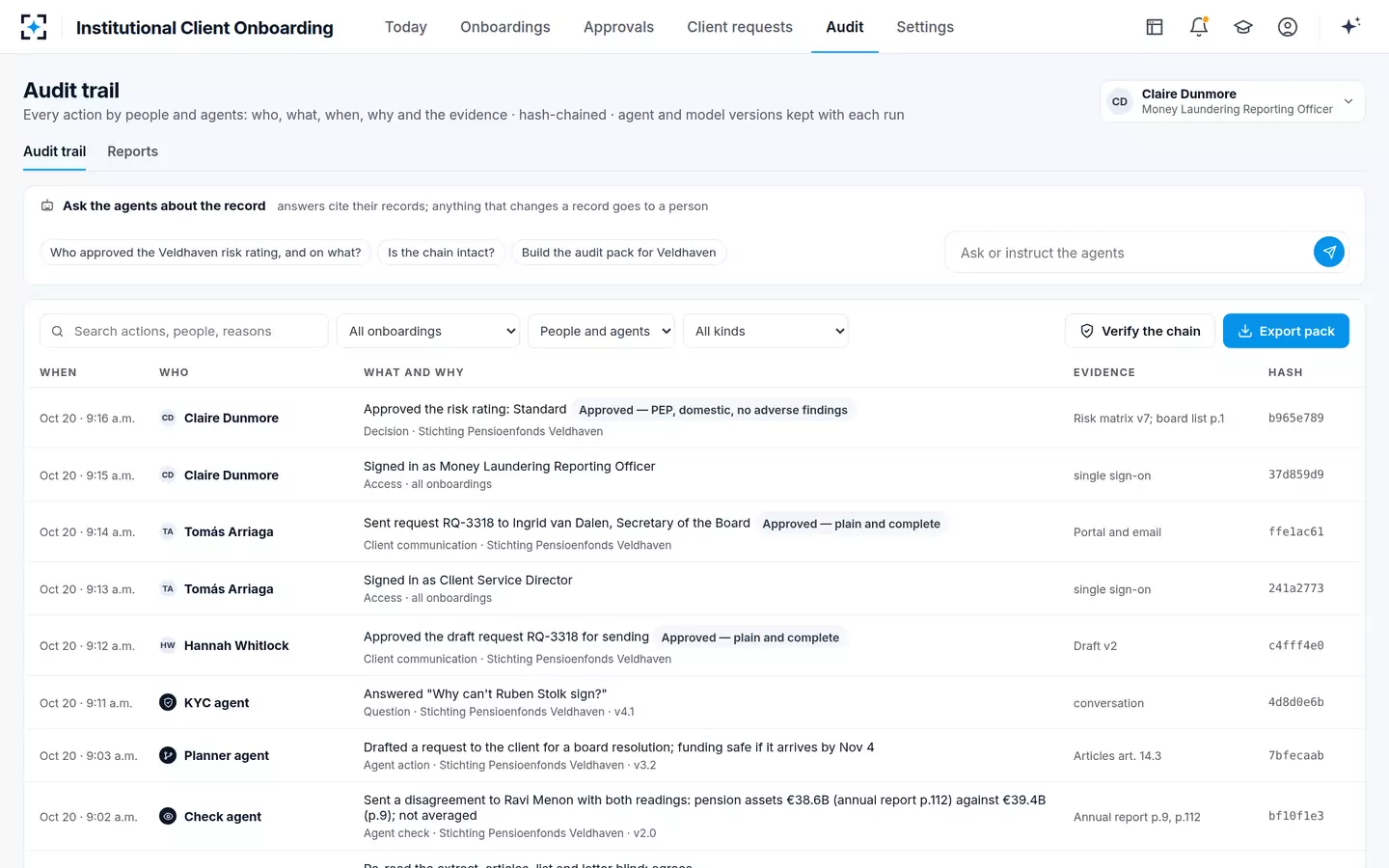
In the solution, the file is built as the work happens rather than assembled at the end: every document original and in English, every decision with its signatures, and the agents' runs with their versions. The rest of the Veldhaven onboarding, including the one request that cleared the signer problem, is on the Institutional Client Onboarding page.
Questions people ask
What is an institutional account opening form?
It is the manager's or custodian's own form for a new institutional client, usually capturing the legal name, registration and tax identifiers, addresses, the controlling persons, the authorized signers and the account details. It summarises the file but proves nothing on its own: each field should trace to a source document. A form built from the source documents, rather than typed in by the client, cannot disagree with them.
What are the KYC requirements for trusts opening an account?
Under the US CDD rule a trust is generally not a legal entity customer unless a state filing created it, so there are no beneficial owners to certify under that rule. Institutions still identify the trustees, who sign for the trust. UK rules differ: the Money Laundering Regulations 2017 treat the settlor, trustees and beneficiaries as beneficial owners of a trust.
Does an asset manager have to collect beneficial ownership documents?
Not under the US CDD rule today, which covers banks, broker-dealers, mutual funds and futures firms, though custodians and brokers serving the same client will collect them. FinCEN's adviser AML rule, now effective 1 January 2028, did not add a beneficial ownership requirement and left it to a later rulemaking. UK managers apply the Money Laundering Regulations 2017.
How old can a registry extract be at account opening?
Neither the US CDD rule nor the UK Money Laundering Regulations set a single age; it is a matter of firm policy. The fictional manager in these guides uses three months. What matters is that the file records the extract's date and its source, and re-pulls it when the board or signers change.
Can documents in a foreign language be used without a certified translation?
That is a policy decision for the firm, not a rule in the US CDD text. A working practice is to keep the original, record the English relied on beside it with the same passage marked, and have a second reader confirm the reading. On the fictional Veldhaven file none of the 17 Dutch and English documents needed a certified translation under the sample firm's policy.