The best client onboarding software for an asset manager runs the whole institutional mandate, not just the KYC form: the investment management agreement and guidelines, entity KYC and screening, tax forms, signer authority and settlement instructions, custody and cash accounts, and trading setup, all against one funding date. It must read documents as they arrive, often in the client's language, show the source of every value, check documents against each other, and leave every decision with a named person and a complete file. Choosing is hard because most onboarding products were built for high-volume retail accounts or for a bank's own KYC, and an institutional mandate is a few dozen entities with many parties each. Botminds' Institutional Client Onboarding was built for that case: seven agents read, check and chase, people approve, and the firm's own policy sets every threshold. This guide shows how to test it, or anything else, and how to go live in about eight weeks.
Examples use the solution's fictional manager, Quillfield Capital. The plan is a target, not a promise: its weeks depend on how quickly your systems can be connected and your closed files assembled.
What firms worry about when the software is someone else's AI
40%
of respondents named information security and operational resilience a major constraint on third-party AI
34%
named limited transparency into third-party AI systems
2%
had deployed AI agents with broad autonomy
What is the best client onboarding software for an asset manager?
The one that fits institutional work and can prove its own output. Fit means it handles entity clients with no owners, boards that sign jointly, documents in several languages, custodians and transition managers outside the firm, and an agreement whose guidelines become trading rules. Proof means that every value it extracts links to a page, every check can be re-run, every decision has a named person and a reason, and the whole file can be exported for an examiner.
Three product categories compete for the search, and they are not substitutes. Client lifecycle management platforms keep the client file and the workflow across a bank's products. Retail and wealth account-opening tools are built for volume and a household's paperwork, as the neighbouring guide to client onboarding software for financial services describes. Agent-based onboarding reads, compares and chases around the systems a firm already has. Many managers will end up with two of the three, which is why the comparison in client lifecycle management platform vs onboarding agents treats them as layers.
Which eight questions should you ask before you buy onboarding software?
Ask questions whose answers can be demonstrated on your own files, not described on slides. A vendor that cannot run its product on ten of your closed mandates in a week has told you something important.
Eight questions for any client onboarding software, and the answer to look for
- Show me the page behind this value.
Every extracted value should open the source passage, in the original language beside the English it was read as.
- Who checks the reader?
A second, independent reading of the same source, without sight of the first answer; disagreements go to a named person, never averaged.
- What does it hold when one signer is wrong?
Only the stations that depend on the signer. Custody, cash accounts and trading setup should keep moving.
- Who calls back new bank details, on which number?
A person, on a number from an independent source such as the CRM or the registry, with a second person approving. Never the number on the letter.
- What can it send to the client without a person?
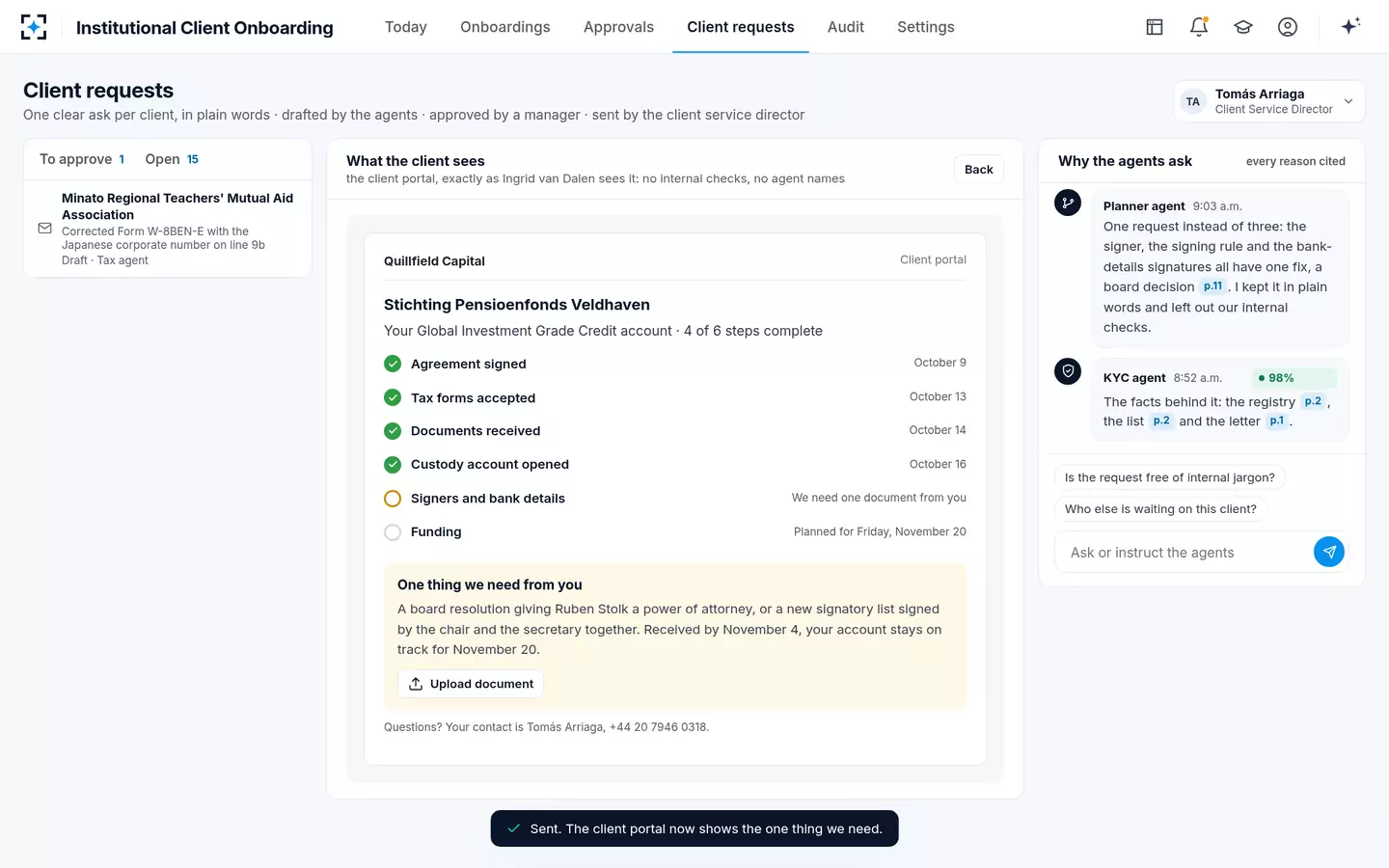
Nothing. Drafts are fine; a manager approves and client service sends.
- Whose KYC policy does it apply?
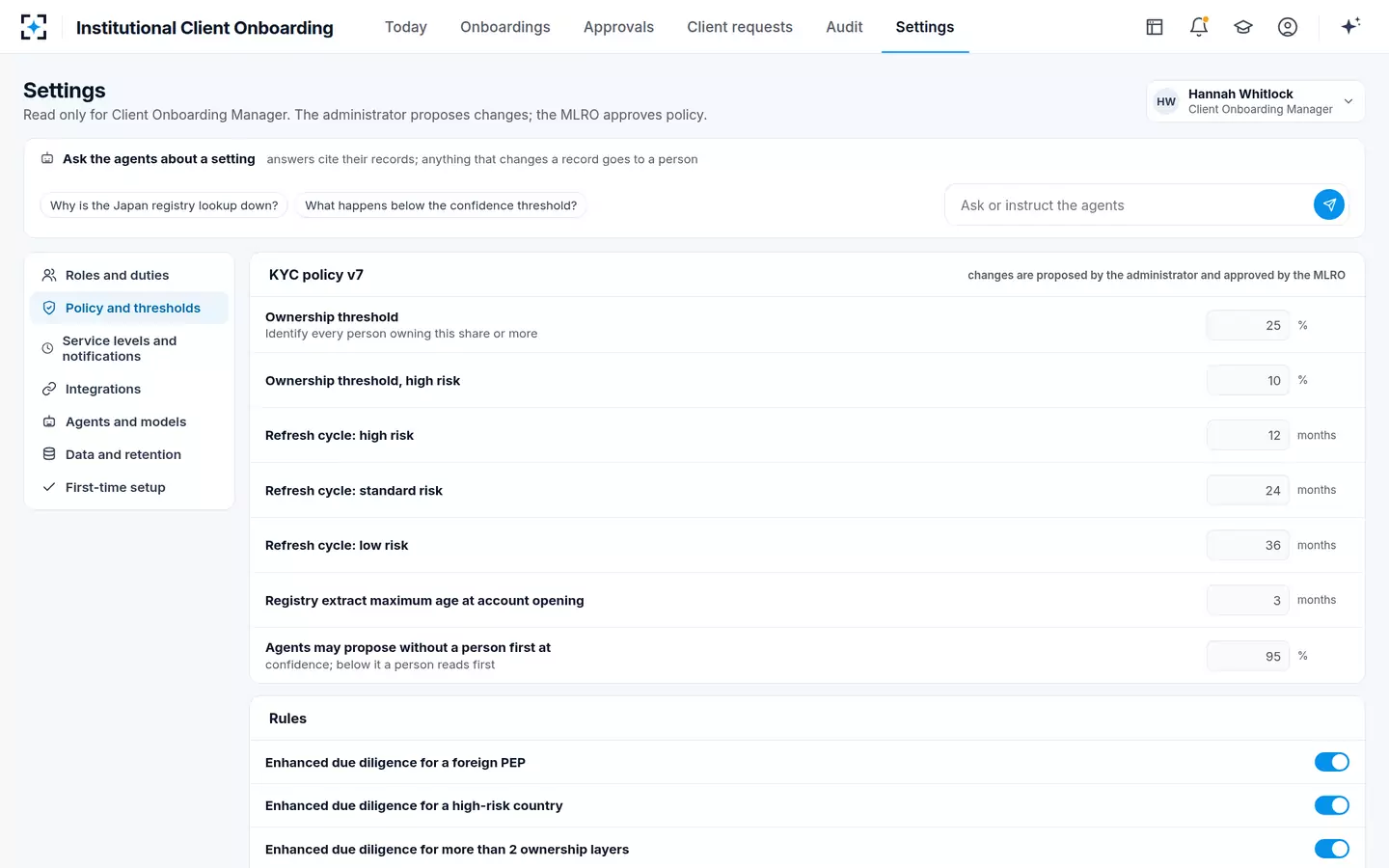
Yours, as settings: ownership thresholds, refresh cycles, registry age, enhanced due diligence triggers, changed only with your MLRO's approval.
- Which systems does it write to, and when?
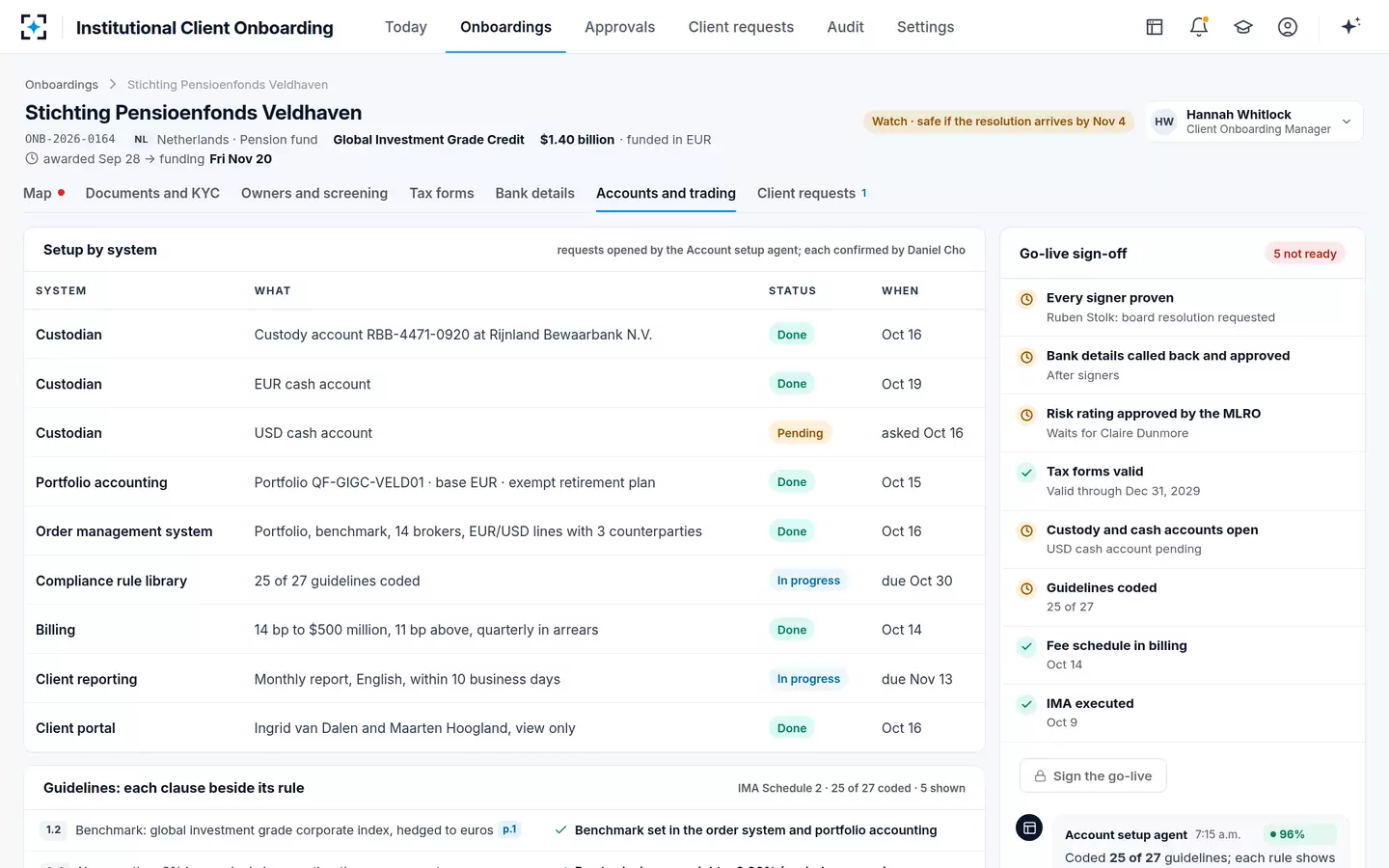
Custodian messaging, portfolio accounting, order management, compliance rules and billing, each request confirmed by a person before anything goes live.
- Can I export one complete file?
Every document, value, disagreement, decision, signature and agent version for a mandate, in order, with the export itself logged.
What do you bring in week one?
Your rules and your history. The software brings the reading, checking and chasing; the firm brings the policy those run against and the closed files that prove they work. Gathering them is usually the slowest part of the first two weeks, so it pays to start before the contract is signed.
What a firm brings to an eight-week go-live, and who owns each item
| Bring | Why it is needed | Owner |
|---|---|---|
| KYC policy and risk matrix | Every check and every risk factor is a setting drawn from it: ownership thresholds, refresh cycles, enhanced due diligence triggers. | MLRO or AML officer |
| Signer evidence rules | Which documents prove authority: registry, board resolution, notarized power of attorney; what to do when they conflict. | Legal and operations |
| Roles and approvals | Who prepares and who approves each decision, so the screens can enforce that the preparer never approves. | Head of onboarding |
| Last year's mandates | Ten to twenty closed onboardings with their documents and outcomes, for replay and planted-error tests. | Onboarding manager |
| System access | Read access first, then write access in approval mode: CRM, registry and LEI lookups, screening, custodian messaging, portfolio accounting, order management, billing. | IT and information security |
Your KYC policy, as settings the MLRO approves
An eight-week onboarding software go-live, week by week
The plan moves from rules to replay to a live mandate, and each step has a test that must pass before the next. It assumes the systems in week one can be connected within two weeks; where a custodian's messaging or an order management system needs longer, the live weeks move and the replay weeks do not.
From policy to first funded mandate in about eight weeks (target)
- Policy, roles and approvals as settingswk 1
- Read-only connectionswk 2
- Replay closed mandateswk 3
- Planted-error testwk 4
- Write connections in approval modewk 5
- Shadow two live mandateswk 6
- First live mandate, dual controlwk 7
- Go-live sign-off and baselinewk 8
Weeks one and two turn the policy into settings and connect what the agents need to read: the CRM award, registry and LEI lookups, and the screening service. Nothing writes anywhere yet. Week three replays ten or more closed mandates and records, for each, which values the reading agent and the checking agent agreed on, which they did not, and how a person resolved each disagreement. Week four plants the errors the firm fears most into copies of those files: a signer the registry does not authorize, a bank letter with a new phone number, a guideline the order system cannot test.
Week five connects the systems the agents write to, in approval mode: custody requests, portfolio set-up, compliance rules and billing, each confirmed by a person. Week six runs the agents alongside two live onboardings without acting on them, so the team can compare. Week seven runs one new mandate through the solution with the old controls still in place. Week eight is the go-live sign-off and the first baseline of the metrics in client onboarding metrics, measured against last year's mandates.
How do you replay last year's mandates in week three?
Feed the agents the documents of closed onboardings exactly as they arrived, and compare what they find with what your team found at the time. A replay is the cheapest evidence a firm can get, because the right answers are already in its files, and it shows where the agents and the team disagree before either is relied on.
What to record for each replayed mandate
| Measure | How to read it |
|---|---|
| Values extracted, and agreed by both readings | High agreement on clear documents is expected; the interest is in the values where they differ. |
| Disagreements, and who was right | Each one resolved by a person against the source. A disagreement the original team missed is a finding about the old process. |
| Held stations, and their reasons | Every hold should cite a page. A hold the team would not have raised needs an explanation either way. |
| Issues the team found that the agents did not | The number that matters most; each one becomes a test case for week four. |
| Requests the agents would have sent | Compare with the requests actually sent: how many separate asks became one. |
| Days on the critical path, re-estimated | Not a result, an estimate of where time would have been saved, for the baseline in week eight. |
Which tests must pass before onboarding software goes live?
Six, each with a pass mark set before the test, not after. The point of setting them in advance is that a test chosen after the results are known cannot fail.
Six go-live tests, with the pass mark set in advance
- Every planted signer mismatch is held, with the registry passage cited
Pass: all of them. A missed signer is a missed control.
- Every disagreement between the two readings goes to a person
Pass: none averaged, none settled by an agent.
- No bank detail is used without a call-back by a person and a second approver
Pass: every one. This is a design target of the solution: zero accounts funded otherwise.
- Nothing reaches a client without approval
Pass: no message sent by an agent; every request approved by a manager and sent by client service.
- Every agent action shows the agent and model version
Pass: every action in the trail; a version change during the test is visible.
- One complete file exports for each replayed mandate
Pass: internal audit can trace one decision, end to end, without asking anyone.
Who signs off each stage?
The people who will own the risk once it is live, not the project team. A go-live signed only by the sponsor tells an examiner that nobody responsible for KYC, operations or compliance looked.
Six sign-offs between contract and first live mandate
Today
Owns the written KYC policy and risk matrix.
With agents
Approves the policy as settings in week 1, and every later change.
Still theirs: No threshold changes without her.
Today
Owns the onboarding plan and the funding dates.
With agents
Approves roles and the replay results in week 3.
Still theirs: Signs the go-live in week 8.
Today
Owns access to client data and systems.
With agents
Approves read-only access in week 2 and write access in week 5.
Still theirs: Data stays in the client's region.
Today
Owns call-backs and bank detail controls.
With agents
Approves the planted bank-letter results in week 4.
Still theirs: A second person approves every call-back.
Today
Owns the guideline rules in the order management system.
With agents
Reviews each guideline the agent coded, with its clause cited.
Still theirs: Takes every guideline the agent cannot test pre-trade.
Today
Tests the controls after the fact.
With agents
Traces one replayed and one live mandate through the exported file.
Still theirs: Independent of the project.
Go-live: each system's request confirmed by a person, five prerequisites open
What do the SEC and FinCEN calendars mean for the choice?
They mean the software must work under today's rules and the ones coming, and must show its third-party risk plainly. FinCEN has delayed its AML program rule for SEC-registered and exempt reporting advisers to 1 January 2028 and said it will review the rule's scope (91 FR 36); onboarding files built now will be the files an adviser's program inherits. The guide to the investment adviser CIP rule tracks what the pending identification rule means for onboarding.
On third parties, the SEC's fiscal 2027 examination priorities say the Division will focus on advisers that use certain third-party service providers, including "advisers using third parties to access clients’ accounts, where existing controls may be insufficient to protect client assets and data" (SEC Division of Examinations, FY2027). There is no specific SEC outsourcing rule to satisfy: the Commission withdrew its 2022 proposal on outsourcing by advisers in June 2025 (90 FR 25531). That leaves the adviser's general obligations, including keeping the agreements and records the books-and-records rule requires (17 CFR 275.204-2), and it puts the burden of proof on the questions above.
Where does Institutional Client Onboarding fit, and where does it not?
It fits a manager that onboards institutional entities, such as pension funds, insurers, endowments, foundations and public bodies, into separate accounts or funds, with documents in several languages and a custodian it does not control. On the fictional sample book that is 46 onboardings in flight across 17 countries, and the solution's value is in the stations where documents must agree and people must sign.
It is not the right tool for three jobs. It is not a high-volume retail account-opening system. It is not a replacement for a client lifecycle management platform that already holds the firm's client file; it works alongside one. And it does not do the judgment work it is designed to prepare: it gives no tax advice, verifies no bank detail by itself, sets no risk rating and sends nothing to a client. A firm that wants an agent to do those things should not buy it. To see the whole mandate run, open Institutional Client Onboarding.
What the client sees: one thing needed, and the date it protects
Questions people ask
How long does it take to go live with client onboarding software?
For Institutional Client Onboarding the target is about eight weeks from policy to a first live mandate, assuming read and write connections can be made within the first five weeks. The longest waits are usually assembling closed files and connecting custodian messaging. A plan should move live weeks, never skip replay or planted-error tests.
What is client onboarding workflow software?
It routes onboarding tasks between teams and tracks their status. On its own it does not read the documents or check them against each other, which is where most institutional delays and errors sit. Agent-based onboarding adds the reading, comparing and drafting, with people still approving.
Should we replace our CLM platform to automate onboarding?
Usually not. A client lifecycle management platform is a system of record for the client file; agents can read from it and write to it after approval. Replacing it adds a data migration to an onboarding project without changing the reading work that takes the time.
What does client onboarding automation software cost?
Vendors rarely publish prices, so compare on cost per funded mandate. Price the licence and implementation against the internal hours each mandate uses today and the weekly fee delay on your typical mandate size, which on a $1.4 billion mandate at about 12 basis points is about $32,500 a week. The metrics guide shows the arithmetic.
Can onboarding software keep client data in its own region?
It should, and the question belongs in the contract. In Institutional Client Onboarding files stay in the client's region, enhanced due diligence files are need-to-know, and onboarding data is never visible to portfolio managers or traders.