A transition manager is a specialist, usually an investment bank, custody bank, asset manager or dedicated firm, that an asset owner such as a pension fund hires to move a portfolio between managers or markets: it hedges the exposure, sells what the new mandate does not want, buys what it does, and transfers the securities that both portfolios hold. The FCA describes the job as moving the existing ("legacy") portfolio into a replacement ("target") portfolio through programme trades, often using hedging instruments to limit exposure to market moves in between. For the incoming manager, the transition decides when and in what form the money arrives, so onboarding has to be finished to its timetable. Botminds' Institutional Client Onboarding plans every station of an onboarding back from the funding date and shows what is still open when the transition is due.
Market figures and findings come from the FCA's 2014 thematic review of transition management, which the FCA now marks as historical, and from FCA and SEC enforcement releases. Onboarding examples use the solution's fictional sample manager, Quillfield Capital.
Transition management in the UK, as the FCA measured it
£165bn
or more of legacy-portfolio assets transitioned in the UK each year, 2010–12
700
transition mandates a year, roughly
13
firms providing transitions regularly at the start of 2013
68%
of transitions by number handled by the top five firms; nearly 80% by volume
What is a transition manager?
It is the firm responsible for moving assets when an asset owner changes manager, asset class or market. The asset owner decides to move; the transition manager carries it out, with the aim of keeping the portfolio's market exposure steady and its trading costs low while the change happens. The FCA lists the main providers as investment banks, custody banks, asset managers and specialist firms.
The service exists because a manager change is a large, one-off trade done by someone who does it rarely. The FCA put the client's position plainly: "The asset owner or client can be unfamiliar with the TM process, as it is not carried out often" (FCA, TR14/1). The FCA counted about 700 transition mandates a year among 13 providers, so a provider does it constantly. That asymmetry is the source of the service's value and, as the FCA found, of its conflicts.
What is transition management in finance, and how does it work?
Transition management is the planned movement of a portfolio from one shape to another with controlled risk and cost. In the FCA's description, the provider will generally use hedging instruments to minimise exposure to market movements "before selling the existing (‘legacy’) portfolio and buying a replacement (‘target’) portfolio through programme trades", with a trading strategy designed to have "the least negative impact on the value of the assets being transitioned" (FCA, TR14/1).
A transition, from the decision to the new manager's first trade
- Manager selectedaward
- Transition manager appointed; pre-trade estimateplan
- Waits for both managers' accounts and instructionswait
- Hedge, transfer in kind, sell, buytrade
- Reportpost-trade
- IMA, KYC, signers, accounts, guidelines codedonboarding
- Fundedday one
Three documents frame the trade. Before it, a pre-trade estimate of cost and risk. During it, the instructions and the accounts at the client's custodian. After it, a post-implementation report comparing what happened with the estimate and a benchmark. The FCA found that those pre- and post-implementation reports "vary in the level of detail and clarity provided", and that there was often no internal separation between those carrying out a transition and those reporting on its performance (FCA, TR14/1). Some clients hire an independent party to check the report.
Who decides whether a portfolio moves in kind or in cash?
The asset owner, on its consultant's and transition manager's advice, within what the new manager's agreement allows. An in-kind transfer, called "in specie" in UK usage, moves securities from the old account to the new without selling them; it suits securities the legacy and target portfolios both want to hold. A cash transition sells the legacy portfolio and delivers money for the new manager to invest.
The choice has a cost and an incentive attached. The FCA noted that where the two portfolios share securities, "it may be in the client’s interest for these to be transferred via an ‘in specie’ transfer, but if the TM provider is remunerated by commission (as is industry standard), it may not be incentivised to choose the lower-cost option" (FCA, TR14/1). On fixed income mandates it saw the same problem in a different form: a provider paid per trade may not look hard for substitutes the target portfolio could accept. The new manager's guidelines decide which legacy securities it may accept at all, so the guideline coding done during onboarding is also the list of what can arrive in kind.
In kind or in cash: what changes for onboarding
| In kind (in specie) | In cash | |
|---|---|---|
| What arrives | Securities, re-registered or moved between accounts at the custodian | Cash in the account's currency, on the funding date |
| What must be ready first | Custody account, the list of acceptable securities under the guidelines, portfolio accounting set to receive positions | Cash account in the right currency, broker and FX lines to invest it |
| Who prices the day | The custodian and portfolio accounting value positions on arrival | The new manager's first trades set the starting point |
| The usual risk | A security arrives that the guidelines do not allow, and must be sold | Exposure is out of the market between sale and reinvestment unless hedged |
What conflicts did the FCA find in transition management?
Conflicts built into the structure of the service. A manager is the client's agent; a transition manager may not be, because it may trade as principal against the client. The FCA wrote that TM clients "are used to dealing with asset managers who act as an agent for them", whereas the duties a TM provider owes "may be different since that TM provider may act as counterparty to elements of the trading" (FCA, TR14/1).
The review listed the conflicts that follow: pre-trade estimates pitched to win the business; misuse of information about large, predictable trades; principal trading; internal crossing between clients at prices worse than the market; routing to venues the provider has an interest in; affiliates adding layers of fees; and the in-kind incentive above. It also found that "the project management elements of TM business are not regulated", and that several firms told clients they would act as a "fiduciary" during the transition, although their standard agreement "had expressly excluded the existence of a fiduciary relationship" (FCA, TR14/1).
Agent or counterparty: the question to settle before a transition starts
If the provider acts as agent: Acts in the client's interest when executing orders, subject to best execution.
If it may act as principal: May take the other side of some trades; its duties are those in the agreement.
If the provider acts as agent: Execution policy, venues used, crossing rules, the post-trade report against the estimate.
If it may act as principal: Which trades it may take as principal, how they are priced and disclosed, and how the agreement describes its role.
If the provider acts as agent: Marketing that promises more than the agreement does.
If it may act as principal: Material calling it a fiduciary while the agreement excludes it.
How does a transition manager get paid, and what went wrong when it was hidden?
In one or more of three ways: commissions on equity and futures trades, mark-ups on bonds, and a project management fee, fixed or as a percentage of the portfolio. The FCA set out those three in its enforcement release against State Street's UK transition business, and the case shows why they need to be agreed and visible (FCA, 31 January 2014).
The FCA fined State Street UK £22,885,000, finding that between June 2010 and September 2011 its transition business "deliberately overcharged six clients a total of $20,169,603" through mark-ups that "had not been agreed by the clients and were concealed from them"; the firm settled early, without which the penalty would have been £32,692,800 (FCA). The SEC charged State Street over transition management overcharging in 2017: the firm agreed to pay more than $35 million, and the SEC's order found the scheme "generated approximately $20 million in improper revenue", using "false trading statements, pre-trade estimates, and post-trade reports to misrepresent its compensation" (SEC press release 2017-159).
The lesson for the receiving side is narrow but real. The new manager does not pay the transition manager, but it often sees the arriving positions and prices first, and its own reconciliation of what arrived is a check the asset owner can use. Among the oversight failures the FCA listed was a "failure to reconcile amounts agreed with clients with amounts invoiced" (FCA, TR14/1). For an ERISA plan, the DOL's service-provider rule requires covered service providers to disclose their compensation to the plan fiduciary in writing, in advance, which is where a covered transition provider's charges should appear (29 CFR 2550.408b-2).
What should the new manager check when a transition delivers?
That what arrived is what was planned, and that all of it is allowed. The new manager is often the first party after the transition manager to see the actual positions and prices, which makes its first reconciliation a control for the asset owner as well as for itself.
Four checks cover most of it. The positions received should match the transition's final instructions, security by security and quantity by quantity. Every in-kind position should pass the guideline rules coded during onboarding, so that a security the mandate may not hold is caught on day one rather than at the first monthly report. Cash should land in the account and currency the settlement instructions name. And the starting valuation in portfolio accounting should agree with the custodian's, because it is the base for both performance and the first fee. The FCA's review found pre-trade estimates that could be pitched to win business and post-trade reports of varying clarity (FCA, TR14/1); a clean reconciliation on the receiving side gives the asset owner something independent to set beside the transition manager's own report.
Transition manager vs custodian vs new manager: who does what?
The custodian holds the assets and opens the accounts; the transition manager trades them from the old shape to the new; the new manager runs the target portfolio from the funding date. Each needs something from the others on the same day, which is why a transition is also an onboarding deadline.
Three parties on the funding date, and what each needs from the others
| Party | Its job | What it needs before the day |
|---|---|---|
| Client's custodian | Holds the assets; opens custody and cash accounts; settles trades on instructions | Account opening documents, authorized signers, settlement instructions it can rely on |
| Transition manager | Hedges, transfers in kind, sells and buys to reach the target portfolio | Both managers' account details, the target portfolio or its rules, the trading window |
| New manager | Manages the target portfolio under the IMA from funding | Signed IMA, KYC approved, every signer proven, bank details called back, guidelines coded, portfolio set up |
| Asset owner and consultant | Decides the move and appoints the parties | The pre-trade estimate, the timetable, and one clear list of what each party still needs |
What must onboarding finish before the first trade?
Everything the transition needs from the new manager, by the day before it starts. If the new manager's accounts, settlement instructions or guideline rules are not ready, the transition waits, the client's exposure stays in the old shape or out of the market, and the funding date moves.
Seven things a new manager must have ready before a transition delivers
- IMA executed, with guidelines and fee schedule
Signed by people with authority; for an ERISA plan, the fiduciary acknowledgment in place.
- KYC approved
Risk rating prepared and approved by different people; every party screened.
- Every signer proven
The signatory list matches the registry or articles, so instructions can be relied on.
- Bank details called back
On an independent number by one person, approved by a second.
- Custody and cash accounts open in each currency
Including any currency the transition delivers or the mandate trades.
- Guidelines coded as pre-trade rules
So the first order, or the first in-kind position, is tested against the IMA.
- Portfolio, benchmark, brokers and FX lines set up
In portfolio accounting and the order management system, ready to receive positions or cash.
On the Veldhaven sample, day 22 of 53, the custody account and the euro cash account were open and the portfolio was set up in portfolio accounting and the order management system with 14 brokers; 25 of 27 guidelines were coded, with two handed to investment compliance. The go-live sign-off still listed five open prerequisites: every signer proven, the bank details called back, the MLRO's approval of the risk rating, the dollar cash account, and the last two guidelines. Each was dated back from the funding day, so the onboarding manager could tell the client which of them, if any, threatened 20 November.
Accounts and go-live: what a transition would find ready, and what it would not
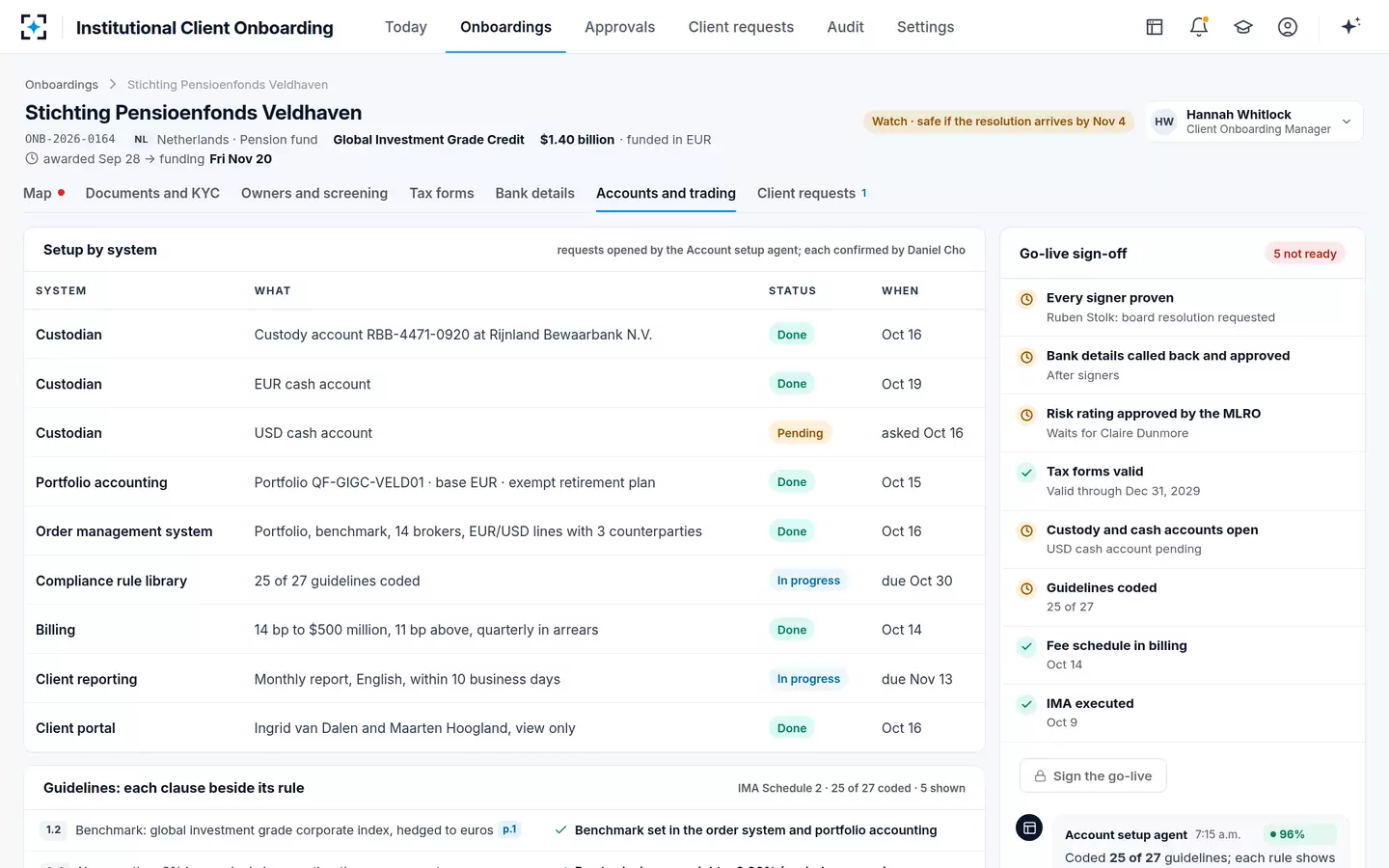
The dependencies are the same ones mapped in the asset management client onboarding process, and the weekly cost of a transition that has to wait is priced in client onboarding metrics. The full sample mandate is on the Institutional Client Onboarding page.
Funding dates in the next 30 days, beside what each one is waiting on
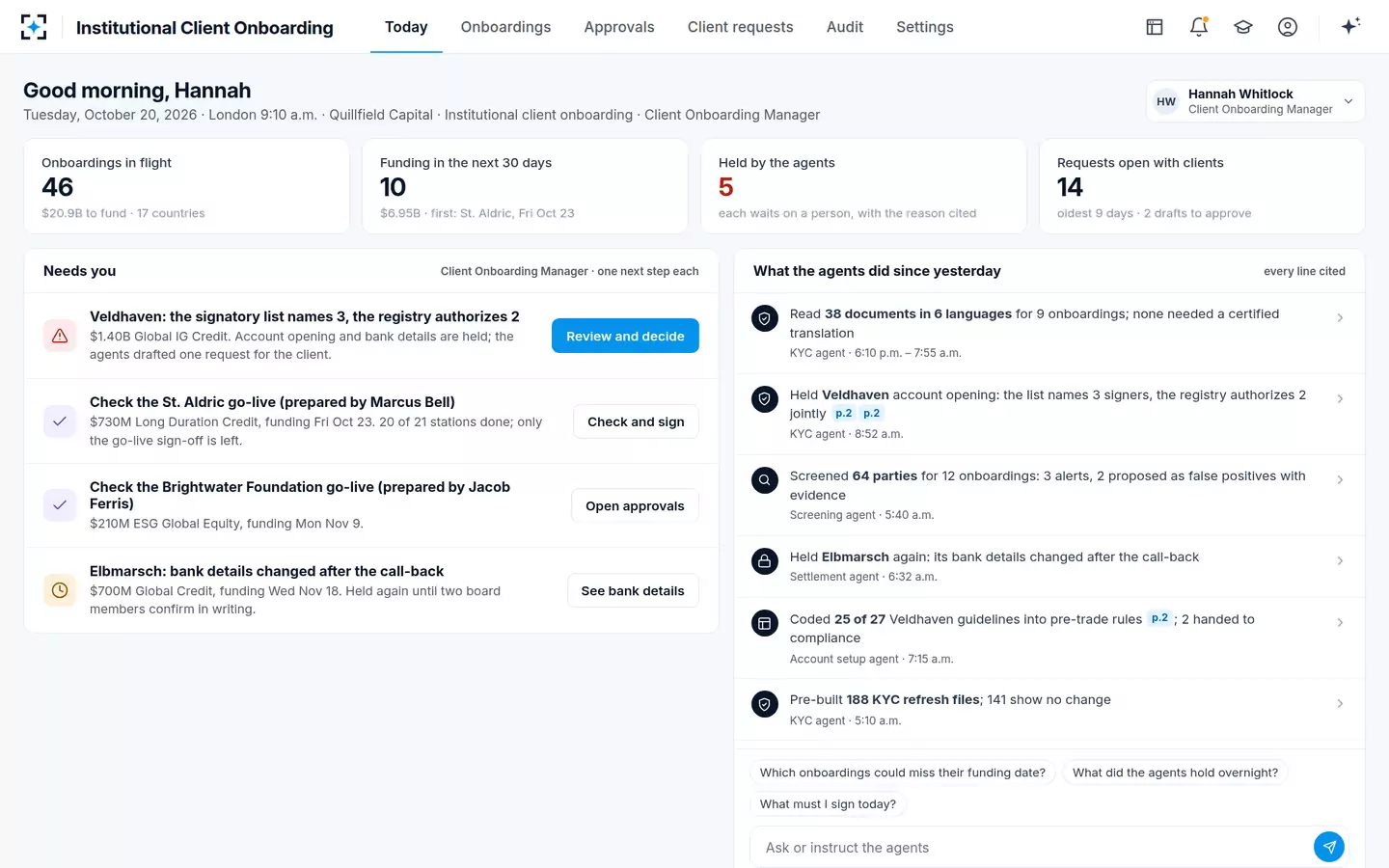
Questions people ask
What is an in-kind transfer?
It is a transfer of securities from one account to another without selling them, so the client keeps the positions and avoids the cost of selling and rebuying. In UK usage it is called an in specie transfer. It works only for securities the new manager's guidelines allow it to hold.
What is the difference between a transition manager and a custodian?
The custodian holds the client's assets and settles trades on instructions; the transition manager trades the portfolio from its old shape to its new one. A custody bank can also offer transition management, which is one of the conflicts of interest the FCA examined. The roles, and the agreements for them, are separate.
Is a transition manager a fiduciary?
It depends on its agreement and the law that applies to the client. The FCA found UK providers whose marketing called them fiduciaries while their agreements expressly excluded a fiduciary relationship, and noted that a provider may act as counterparty to some trades. Asset owners should read the agreement, not the brochure.
How long does a portfolio transition take?
The trading itself is usually planned to take days, not weeks, to limit market risk, but the transition cannot start until every party's accounts and instructions are ready. For the incoming manager, the onboarding before the trade is usually the longer part, which is why the funding date is set by onboarding readiness.
Who pays the transition manager?
The asset owner, through commissions on trades, mark-ups on bonds, a project management fee, or a mix. The FCA's 2014 case against State Street UK, and the SEC's 2017 case over State Street's transition management charges, both turned on mark-ups that clients had not agreed and could not see.