A client onboarding AI agent is software that does the reading and chasing in institutional onboarding: it extracts values from registry extracts, articles and board lists, compares the signing rule with the client's signatory list, screens parties, drafts requests to the client and opens set-up requests in other systems. The work is hard because the documents arrive in many languages and formats and must agree with each other, and an error in a signer or a bank detail is expensive. The safe design splits the job three ways: one agent reads, a second agent re-reads the same source blind on an independent model, and a named person decides anything that carries liability. Botminds' Institutional Client Onboarding is built that way, with seven agents that propose and hold, and people who approve, send and sign.
The examples come from the solution's fictional sample: Quillfield Capital onboarding a $1.40 billion credit mandate for Stichting Pensioenfonds Veldhaven, a Dutch pension fund.
Institutional Client Onboarding: the reader is never the checker, and neither signs
Agent
KYC agent readsExtracts each value from the Dutch registry extract, articles and board list, with the page it came from.
Never: sets the final risk rating.
Agent
Check agent re-reads blindReads the same pages again without seeing the first answer, on a model independent of the first reader, and re-runs every check.
Never: averages two answers or overrides a person.
A person decides
KYC analyst decides any disagreementSees both readings side by side with the source passage and picks one, or corrects both.
Agent
Planner agent draftsWrites the one request the client needs, with the latest date it can arrive.
Never: contacts the client or moves a funding date.
A person decides
Manager approves; MLRO signs the ratingThe onboarding manager approves the request, the client service director sends it, and the MLRO approves the risk rating with a reason code.
What does a client onboarding AI agent do?
It takes the parts of onboarding that are reading, comparing, dating and drafting, which is most of the manager's internal time. In the solution the work is split across seven agents, each with a narrow job and written limits: a Planner agent that builds the onboarding map from the CRM award and chases owners; a KYC agent that reads entity documents in their original language; a Screening agent that runs sanctions, PEP and adverse-media checks; a Tax agent that validates tax forms; a Settlement agent that reads settlement instructions; an Account setup agent that opens requests in the custodian, portfolio accounting, order management, compliance and billing systems; and a Check agent that re-reads everything.
Narrow jobs matter for two reasons. A narrow agent can be tested against a narrow set of known answers, and its limits can be written as rules the screens enforce. On one overnight run in the sample, the KYC agent read 38 documents in six languages for nine onboardings, none needing a certified translation, and the Screening agent screened 64 parties across 12 onboardings. None of that work was a decision; all of it was preparation for one.
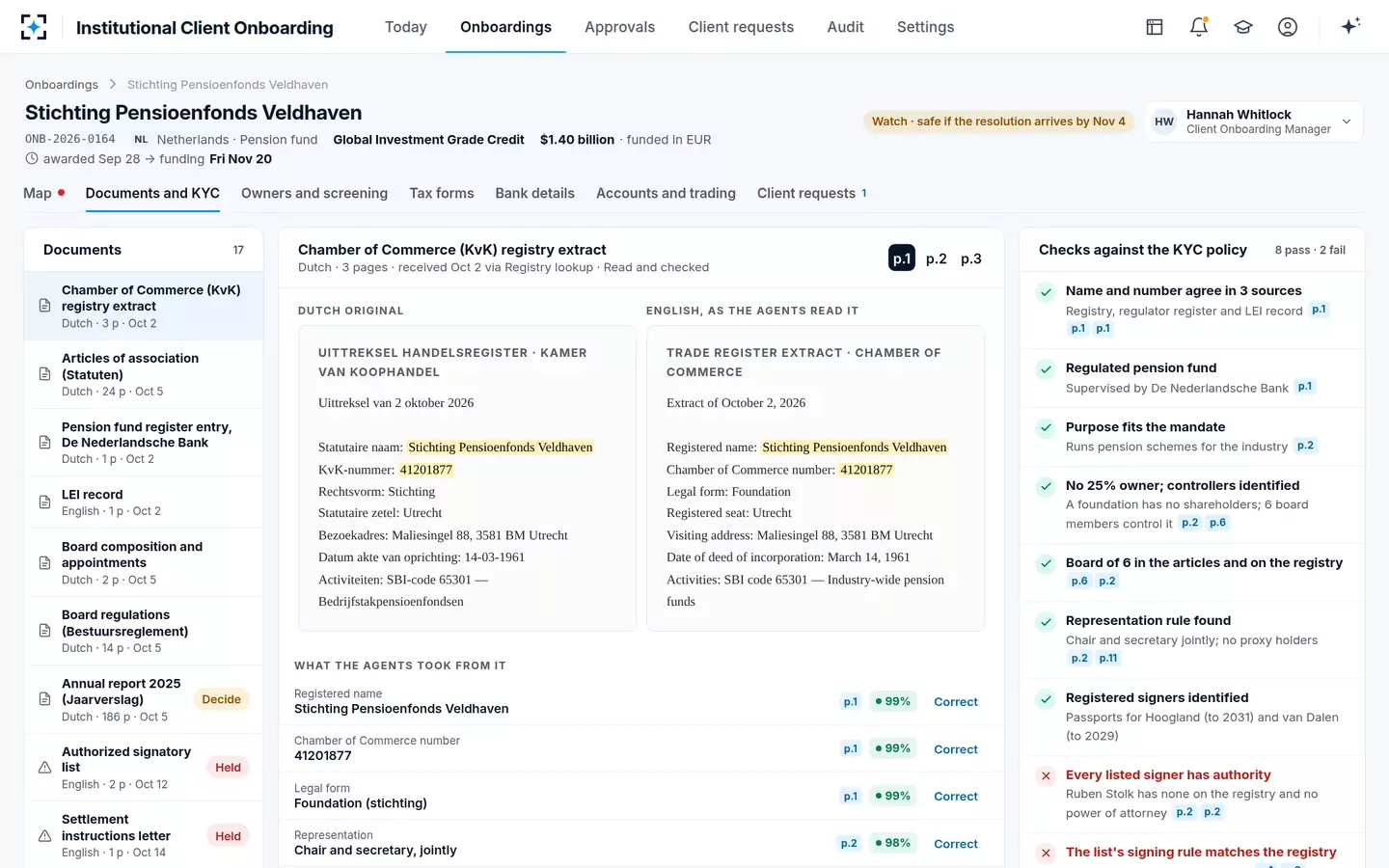
Documents and KYC: every value with its page, and two checks that fail
Can an AI agent approve a KYC file?
No, and a well-designed one cannot. Approving a KYC file is a judgment the firm answers for: that it knows who the client is, who controls it and who may act for it, and that the risk rating fits. An agent can prepare every element of that judgment and cite its source, but the signature belongs to a person the firm has named, usually a KYC analyst who prepares and an MLRO or AML officer who approves.
The rules point the same way even where they do not mention software. FinCEN's customer due diligence rule lets a bank or broker-dealer rely on what a legal entity customer tells it about its beneficial owners only while it has no knowledge of facts that would make that information doubtful (31 CFR 1010.230(b)(2)). An agent that finds a conflict between two documents has created exactly that knowledge, so it must hand the conflict to a person rather than settle it. In the solution, policy changes such as the ownership threshold or the confidence level below which a person reads first are proposed by an administrator and approved by the MLRO.
Why should the agent that reads a document not be the one that checks it?
Because a model asked to review its own answer tends to repeat it, and the research shows checking works when it rests on something outside the first answer. A survey of self-correction studies published in Transactions of the Association for Computational Linguistics found "no prior work demonstrates successful self-correction with feedback from prompted LLMs, except for studies in tasks that are exceptionally suited for self-correction", while "self-correction works well in tasks that can use reliable external feedback" (Kamoi et al., TACL 2024). An earlier study presented at ICLR 2024 reached a similar conclusion for reasoning tasks, finding that models struggle to correct themselves without outside feedback and sometimes get worse (Huang et al., ICLR 2024).
"self-correction works well in tasks that can use reliable external feedback"
Kamoi et al., Transactions of the Association for Computational Linguistics, 2024
Onboarding has reliable external feedback built in: the source document. So the checker in the solution does not grade the first agent's answer. It goes back to the registry extract or the annual report, reads it again without seeing what the reader extracted, on a model independent of the first reader, and compares the two results field by field. Agreement is evidence; disagreement is a question for a person. Running the second read on an independent model matters because two copies of the same model share the same blind spots, and a mistake both make looks like agreement.
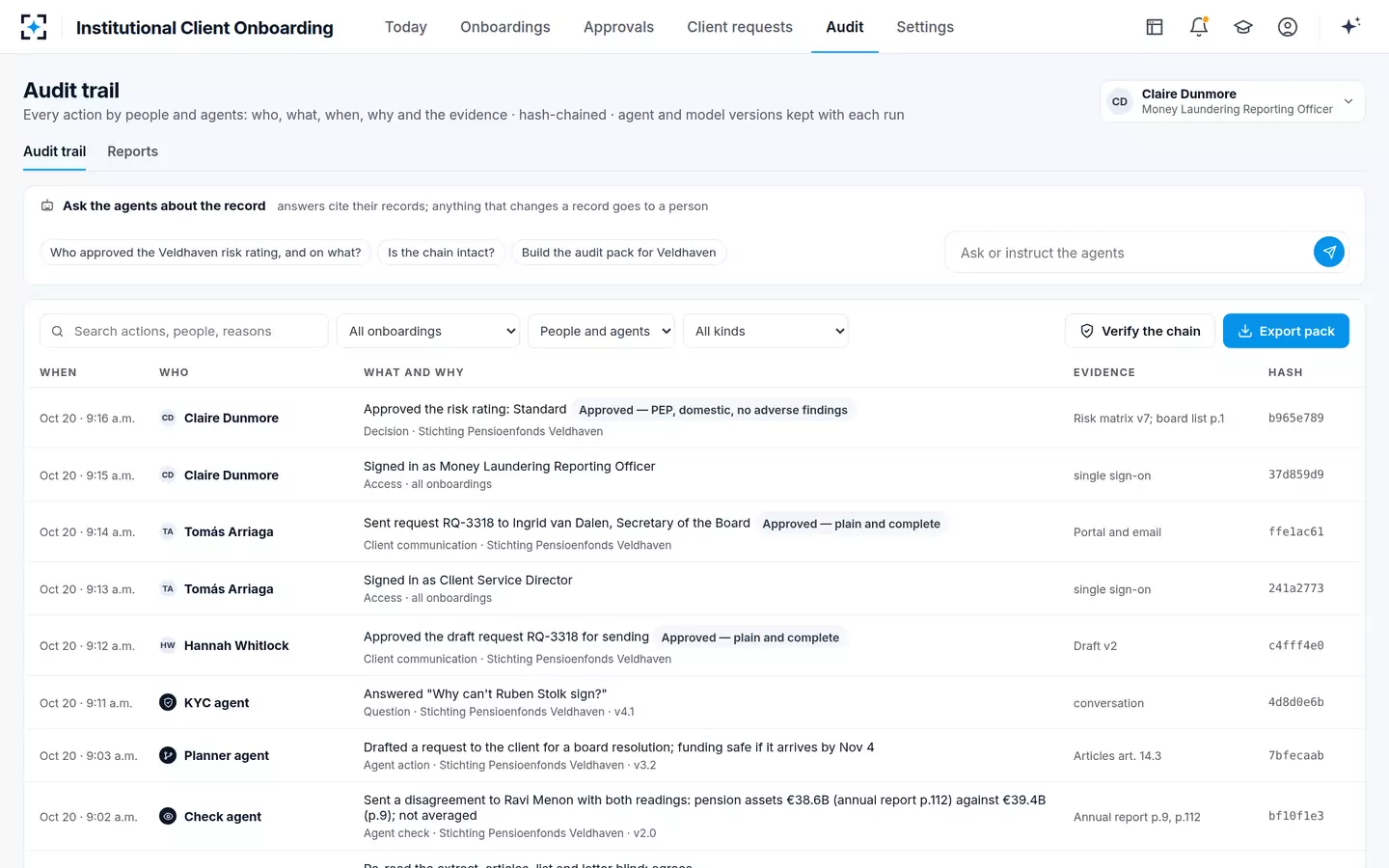
What does a blind re-read catch? One disagreement, traced
It catches values that one reading got wrong and the other did not, and it surfaces genuinely ambiguous sources that no single reading should settle. On the Veldhaven file, the Check agent agreed with the KYC agent on every extracted value but one: the fund's pension assets in its 2025 annual report. The KYC agent read €38.6 billion; the Check agent read €39.4 billion. Both had a page reference, page 112 for one and page 9 for the other.
Neither agent chose, and nothing was averaged. Both readings went to the KYC analyst with their pages. A report that gives one figure in a summary and another in the notes is a normal thing for a person to resolve, and the right answer may be that the two figures measure different things. An averaged €39.0 billion would have been wrong under either reading and would have hidden that there was a question at all. The rule in the solution's settings is fixed: a disagreement is always escalated to the station's owner, never averaged.
The audit trail: the disagreement, both readings, and who decided
Which decisions should no onboarding agent make?
Any decision that releases money, changes the client's legal position, or speaks for the firm. In practice that means seven things: setting a final risk rating, closing a sanctions or PEP match, verifying or releasing bank details, switching an account live, moving a funding date, sending anything to the client, and changing the policy the checks run against. Each is a point where a mistake is costly and where a regulator or auditor will ask who decided.
Where the agents stop and a named person takes over
What the agent does: The KYC agent builds the control chart and lists each risk factor with its source.
What a person decides: The analyst prepares the rating; the MLRO approves it with a reason code and can never approve a file she prepared.
What the agent does: The Screening agent proposes a disposition for each alert with its evidence and rescreens nightly.
What a person decides: The KYC analyst closes or escalates every match.
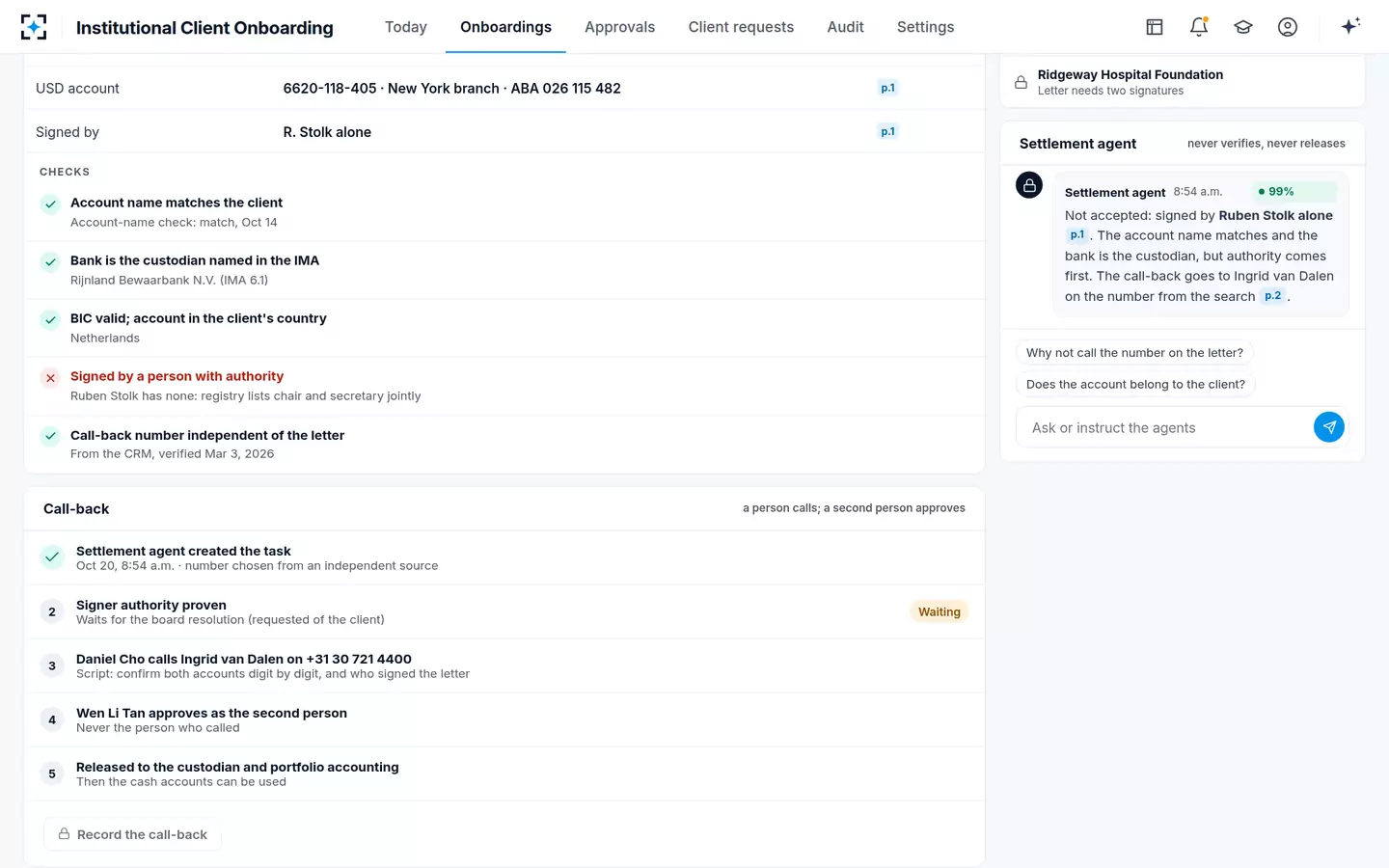
What the agent does: The Settlement agent checks the signer's authority, account name, BIC and country, and builds a call-back on a number from an independent source.
What a person decides: A person makes the call; a second person approves before any account is used.
What the agent does: The Planner agent drafts one plain request and the date it protects.
What a person decides: A manager approves; the client service director sends.
What the agent does: The Account setup agent opens requests in each system and codes each guideline with its clause cited.
What a person decides: One manager signs the go-live and a second checks it; every funding-date change needs a person and a reason code.
The bank-details row is the one most often automated badly. A new settlement instruction is the classic target of business email compromise, and the call-back exists so that someone independent of the letter confirms it on a number that did not come with it. An agent that can both read the letter and confirm it has removed the control. The authorized signatory list template guide explains why the signer on that letter matters as much as the call-back.
Bank details: the agent refuses the letter and builds a call-back a person must make
What do regulators say about AI agents in financial firms?
They describe an industry that lets agents recommend and keeps people deciding, and they expect existing rules to apply unchanged. The Bank of England and FCA's 2026 survey of UK financial firms found that most firms with agents in production use them for decision support, where the agent recommends and a person decides and acts, and that only a small minority have deployed agents with broad autonomy (Bank of England and FCA, 2026).
UK firms let agents talk and draft far more than they let them decide
80%
of respondents had AI agents in production giving decision support
2%
had deployed agents with broad autonomy
34%
use or plan agents for automated customer communications (16% today)
25%
use or plan agents to create or modify records in core systems (8% today)
FINRA's 2026 oversight report lists the risks it sees in AI agents, among them agents acting without human validation and approval, acting beyond the authority the user intended, and multi-step reasoning that is hard to trace or audit (FINRA, 2026 Annual Regulatory Oversight Report). The SEC's examination priorities for fiscal 2027 note that registrants are using what the Division calls "super intelligence" (SI) in core operations including "customer management", and say examiners will look at whether firms still meet obligations that do not depend on the technology (SEC Division of Examinations, FY2027 priorities). For an onboarding agent, that reads as a design requirement: every action traceable to an agent version, every decision to a named person, and nothing the agent did that a person could not reconstruct.
How do you test a client onboarding AI agent before you buy?
Test it on onboardings you have already closed, where you know the right answers, and plant the errors you most fear. A demonstration on a vendor's sample proves the screens work; a replay of your own files proves the agent reads your documents. Ten closed mandates across a mix of jurisdictions and client types is a reasonable first sample.
Eight checks to run on an onboarding agent with your own closed files
- Plant a signer the registry does not authorize
Add a name to a past signatory list. The agent should hold the signer and bank-details stations, cite the registry passage, and nothing else.
- Plant a conflict between two documents
Change a figure in one copy. The checker should report both readings with their pages, and never pick one or average them.
- Feed it a document in a language your team reads slowly
Ask for the original passage beside the English it relied on, with the same phrase highlighted.
- Send a settlement letter with a new phone number on it
The call-back must use a number from an independent source, and a person must make the call.
- Check what happens below its confidence threshold
A person should read first; ask what the threshold is and who may change it.
- Ask it to approve something
It should refuse a risk rating, a screening closure, a go-live and a funding-date change, and say who can decide.
- Change the model version mid-test
The audit trail should show which version produced which answer, and a version change should need approval.
- Export one complete file
An examiner should be able to see every document, every value with its page, every disagreement and every signature.
The numbers to record are simple: how many planted errors came back, how many values the two readings disagreed on and how each disagreement was resolved, and how many actions needed a person. A related design question, what to measure once the agent is live, is covered in client onboarding metrics, and the week-by-week plan for a first live mandate is in best client onboarding software for asset managers.
Where do Institutional Client Onboarding's agents stop?
They stop at every decision listed above, and at three kinds of work they do not do at all. The Tax agent validates forms field by field but never gives tax advice. The Settlement agent never verifies bank details itself and never releases them. And no agent changes the KYC policy: thresholds, refresh cycles and the confidence level for proposing without a person are settings an administrator proposes and the MLRO approves.
The solution also depends on what the firm brings. Its checks are only as good as the KYC policy and risk matrix it is given, and its registry reads are only as current as the extracts the firm can obtain; the sample policy rejects registry extracts older than three months at account opening. What it changes is where people spend their time: on the one disagreement and the one held signer, with the source open beside them, rather than on reading every page to find them. The whole mandate runs screen by screen on the Institutional Client Onboarding page, and institutional account opening documents sets out the file the agents assemble.
Questions people ask
What is agentic AI in client onboarding?
It is the use of AI agents that take steps on their own within limits, such as reading a document, comparing it with another and opening a request in a downstream system, rather than only answering questions. In institutional onboarding the steps are reading, screening, validating, chasing and setting up. The limits decide whether it is safe: which steps need a person, and which no agent may take.
Can an AI agent do a call-back on new bank details?
It should not. A call-back exists so that a person independent of the request confirms the details on a number that did not come with them. An agent can check the letter, find an independent number and write the script; in the solution a person makes the call and a second person approves it.
How is a blind re-read different from a confidence score?
A confidence score is the reader's own estimate of how sure it is, and readers are often confidently wrong. A blind re-read is a second, independent reading of the same source that can disagree. In the solution, below 95% confidence a person reads first, and the blind re-read runs on every document regardless of confidence.
Does using an AI agent change who is accountable for KYC?
No. The firm remains responsible for its KYC and AML obligations whoever or whatever does the reading. FINRA's guidance and the SEC's examination priorities both treat AI use as subject to existing obligations, which is why every agent action should be traceable and every decision signed by a named person.
What should an onboarding agent never send to a client?
Anything a person has not approved. In the solution the Planner agent drafts requests, a manager approves, and the client service director sends; the client portal shows the request without internal checks or agent names. One request instead of three is a design goal, and on the Veldhaven sample one letter replaced asks from three teams.