Who is the beneficial owner of a pension fund? Usually no individual, because a pension plan rarely has anyone who owns 25% of it, so the answer depends on its legal form. The rest of a pension fund client's KYC is the same in outline as for any institutional client: identify the entity from an independent source, establish who controls it and who may act for it, screen every party, understand the purpose of the relationship and set a risk rating. The beneficial-owner step is where pension clients differ: under the US customer due diligence (CDD) rule, a public pension system may fall outside the definition altogether, a trust is generally not a "legal entity customer", a nonprofit is subject to the control test only, and a foreign foundation faces both tests and usually passes the first with no one to name. UK rules ask a different question, about trustees, beneficiaries and the class of members. Botminds' Institutional Client Onboarding reads the plan's own documents, builds the control chart, records which route the firm's policy applied and why, and leaves the rating to people.
The examples use the solution's fictional sample, Stichting Pensioenfonds Veldhaven, a Dutch pension foundation supervised by De Nederlandsche Bank and onboarded by the fictional manager Quillfield Capital. This page explains the rules; it is not legal advice.
Which ownership test applies? A decision order for institutional clients under the US CDD rule
- 1
Is the client a US state or local government body, or an entity exercising governmental authority?
Outside the US definition of a legal entity customer. Record the statute that creates it and the officials who act for it.
- 2
Is it a state-regulated insurer, a registered fund or an SEC-registered adviser?
Also outside the definition. Record the regulator and the licence or registration.
- 3
Is it a trust that no state filing created, as many pension plans are?
Not a legal entity customer under the US rule. Identify the trustees, who sign for it; under UK rules, settlor, trustees, beneficiaries and controllers.
- 4
Is it a nonprofit corporation, such as many endowments and foundations?
Control test only: one individual with significant responsibility to control, manage or direct it.
- 5
Otherwise: a company, or a foreign entity similar to one, such as a foundation
Both tests. The ownership test usually finds no one at 25%; record that, and name the control person.
What does KYC for a pension fund client cover?
Five things: who the fund is, who controls it, who may act for it, whether any of those people or the fund itself raises a sanctions, PEP or adverse-media concern, and what the relationship is for. The documents differ by legal form, but for most funds they are a registry entry or the statute or deed that created the fund, its governing documents, a list of its board or trustees, the identity of the people who will sign, the regulator's register entry where it is supervised, and the source of its money, usually contributions and investment returns.
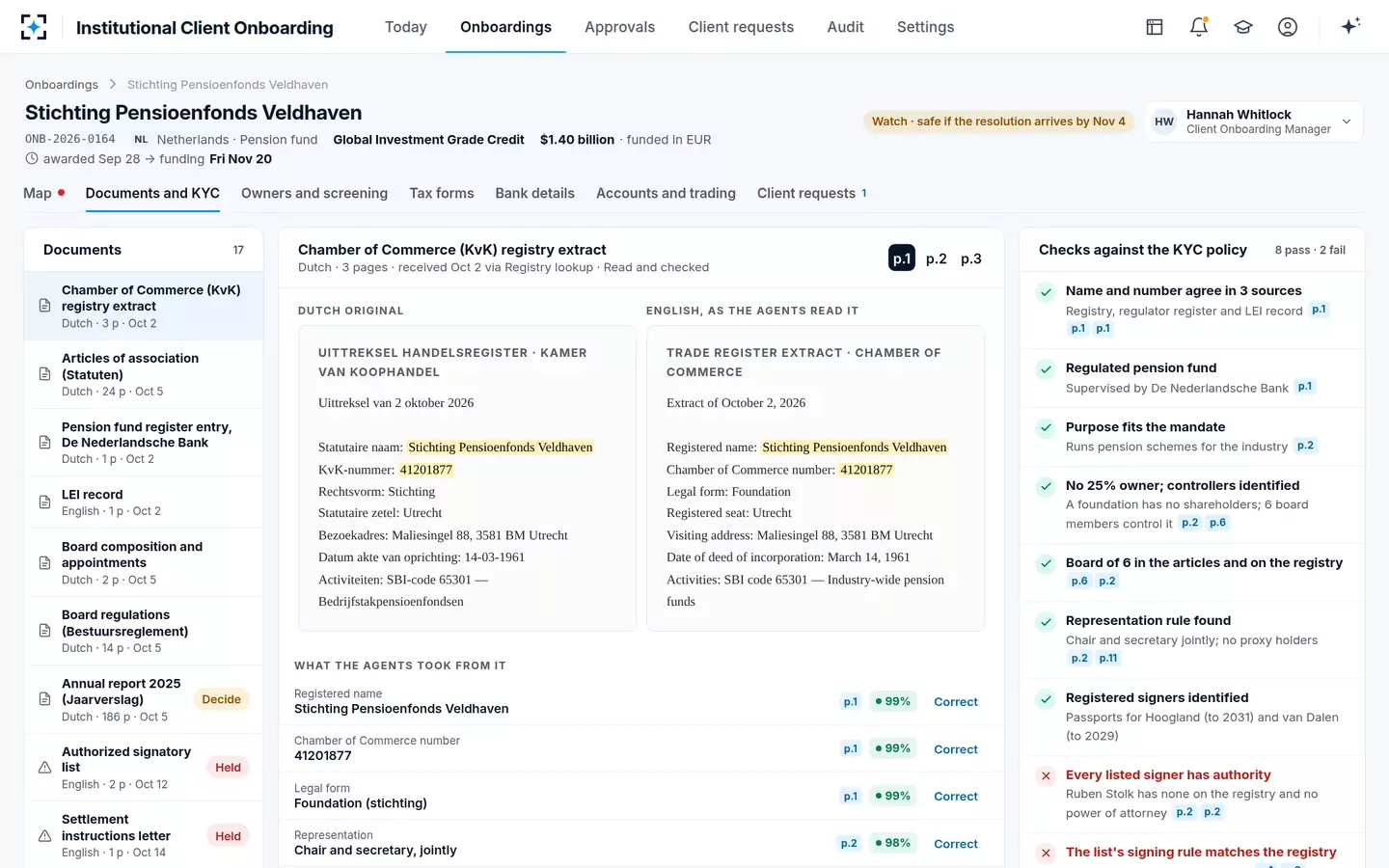
The beneficial-owner question is the one that trips up standard forms. A form built for companies asks for every individual owning 25% or more, and a pension fund's answer is none. That is a correct answer, not a missing one, and the file should say why. In the Veldhaven sample the KYC check reads: no 25% owner, controllers identified, because a foundation has no shareholders and its six board members control it.
A pension foundation's file: no 25% owner, controllers identified
Who is the beneficial owner of a pension fund?
Usually no one in the ownership sense, and the people who control it in the control sense. Under the US CDD rule a beneficial owner is each individual owning 25 percent or more of a legal entity customer's equity, plus a single individual with significant responsibility to control, manage or direct it, such as an executive officer (31 CFR 1010.230(d)). A pension fund has members and beneficiaries, not equity holders, so the first limb is normally empty and the second names one person: in practice the chair, chief executive or chief investment officer, whoever the fund's governance gives significant control.
UK rules answer differently because they look at the fund's form. For a trust, the Money Laundering Regulations 2017 treat as beneficial owners "the settlor", "the trustees", "the beneficiaries", where the individuals who will benefit are not yet known, the class for whose main benefit the trust exists, and "any individual who has control over the trust"; for a foundation or similar arrangement, "those individuals who hold equivalent or similar positions" (MLR 2017, reg. 6). For a pension scheme with thousands of members, the class of members is the practical answer to the beneficiaries limb.
Does the 25 percent ownership test apply to a pension plan?
Often not at all under the US rule, and where it does it usually finds no one. Three provisions do the work. First, the CDD rule applies to "accounts", and the account definition it borrows excludes "an account opened for the purpose of participating in an employee benefit plan established under the Employee Retirement Income Security Act of 1974" (31 CFR 1023.100(a)(2)); FinCEN explained that such accounts "are of extremely low money laundering risk" (81 FR 29398, 2016).
Second, the rule's definition of a legal entity customer covers entities created by filing a public document with a secretary of state or a similar office, general partnerships and similar foreign entities (31 CFR 1010.230(e)(1)). A trust that no filing created is outside it, and FinCEN said so when it adopted the rule, while noting that institutions still identify trustees. Third, for non-ERISA plans FinCEN said "the customer would generally either be the trust established to maintain the assets, or the employer that contracts with the financial institution to establish the account, and not the underlying participants in or beneficiaries of the account" (81 FR 29398). Where the employer is the customer and is itself a legal entity, the employer's owners are the ones identified.
The practical point for a manager: the participant-account exclusion was written for plan participants, and a separate account opened for a plan's trust is a different thing. Which route applies to a given plan is a question for the firm's policy and counsel, and the file should record the answer and the reason, not just leave the ownership section blank. For trusts generally, the neighbouring guide does a trust need beneficial ownership sets out the rule in more detail.
What are the KYC requirements for government entities and public pension systems?
Under the US CDD rule, a US governmental body is not a legal entity customer at all. The rule excludes persons described in the currency-reporting exemption list, which covers departments and agencies of the United States, of any state or of any political subdivision of a state, and any entity established under federal or state law "that exercises governmental authority" on behalf of the United States, a state or a political subdivision (31 CFR 1020.315(b)(2)–(3); 1010.230(e)(2)(ii)). A foreign governmental department, agency or political subdivision is excluded too, but only if it "engages only in governmental rather than commercial activities" (1010.230(e)(2)(xv)).
US public pensions: many systems, large balances, no owners
311
state-administered public pension funds in 2025
4,061
locally administered defined benefit systems
$6.49T
invested by state and local government pension plans in 2025, up from $5.98 trillion in 2024
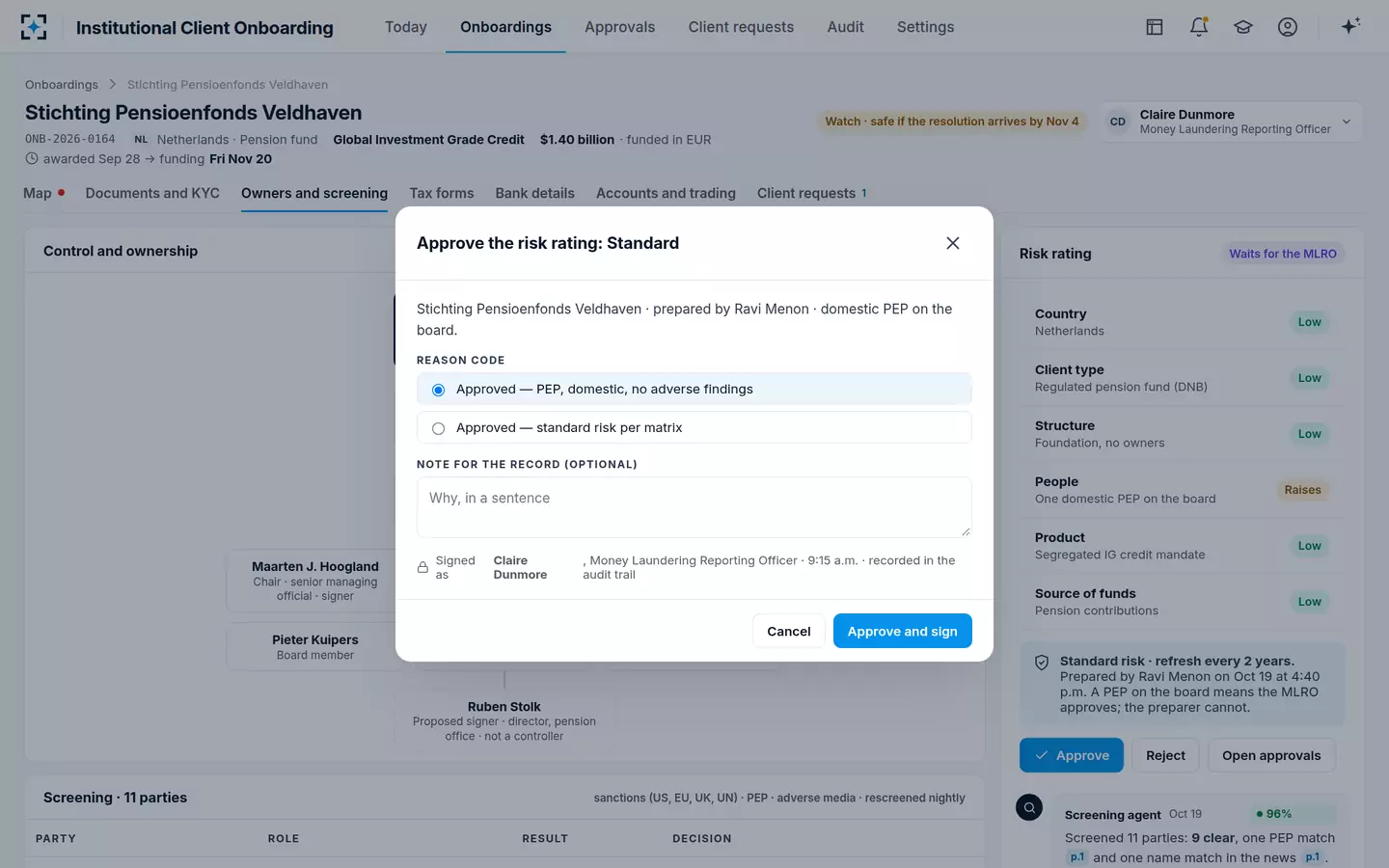
Whether a particular public pension system is a governmental department, an agency or an entity exercising governmental authority is a question about its enabling statute, and the file should cite it. What does not disappear with the exclusion is the rest of KYC: the officials who act for the system must still be identified, their authority traced to the statute or a board resolution, and the system and its officials screened. Public officials on a pension board are often politically exposed persons under a firm's policy, which is why a PEP on the Veldhaven board made its rating one the MLRO must approve.
Endowments, foundations and insurers: which test applies to each?
Each falls in a different place. A US nonprofit corporation, which describes many university endowments and charitable foundations, is subject only to the control test: FinCEN chose to exclude nonprofits from the ownership test, reasoning that they have no ownership interests to identify, and to require one individual with significant responsibility to control, manage or direct them (81 FR 29398; 1010.230(e)(3)(ii)). A state-regulated insurance company is outside the definition: the exclusion list includes "An insurance company that is regulated by a State" (1010.230(e)(2)(xii)).
Institutional client types and the US CDD route for each
| Client | US CDD route | What the file still needs |
|---|---|---|
| US public pension system | Excluded if a governmental department, agency or entity exercising governmental authority | Enabling statute, board resolution, officials' identities and authority, screening |
| ERISA plan (trust) | Participant accounts excluded; a trust not created by filing is not a legal entity customer | Trust and plan documents, trustees, named fiduciary's authorization, screening |
| Corporate plan where the employer contracts | The employer is the customer; its owners and a control person are identified | Employer's entity documents and owners, plan documents |
| Endowment or foundation (US nonprofit corporation) | Control test only | Certificate of incorporation or good standing, one control person, board list |
| State-regulated insurer | Excluded | Licence and regulator, officers who sign, screening |
| Foreign pension foundation (e.g. a Dutch stichting) | Both tests as a similar foreign entity; ownership usually none | Registry extract, articles, board, one control person, supervisor's register entry |
Foreign foundations are the case most US forms handle worst. A Dutch stichting is created by notarial deed and registered with the Chamber of Commerce, which on our reading makes it the kind of entity, formed under foreign law and similar to a company, that the US definition covers. It has no shareholders, so the ownership test finds no one, and the control test names one individual. The Veldhaven sample records the chair and the secretary, who jointly represent the fund, as senior managing officials under the firm's policy; that is a policy choice to record more than the US minimum, which is one person.
Which UK rules apply to a pension scheme client?
The Money Laundering Regulations 2017, read with the scheme's form. Most UK occupational schemes are trusts, so the trust definition applies: settlor, trustees, beneficiaries or the class of members, and anyone with control over the trust. Two provisions make that workable for a pension scheme.
The first concerns control. A person does not have control over a trust "solely as a result of" certain powers, including "any discretion delegated to P under section 34 (power of investment and delegation) of the Pensions Act 1995" (MLR 2017, reg. 6(4)(b)(ii)). The investment manager the trustees appoint is therefore not a beneficial owner of the scheme because it manages the money. The second concerns depth: simplified due diligence may be applied to a low-risk relationship, and the regulations list as a lower-risk factor a pension scheme that provides retirement benefits to employees, whose contributions "are made by way of deductions from wages", and whose rules "do not permit the assignment of a member's interest under the scheme" (MLR 2017, reg. 37(3)(b)(iii)). Simplified measures still require monitoring, and stop if the firm doubts the information or suspects money laundering.
The same pension trust, under the US and UK rules
US CDD rule (31 CFR 1010.230): A trust not created by a state filing is not a legal entity customer; participant accounts in an ERISA plan are excluded from "account".
UK MLR 2017 (reg. 6): Yes: beneficial owners of a trust are defined, and a pension scheme is a trust in most cases.
US CDD rule (31 CFR 1010.230): In practice the trustees, who sign; no ownership certification under the rule.
UK MLR 2017 (reg. 6): Settlor, trustees, beneficiaries or the class of members, and any individual with control.
US CDD rule (31 CFR 1010.230): Not addressed by the rule.
UK MLR 2017 (reg. 6): Not a controller solely because trustees delegated investment discretion to it under the Pensions Act 1995.
US CDD rule (31 CFR 1010.230): None specific to pension trusts.
UK MLR 2017 (reg. 6): Simplified due diligence may apply where the scheme meets the regulation 37 conditions and the risk is low.
Does an asset manager have to identify beneficial owners?
In the US, not under the CDD rule today; in the UK, yes. The US rule binds "covered financial institutions": banks, broker-dealers, futures commission merchants and introducing brokers, and mutual funds (31 CFR 1010.605(e)(1)). FinCEN's AML program rule for advisers, now effective 1 January 2028, deliberately left beneficial ownership to a later rulemaking (89 FR 72156), as the guide to the investment adviser AML rule explains; the identification rule still pending for advisers is covered in the investment adviser CIP rule guide. A US adviser identifies owners and controllers as a matter of its own policy, and because the custodian and broker serving the same client must.
A UK manager is in a different position. The UK regulations treat as a financial institution a person whose business is providing investment services or performing investment activities on a professional basis (MLR 2017, reg. 10(2)(c)), which brings portfolio managers into the beneficial-owner rules above. A firm with clients in both places, like the fictional London-based manager in these guides, usually writes one policy that meets the stricter rule for each client type, and records which provision each file relied on.
The control chart and the rating: who controls the fund, and who approves
How often should a pension fund's KYC be refreshed?
On a schedule set by risk, and on events. Neither the US CDD rule nor the UK regulations fix a calendar for institutional clients; the firm sets one and follows it. In the sample policy, high-risk files are refreshed every 12 months, standard every 24 and low every 36, and a change found in a registry or the board brings a file forward.
For the banks and broker-dealers that serve the same clients, FinCEN changed one trigger in February 2026: they may now identify and verify a legal entity customer's beneficial owners when it first opens an account, then again only when they learn facts that call the information into question or when their risk-based procedures call for it, rather than at every new account (FinCEN, FIN-2026-R001, 13 February 2026). The relief changes when the check is repeated, not whether it is done.
Six things to record on every pension fund KYC file
- The legal form, from the source that created it
Statute, deed, registry entry or certificate of incorporation, with its date.
- The route taken on ownership, and why
Excluded, trust, control test only, or both tests with no 25% owner, citing the provision.
- The control person, or the trustees and controllers
Named, identified, and screened; for UK trusts, the class of members.
- Who may act for the fund
The signing rule and each signer's authority, traced to the registry, articles, deed or statute.
- The regulator and the source of funds
The supervisor's register entry where there is one; contributions and returns as the source.
- The refresh date and the events that bring it forward
Set by risk; board and registry changes reopen the file.
The documents behind each item are listed in institutional account opening documents. The full Veldhaven onboarding, from the registry extract to the MLRO's signature, is on the Institutional Client Onboarding page.
Questions people ask
What is the ultimate beneficial owner definition?
The individual who ultimately owns or controls an entity, or on whose behalf a transaction is conducted. The US CDD rule turns it into two tests, 25% or more of the equity and one individual with significant control. The UK regulations use more than 25% for bodies corporate, and for trusts name settlor, trustees, beneficiaries and anyone with control.
What are the KYC requirements for foundations?
Under the US rule, a nonprofit corporation is subject to the control test only, and a foreign foundation registered like a company faces both tests and usually has no 25% owner. Under the UK regulations, a foundation's beneficial owners are the individuals holding positions equivalent to a trust's settlor, trustees, beneficiaries and controllers.
Is a pension fund a high-risk client for KYC?
Often not, but it depends on the fund. Supervised schemes funded by wage deductions are listed as a lower-risk factor in the UK regulations, and FinCEN called ERISA participant accounts extremely low risk. A PEP on the board, a high-risk country or complex layers raise the rating; the fictional Veldhaven fund rated standard, with a domestic PEP on its board as the one factor that raised it.
Do I need to identify every member of a pension scheme?
No. Under the UK regulations, where beneficiaries are not individually determined, the class of persons in whose interest the trust is set up is identified. Under the US rule, participants are not the customer. The trustees, controllers and signers are the people the file names.
Who signs for a pension fund?
Whoever its governing rules authorize: trustees under the deed, officers under a registry entry, or officials under a statute, alone or jointly as the rules say. The Veldhaven foundation's registry gives that power to the chair and the secretary together, with no proxy holders, which is why its signatory list needed a board resolution.