An authorized signatory list (or authorised signatory list) is the document in which an institutional client names the people who may sign agreements and give instructions for it, how each may sign, alone or jointly, and with specimen signatures. A good template has seven fields, but the fields are not what makes a list pass. A list passes when it is no wider than the signing rule in the client's registry entry or articles, when every authority on it traces to a board resolution or power of attorney, and when the people who certify it are themselves authorized. Most lists come back because they disagree with those documents, not because something is missing. Botminds' Institutional Client Onboarding reads the registry and articles in their own language, compares the signing rule with the list, holds only what depends on a mismatch and drafts one request that fixes it.
The examples use the solution's fictional sample: Quillfield Capital onboarding Stichting Pensioenfonds Veldhaven, a Dutch pension foundation, whose list named three signers when its registry authorized two, acting together.
An authorized signatory list template: seven fields, and why each one is checked
Legal name, registration number and LEI
Exactly as the registry and LEI record show them, so the list can be matched to the entity.
The authority the list rests on
The article of the articles or deed, and the date of the board resolution or power of attorney that grants each authority.
Each signer: full name, title, ID reference
Names spelled as on the passport and the registry; titles as the board appointed them.
How each may sign: alone, or jointly with whom
The field most lists get wrong. It must not be wider than the signing rule allows.
What each may sign
Agreements, investment instructions, settlement instructions, or all three; limits by amount if any.
Specimen signature
One per signer, for comparison with signatures on later instructions.
Certification, date and what it supersedes
Signed by people the signing rule authorizes, dated, and naming the list it replaces.
What is an authorized signatory list?
It is the client's own statement of who may act for it in a relationship, and it is evidence only of what the client says. Asset managers, custodians and banks use it to decide whose signature on an agreement, an investment instruction or a bank-details letter they may rely on. It sits beside, and must agree with, three other documents: the registry entry or articles that set the entity's signing rule, the resolution or power of attorney that delegates authority to anyone else, and the identity documents of each signer.
The distinction matters because the list can be wider than the law. A board can delegate authority within what its articles allow, but a list typed up by the client's operations team can say anything. The manager's job is to check the list against the sources, not to accept it as the source. In the sample firm's policy, signer evidence must be the registry, a board resolution or a notarized power of attorney; a list alone is never enough.
What should an authorized signatory list template include?
The seven fields above, filled from the client's own documents rather than from memory. Two of them carry most of the risk: how each person may sign, and who certifies the list.
"How each may sign" is the field to read twice. Signing rules are often joint: two directors, or a chair with a secretary. A list that lets each named person sign alone is wider than a joint rule and cannot be relied on for anything the joint rule governs. Certification fails in a quieter way. A list signed by the client's head of operations, who is not an authorized signer, certifies nothing. It should be signed by people the rule authorizes, in the combination the rule requires, and dated, with a line saying which earlier list it replaces.
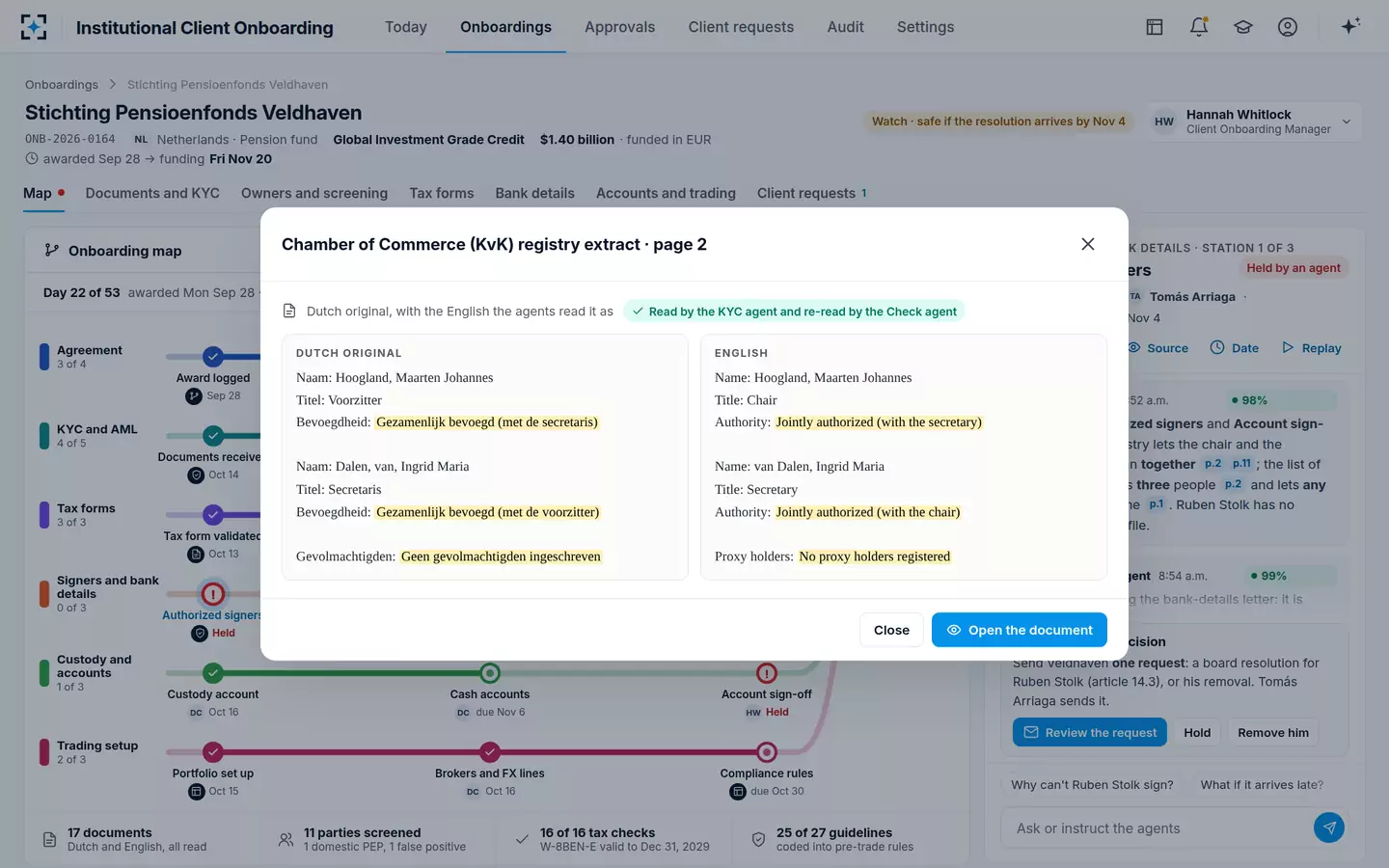
The registry's signing rule, in Dutch, beside the English the agents read
Why does the signing rule come from the registry or the articles, not the list?
Because company and foundation law gives the authority, and the registry or articles are where that law is applied to the entity. In England and Wales, for example, a document is validly executed by a company if it is signed on its behalf "by two authorised signatories" or "by a director of the company in the presence of a witness who attests the signature", where every director, and the secretary of a public company or of a private company that has one, counts as an authorised signatory (Companies Act 2006, s.44). Other jurisdictions record the rule in the commercial register. The Dutch extract in the sample states each officer's authority and whether any proxy holders are registered.
For institutional clients the rule varies by legal form, which is why a single template cannot settle it. The table shows where to look.
Where the signing rule lives, by type of institutional client
| Client | Where the rule is | What to collect |
|---|---|---|
| Company (UK) | Companies Act 2006 s.44 and the articles; board resolutions for delegated authority | Articles, board resolution, register of directors |
| Foundation or company (Netherlands and other civil-law registers) | The commercial register entry and the articles | Registry extract stating each officer's authority and any proxy holders; resolution or notarized power of attorney for anyone else |
| Trust, including many pension plans | The trust deed: trustees act, often jointly or by a stated majority | Deed or the relevant extract, list of current trustees, any delegation the deed permits |
| ERISA plan | The plan documents and the named fiduciary's delegations | Plan and trust documents, the appointment of the investment manager, the named fiduciary's authorization |
| Public pension system | The statute or ordinance that creates it, and its board's resolutions | Statutory citation, board resolution, officers' appointments |
Trusts deserve a note. Under the US CDD rule a trust is generally not a legal entity customer, so there are no beneficial owners to certify for it under that rule, but FinCEN observed when it adopted the rule that institutions generally identify trustees anyway, because trustees will be the signatories on a trust's accounts (81 FR 29398, 2016). For a trust client the signatory list and the list of trustees are close to the same document, and they should agree.
Certificate of incumbency, secretary's certificate or board resolution: what is the difference?
They answer different questions. A board resolution is the decision itself: it grants an authority, such as a power of attorney to a named person. A certificate of incumbency, as the term is commonly used, confirms who currently holds which office, often with specimen signatures, and is usually signed by the company secretary, a director or a registered agent. A secretary's certificate certifies that copies of documents, such as the articles and a resolution, are true and still in force, and may include an incumbency section. None of the three is defined by a US or UK regulator; usage varies by jurisdiction, so the content matters more than the label.
Three documents that support a signatory list, and what each proves
What it proves: That the board granted a named authority on a date, under a stated article.
What it cannot prove alone: That the people who passed it were the board, or that it is still in force. Pair it with the registry and a certificate.
What it proves: Who holds each office today, signed by someone in a position to know.
What it cannot prove alone: What each officer may sign alone. Office and authority are different things.
What it proves: That attached copies of the articles and resolutions are true and in force.
What it cannot prove alone: That the signatory list agrees with them. That comparison is the manager's job.
Why do authorized signatory lists get rejected?
Because they disagree with another document in the file. Seven mismatches account for most returns, and each can be checked mechanically before anyone asks the client anything.
Seven mismatches that send a signatory list back
- A signer the rule does not authorize
The list names someone with no office in the registry and no resolution or power of attorney behind them.
- "Any one alone" where the rule says jointly
The list is wider than the signing rule. It cannot be relied on for anything the rule governs.
- Certified by the wrong people
Signed by someone who is not an authorized signer, or by one signer where two are required.
- A board that has changed since
A new chair or secretary on the registry who is not on the list, or a departed one who still is.
- Names or titles that do not match
Spellings that differ from the passport or the registry, or titles the board never appointed.
- Scope too narrow or unstated
The list covers agreements but the same person signs settlement instructions, or the list says nothing about scope.
- Missing specimen signatures or dates
Nothing to compare a later instruction with, and no way to tell which list is current.
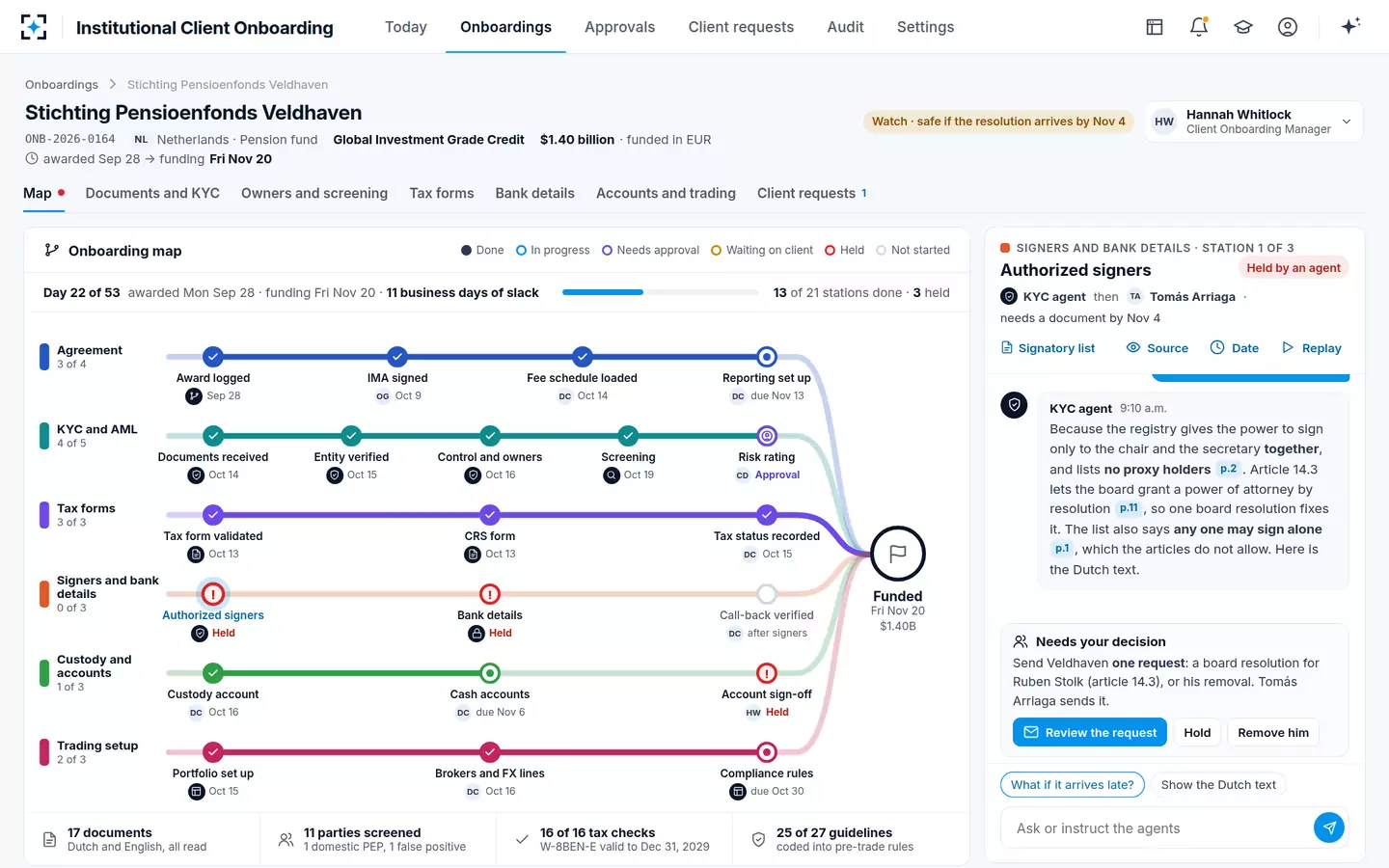
The first two often come together, as they did for Veldhaven. The fund's list named three people who could each sign alone; the registry gave the chair and the secretary joint authority and listed no proxy holders, so the third person, a pension office director, had no authority at all. The articles offered a way out: article 14.3 lets the board grant a power of attorney by resolution. One board decision, either that resolution or a new list without him signed by the chair and the secretary together, fixes both mismatches.
The held station and a plain answer: why one signer cannot sign
Authorized signatory list example: the sample fund's list, before and after
The sample list failed on two fields and was fixed by changing those two, not by adding paper. The table shows the fictional Veldhaven fund's list as it arrived and as the board's decision would leave it under either option the fund was offered.
One signatory list, as submitted and as the registry allows it
| Field | As submitted | Option A: power of attorney | Option B: new list |
|---|---|---|---|
| Signers | Chair, secretary and the pension office director | All three, the director under a board power of attorney | Chair and secretary only |
| How each may sign | Any one alone | Chair and secretary jointly; the director alone only within the power of attorney's scope | Chair and secretary jointly |
| Authority it rests on | The list itself | Article 14.3 and the dated board resolution | The registry entry and the articles |
| Bank-details letter | Signed by the director alone, so not usable | Usable if within his scope, after the call-back | Re-signed by chair and secretary, then called back |
Either option works, and the choice is the client's. What matters to the manager is that the request offered both, said exactly what each must contain, and named the date by which it was needed to keep the funding date: 4 November for funding on 20 November. A request that said only "please send a corrected list" would have started another round.
Why does the signer on a settlement instruction matter so much?
Because a bank-details letter is only as good as the authority of the person who signed it, and new bank details are the target of business email compromise. The FBI's Internet Crime Complaint Center recorded $3,046,598,558 of reported business email compromise losses in 2025 (FBI IC3, 2025 Internet Crime Report). A call-back on an independent number is the main control, but it confirms the instruction only if the person called back has authority to give it.
In the sample, the fund's settlement instructions letter passed the checks on account name, custodian and BIC, and was still not accepted: it was signed by the director with no authority, alone. The Settlement agent built the call-back for after the signer question was settled: a named operations lead calls the fund's secretary on the number verified in the CRM during the manager search, and a second person approves. The call-back and settlement-instruction controls in detail belong to operations; the signatory list is where they start.
How Institutional Client Onboarding checks a signatory list
Agent
Read the ruleThe KYC agent reads the registry extract and articles in their own language and extracts each officer's authority and any proxy holders, with pages.
Never: treats the list as the source of authority.
Agent
Compare the listIt compares every name, title and signing mode on the list with the rule, and the signer on each settlement instruction with the list.
Agent
Re-read blindThe Check agent reads the same pages independently and must agree before a mismatch is reported.
Never: averages two readings.
Agent
Hold and draftOnly the signer and bank-details stations are held; the Planner agent drafts one request with the latest date it can arrive.
Never: contacts the client.
A person decides
Approve and sendThe onboarding manager approves the request; the client service director sends it.
How do you keep an authorized signatory list current?
Treat any change on the registry or in the board as an event that reopens the list, and check the list at every KYC refresh. A list is a snapshot; boards change between refresh dates, and a list that was right at onboarding can be wrong by the next quarter.
In the solution's sample refresh queue, one German pension scheme's file showed a new board chair since 1 August, found in the German register when the agents re-pulled it; that is the moment to ask for a new list, not at the next scheduled review. The sample policy also caps the age of a registry extract at three months at account opening, so a list checked against an older extract is checked against a rule that may have changed.
One request that fixes the signer, the list and the bank-details signatures
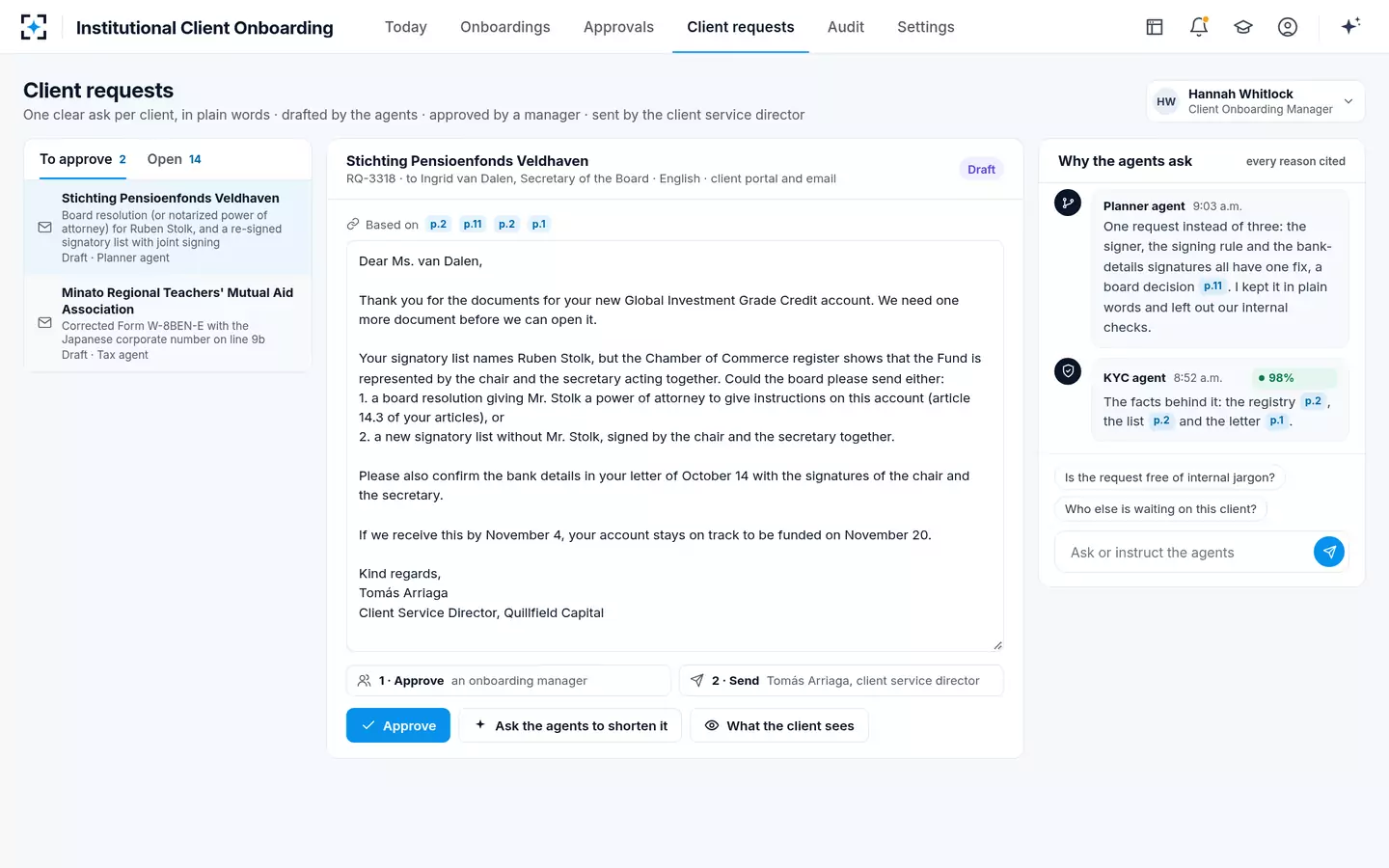
The same file holds the list beside everything it must agree with, as set out in institutional account opening documents, and the one-request approach is why a held signer need not move the funding date, as the asset management client onboarding process shows. The whole Veldhaven onboarding is on the Institutional Client Onboarding page.
Questions people ask
What is the format of an authorized signatory list?
Usually a one- or two-page letter on the client's letterhead: the entity's legal name, registration number and LEI, the authority the list rests on, a row per signer with name, title, signing mode, scope and specimen signature, and a dated certification by authorized signers. The format matters less than agreement with the registry and resolutions.
What is a certificate of incumbency?
In common usage it is a document confirming who currently holds which office in an entity, often with specimen signatures, signed by the company secretary, a director or a registered agent. It proves who holds office, not what each officer may sign alone, so it should be read with the registry's signing rule.
What should a board resolution authorizing a signatory say?
It should name the person, state exactly what they may sign and whether alone or jointly, cite the article of the articles or deed that allows the board to delegate, give the date and any expiry, and be signed or certified in the way the entity's rules require. The sample fund's articles allowed a power of attorney by board resolution under article 14.3.
Who should sign the authorized signatory list itself?
People the entity's signing rule authorizes, in the combination it requires. If the rule is two directors jointly, one director's signature does not certify the list. A list certified by someone who is not an authorized signer certifies nothing.
How often should an authorized signatory list be updated?
Whenever the board, the officers or the delegated authorities change, and at each KYC refresh. The fictional manager in these guides refreshes standard-risk institutional files every two years and brings a file forward when a registry change is found.
Is an authorised signatory list the same in the UK?
The document is the same; the signing rule behind it comes from UK company law and the articles. Under the Companies Act 2006 a company executes a document by two authorised signatories, being directors or a secretary, or by one director with an attesting witness, and boards delegate other authority by resolution.