The asset management client onboarding process is everything between the day a pension fund, insurer or endowment awards a mandate and the day its money lands in a funded, tradable account: the investment management agreement (IMA) and its guidelines, KYC and AML on the client, its controllers and its signers, tax forms, proof of who may sign, settlement instructions, custody and cash accounts, and trading setup. It is slow not because any one task is long but because eleven parties hand work to each other, and the client's own board, custodian and outgoing manager sit on the critical path. Botminds' Institutional Client Onboarding runs each mandate as one map, with agents that read, check and chase every station and people who approve every signer, bank detail and go-live.
The examples come from a fictional manager, Quillfield Capital, and its sample mandate from Stichting Pensioenfonds Veldhaven, a Dutch pension fund: $1.40 billion of global investment grade credit, awarded on Monday 28 September and due to fund in euros on Friday 20 November. People, firms and accounts are invented; the rules are quoted from the regulators that wrote them.
Eleven parties stand between a won mandate and a funded account
The client
Board or trustees
Resolutions, signer changes and the signed agreement wait for the next meeting.
Pension or treasury staff
Gather registry extracts, deeds, board lists, passports and tax forms.
Investment consultant
Confirms the award and often the funding plan and the guidelines.
The manager
Legal
The investment management agreement, its schedules and any side letter.
KYC and AML, then the MLRO
Entity, controllers and signers verified, every party screened, a risk rating approved.
Tax operations
The client's tax status forms checked against each other.
Operations
Signer authority proven, new bank details called back, custody and cash accounts opened.
Investment compliance, billing, reporting
Guidelines coded into pre-trade rules, the fee schedule loaded, reports set up.
Third parties
The client's custodian
Opens the custody and cash accounts and takes settlement instructions.
Transition manager or outgoing manager
Moves the legacy portfolio in kind or in cash on the funding date.
Registries and the LEI issuer
Supply the extracts and identifiers every other document is checked against.
What is the asset management client onboarding process?
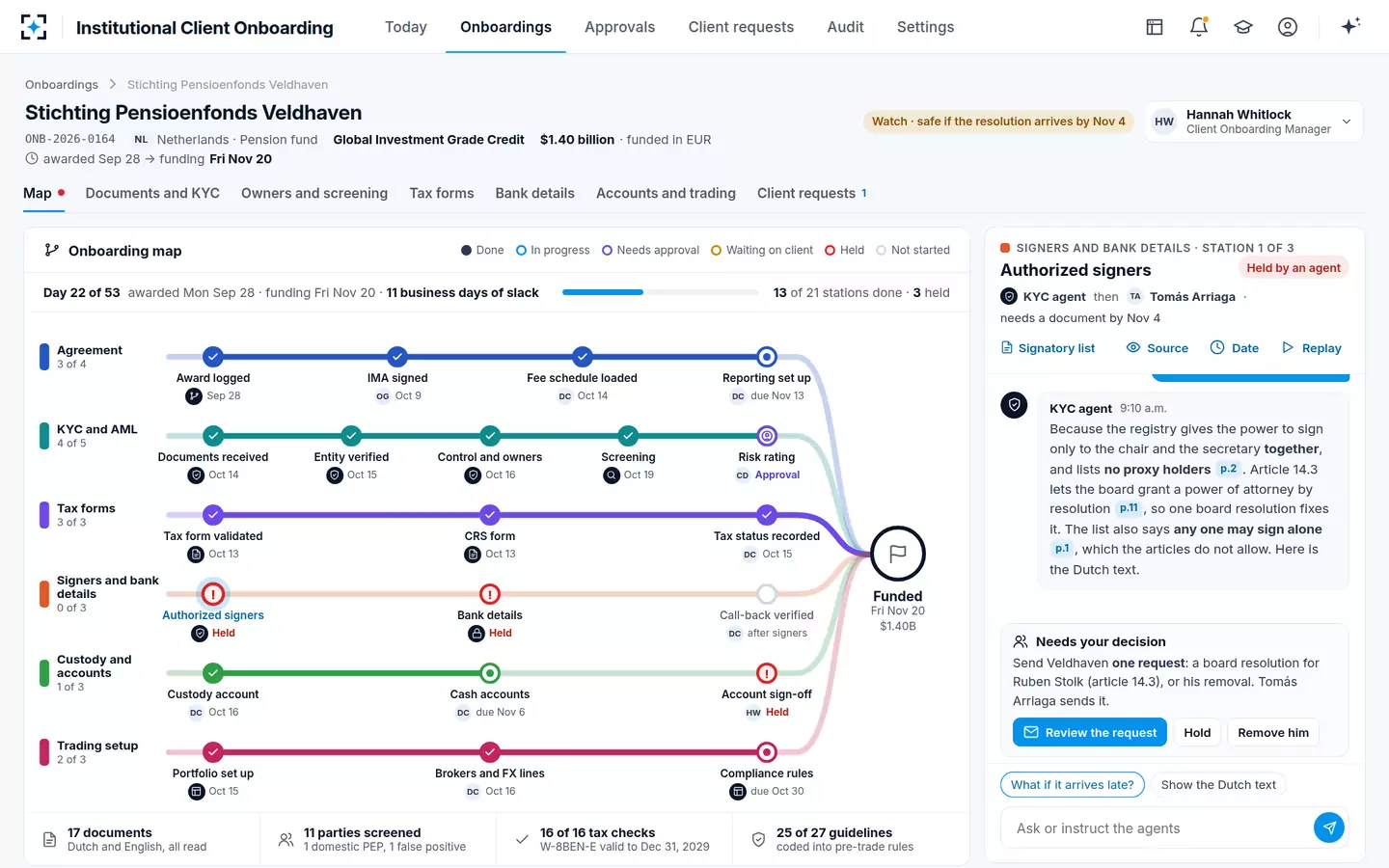
It is the set of tasks an asset manager must finish before it can invest a new institutional client's money, run as six lines of work that converge on one funding date. The lines are the agreement, KYC and AML, tax forms, signers and bank details, custody and accounts, and trading setup. Each line has stations, and each station has an owner, a document and a status.
The process differs from retail or wealth onboarding in three ways. The client is an entity, often one with no owner in the ordinary sense, so identity work is about control and authority rather than a passport. The money usually arrives from somewhere else, an outgoing manager or a transition manager, on a date set weeks in advance. And the agreement does not just set a fee; its guidelines must be coded into the trading system before the first order, because a breach on day one is still a breach. For the household version of the same work, see the neighbouring guide on client onboarding in wealth management.
One mandate as one map: six lines, 21 stations, one funding date
Who are the parties in an institutional onboarding, and what does each wait for?
The parties fall into three groups: the client's own people, the manager's teams, and third parties neither of them controls. The first group decides how fast the process can possibly go, because every signature, resolution and document starts there. The second group does most of the work. The third group sets dates the other two must meet.
The client side is easy to underestimate. A pension fund's staff collect the documents, but a change to who may sign for the fund usually needs its board, and boards meet on a calendar. An investment consultant often stands between the two sides, confirming the award and sometimes the guidelines and the funding plan. On the manager's side, KYC prepares a risk rating that a money laundering reporting officer (MLRO) or equivalent approves, operations proves every signer before any bank detail is used, and investment compliance codes the guidelines. Neither group controls the custodian, which opens accounts on its own procedures, or the outgoing manager or transition manager, who delivers the assets.
Treasury's 2024 risk assessment of the adviser sector describes the same fragmentation from the AML side: the institutions that do carry AML obligations, "such as custodian banks or broker-dealers", working with an adviser "may not necessarily have a direct relationship with the client" (US Treasury, 2024 Investment Adviser Risk Assessment). The custodian knows the account; the adviser knows the client. Onboarding is where the two have to agree.
Why does onboarding take weeks after the mandate is won?
Because most of the elapsed time is waiting for another party, not doing the work. A KYC analyst may need an hour to read a registry extract and days to receive it; a board resolution takes minutes to draft and weeks to sign. No regulator or independent study publishes how long institutional onboarding takes, so the only honest benchmark is a firm's own timestamps, and the way to read them is by who held the file at each moment.
Where a 71-day onboarding goes: the client's documents are the longest wait
The split makes two points. The client's own documents are the largest single block, which is why the order and clarity of what the client is asked for matter more than the speed of any internal team. And the next two blocks, KYC and signers, are where foreign-language documents and conflicting authority wait longest: a Dutch registry extract that needs a translator, or a signatory list that names someone the registry does not. The guide to client onboarding metrics shows how to build this chart from your own files and what each week of it costs in fees.
Which rules set the order of the work?
Four sets of rules fix what must happen before what, and they explain why the lines cannot simply run in any order. They concern the agreement, the plan client, identity, and the trading identifiers.
The rules that put stations in order
| Rule | What it requires | What it means for the sequence |
|---|---|---|
| ERISA section 3(38) | To be an investment manager of an ERISA plan, the adviser must acknowledge in writing that it is a fiduciary of the plan. | The written acknowledgment sits in the IMA, so an ERISA mandate cannot be managed before the agreement is signed. |
| DOL rule 408(b)(2) | A covered service provider discloses its services, fiduciary status and compensation to the responsible plan fiduciary "reasonably in advance of the date the contract or arrangement is entered into". | The fee disclosure precedes the signed IMA, not the other way round. |
| FinCEN CDD rule, 31 CFR 1010.230 | Banks, broker-dealers, mutual funds and futures firms identify the beneficial owners of a legal entity customer when it opens a new account. | The custodian and any executing broker run their own checks on the client, on their own clock. |
| CFTC rule 45.6 | Each counterparty to a swap that is eligible for a legal entity identifier must obtain one and be identified by it. | A mandate that may trade swaps or futures needs the client's LEI before the brokers and FX lines are set up. |
A fifth rule governs what is kept rather than when. An SEC-registered adviser must keep a copy of every written agreement it enters into with a client, for five years from the end of the fiscal year of the last entry (17 CFR 275.204-2(a)(10) and (e)(1)). The signed IMA and every amendment made during onboarding belong in that file, which is why the agreement station ends with an executed copy, not an email saying the client agreed.
Why is the client's board on the critical path?
Because only the client can change who may act for it, and a change of authority usually needs its governing body. Most onboarding holds that last more than a week are not internal: they are a resolution, a power of attorney or a re-signed form that the client must produce through its own process.
The Veldhaven mandate shows how one such hold spreads. The fund's signatory list names three people who may each sign alone. The Dutch Chamber of Commerce extract says the chair and the secretary may represent the fund only together, and lists no proxy holders. So the third person, a pension office director, cannot sign anything yet, and the settlement instructions letter he signed alone cannot be used. Three teams would normally write to the client: KYC about the list, operations about the letter, and the client service director about the timetable.
One board decision clears three held stations
- KYC asksthe list
- Ops asksthe letter
- Board meets; replies arrive apartboard
- One asksent
- Board resolves onceby 4 Nov
- Call-back, sign-off, fundingto 20 Nov
The fix is one letter. A single board decision, either a resolution giving the director a power of attorney under the fund's articles or a new list without him signed by the chair and the secretary together, clears the list, the letter and the bank-details signatures at once. The guide to the authorized signatory list template explains why lists fail this way so often. In the solution, the Planner agent drafts that one request and works out the latest date it can arrive; the onboarding manager approves it, and the client service director sends it.
Which third parties does the manager not control?
The client's custodian and whoever delivers the assets. Both have their own procedures and calendars, and the funding date depends on them as much as on anything the manager does.
The custodian opens the custody account and the cash accounts in each currency, and needs settlement instructions it can rely on. For Veldhaven, the custody account and the euro cash account opened in mid-October; the dollar cash account was still pending on day 22. Nothing about that wait was in the manager's hands, but the manager still has to know about it, because the order management system cannot be finished until it knows where trades settle.
The assets themselves usually come from an outgoing manager, often through a transition manager. The FCA's review of the market describes transition management as the service pension funds and other asset owners use to move portfolios between managers or markets while controlling market risk and trading costs (FCA, TR14/1, 2014). A transition that delivers securities in kind on the funding date needs the new manager's accounts, its guidelines and its broker lines ready the day before. The guide what is a transition manager follows that handover in detail.
Accounts and go-live: every system, and the five prerequisites still open
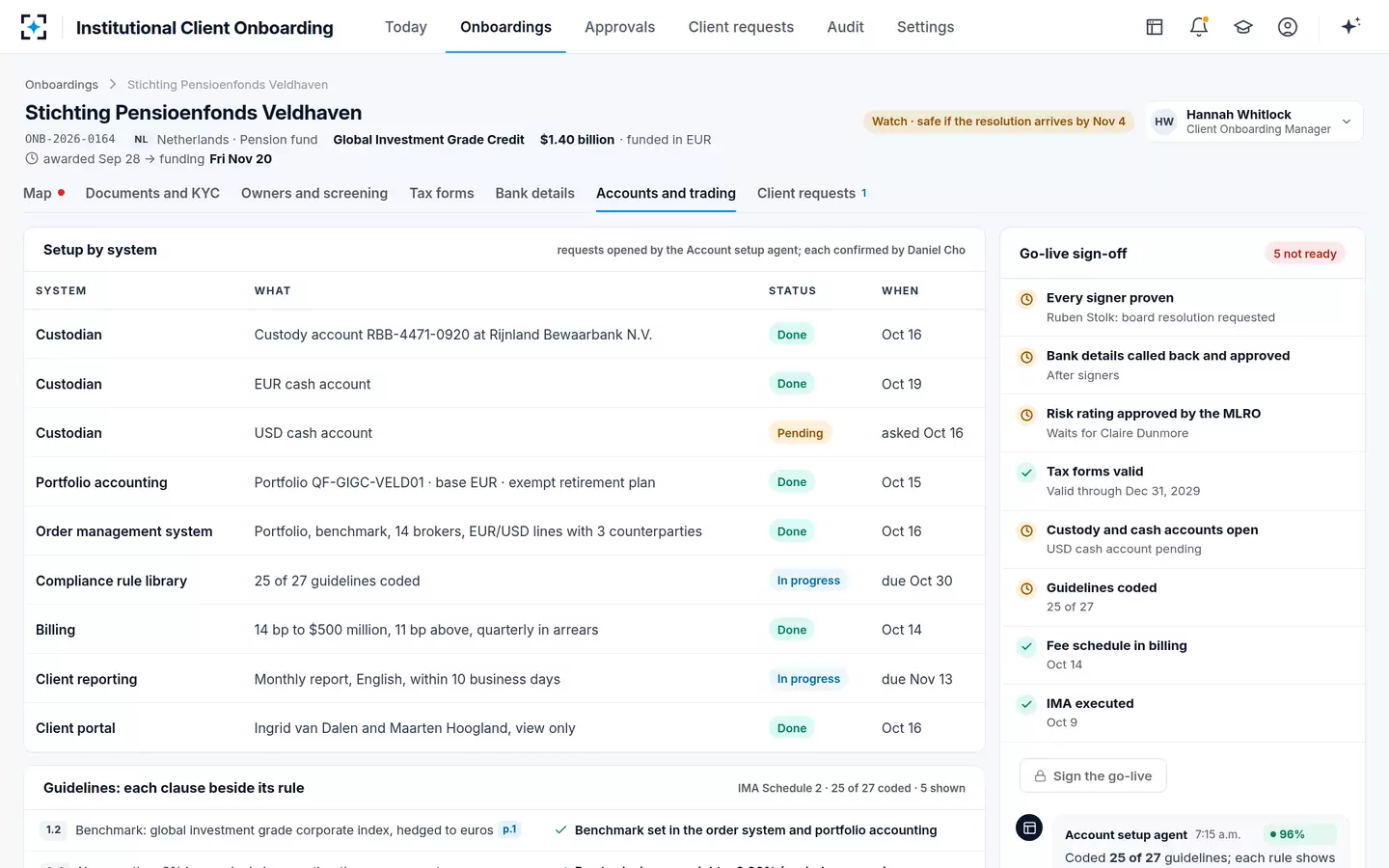
How do you map an onboarding so the waits show?
Map it backwards from the funding date, by line, with a named owner and a waiting-on field for every station. A plan that lists tasks but not who is holding each one hides the very thing that decides the date. Four fields per station are enough: owner, document, waiting on, and the latest date it can finish without moving funding.
The latest-date field is what turns a checklist into a plan. Working back from Friday 20 November, the Veldhaven map gave the board resolution until 4 November and showed 11 business days of slack across the whole mandate on day 22 of 53. When a station runs late, the slack falls, and the owner is warned before it reaches zero rather than after. The same map also shows what does not depend on the held line: the tax forms had passed their checks and the custody account was open, so a signer problem in one line stopped three stations, not twenty-one.
The other test of a map is whether it tells the client one thing at a time. Separate teams writing separately is the most common way a client's own wait grows, because each request starts its own internal cycle on the client's side. A map that knows every open question can bundle them into one request, written in plain words, and say what date it protects.
The onboarding manager's morning: what needs her, and what the agents did
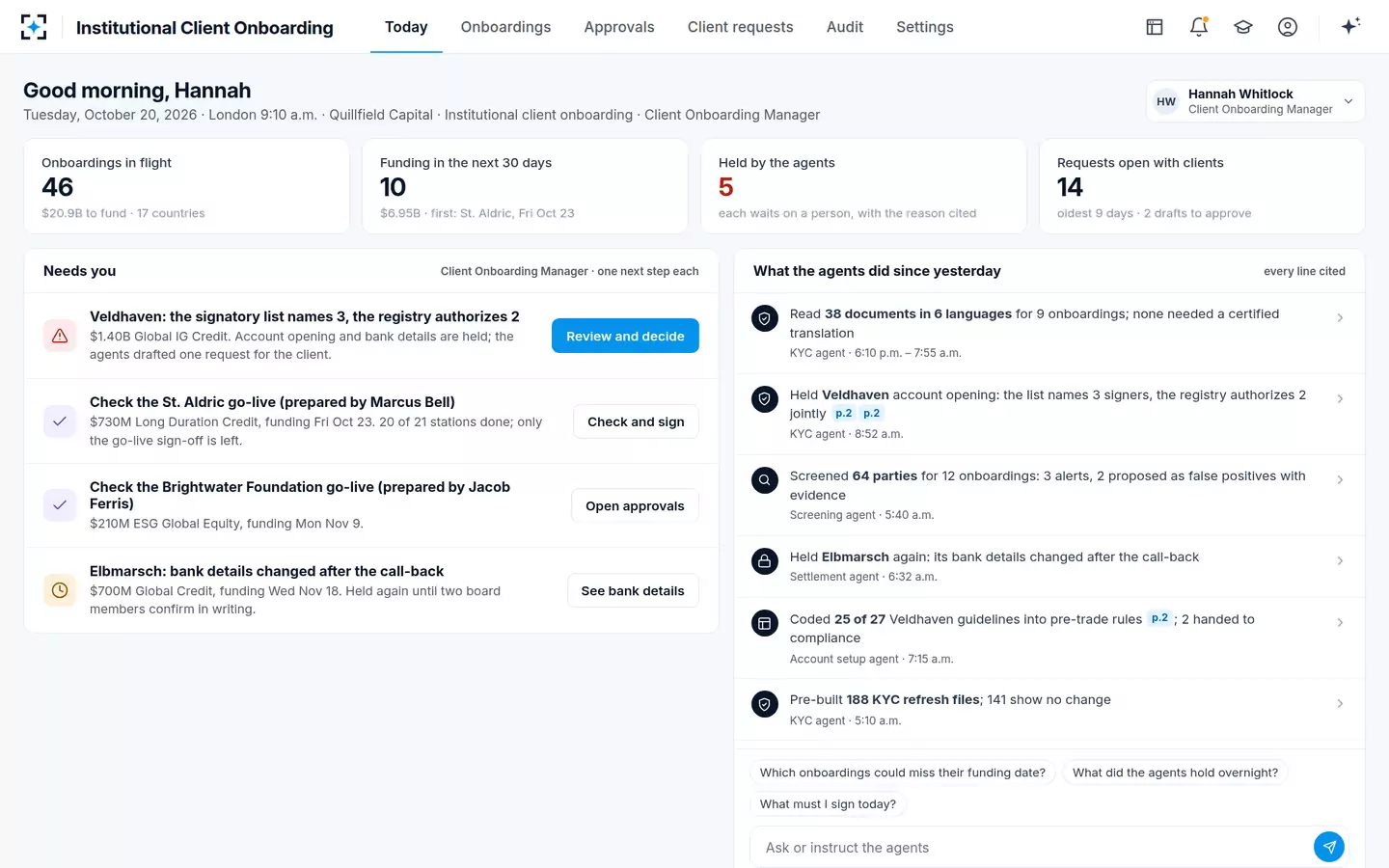
What can agents chase, and what stays with people?
Agents can read, compare, date and draft; people decide, sign and send. That split follows the waits on the map. Most of the time lost inside the manager is spent reading documents, comparing them with each other and writing to someone, all of which an agent can do and a second agent can check. The decisions that carry liability, a risk rating, a released bank detail, a go-live, a message to the client, stay with named people.
Five seats on one mandate, before and after the agents take the reading and chasing
Today
Kept the plan in a spreadsheet only she saw and chased every team by email.
With agents
Opens one map per mandate with each hold and its reason, and approves the one request that fixes a held line.
Still theirs: Approves client requests and signs the go-live; a second manager checks it.
Today
Waited for translators before a Dutch or German deed could move.
With agents
Checks the agents' values against the original beside the English, and decides every disagreement between two readings.
Still theirs: Prepares the risk rating; cannot approve it.
Today
Signed ratings whose evidence sat across emails.
With agents
Sees each risk factor with its source and signs with a reason code.
Still theirs: Approves ratings and policy changes; never a file she prepared.
Today
Watched the client receive three emails from three teams.
With agents
Sees exactly what the client portal will show, then sends one request.
Still theirs: Sends everything the client receives.
Today
Proved each signer by hand and hunted for a safe phone number.
With agents
Gets a call-back task with authority checked and an independent number.
Still theirs: Makes the call; a second person approves before any account is used.
The design choice that matters most is that the agents hold only what depends on an exception. When the KYC agent found that one signer had no authority, it held the signer and bank-details stations and nothing else, so the custody account, the portfolio set-up and the guideline coding went on. How the agents read and check each other, and why the reader is never the checker, is the subject of the client onboarding AI agent guide. The full mandate, screen by screen, is on the Institutional Client Onboarding page.
Questions people ask
How long does institutional client onboarding take?
No regulator or independent study publishes a figure, and vendor surveys measure different things. A firm should take its own last twelve months of mandates and measure award to funded, then split each one by who was holding the file. The fictional manager in these guides had a 71-day median, of which about 20 days were spent waiting for the client.
What is the difference between onboarding and account opening?
Account opening is one line of onboarding: the custody and cash accounts at the client's custodian. Onboarding also covers the agreement, KYC and AML, tax forms, signer authority, settlement instructions, guideline coding and billing. An account can be open weeks before it can be funded or traded.
Who owns the onboarding process at an asset manager?
Usually a client onboarding or client operations team, with KYC, legal, tax, operations and investment compliance each owning their own stations. The onboarding manager owns the plan and the date, not every task. Approvals stay with the function that carries the risk, such as the MLRO for a risk rating.
Does an ERISA plan add steps to onboarding?
Yes. The manager must give the plan fiduciary its 408(b)(2) disclosure of services, fiduciary status and compensation reasonably in advance of signing, and must acknowledge in writing that it is a fiduciary to act as a section 3(38) investment manager. Large plans filing Form 5500 later list, on Schedule C, each service provider paid $5,000 or more.
Why does the custodian need its own documents?
Because a custodian bank has its own AML obligations and account-opening procedures; in the US they include identifying the beneficial owners of legal entity customers under FinCEN's CDD rule. The manager's KYC does not replace the custodian's. Sending both from one well-organised file avoids asking the client twice.
What is a client onboarding process map?
A map lays the work out as parallel lines converging on the funding date, with each station's owner, document, status and latest finish date. It differs from a checklist because it shows dependencies: which held station stops which others. On the Veldhaven sample, one held signer stopped three of 21 stations.