A client lifecycle management platform (CLM) is the system a financial firm uses to hold each client's file and run the work on it from onboarding through periodic review to exit: the entity data, the documents, the KYC and AML checks, the approvals and the refresh calendar, usually with workflow that routes tasks between teams. It is a system of record, and a good one makes the client, not the account, the unit of work. What it does not do is read: it stores a Dutch registry extract but does not tell you that its signing rule contradicts the signatory list, and it routes a task to chase the client without knowing which three questions one letter could answer. That reading, comparing and chasing is where onboarding agents fit. Botminds' Institutional Client Onboarding does that work with agents that propose and hold and people who decide, so the honest comparison is layers, not rivals.
Examples use the solution's fictional sample manager, Quillfield Capital, and its client book. No regulator defines a CLM platform; the definition above is the market's usage.
Three layers: the file, the reading and the decision
People decide and sign
- Approve risk ratings and policy
- Close screening matches
- Make and approve call-backs
- Approve and send client requests
- Sign and check go-lives
Agents read, compare and chase
- Read registry extracts and deeds in their language
- Compare the signing rule with the signer list
- Re-read every source blind
- Draft one request and date it
- Open set-up requests in each system
Systems of record keep the file
- CLM platform or KYC system: the client file
- CRM: awards, contacts, verified numbers
- Custodian, portfolio accounting, order management
- Compliance rules, billing, client portal
What is a client lifecycle management platform?
It is software that keeps one record per client across every stage of the relationship and runs the tasks that keep the record current. A typical platform holds the client's legal entity data and hierarchy, the documents collected, the KYC and screening results, the risk rating and its approvals, and the date of the next review, with workflow that sends each task to the right team. In banking, where one client may hold accounts across many products, it is the answer to the old problem of each desk keeping its own file.
FinCEN's February 2026 relief made that client-level view more natural for US banks and broker-dealers. Instead of identifying and verifying a legal entity customer's beneficial owners each time it opens an account, they may do it when the customer first opens an account and then when they learn facts that call the information into question or their risk-based procedures require it (FinCEN, FIN-2026-R001). A platform built around the client file is where that kind of rule is easiest to apply. The neighbouring guide to client lifecycle management in KYC covers the banking side in depth.
What does a CLM platform leave to people?
The reading and the judgment around it. A CLM platform can require a document, store it and record that someone checked it; it cannot, by itself, read a registry extract in Dutch, notice that the authority on page 2 is joint while the client's list says "any one alone", or decide that two figures in an annual report measure different things. Those are the steps where most institutional onboarding time goes, and where errors start.
What a CLM platform does, and what onboarding agents add
CLM platform: Stores each document and records that it was received and reviewed.
Onboarding agents beside it: Read each one in its own language, extract every value with its page, show the original beside the English.
CLM platform: Holds the signer list and the registry extract as separate items.
Onboarding agents beside it: Compare them, and the signer on every settlement letter, and hold only what depends on a mismatch.
CLM platform: Records the maker and the checker of each task.
Onboarding agents beside it: Add an independent re-read of every source on a different model; disagreements go to a person with both readings.
CLM platform: Routes a task to request a document.
Onboarding agents beside it: Draft one plain request that answers every open question, with the latest date it can arrive, for a person to approve.
CLM platform: Often outside its scope for asset managers.
Onboarding agents beside it: Open requests in the custodian, portfolio accounting, order management, compliance rules and billing, each confirmed by a person.
Should onboarding agents replace a CLM platform?
Usually not. Replacing a system of record means migrating every client's file, history and approvals, retraining every team that uses it and re-proving its controls to auditors; agents can do their work without any of that. Where a firm already has a CLM platform it trusts, the case for agents is to take the reading and chasing off people's desks, not to move the file.
The case changes for an asset manager without one. Many institutional managers onboard a few dozen mandates a year and keep the file in a CRM, a shared drive and email. For them, the onboarding map, the KYC file and the refresh queue in Institutional Client Onboarding can be the onboarding record for institutional clients, alongside the CRM. Treasury's 2024 risk assessment explains why that record matters even before an adviser AML rule applies: the custodian banks and broker-dealers that do carry AML obligations may have no direct relationship with the adviser's client at all (US Treasury, 2024), so the adviser's own file is often the only one that knows the client well.
Which onboarding tasks are reading and chasing, not storing?
Most of them. Splitting the work by task shows which layer each belongs to, and therefore where an agent can help without changing who owns the record or the decision.
Onboarding tasks by layer: record, agent or person
| Task | Kept in the record | Done by an agent | Decided by a person |
|---|---|---|---|
| Entity identity | Legal name, number, LEI, documents | Read the registry extract and LEI record; check they agree | Accept the entity data |
| Ownership and control | Control chart, route taken | Build the chart from the articles and board list | Prepare and approve the rating |
| Signer authority | Signer list, resolutions | Compare the signing rule with the list | Accept the list or approve a request to fix it |
| Screening | Results and dispositions | Screen every party nightly; propose dispositions | Close every match |
| Bank details | Settlement instructions, call-back record | Check the signer, account name, BIC; build the call-back | Make the call; approve as second person |
| Client requests | Requests sent and answers | Draft one request with its date | Approve and send |
| Refresh | Next review date by risk | Pre-build the file: re-pull, rescreen, re-check | Confirm no change; decide changes |
The middle column is the one that consumes analyst weeks, and it is also the one where errors are made without anyone noticing. That is why the agents in it are paired: research on self-correction finds that a model's answers improve when they are checked against a reliable outside source rather than against the model's own reasoning (Kamoi et al., TACL 2024), and in onboarding the source document is that outside source. The detail of how the reader and checker work is in the client onboarding AI agent guide.
What changes in the record when an agent writes to it?
Nothing should change without a person's confirmation and a trace of which agent version proposed it. Writing to a system of record is the step regulators watch: FINRA's 2026 oversight report lists among the risks of AI agents that they may act beyond the user's intended scope and authority, and that multi-step agent work can be hard to trace (FINRA, 2026), and the Bank of England and FCA's 2026 survey found far fewer UK firms letting agents create or modify records in core systems than letting them draft communications (Bank of England and FCA, 2026).
In the solution the rule is simple. The Account setup agent opens requests in the custodian, portfolio accounting, the order management system, the compliance rule library and billing, and an operations lead confirms each one; it never switches an account live. Every action, by a person or an agent, is recorded with who, what, when, why and the evidence, with the agent's version, in a hash-chained trail. A CLM platform beside it should be treated the same way: one more system of record, written to only after approval.
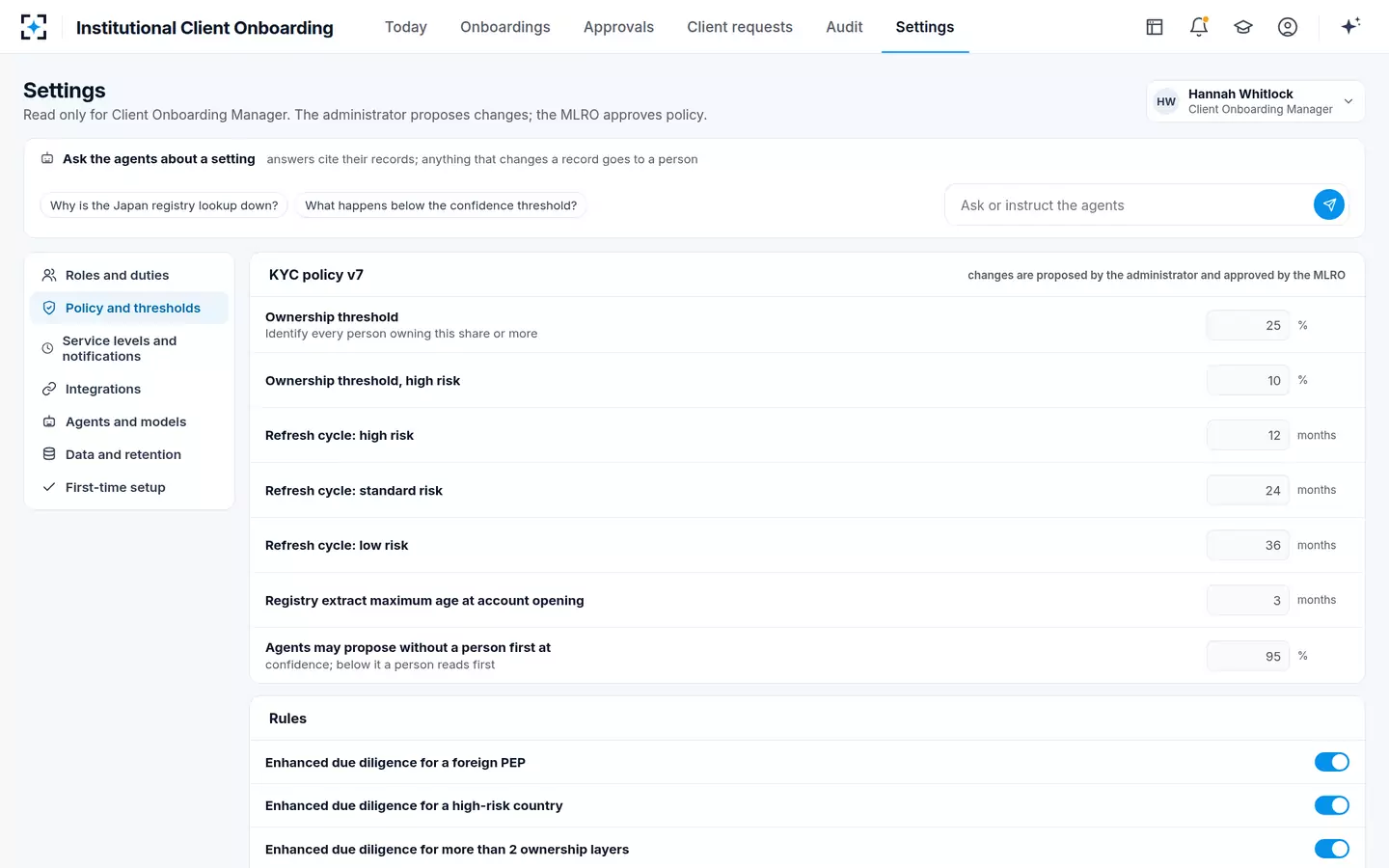
The policy every check runs against, owned by the MLRO
Client lifecycle management after onboarding: who keeps the file current?
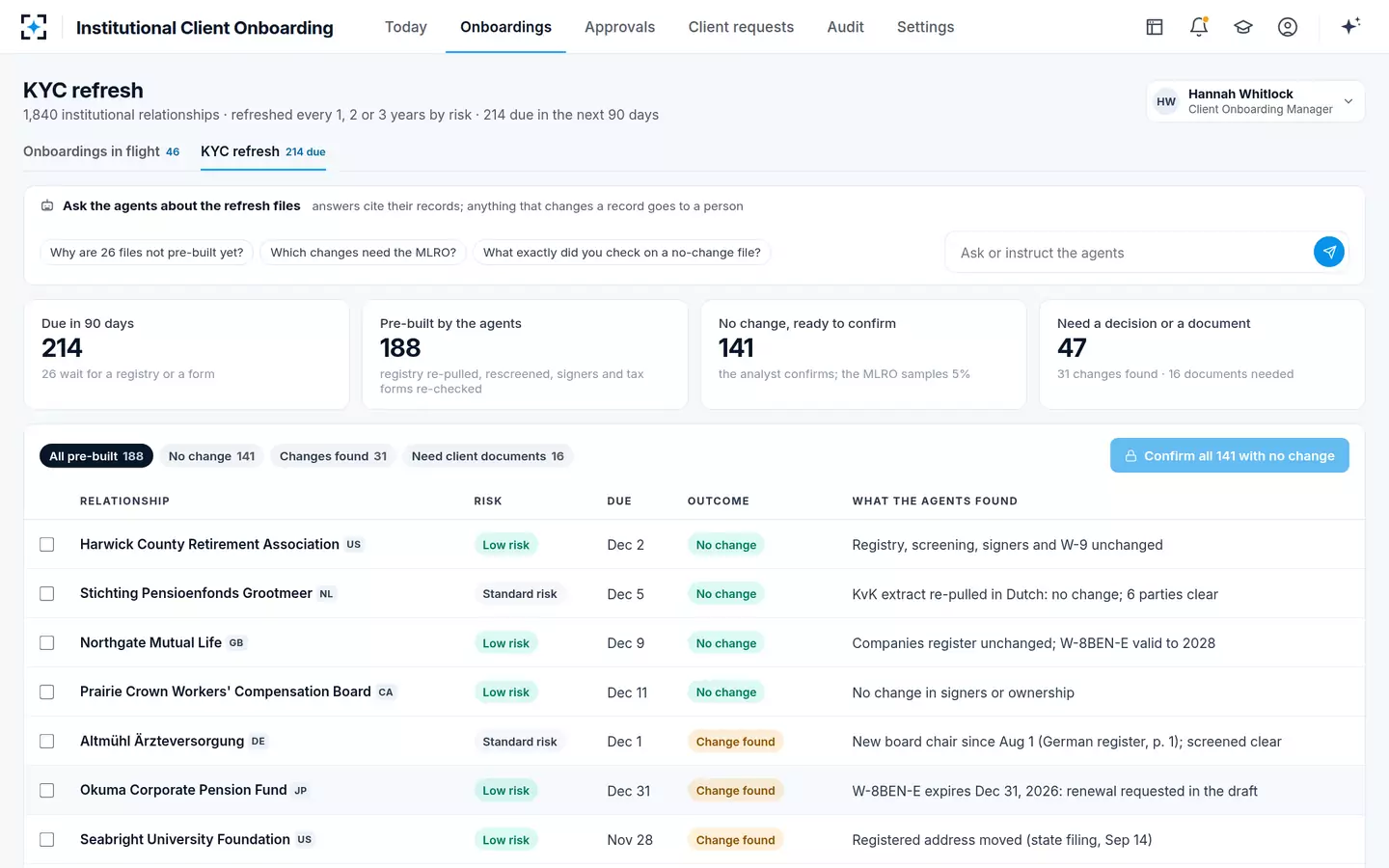
The platform schedules the review; the agents can pre-build it; a person confirms it. Periodic review is the part of client lifecycle management that follows onboarding, and it is where a file that was right on day one becomes wrong by year two: a new board chair, a moved address, an expiring form.
One sample refresh queue: most files can be pre-built, and most show no change
214
institutional files due for review in the next 90 days, of 1,840 relationships
188
pre-built by the agents: registry re-pulled, parties rescreened, signers and forms re-checked
141
no change, waiting for the analyst to confirm; the MLRO samples 5%
47
need a decision or a document: 31 changes found, 16 documents needed
KYC refresh: what changed, and what only needs a confirmation
Which data should flow between a CLM platform and onboarding agents?
Documents and reference data in, approved results out, and nothing else without a person. A layer works only if both sides agree on which system owns which field; otherwise the agents and the platform overwrite each other, and the file stops being a single record.
A data contract between the record and the reading layer
| Flow | From the record to the agents | From the agents back to the record |
|---|---|---|
| Entity data | Legal name, identifiers, hierarchy as last approved | Proposed corrections, each with its source page, after a person accepts them |
| Documents | Every document received, with its date and channel | The English reading beside the original, and the values extracted |
| Ownership and control | The current chart and the route last applied | A rebuilt chart for a person to approve, with the route and reason |
| Screening | Parties and prior dispositions | Proposed dispositions; the decision stays with the analyst |
| Approvals | Who may approve what | Nothing: approvals are made by people in whichever system the firm chooses |
| Refresh | Next review dates by risk | A pre-built file, and whether anything changed |
How do you decide: keep, replace or layer?
Decide by where your time and errors go, not by which product is newer. If most of the delay is in reading, comparing and chasing, a layer of agents beside the existing record addresses it directly. If the problem is that there is no single record at all, the first decision is where the record lives.
Six questions to settle before you buy a CLM platform or onboarding agents
- Where do the days go?
Measure last year's mandates by station and by who held the file; the metrics guide shows how.
- Is there one record per client today?
If yes, keep it and layer agents beside it. If no, decide where the record lives before anything else.
- Who reads the foreign-language documents now?
If the answer is a translator queue, reading is the bottleneck, and a record will not fix it.
- How are documents compared with each other?
Signer lists against registries, settlement letters against signers. If it is by eye, the comparison is the risk.
- What may software write, and who confirms it?
Every write to a system of record should need a person, and show which agent version proposed it.
- What will an examiner ask for?
One complete file per client: documents, values with pages, disagreements, decisions and signatures, wherever they are kept.
Measuring where the days go is the subject of client onboarding metrics, and a week-by-week plan for putting agents live beside existing systems is in best client onboarding software for asset managers.
Where does Institutional Client Onboarding sit beside a CLM platform?
In the middle layer, connected to the systems an onboarding already runs on. It works with the CRM for awards, contacts and verified call-back numbers; registry and LEI lookups for extracts in the original language; a screening service; custodian messaging for custody and cash accounts; portfolio accounting and order management; and e-signature, billing and the client portal. A firm whose client file lives in a CLM platform should treat that platform as one more system of record to connect, and ask how its data will flow both ways before signing.
What reaches the client is one request, whichever system holds the file
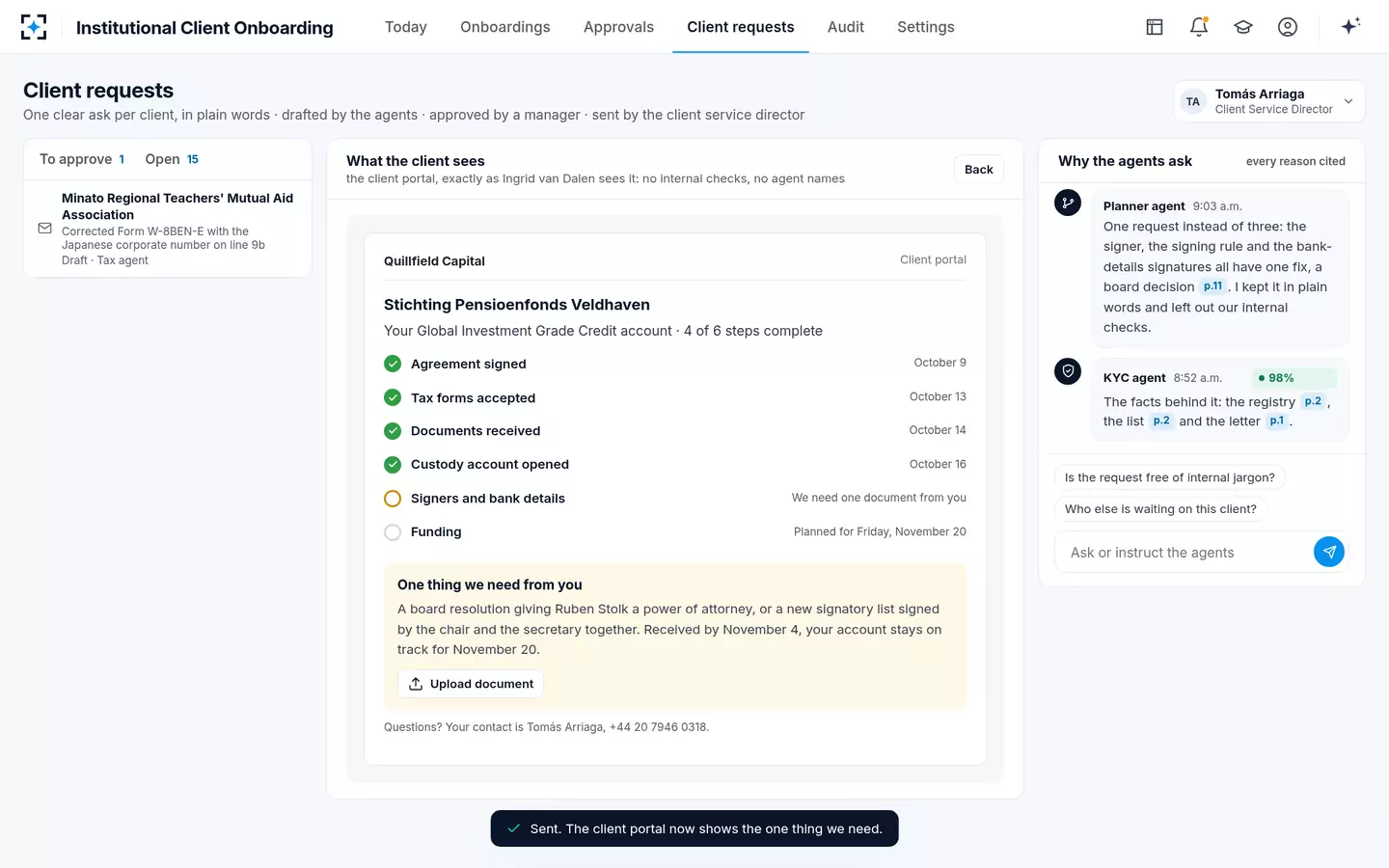
The whole sample mandate, from award to the go-live sign-off, is on the Institutional Client Onboarding page.
Questions people ask
What is client lifecycle management in banking?
It is the practice, and the software, of keeping one file per client across every product and stage, from onboarding through periodic review to exit, instead of each desk keeping its own. It matters most where one client holds many accounts. FinCEN's February 2026 relief, which lets covered institutions identify beneficial owners at a customer's first account rather than at each new one, fits that client-level view.
What does a client lifecycle management analyst do?
A CLM analyst keeps client files complete and current: collects and checks documents, runs or reviews KYC and screening, chases clients for what is missing, and prepares files for periodic review and approval. Most of the role is reading and chasing, which is the work agents can prepare, leaving the analyst to decide the disagreements and confirm the results.
Is CLM the same as KYC software?
Not quite. KYC software covers identity, ownership, screening and risk rating; a CLM platform usually includes those and adds the wider client file, workflow across teams and the lifecycle of reviews. For an asset manager, onboarding also covers the agreement, signers, settlement instructions and trading setup, which neither always covers.
Can onboarding agents work without a CLM platform?
Yes. Institutional Client Onboarding keeps its own onboarding map, KYC file, refresh queue and audit trail, and connects to the CRM and the firm's other systems. For a manager with no CLM platform, that can serve as the onboarding record for institutional clients.
What is a CLM platform's biggest gap in institutional onboarding?
Reading documents and comparing them with each other. A platform can require a registry extract and a signatory list and record that both were reviewed, but the conflict between them is found by reading. On the fictional Veldhaven file, that single conflict held three of 21 stations until one board decision fixed it.