DDQ vs RFP comes down to purpose. A request for proposal (RFP) invites an asset manager to bid for a specific mandate and is scored against rival bids; a due diligence questionnaire (DDQ) asks the manager to evidence how the firm and the strategy are run, often alongside the RFP or after a shortlist. Most institutional managers also keep a third document that nobody requests: the strategy's profile in each investment consultant's database, updated every quarter so that researchers can screen managers before any search begins. The three carry the same numbers, but the SEC treats a profile read by a whole research team differently from an answer written for one plan, so the same figure can carry different obligations in each. Botminds' Consultant Database Management keeps every copy tied to one approved source.
An RFP and a DDQ ask different questions about the same firm
Request for proposal (RFP): Win a specific mandate against other bidders
Due diligence questionnaire (DDQ): Evidence how the firm and strategy operate, so risks can be judged
Request for proposal (RFP): A plan sponsor, often run by its investment consultant
Due diligence questionnaire (DDQ): An allocator, a consultant’s research or operations team, or a fund platform
Request for proposal (RFP): Firm, team, process, performance, fees, client service, a fee proposal
Due diligence questionnaire (DDQ): Ownership, controls, compliance, operations, valuation, service providers, business continuity
Request for proposal (RFP): Fit, performance, fees and the team, against competitors
Due diligence questionnaire (DDQ): Adequacy of controls; rarely ranked against peers
Request for proposal (RFP): Usually a senior distribution executive
Due diligence questionnaire (DDQ): Often the CCO, COO or another officer, sometimes with attestations
Request for proposal (RFP): Heavy reuse of firm and process text, figures updated to the as-of date
Due diligence questionnaire (DDQ): Heavy reuse year to year; changes in controls must be caught
DDQ vs RFP: what is the difference?
An RFP is a competition; a DDQ is an examination. The RFP asks "why should we hire you for this mandate?" and expects a proposal, including fees. The DDQ asks "how do you run your business, and can you show it?" and expects evidence: policies, organisation charts, service-provider lists, valuation procedures, incident history. In practice they overlap heavily, and many consultants embed a DDQ inside the RFP, but the difference shows in who reads them. An RFP is read by the investment committee's advisers to compare candidates; a DDQ is read by specialists, often operational due diligence analysts, looking for weaknesses.
An RFI, a request for information, sits before both. It is a short screen that gathers basic facts (assets, track record length, vehicles, minimums) to decide who receives the RFP. Many searches skip it because the consultant's own database already answers those questions, which is the first reason the database profile matters as much as any document a manager sends.
RFI, RFP, DDQ and finals: the order a search usually runs
No regulation fixes the sequence, and consultants vary it, but most institutional searches move from wide to narrow in four steps. The consultant screens its database and may send an RFI to widen or confirm the long list. It then issues the RFP to a shorter list, often with a DDQ attached or following for the semi-finalists. The last two or three managers present in finals to the plan's committee, and the winner faces a fuller operational review before funding. A manager can be dropped at any step, and the first step happens before the manager knows a search exists.
Each step reuses facts from the one before, under more scrutiny. The assets and returns in the database profile reappear in the RFP; the team named in the RFP is examined in the DDQ; the finals deck, built by the sales team, is compared by the consultant with all three. That is why a correction made only in the document currently in play leaves the others wrong, and why the finals deck should draw on the same approved figures as everything before it.
The timing also explains where errors come from. A database profile is refreshed on the consultant's quarterly calendar, while an RFP asks for figures as of a date the issuer chooses, often a month-end that is not a quarter-end. Two correct numbers for two different dates can look like a contradiction to a reader who does not check the as-of date, so every figure should carry its date wherever it goes.
What is a due diligence questionnaire in asset management?
A DDQ is a structured set of questions an allocator uses to test a manager before and after investing. Investment due diligence questions cover philosophy, process, team, risk and performance attribution; operational due diligence questions cover governance, compliance, trading and settlement, valuation, cash controls, technology, cyber security and service providers. Many are long, and the same questions return each year, so firms keep an approved answer set and update it annually and whenever something material changes.
The allocator's side of that exercise, how to test whether a manager's DDQ answers are true, is a separate discipline; testing an operational due diligence questionnaire covers it from the reviewer's chair. This page stays with the manager answering.
The consultant database profile: the document nobody requests
A profile is a standing answer to questions the consultant asks of every manager. It holds the strategy's assets and accounts, returns gross and net of fees over standard periods, benchmark returns, risk statistics, holdings and characteristics, team, fees and commentary, in that consultant's fields and definitions. Researchers screen these profiles to build a long list before a search is announced, so a manager whose profile is stale or wrong can be screened out without ever seeing the RFP. What consultant databases ask, and who reads them sets out the fields and the research on consultants' recommendations.
Because no one issues a deadline for a profile except the consultant's quarterly cycle, profiles are where staleness accumulates. Team bios outlive the people in them, fee schedules lag the new pricing, and a figure typed into one portal outside the cycle stays there until someone compares it with the source.
Is an RFP response an advertisement under the Marketing Rule?
Usually not, though parts of it can be. The SEC's Marketing Rule defines an advertisement, in its first prong, as a communication to more than one person that offers advisory services (17 CFR 275.206(4)-1(e)(1)). An answer written for one plan is a communication to one person, and the SEC said that sending it to several people at the same institution does not change that, because the one-on-one exclusion covers a single adviser and a single investor even when the investor is an entity with many employees (adopting release, 86 FR 13024).
“We believe that if, for example, an adviser responds to a request for proposal (‘‘RFP’’) from an entity and the entity subsequently makes such responses available to the public pursuant to a Freedom of Information Act request or other public disclosure requirements, this would not be an advertisement merely by virtue of the entity's disclosure.”
SEC, Investment Adviser Marketing adopting release, 86 FR 13024 (March 5, 2021)
Three things can still pull an RFP answer into the rule. First, reused content: the release said performance inserts kept in a database and dropped into customised answers must be treated as advertisements, because the same insert goes to many recipients, and it asked advisers to have procedures for spotting communications nominally addressed to one person that in fact go to many. Second, hypothetical performance: the definition's first prong reaches a communication to even one person if it includes hypothetical performance, unless an exclusion applies, such as hypothetical performance provided in response to an unsolicited request for that information. Third, templates: a standard presentation with the prospect's name filled in is not a one-on-one communication. Which answers fall where is compliance's judgement, made in advance in the firm's marketing review policy.
A consultant database profile sits on the other side of the line in most firms' policies, because it is disseminated to every researcher at the consultant. The SEC described advertisements an adviser gives a consultant to pass on as the adviser's own indirect communications, and recalled a 1998 settled case built partly on performance an adviser had entered in questionnaires for online databases with subscribers across the country (86 FR 13024, citing Profitek, IA-1764).
One figure, three documents, three sets of obligations
Take a strategy's one-year return. The number is identical wherever it appears; what changes is the obligation attached to it.
The same return carries different obligations in each document
| Question | RFP answer for one plan | DDQ answer | Consultant database profile |
|---|---|---|---|
| Advertisement under the Marketing Rule? | Generally a one-on-one communication; reused inserts and hypothetical performance are the exceptions | Same analysis as an RFP answer; standard answer sets sent widely may be advertisements | Treated as an advertisement in most firms’ policies |
| Net with gross, same period and method? | Required where it is an advertisement; good practice regardless | As for the RFP | Required: 17 CFR 275.206(4)-1(d)(1) |
| One-, five- and ten-year periods? | Where it is an advertisement and not a private fund | As for the RFP | Required for portfolios other than private funds: (d)(2) |
| Copy and support kept? | Yes: written communications sent relating to the performance of managed accounts or portfolios must be kept, 204-2(a)(7)(iv) | As for the RFP | A copy of each advertisement and the support for its performance: 204-2(a)(11) and (a)(16) |
| How long it stays live | Until the search ends; public plans may later publish it | Until the next annual update | Until the next quarterly update, or longer if missed |
The practical consequence is that the strictest treatment should set the standard for the shared figure. If a return will appear in a profile, it must already meet the presentation rules there; there is little sense in maintaining a looser version for RFPs that will later be compared with the profile by the same consultant.
Where the three documents drift apart, and how to keep them aligned
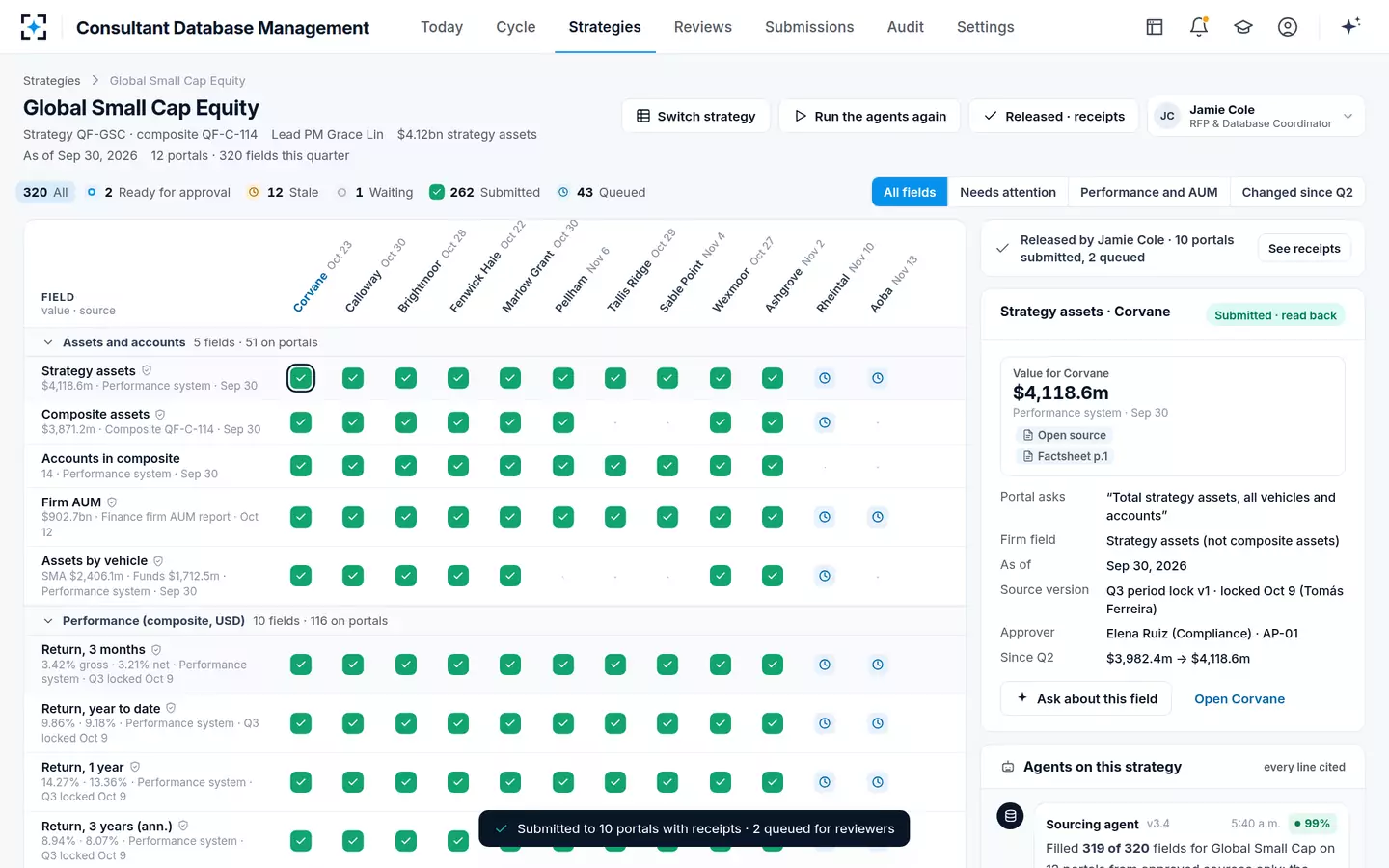
They drift because each is updated on its own clock by different people. The RFP team updates answers to the as-of date the issuer asks for; the DDQ is refreshed once a year; the database runs on the consultant's quarterly calendar; and the CRM, which salespeople treat as the source, is edited by anyone. Take the sample firm in Consultant Database Management, the fictional Quillfield Capital: in its third-quarter 2026 cycle a hand edit of the CRM's strategy-assets figure reached one consultant's live profile with two digits swapped, overstating assets by $91.4 million. When its Conflict agent traced the error, it also checked every RFP, DDQ and other portal in the cycle for the same figure and found none had used it.
That last check is the one most firms cannot run by hand. Knowing which documents carried a value, and which version, is what makes a correction complete rather than partial.
One correction released to every portal that carries the strategy
Six habits that keep an RFP, a DDQ and a profile in step
- One source per figure
Fill every copy from the locked source, never from another copy, and stamp each with its as-of date.
- The strictest rule wins
Present shared figures to the profile standard: net with gross, the required periods, the benchmark named.
- Log where each value went
Document, recipient, version and date, so a correction can reach everyone who received the old value.
- Refresh the DDQ on change, not only annually
A new service provider or a team departure is a DDQ change the day it happens.
- Keep the CRM for reference
Let salespeople read figures there, but never let a CRM value fill a regulated field.
- Compare live copies every cycle
Read back what each portal actually shows, not what was sent.
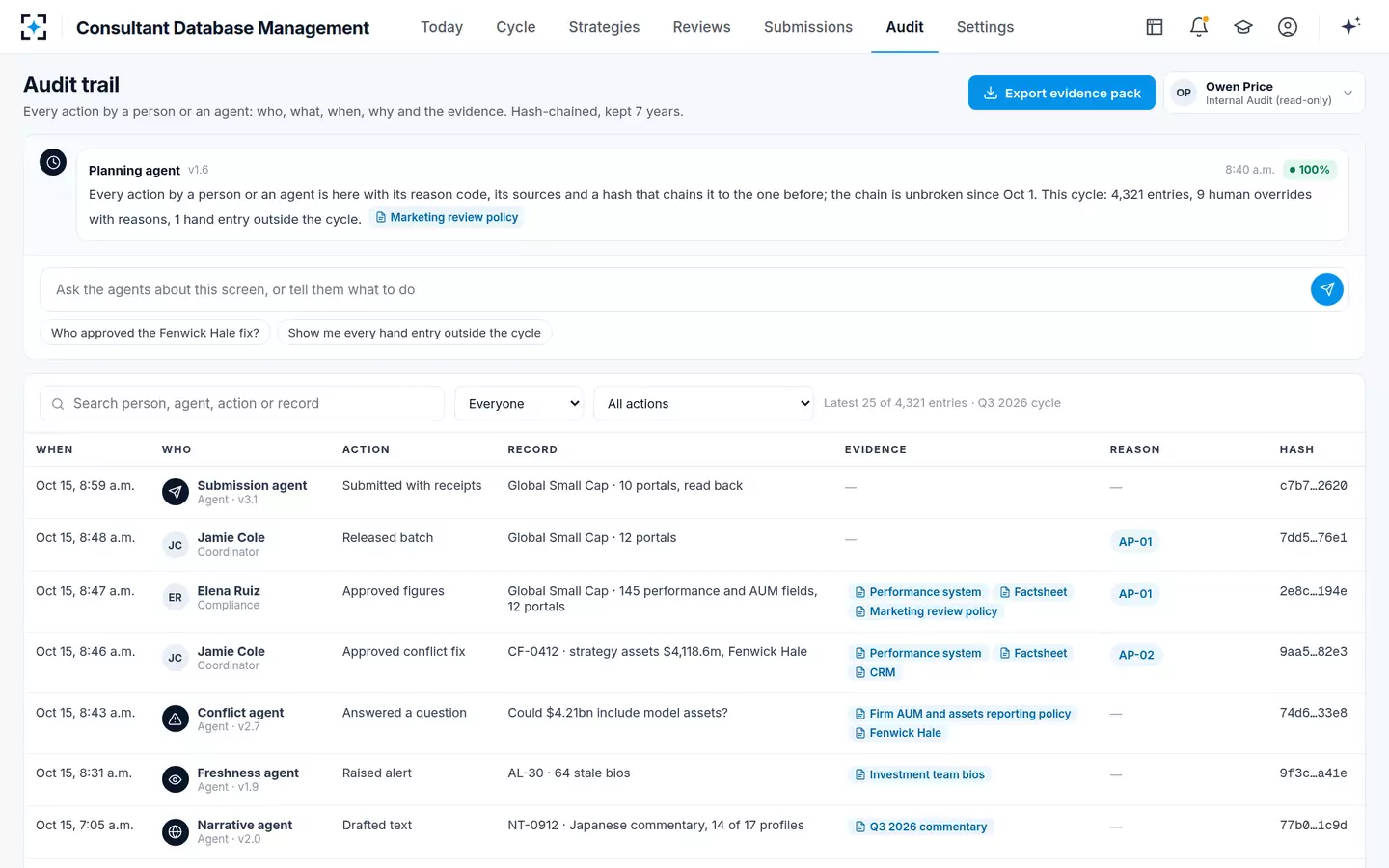
Who approved what, and the hand entry nobody approved
For the RFP side of the work, what an agent may draft and who signs sets out the split between drafting and approval, and the sources to bring lists what a shared library needs. To see the three documents drawn from one source, start from Consultant Database Management.
Who owns each document inside an asset manager?
Usually three teams, and the seams between them are where the facts diverge. RFPs typically sit with the RFP or proposal team inside distribution, which owns the calendar and the library. DDQs are often split: the RFP team coordinates, but compliance, operations, legal and technology each own their sections, and the chief compliance or operating officer signs. Consultant database profiles belong to a database coordinator or consultant relations, who answers to the consultants directly.
Ownership of the document is not ownership of the facts. Returns belong to the performance team, assets to finance and performance, the team to HR, fees to consultant relations and the product team, and the presentation rules to marketing compliance. A firm that lets each document team keep its own copy of those facts will have three versions of each by the end of a busy quarter; a firm that fills all three documents from the same owned sources will not. In Consultant Database Management the approver for each field family is a setting: compliance for returns and assets, the coordinator for holdings, consultant relations for team, terms and fees.
Questions people ask
What is the difference between an RFI and a DDQ?
An RFI is a short screening request for basic facts, sent to many managers to decide who receives an RFP. A DDQ is a long questionnaire about how a firm operates, sent to a shortlisted or existing manager to evidence its controls. An RFI rarely needs supporting documents; a DDQ usually does.
What is a DDQ in finance?
A due diligence questionnaire: a standard set of questions an investor or its consultant sends a manager, fund or service provider before investing and periodically after. In asset management it covers investment process and operations; in banking a similar document is used for correspondent and counterparty reviews.
Do DDQ answers need compliance approval?
No rule requires every DDQ answer to be approved by compliance, but answers that include performance, assets or statements about the firm's services can fall under the Marketing Rule if they are reused widely, and all of them are written communications the firm must keep. Most firms route performance and regulatory answers through compliance as a matter of policy.
Can a public pension publish our RFP response?
Many public plans are subject to open-records laws and may release responses on request. The SEC said such a release does not by itself make the response an advertisement. Firms should still mark confidential sections as the RFP instructions allow and assume the rest may become public.
Should RFP answers match the consultant database profile exactly?
For the same figure, period and definition, yes. Consultants compare them, and a mismatch invites questions about which one is right. Differences are acceptable only where the definitions or as-of dates differ, and then the answer should say so.