An RFP writer in asset management drafts the firm's answers to requests for proposal and due diligence questionnaires from pension plans, endowments and their investment consultants, and in most firms the same small team also updates every strategy's profile in the consultant databases each quarter. The hard part is not the writing. It is that every answer carries assets, returns gross and net of fees, team names, fees and holdings that must match the firm's approved sources, pass a marketing compliance review and still be true when a consultant reads them months later. Botminds' Consultant Database Management exists for that seat: it fills each consultant portal from approved fund data, shows the source behind every value, and leaves approvals with the people who sign.
Titles vary. Job boards and org charts say RFP writer, RFP coordinator, RFP and database coordinator, consultant database analyst or proposal manager, and larger firms split the work between a writing team and a database team. What the titles share is a role that sits between sales, portfolio management, performance measurement and compliance, owned by none of them and dependent on all four.
One quarter on one desk, in a sample firm
60
institutional strategies, each with a profile to keep current
12
consultant portals, each with its own fields, definitions and deadline
9,012
fields in the third-quarter cycle, before any RFP or DDQ arrives
~100h
of keying alone at about 40 seconds a field, our estimate
What does an RFP writer in asset management do?
An RFP writer turns a questionnaire into an answer the firm can stand behind. A typical institutional RFP or DDQ asks a few hundred questions: firm history and ownership, assets under management by type, the investment team and its tenure, process and risk controls, performance gross and net over standard periods, fees, compliance, business continuity and, increasingly, responsible investment. The writer starts from the firm's approved answer library, updates every figure to the requested as-of date, routes new or changed text to its owner and sends the result to marketing compliance before the deadline the issuer set.
The consultant database work is the same job without a deadline from anyone else. Each consultant runs a database of manager profiles that its researchers screen before they shortlist a manager for a search. The manager keeps those profiles current: quarterly returns, assets and account counts, characteristics and holdings, team, fees and commentary. Nobody issues a request; the firm simply falls off the screen if its numbers are stale. How an RFP, a DDQ and a database profile differ matters to the writer because the same number carries different obligations in each.
In practice the week divides into three kinds of work. Copying figures from the performance system, factsheets and composite reports into answers and portal forms. Chasing the people who own the inputs: portfolio managers for commentary, HR for team changes, performance analysts for the locked quarter, translators for the Japanese or German portal. And defending the result: answering compliance's questions, correcting a portal after a consultant spots a mismatch, and finding, when asked, which source a figure came from.
Four people carry one quarter of consultant database updates
Today
Rebuilds the portal calendar every quarter and copies fields by hand while also answering RFPs. Can type 9,000 numbers but cannot prove where each one came from.
With agents
Opens a grid already filled from approved sources, reviews the mismatches the agents traced, approves fixes with a reason and releases each portal.
Still theirs: Approval of every fix and every release
Today
Re-checks a spreadsheet against the performance system, figure by figure.
With agents
Reviews figures already tested against the firm’s presentation rules, with the source beside each; opens only flagged batches one by one.
Still theirs: Approval of every performance and AUM figure
Today
Hears about team changes and wrong figures late, and so do the consultants.
With agents
Signs drafted notices and correction notes built from the HR system and approved figures.
Still theirs: Every message that reaches a consultant
Today
Answers “which number is right?” by email all quarter.
With agents
Locks the period once; every portal value points back to the locked figures.
Still theirs: The locked performance period
Who approves the performance figures an RFP writer sends?
Marketing compliance approves them, and the reason is legal rather than stylistic. Under the SEC's Marketing Rule, an advertisement is a communication an adviser makes to more than one person that offers its advisory services, and material an adviser hands to a consultant to pass on counts as the adviser's own indirect communication. An advertisement that shows gross performance must also show net performance with at least equal prominence, over the same period and using the same method, and performance for a portfolio other than a private fund must cover one-, five- and ten-year periods ending no earlier than the latest calendar year-end (17 CFR 275.206(4)-1(d)).
Not every RFP answer is an advertisement. A response written for one plan is usually a one-on-one communication, and the SEC said in adopting the rule that an RFP answer a public plan later discloses under a freedom-of-information law does not become an advertisement merely because of that disclosure (adopting release, 86 FR 13024). A consultant database profile, read by every researcher at that consultant, is a different matter. Deciding which is which is compliance's call, and a writer who knows the difference knows which answers need the full presentation review.
Approval also has a paper trail. The adviser must keep a copy of each advertisement it disseminates, and every record needed to support or demonstrate the calculation of the performance it shows, for five years from the end of the fiscal year in which it was last disseminated (17 CFR 275.204-2(a)(16) and (e)(3)). For a profile left live on a portal for years, that clock keeps restarting. The writer is usually the only person who knows which version went where.
How many consultant portals does one coordinator keep current?
No regulator or independent study publishes a count, so the honest answer is: count your own. A useful measure is fields per quarter, not portals, because portals differ widely in depth. Multiply strategies by the portals that carry each one, then by the fields each portal asks for that strategy; add the fields that only change when something happens, such as team and fee terms.
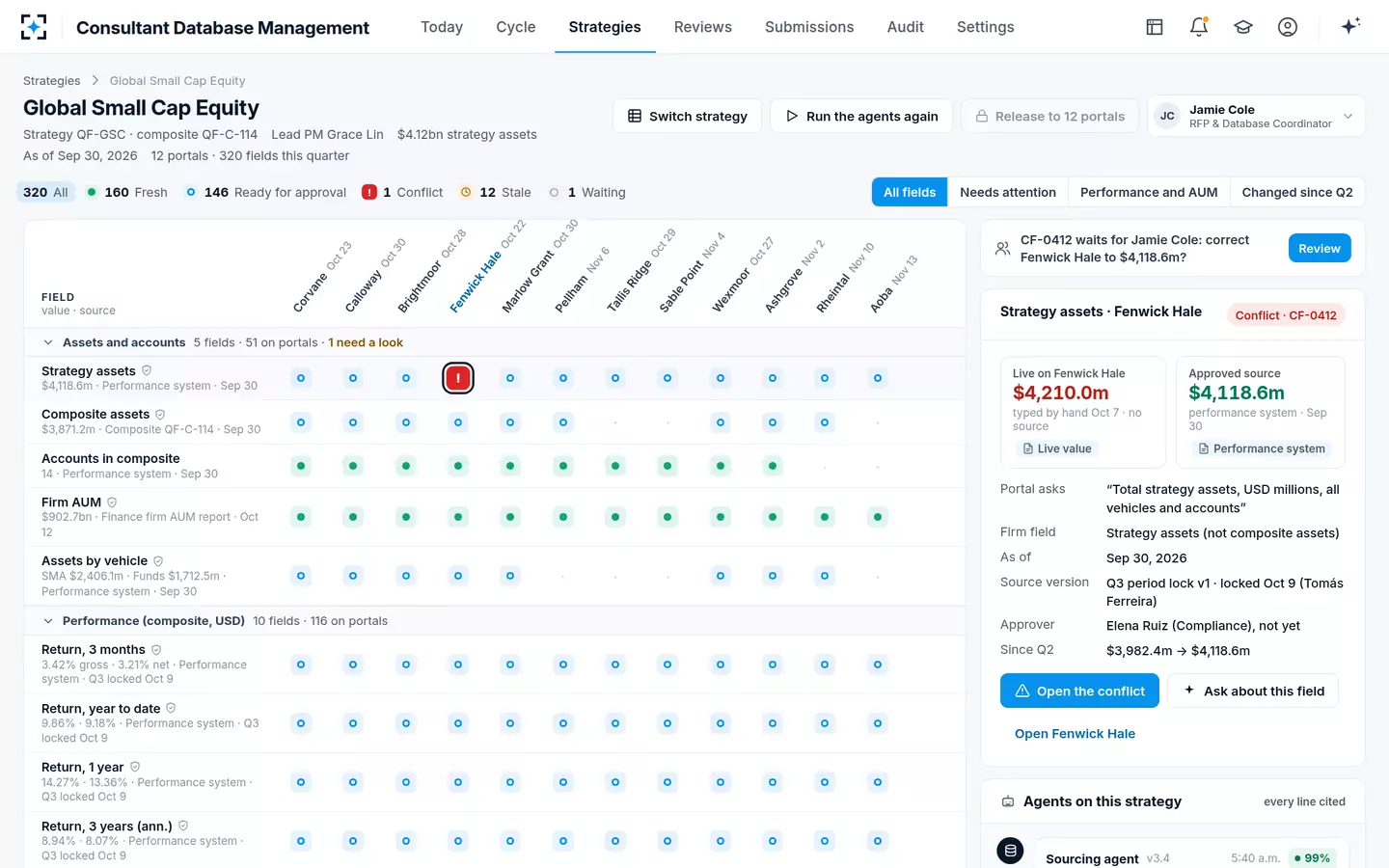
Take the sample firm in Consultant Database Management, the fictional Quillfield Capital, as it runs its third-quarter 2026 cycle. Sixty strategies sit on twelve portals in 300 profiles, which comes to 9,012 fields. One strategy, Global Small Cap Equity, has 320 fields across the twelve portals. Two people carry the cycle while still answering RFPs, which is why the keying estimate of about 100 hours is only the floor: it leaves out checking, chasing and corrections.
Where a quarter's business days go: copying dominates by hand
By hand · 25 days
- Portal calendar and waiting on data · 8%
- Copying fields into each portal · 48%
- Chasing PMs, HR and translators · 16%
- Compliance re-checking every figure · 16%
- Submitting and corrections · 12%
With agents · 8 days (target)
- Portal calendar and waiting on data · 6.25%
- Copying fields into each portal · 25%
- Chasing PMs, HR and translators · 25%
- Compliance re-checking every figure · 31.25%
- Submitting and corrections · 12.5%
The shape of the second bar is the point. Copying shrinks most, but compliance review becomes the largest share, because it should: a person still approves every performance and AUM figure. Chasing barely moves, since a portfolio manager's commentary and a translator's review still take as long as they take.
What BLS pay data say about the RFP writer's job
The Bureau of Labor Statistics has no occupation called RFP writer or consultant database analyst, so any wage figure rests on a mapping. The closest fit is market research analysts and marketing specialists (13-1161), the BLS occupation that holds most marketing staff who are not managers; the reviewers who approve the output sit in compliance officers (13-1041). The mapping is ours, and a firm's own pay bands will differ by city and seniority.
The writer and the reviewer earn almost the same median wage
| Occupation (BLS code) | Median hourly | Median annual | US employment |
|---|---|---|---|
| Market research analysts and marketing specialists (13-1161): closest match for RFP writers and database coordinators | $37.87 | $78,760 | 899,580 |
| Compliance officers (13-1041): closest match for marketing compliance reviewers | $38.81 | $80,730 | 417,070 |
Two things follow for anyone budgeting the seat. First, an hour of the writer's time and an hour of the reviewer's cost about the same, so a process that saves the writer an hour by pushing an hour of checking onto compliance saves nothing. Second, these are wages, not employer cost; benefits and overhead sit on top. What a quarter of RFP and database hours costs builds the full figure from these inputs.
RFP writer, consultant relations, product specialist: who does what
The writer is one of three seats that face consultants, and confusing them is how work falls between chairs. Consultant relations owns the relationship: meetings with the consultant's researchers, notices about changes, and the firm's standing with each consultant. Product specialists, often former analysts or portfolio managers, explain the strategy in meetings and finals. The RFP writer or database coordinator owns the written record of all of it: what the firm said, in which document, with which numbers, as of which date.
The split matters most when something changes. A portfolio manager's departure is consultant relations' message to send, the product specialist's story to tell, and the writer's team fields in every profile and open answer to correct. In the sample firm the head of consultant relations signs every message to a consultant while the coordinator releases the corrected fields, and neither can do the other's step. What happens when a portfolio manager leaves follows that change through every document.
The quarter-end month, from locked returns to the last portal
The calendar decides most of the writer's month. Performance cannot be entered until the quarter is locked in the performance system, usually some days after quarter-end, and holdings and characteristics wait for portfolio accounting. Consultants then set their own deadlines, often staggered over three or four weeks. In the sample cycle the twelve portals fall due between October 22 and November 13, and a firm setting asks for every portal to be ready three business days before its deadline.
Private markets strategies stretch the month further. Their quarter-end marks arrive later from the fund administrator, so their fields wait while public strategies are submitted. In the sample firm 180 private markets fields wait for marks due November 12, while one portal's deadline is November 6, which is why the coordinator needs an extension request drafted early rather than a late submission.
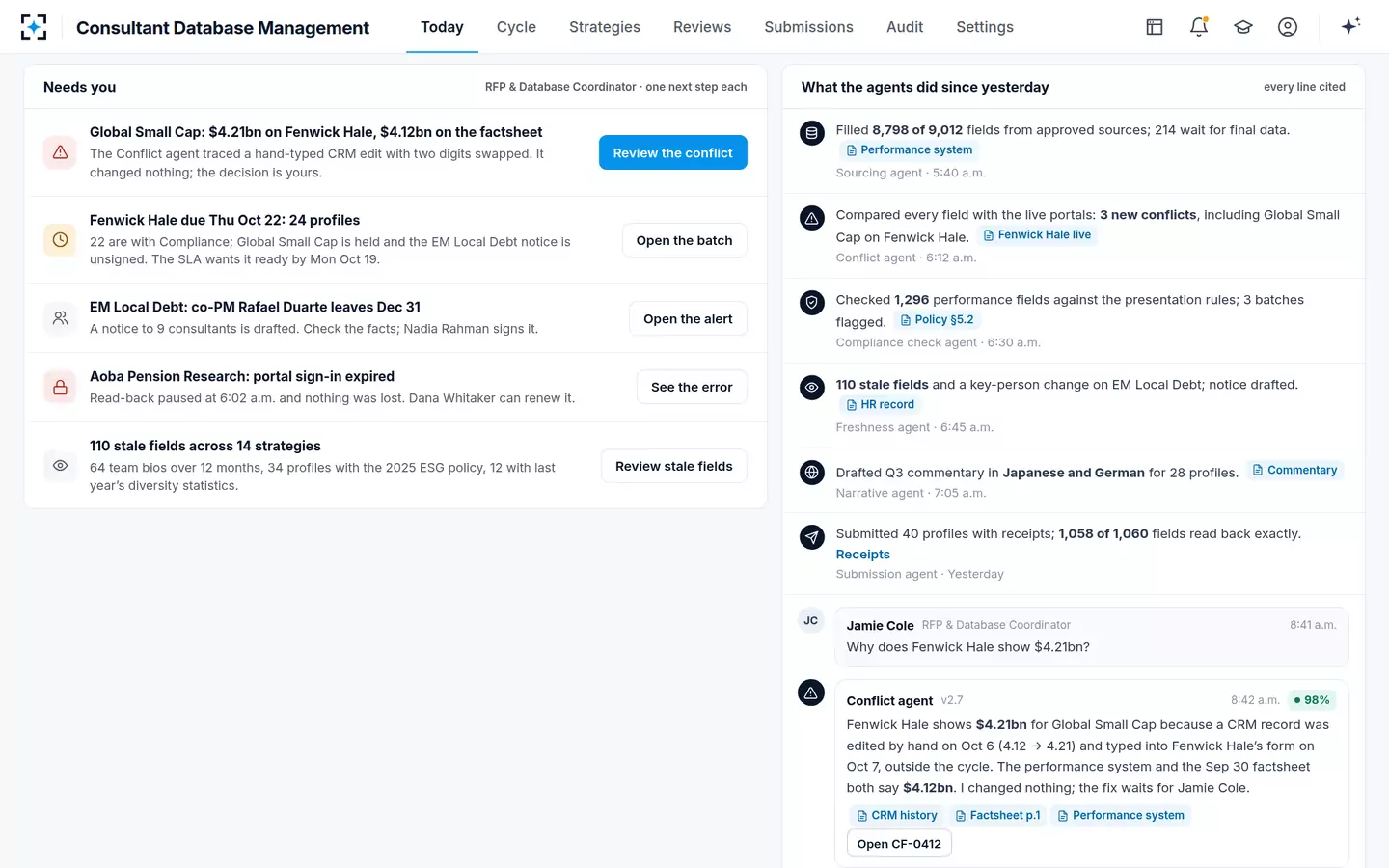
The coordinator's morning in Consultant Database Management
Where an RFP writer's risk actually sits
The risky number is rarely the one in this quarter's spreadsheet. It is the one typed somewhere else, outside the cycle, that nobody compares. In the sample firm a salesperson edited the CRM's strategy-assets figure by hand on October 6, swapping two digits so that $4.12 billion became $4.21 billion, and the next day someone typed the CRM figure into one consultant's portal. The live profile overstated strategy assets by $91.4 million, 2.2%, and would have sat in front of that consultant's researchers for a whole quarter.
The SEC has treated this kind of error as an advertising problem for a long time. Its 2021 adopting release cites a 1998 settled order against an adviser charged with distributing misleading advertisements, in part through performance it entered in questionnaires for online databases that subscribers across the country could read (86 FR 13024, citing In the Matter of Profitek, IA-1764). A consultant database is not a private conversation; it is distribution.
Every field against every portal: one red mark is the CRM figure
What changes in the seat when agents fill the fields
The writer stops being the copying machine and becomes the person who decides. In Consultant Database Management a Sourcing agent fills fields only from approved sources (the performance system once the quarter is locked, portfolio accounting, the firm AUM report, factsheets, composite reports, prospectuses and the content library) and never from the CRM, a prior portal answer, an email or free text. Below 95% confidence it leaves a field waiting and asks its owner. A Conflict agent compares every live portal value with this quarter's drafts and the sources, and traces each mismatch to its cause.
What does not change is who signs. The agents never approve, overwrite a value or send anything to a consultant. The coordinator approves fixes and releases, compliance approves every performance and AUM figure, consultant relations signs every message, and nobody approves what they prepared. That division is the job description an RFP writer should want anyway, because it is the one an examiner will ask about.
There are also things the solution does not do. It does not write a new investment philosophy, decide whether an RFP answer is an advertisement, or choose which searches to answer; RFP Tracking handles the search pipeline and Pitch Book Creation the finals deck. It keeps the numbers and the standing profile text true to their sources.
Seven skills that make a strong RFP writer in asset management now
- Reads definitions before numbers
Strategy assets, composite assets and firm AUM are different figures; so are effective and modified duration. Each portal says which it wants.
- Knows which source wins
The locked performance period beats the CRM, last quarter’s answer and anyone’s email, every time.
- Can explain gross and net
Which fee the net figure deducts, over which periods, and why compliance will ask.
- Keeps an answer library with owners and dates
Every boilerplate answer has a named owner and an expiry; stale team bios are the commonest error in the work.
- Tracks what went where
Which version of which answer each consultant and prospect received, so a correction reaches all of them.
- Writes for translation
Short sentences with no idiom survive a Japanese or German reviewer.
- Escalates early
A late private markets mark or a team change is a message to consultant relations this week, not a footnote next quarter.
For the definitions, regulatory assets under management and the other AUM figures sets out which number belongs in which field. To see the seat with the agents beside it, start from Consultant Database Management.
Questions people ask
What is an RFP writer?
An RFP writer prepares a firm's written responses to requests for proposal, and in asset management usually to due diligence questionnaires as well. The writer drafts from an approved answer library, updates every figure to the requested date, routes new text to its owners and sends the result for compliance review before the issuer's deadline.
What is an RFP coordinator in asset management?
An RFP coordinator manages the response process rather than every sentence: logging requests, assigning sections, chasing inputs and tracking deadlines. In many asset managers the same person also coordinates the quarterly consultant database updates, which is why "RFP and database coordinator" is a common title.
How much does an RFP writer in asset management earn?
BLS publishes no wage for the title. The closest occupation, market research analysts and marketing specialists, had a median of $78,760 a year in May 2025; compliance officers, who review the output, had $80,730. Asset managers in large financial centres typically pay above national medians, and senior proposal managers more.
Do RFP writers need a securities licence?
The SEC's Marketing Rule applies to the adviser, not to an individual writer, and no SEC rule requires a licence to draft an RFP answer. Where a broker-dealer affiliate distributes the material, FINRA's communications rules and its own registration requirements may apply to the people involved; the firm's compliance team decides.
Who is responsible if an RFP answer contains a wrong number?
The firm is. Under the Marketing Rule the adviser answers for advertisements it disseminates directly or indirectly, including through consultants. Internally, the person who approved the figure owns the decision, which is why a clear split between who prepares and who approves protects the writer as much as the firm.
Is an RFP writer the same as a proposal manager?
Often in title, rarely in scope. A proposal manager in most industries runs the bid; in asset management the writer also carries a regulated advertising function, because performance and assets in a database profile or a widely reused answer fall under the Marketing Rule. Larger firms split the roles, with a manager owning the calendar and specialists owning the content and the database.