Generative AI for RFP responses works well for the part of an asset manager's answer that already exists somewhere approved: firm descriptions, policies, process narrative, and figures that sit in a locked performance period. It works badly, and can do real damage, when it is asked to produce a number, a claim or a team change that has no source. So the question to ask of any AI RFP response tool is not "can it write?" but "can it show where each sentence and figure came from, and does a person approve what goes out?" Botminds' Consultant Database Management applies that split to RFPs, DDQs and consultant database profiles: agents fill and draft only from approved sources and say so when there is none, and compliance and consultant relations sign every figure and message.
This page sets out which answers an agent can draft, what the research on AI-assisted writing actually measured, what regulators have said about AI-written client material, and how to test a tool before buying it.
Which RFP and DDQ answers an agent may draft, and who signs each
Firm facts: ownership, history, offices, policies
Where it must come fromApproved answer library, with owner and expiry date
What the agent doesDrafts and fills
Who signsCoordinator
Assets and accounts by strategy, composite, vehicle
Where it must come fromLocked performance period; firm AUM report
What the agent doesFills after matching the field’s definition; never estimates
Who signsCompliance
Returns gross and net, risk statistics, benchmark
Where it must come fromLocked performance period
What the agent doesFills and tests presentation; never generates or rounds a figure on its own
Who signsCompliance
Team, tenure, bios, fees
Where it must come fromHR system, approved bios, fee schedule
What the agent doesFills; flags any change since last quarter
Who signsConsultant relations
Philosophy, process, risk controls
Where it must come fromApproved narrative in the library
What the agent doesAdapts length and translates; adds no new claim
Who signsContent owner, then compliance if changed
A question with no approved answer
Where it must come fromNone yet
What the agent doesSays there is no source and routes it to an owner
Who signsOwner writes; compliance approves
Backtests, projections, targets
Where it must come fromOnly what compliance has approved for that audience
What the agent doesNever drafts
Who signsCompliance decides
Can generative AI write RFP responses an asset manager can send?
It can write most of the first draft, and a person still has to own what is sent. A typical institutional questionnaire repeats questions the firm has answered many times, which is exactly what language models handle well: finding the closest approved answer, adjusting it to the question's wording and length, and updating dates. The same models are poor at knowing when an answer has become untrue, because nothing in the old text says that a portfolio manager resigned last week or that the fee schedule changed on July 1.
That is why the split above runs on evidence. Where an approved source exists, an agent can draft and fill it, citing the source. Where the answer is a regulated figure, the agent fills it only from the locked source and a compliance reviewer approves it. Where no source exists, the agent's job is to say so and route the question, not to invent a plausible paragraph.
What the research measured when people wrote with AI
The peer-reviewed evidence is encouraging on speed and cautious on accuracy. In a preregistered experiment with 453 college-educated professionals given writing tasks from their own occupations, Noy and Zhang found that a chat assistant cut the average time taken by about two-fifths and raised graded quality by 18% (Science, 2023). In a field study of 5,172 customer-support agents, Brynjolfsson, Li and Raymond found issues resolved per hour rose 15% on average, with the largest gains for the least experienced staff (Quarterly Journal of Economics, 2025).
The warnings come from tasks outside what the models do reliably. A working paper by Dell'Acqua and co-authors with 758 consultants found AI users completed more tasks, faster, inside the models' frontier, but on a task chosen to fall outside it they were 19% less likely to reach a correct answer (Harvard Business School working paper, SSRN 2023). Legal research tools built to answer from retrieved sources still produced hallucinated answers between a sixth and a third of the time in a preregistered test (Magesh et al., Journal of Empirical Legal Studies, 2025), and general chatbots did far worse on verifiable legal questions (Dahl et al., Journal of Legal Analysis, 2024).
Faster drafts, uneven accuracy: what four studies found
| Study | Who and what | Finding | What it means for an RFP team |
|---|---|---|---|
| Noy and Zhang, Science (2023) | 453 professionals, writing tasks from their own jobs | Average time down about 40%; graded quality up 18% | Drafting standard answers is where time comes back |
| Brynjolfsson, Li and Raymond, QJE (2025) | 5,172 support agents with an AI assistant | 15% more issues resolved per hour; biggest gains for newer staff | A new coordinator gains most from good suggestions |
| Dell’Acqua et al., HBS working paper (2023) | 758 consultants on realistic tasks | Faster inside the frontier; 19% less likely to be correct outside it | Judgement questions need a person, not a draft |
| Magesh et al., JELS (2025) | Legal research tools that answer from retrieved sources | Hallucinated 17% to 33% of the time | Retrieval alone does not make a figure safe; a check against the source does |
For an RFP team the lesson is specific. The time saved is in drafting repeated text, and the risk is concentrated in figures and claims. A tool that drafts quickly but cannot show, for each number, the source and its as-of date has moved the work from writing to checking without making the checking any easier.
What regulators say about AI-written client material
No regulator has written a rule for AI-drafted RFPs, and none needs to: the existing rules apply to the output, whoever or whatever drafted it. Asked whether a firm answers for communications that AI created, FINRA said yes, in one word, and added that the firm is responsible whether a person or a tool wrote them (FINRA Advertising Regulation FAQ D.8, May 2024); the email triage agent guide quotes the answer in full. That binds broker-dealers, which matters when a distribution affiliate sends the material.
For the adviser itself, the SEC's examiners described in their fiscal 2027 priorities how registrants now use what the Division calls "super intelligence", including for drafting and client communications, and said they will examine whether firms still meet obligations the Division describes as technology-neutral (SEC Division of Examinations, October 23, 2026). The Marketing Rule's tests (no untrue or unsubstantiated statement, net shown with gross, the one-, five- and ten-year periods) apply to an AI-drafted profile exactly as they apply to a typed one (17 CFR 275.206(4)-1).
Supervisors' surveys show the industry already working this way. In the Bank of England and FCA's 2026 survey of UK financial firms, four in five respondents had AI agents in production for decision support, where agents recommend and people decide, and only one in fifty reported agents with broad autonomy (Bank of England and FCA, October 2026).
Is an AI-drafted RFP answer an advertisement?
The drafting method does not decide it; the audience does. An answer written for one plan is generally a one-on-one communication outside the first prong of the Marketing Rule's definition, and the SEC said that a communication to several people at one institution still counts as a communication to one person: the exclusion "permits the adviser to provide communications to multiple natural persons employed by or owning the entity without those communications being subject to the rule" (adopting release, 86 FR 13024).
AI changes the risk at the edge of that exclusion. A tool that reuses the same performance paragraph across many answers is producing the kind of duplicated insert the SEC said must be treated as an advertisement, a point the guide to gross and net attribution under the Marketing Rule sets out in the release's own words. A consultant database profile is read by every researcher at that consultant, so it gets the full review. How an RFP, a DDQ and a consultant profile differ works through the three cases.
Asking the agent back before approving its fix
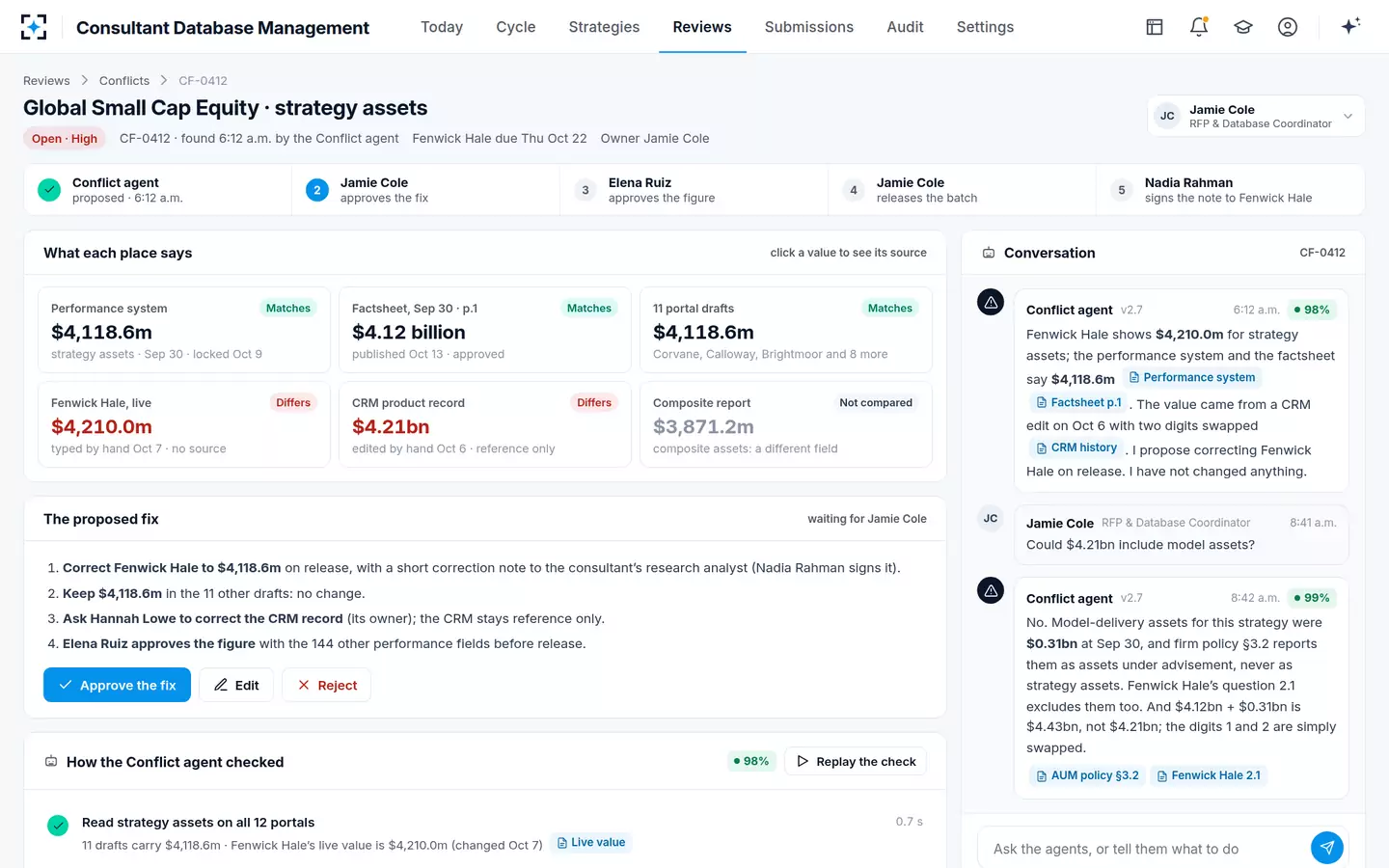
Who signs an AI-drafted DDQ answer?
The people who would sign it if a person had drafted it, and nobody who prepared it. In Consultant Database Management the chain is fixed: agents prepare and check, the coordinator approves fixes and releases, compliance approves every performance and AUM figure, consultant relations signs every message to a consultant, and the submission goes out only for fields a person released.
From approved source to a consultant's portal: agents prepare, people sign
Agent
Sourcing agentFills each field from approved sources, stamped with source, as-of date and version
Never: Takes a number from the CRM, a prior answer, an email or free text
Agent
Conflict agentCompares live portal values, drafts and sources; traces the cause of any mismatch
Never: Overwrites a value
Agent
Compliance check agentTests every performance figure against the firm’s presentation rules and builds the reviewer’s batch
Never: Approves anything
A person decides
RFP and database coordinatorApproves or rejects each proposed fix with a reason; releases batches
A person decides
Compliance reviewerApproves every performance and AUM figure; cannot approve what they prepared
A person decides
Head of consultant relationsSigns every notice and correction note to a consultant
Agent
Submission agentSubmits released fields with a receipt and reads every field back
Never: Submits a field that is not approved and released
How to use AI for RFPs without losing the source
Start with the library, not the model. Every approved answer needs an owner and an expiry date; every figure needs a named source system and an as-of date. Then decide, question family by question family, which of the rows in the task grid applies, and write that into the marketing review policy so the tool is configured to it rather than the other way round. What to bring before any agent writes lists the inputs in detail.
Next, keep the model away from the numbers it does not need to touch. A figure should be filled from the locked source, not regenerated by a model that read last quarter's answer. In the sample firm the Sourcing agent filled 8,798 of 9,012 fields from approved sources and left 214 waiting for final data, such as private markets marks, rather than reuse last quarter's value.
Finally, measure. Run the tool on last quarter's questionnaires and compare its answers field by field with what the firm actually sent; count the figures it could not source, the ones it got wrong, and the reviewer minutes per answer. That comparison is the only evidence worth buying on.
One sample cycle, where the source came first
8,798
of 9,012 fields filled from approved sources
214
left waiting for final data instead of reusing last quarter
0
figures sent without a source
What changes in an RFP team's week when agents draft
The hours move from typing to judging. Drafting standard answers and filling figures shrink, as the research on assisted writing would predict, while three kinds of work grow in importance: reviewing the questions the agents could not source, testing the agents' reasoning on the figures they flag, and keeping the library and its owners current so the next draft is right. None of these is new work, but each used to be squeezed in between copying.
The review load also changes shape. When every figure arrives with its source and every narrative answer maps to approved text, compliance can approve clean batches together and spend its time on the flagged ones. In the sample firm the compliance reviewer approved a strategy's 145 performance and assets fields in one decision, because each had already been tested against the presentation rules with its source beside it, and opened flagged batches one by one. The measure of a good tool is that review minutes per answer fall, not only drafting minutes.
Evaluating AI RFP response tools: six tests before you buy
Most AI RFP response generators demonstrate on narrative questions, where they look best. Ask for the parts that carry regulatory weight instead, and run each test on your own last quarter.
Six tests for an AI RFP response tool
- Show the source of every figure
Click any number in a draft answer: it should open the locked source, its as-of date and version, not a previous answer.
- Refuse when there is no source
Ask a question your library cannot answer. A good tool says so and routes it; a poor one writes a fluent paragraph.
- Match definitions, not labels
Ask for strategy assets where the library holds composite assets. The tool should notice they are different fields.
- Test gross and net presentation
Give it a performance question; check that net appears with gross over the same periods, and that compliance still approves.
- Separate preparer and approver
Confirm the tool blocks a person from approving what they prepared, and keeps who approved what, when and why.
- Find what went where
Change a figure and ask which answers, DDQs and profiles used the old one. The answer should take seconds, not a week.
Be clear about fit, too. Consultant Database Management is strongest where an answer depends on figures and standing profile content: consultant database profiles, the quantitative half of RFPs and DDQs, and the corrections and notices that follow a change. Its Narrative agent drafts only from approved English, with a native reviewer for every Japanese or German text; it does not write new investment philosophy or manage an RFP project calendar. A firm whose main pain is narrative writing for one-off proposals may want a proposal tool first and this beside it.
Compliance's queue: every performance figure pre-tested, none pre-approved
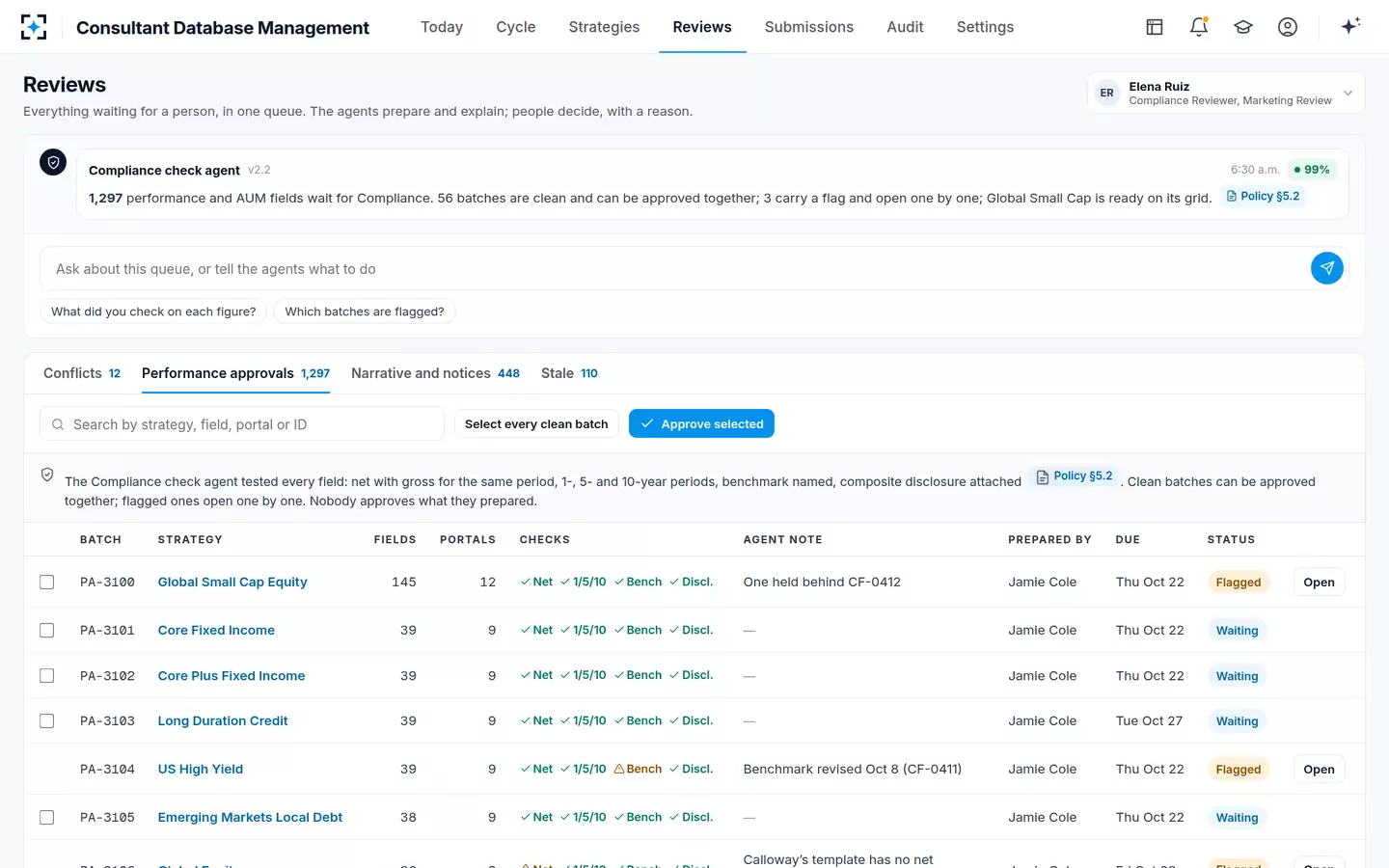
To see the split on your own strategies, start from Consultant Database Management; the companion guide on twelve questions for DDQ software covers the records an examiner will ask for.
Questions people ask
What is the best AI for RFP responses?
The best tool is the one that passes your own test: run it on last quarter's RFPs and DDQs and count unsourced figures, wrong figures and reviewer minutes per answer. For asset managers, a tool that cites the source of every figure and refuses when there is none beats one that writes faster prose.
Can AI fill a consultant database profile?
Yes, if it fills from approved sources and a person approves before release. In the sample firm the agents filled 8,798 of 9,012 fields from the performance system, portfolio accounting, factsheets and other approved sources, left the rest waiting for final data, and submitted only what compliance and the coordinator had approved.
Is there an AI-driven RFP process that works end to end?
The drafting and checking can run end to end; the decisions should not. Supervisors' own surveys show firms deploying agents for decision support far more than with broad autonomy, and the rules on advertisements, books and records and supervision still assign each approval to a person.
Do we have to tell a consultant an answer was drafted with AI?
No US rule requires an adviser to label an RFP answer as AI-drafted. In the EU, ESMA's 2024 statement on AI in retail investment services says firms using AI in client interactions, such as chatbots, should disclose that use (ESMA, May 2024). Whatever the label, the firm should be able to say accurately how each answer was prepared and who approved it.
Will AI replace RFP writers?
The evidence points to reallocated work rather than replaced roles. Studies of AI-assisted writing and support found the largest gains for less experienced staff and on routine text, while judgement tasks suffered without a person. The writer's time moves from copying to checking, sourcing and approving.