RFP content management is the work of keeping an asset manager's approved answers, and the figures inside them, current, owned and dated, so that every RFP, due diligence questionnaire and consultant database profile is drawn from the same sources. It is usually done with an answer library, but a library of text is only half of it: the other half is knowing which locked source each number comes from, which portal definition each field answers, and when each answer expires. Before any software or agent writes a word, a firm needs eight inputs in place. Botminds' Consultant Database Management reads those inputs, fills each field from them with its source and date, and never takes a figure from a previous answer, the CRM or an email.
Eight inputs to bring before any agent writes
1Locked performance period
Why the agents need itEvery return, risk statistic and assets figure is filled from it, never from a copy
OwnerPerformance analyst
RefreshEach quarter, once locked
2Firm AUM and assets policy
Why the agents need itSays what counts as strategy, composite and firm assets, and what is advisement
OwnerFinance and compliance
RefreshOn any change, with a version
3Approved answer library
Why the agents need itFirm, process, risk and policy answers, each with an owner and an expiry date
OwnerRFP lead, with each content owner
RefreshEvery answer on its own expiry
4Team, product and fee sources
Why the agents need itHR system for team and tenure, product register for vehicles, the current fee schedule
OwnerHR, product, consultant relations
RefreshOn every change
5Each portal’s field definitions
Why the agents need itThe consultant’s own wording decides which figure goes in the field
OwnerRFP and database coordinator
RefreshWhen a portal changes its form
6Last quarter’s submitted answers
Why the agents need itFor comparison and change detection only, never as a source
OwnerCoordinator
RefreshEach cycle, kept with receipts
7Marketing review policy
Why the agents need itThe presentation rules each figure is tested against, and who approves which field family
OwnerMarketing compliance
RefreshVersioned; changes need a second approver
8Language rules
Why the agents need itWhich portals need Japanese or German, the name register and the native reviewers
OwnerConsultant relations
RefreshOn any new portal or reviewer
What is RFP content management, and why is a library not enough?
A library answers "what did we say last time?"; content management also answers "is it still true, and who says so?" Most asset managers keep an RFP content library of approved answers searchable by topic. The trouble is that a library entry is a copy, and copies age silently. An answer about the investment team is true until someone resigns; a fee answer is true until the schedule changes; an assets figure is true for exactly one as-of date.
Managing the content means attaching three things to every entry: an owner who can confirm it, an expiry date after which it must be reconfirmed, and, for every number, the source system and period it comes from. With those three in place, a tool can tell a stale answer from a current one. Without them, no tool can, however fluent its drafting.
Why an RFP content library goes stale, in one sample cycle
Staleness arrives from outside the RFP team. Take the sample firm in Consultant Database Management, the fictional Quillfield Capital, partway through its third-quarter 2026 consultant database cycle. Its Freshness agent watches the as-of date of every source and the HR, product and ESG records, and on one morning its alerts read like a list of everything a library misses.
What went stale in one sample quarter, before any consultant saw it
64
profiles carrying team bios approved more than 12 months ago
3
portals still showing a fee schedule replaced on July 1
34
profiles with an ESG policy document 19 months old
1
co-portfolio manager resignation, with notices to 9 consultants drafted
None of these is a drafting problem. Each is a change in a source the library does not watch: HR, the fee schedule, the policy register. A content management process that only reviews library answers on a calendar will catch them eventually; one that watches the sources catches them before the next submission. What happens when a portfolio manager leaves follows the resignation through every place it must reach.
The SEC's view of reusable performance text
Reuse has a regulatory edge. An answer written for one prospect is generally a one-on-one communication, outside the first prong of the Marketing Rule's definition of an advertisement. But in adopting the rule the SEC said that performance inserts or tables kept in a database and dropped into otherwise customised communications must be treated as advertisements, because the same content goes to many people; the guide to gross and net attribution under the Marketing Rule quotes the passage in full (adopting release, 86 FR 13024).
For content management that has a practical meaning. Every reusable block that carries performance belongs in the library with the presentation the rule requires (net with gross over the same periods, the one-, five- and ten-year periods for portfolios other than private funds) and with compliance's approval attached. The SEC staff's FAQ adds that the rule "does not prescribe any particular methodology or calculation for performance", but net must be calculated over the same period and with the same type of return and method as gross (SEC Marketing Compliance FAQ, February 2024), so the method belongs in the library too.
What should be in an approved answer library?
Answers, yes, but also everything needed to prove them. A complete entry has the approved text; its owner; its approval date and approver; its expiry date; the sources of any figures it contains, with periods; the languages it exists in and who approved each translation; and where it has been used. The last item is what turns a correction from a week of searching into a list.
An answer library versus sourced content
A typical RFP answer library: Typed into the text when the answer was last updated
Sourced RFP content: Pulled from the locked source each time, with its as-of date and version
A typical RFP answer library: Reviewed on a calendar, if someone remembers
Sourced RFP content: Flagged when HR records a change or the approval passes 12 months
A typical RFP answer library: Matched by keyword to the closest answer
Sourced RFP content: Matched by definition: strategy assets is not composite assets
A typical RFP answer library: The starting point for this quarter
Sourced RFP content: A comparison: what changed, and why
A typical RFP answer library: Search inboxes and folders for every recipient
Sourced RFP content: A list of every RFP, DDQ and profile that used the value
A typical RFP answer library: Rebuild the support by hand
Sourced RFP content: Export the source, approval and submission for each figure
Locked sources versus copies: what an agent may read
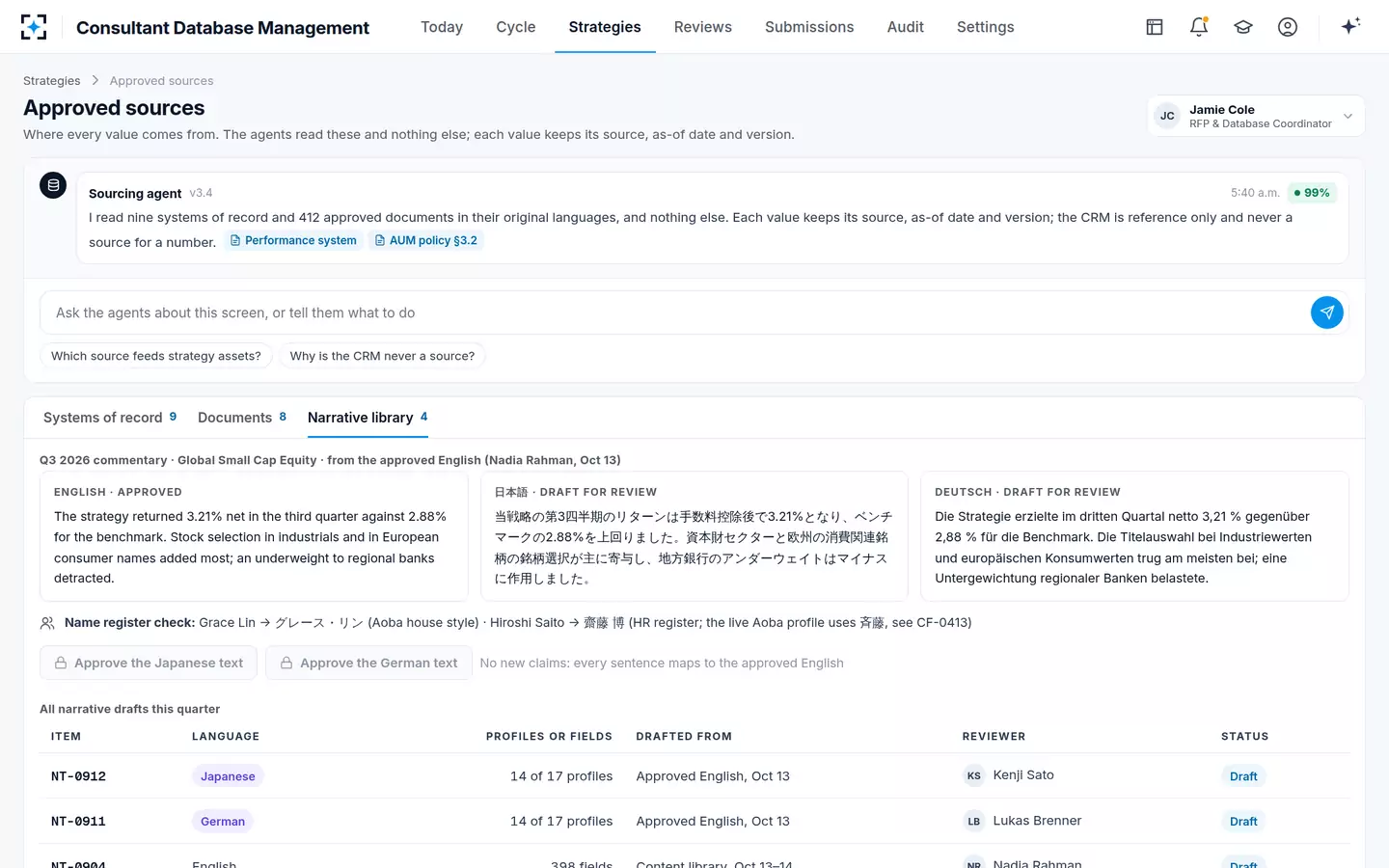
An agent should read sources, not copies. In Consultant Database Management the Sourcing agent fills fields only from approved systems and documents (the performance system once the period is locked, portfolio accounting, the firm AUM report, factsheets, composite reports, prospectuses, the content library, the fund administrator and market data) and never from the CRM, a prior portal answer, an email or free text. A field whose source is not final waits and asks its owner rather than reuse last quarter's value.
The CRM rule is the one firms argue about, because the CRM is where salespeople look for numbers. It is also where numbers are typed by hand. In the sample cycle a hand edit of the CRM's strategy-assets figure swapped two digits and reached one consultant's live profile, overstating assets by $91.4 million. Making the CRM reference only, never a source for numbers, is a setting the firm locks, not a habit it hopes for.
Approved sources, and approved text in three languages
Stale and fresh, field by field, against every portal
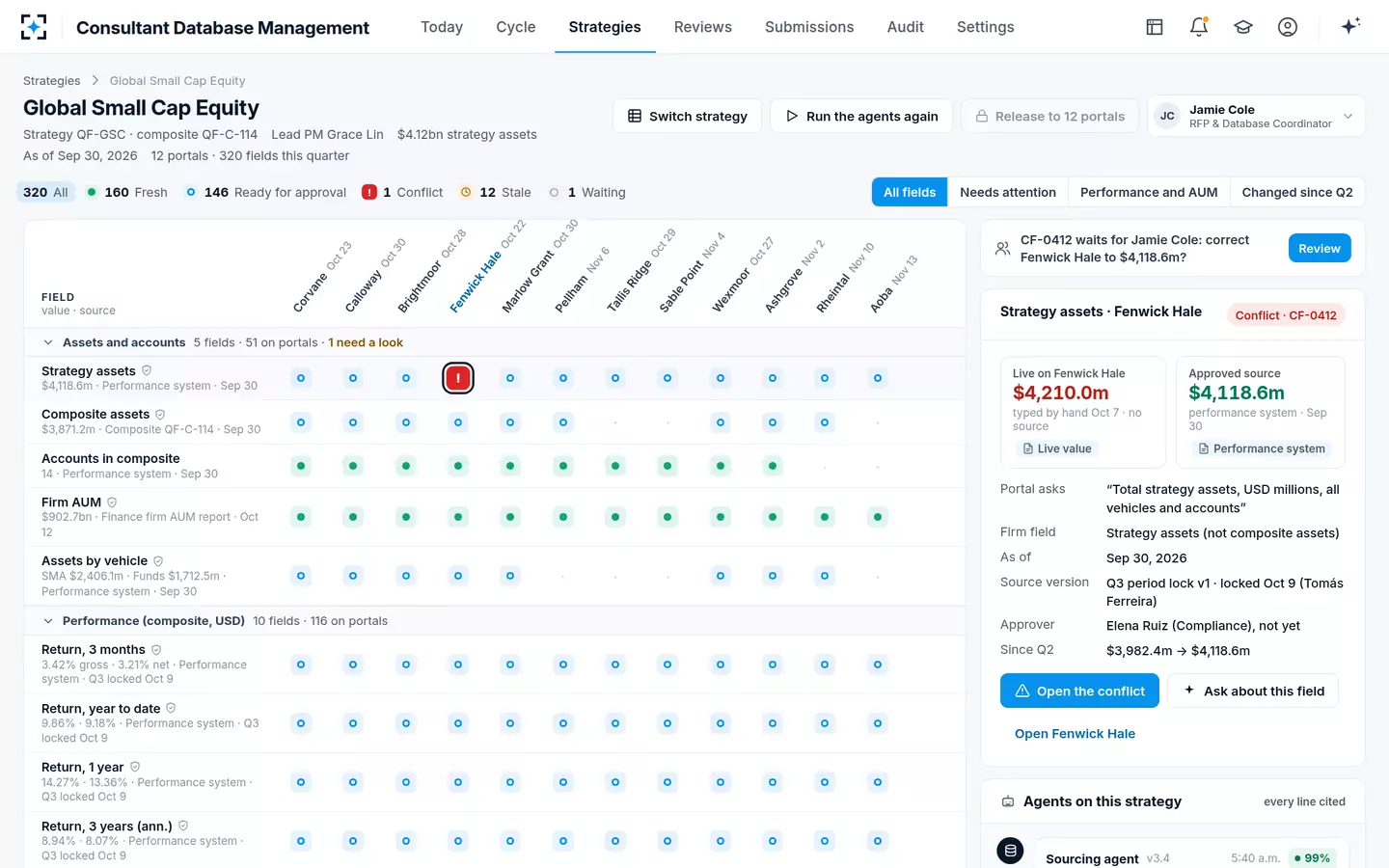
Field definitions: every consultant portal keeps its own dictionary
The most underrated input is the definitions. Each consultant portal has its own field names, precision and meaning: strategy assets or composite assets, effective or modified duration, composite or vehicle inception. A library answer that is correct under one definition is wrong under another, and keyword matching cannot tell them apart. Capture each portal's wording for every field the firm answers, with the date it was last checked, and treat a change in the form as a change in the content.
The same applies to precision and conversion. A portal that stores one decimal will round a two-decimal return, and a firm should decide in advance whether the rounded value is acceptable and who accepts it. Currency conversion needs one rule for the whole cycle; the sample firm uses the London 4 p.m. fixing on the last business day of the quarter, set as a firm policy rather than left to each person.
Records to keep, and how long the clock runs
Books-and-records duties shape the library as much as the rules on content. The sources and approvals that a content management process keeps are, for many entries, records the adviser must keep anyway.
What the books-and-records rule asks of RFP and database content
| Record | Rule 204-2 | How long |
|---|---|---|
| A copy of each advertisement disseminated, directly or indirectly | (a)(11) | Five years from the end of the fiscal year in which it was last disseminated, the first two in an appropriate office |
| Everything needed to form the basis for or demonstrate the calculation of performance in it | (a)(16) | The same, under (e)(3)(i) |
| The compliance policies and procedures in effect | (a)(17) | Those in effect now or at any time in the past five years |
| Electronic copies | (g) | Indexed for easy retrieval, a duplicate copy kept separately, safeguarded from loss, alteration or destruction, with access limited to authorised staff and the SEC |
The clock in row one is the detail most libraries miss. It runs from the end of the fiscal year in which the material "last published or otherwise disseminated", so a performance table left live on a consultant portal for four years keeps its supporting calculations owed for about nine years from first use. Content management that records where each entry went, and until when, is the only way to know which records are still owed.
RFP content management software: what to look for, and where agents fit
Buy for the sources and the records, not the search box. Most RFP content management systems are good at storing and finding answers; fewer can say where a figure inside an answer came from, when it stops being true, or which documents used it. The checklist below tests the parts that carry regulatory weight.
Seven questions for any RFP content management system
- Does every figure link to its source?
A number inside an answer should open the locked source and its as-of date, not the answer it was copied from.
- Does every answer have an owner and an expiry?
And does the system raise the answer for review when either the date passes or the source changes?
- Can it hold portal definitions?
One field, many consultants’ wordings, each mapped to the right figure.
- Does it keep approvals with the content?
Who approved which version, when and under which policy version.
- Can it list every use?
Each RFP, DDQ and profile that carried an answer or figure, for corrections and for the retention clock.
- Does it block copies as sources?
The CRM and past answers can inform a draft; they should never fill a regulated field.
- Will an examiner be able to read it?
Indexed, exportable, tamper-evident and kept for the full retention period.
Consultant Database Management is built for the source half of this: it reads the content library, the performance system and the other inputs, fills consultant database profiles and the figures in RFPs and DDQs from them, and keeps each value's source, approval and submission on a hash-chained audit trail. It does not replace a proposal tool's project management or its search across years of narrative answers; many firms will run both, with the library as one of the sources the agents read. Twelve questions for DDQ software covers the questionnaire side in more depth.
The first month, week by week
A sensible start runs one quarter in parallel rather than switching over. The plan below is ours and assumes the eight inputs exist somewhere, even if scattered.
A four-week start: inventory, map, replay, run in parallel
- Inventory sources and ownersWeek 1
- Map portal definitionsWeek 2
- Replay last quarterWeek 3
- Run beside the teamWeek 4
The replay in week three is the most revealing step. Comparing what the agents would have filled with what was actually submitted surfaces stale answers, figures typed outside the cycle and definitions nobody wrote down, before a consultant finds them. To run it on your own strategies, start from Consultant Database Management.
Questions people ask
What is an RFP content library?
A searchable store of approved answers a firm reuses across RFPs and DDQs: firm history, process, risk management, policies and standard descriptions. To stay useful each answer needs an owner, an approval date and an expiry date, and every figure inside it needs a named source and period.
What is the difference between an RFP content library and an RFP content database?
Usage varies, but a library usually means approved narrative answers, while a content database also holds structured data: returns, assets, holdings and team details by strategy and period. Asset managers need both, because consultant database fields are mostly structured data with a little narrative.
How often should RFP content be reviewed?
No rule sets a frequency. Figures change every quarter; team bios and policies should be reviewed whenever the underlying source changes and at least on a fixed cycle, which the sample firm sets at 12 months. Rule 206(4)-7 requires an annual review of the compliance policies themselves.
Who should own RFP content in an asset manager?
The person who can confirm it. Performance analysts own returns, finance owns firm assets, HR owns team data, portfolio managers own process and commentary, and compliance owns the presentation rules. The RFP lead owns the library itself and the calendar, not the truth of each answer.
Can an RFP content library feed consultant databases?
Its narrative can, after a check that each answer still holds. Its figures should not; database fields should be filled from the locked sources directly, because a figure copied into a library answer is already one step from its source and goes stale on the next quarter-end.