FCA Consumer Duty outcomes monitoring is the obligation in PRIN 2A.9 of the FCA Handbook for a firm to monitor, regularly, the outcomes its retail customers receive from its products, its communications and its customer support. The monitoring must be good enough to tell the firm whether the four Duty outcomes are being delivered, whether it is complying with the Duty's cross-cutting obligations, whether any group of customers of a product fares worse than another, and whether anyone has been harmed; the firm must then find the root causes of failures and act on them. It is what the annual board report summarises, and what the FCA reviewed across sectors in a report published on 27 July 2026. Botminds' Consumer Duty Outcomes Monitoring carries the mechanical part for UK banks: it assembles outcome measures from the bank's systems, compares groups, and turns the results into cited findings that people challenge and act on.
Examples on this page come from a fictional sample bank, Corvane Bank UK, as it runs through the solution. The rule text is quoted from the FCA Handbook as in force on 27 October 2026.
Outcomes monitoring under the Consumer Duty, in four numbers
3
things every firm must monitor: products, communications and customer support
4
outcomes the monitoring must test: products, price and value, understanding, support
56
firms surveyed for the FCA’s outcomes monitoring review
27 Jul
2026: the FCA publishes its outcomes monitoring review
What is Consumer Duty outcomes monitoring?
Consumer Duty outcomes monitoring is a firm's continuing check that customers are getting good outcomes in practice, not just in the product design. The core rule is PRIN 2A.9.8R: “A firm must regularly monitor the outcomes retail customers receive from: (1) the products the firm manufactures or distributes; (2) the communications the firm has with retail customers; and (3) the customer support the firm provides to retail customers” (PRIN 2A.9.8R). Guidance at PRIN 2A.9.2G gives the purpose: to let firms see whether there are risks they are not meeting the cross-cutting obligations and the outcomes.
It is broader than any one of the four outcome rules and runs underneath all of them. Specific monitoring required elsewhere, such as testing and monitoring communications under PRIN 2A.5.10R, forms part of it, and its results are what PRIN 2A.8.3R requires the board report to set out. FG22/5 puts the reason simply: without assessing, testing and evidencing outcomes, “it will be impossible for firms to know that their products and services are working as they and their customers would have expected” (FG22/5, paragraph 11.1).
What does PRIN 2A.9 require?
PRIN 2A.9 requires firms to monitor three things, to be able to determine at least four, to identify three more, to find root causes, to act, and in a distribution chain to tell the FCA about others' failures. The checklist below sets the rules out in order, in their current form.
What PRIN 2A.9 requires of FCA Consumer Duty outcomes monitoring
- Monitor three things, regularly
PRIN 2A.9.8R: outcomes from the products the firm makes or distributes, its communications with retail customers, and its customer support.
- Determine whether the four outcomes are delivered
PRIN 2A.9.9R: products designed for customers’ needs; fair value, with action on products that are not; information for informed decisions; the support customers need.
- Identify compliance, group differences and harm
PRIN 2A.9.10R: whether the firm complies with Principle 12 and the cross-cutting obligations; whether any group of a product’s customers gets different outcomes from another group of the same product; whether anyone has been harmed by the firm’s acts or omissions.
- Find the root causes
PRIN 2A.9.11R: processes to identify the root causes of any failure to deliver the outcomes.
- Act on what it finds
PRIN 2A.9.12R: appropriate action where outcomes are not delivered or at risk, where a group fares worse, or where the firm is not complying.
- Keep the records
PRIN 2A.9.15G: firms decide, under SYSC 3 and SYSC 9, what records the Duty requires them to keep.
- Report others’ failures
PRIN 2A.9.17R: a firm in a distribution chain must notify the FCA if it becomes aware another firm in the chain is not, or may not be, complying with the Duty.
Two limits keep the rule workable. PRIN 2A.9.3G says the frequency and the information needed depend on the type of firm, its role in the distribution chain, the product and the target market, and 2A.9.4G scales the duty for firms without direct customer contact. And PRIN 2A.9.13G says a firm need not act to remove the effects of risks inherent in a product that it reasonably believed the customer understood and accepted.
What did the FCA outcomes monitoring review find?
The FCA's review, published on 27 July 2026, found that the strongest approaches were structured, evidence-based and built around clear definitions of good outcomes, and that weaker ones described monitoring at a high level without a way to identify poor outcomes or understand why they happened (FCA, Outcomes monitoring: good practice and areas for improvement). It assessed board reports and responses to information requests from firms across sectors and sizes, and surveyed 56 firms on their strategy and framework, their data, MI and testing, and their governance.
Its good-practice examples start with definitions. “One firm defined good outcomes for each of its key products, rather than having a single broad statement covering all the products”, describing what customers should experience when joining, using the service and leaving, and linking those statements to customer journeys. The commonest weakness was the reverse: “Some firms used operational activity metrics, like conversion rates or review completion, as a proxy for customer outcomes – but did not define good or poor outcomes for customers at different stages of the journey.”
The review was equally direct about governance and follow-through. Boards were usually described as central to oversight, but “In many cases, they focus on reviewing and approving reports rather than challenging them or pushing for further action.” And on remedies: “Evidence was stronger where firms tested whether interventions reduced repeat contact, avoidable customer effort and unresolved journeys, rather than relying only on the fact that they had agreed some actions.” Monitoring that stops at the action, without measuring whether it worked, did not satisfy the FCA.
How is outcomes monitoring different from MI?
MI is the data; outcomes monitoring is what a firm does with it. The FCA's 2026 review set the test in its introduction: firms should be able to explain what their information tells them, how they use it to identify risks or issues, what action they take, and how they judge whether those actions improved outcomes. A firm with excellent MI and no answer to those four questions has data, not monitoring.
Management information and outcomes monitoring, side by side
Management information: What happened in our operations?
Outcomes monitoring: What did customers get, and was it good?
Management information: Calls answered, letters sent, reviews completed
Outcomes monitoring: Customers who understood, moved, were supported, got fair value
Management information: A target met or missed
Outcomes monitoring: A defined good outcome, with a threshold and a reason for it
Management information: Totals and averages
Outcomes monitoring: Groups of the same product’s customers compared
Management information: A report
Outcomes monitoring: A root cause, an action, and a test of whether it worked
The difference shows up in board reports. The sample bank's MI includes the number of savings letters sent; its outcomes monitoring asks whether holders of closed savings issues moved to a better rate, finds that 3.1% did in the year, and treats that as a finding. Consumer Duty MI measures follows one such measure from its source to the board.
Do you need to compare customer groups?
Yes. PRIN 2A.9.10R requires monitoring that can identify whether, for any product, one group of its customers gets different outcomes from another group of the same product, and PRIN 2A.9.12R requires action where “any group of retail customers for a product are receiving worse outcomes than another group of retail customers for the same product” (PRIN 2A.9.12R). Customers with characteristics of vulnerability are the group most firms start with; FG22/5 makes clear they are not the only one.
FG22/5 frames the test as a question firms can ask themselves: “is the firm using the same levels of segmentation and analysis to monitor outcomes as they are to target sales?” (FG22/5, paragraph 11.13). A bank that can target savings offers by balance band, age and channel can split its outcomes the same way. At the sample bank, the split that mattered most was by the four drivers of vulnerability in the FCA's FG21/1 guidance, against all customers.
Consumer Duty Outcomes Monitoring: one outcome table, five groups compared with all customers
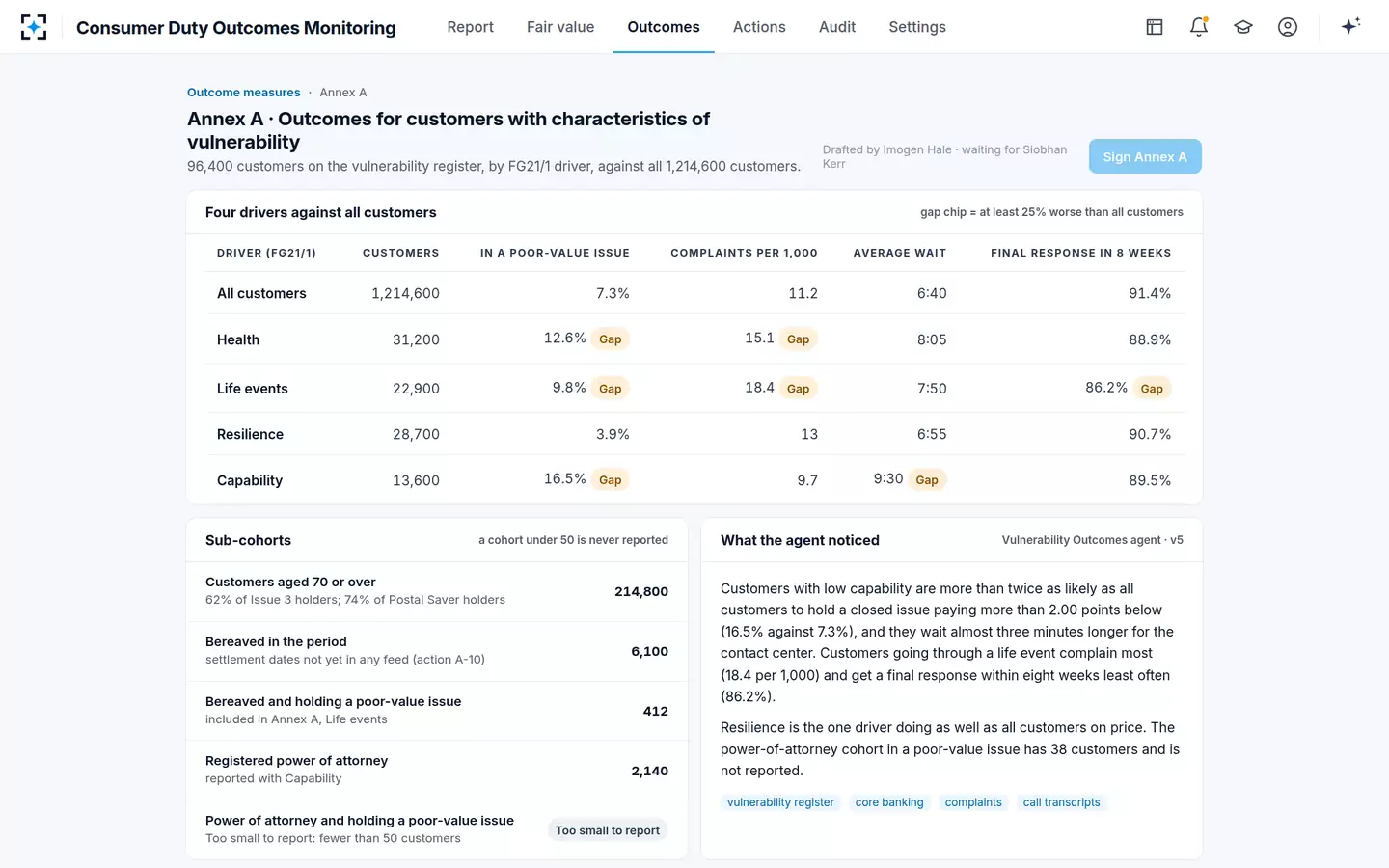
Group comparisons for customers in vulnerable circumstances have their own guidance and their own pitfalls, from small numbers to consent, set out in FCA vulnerable customer outcomes in the Vulnerable Customer Support series. The outcomes monitoring rule is the same for every group: compare, find the cause, act.
What is root cause analysis under the Consumer Duty?
Root cause analysis under the Consumer Duty is the process PRIN 2A.9.11R requires: “A firm must have in place processes to identify the root causes of any failure to deliver the outcomes listed in PRIN 2A.9.9R for retail customers.” It is the step that turns a measure outside threshold into something a firm can fix. FG22/5's description of complaints analysis states the standard for all of it: “investigating complaints fully to understand the cause of customer complaints, not just dealing with the symptoms” (FG22/5, paragraph 11.33).
The outcomes monitoring loop PRIN 2A.9 describes, with the agents' and people's parts
Agent
Monitor and compareRead outcome measures for products, communications and support from the bank’s systems, each with its source and date, and split each by group of the same product’s customers.
Never: estimates a missing number, or reports a group under 50
Agent
TraceGather the evidence behind a failure: what customers were sold, told and offered, from letters, messages and calls.
Never: names a customer in the report
A person decides
Find the root causeDecide why the outcome failed: product design, price, communication, support, or a third party.
A person decides
ActCommit an owned, dated action; approve any price change; tell others in the chain where they are the cause.
A person decides
Test the fixName the measure that will show the action worked, and read it again next period.
The sample bank's closed savings issue shows the loop end to end. The measure: 41,800 holders on 1.10% against 3.85% on the issue on sale. The comparison: 62% of holders aged 70 or over, and customers with low capability more than twice as likely as others to hold a poor-value closed issue. The trace: two mentions of a better rate in four years, and 204 of 312 rate calls in which the adviser did not mention a better account. The cause the conduct risk lead acted on was price, not paperwork: her answer to the challenge was an action to move holders to the current rate or raise Issue 3 to it. The action raises the rate from 1 December 2026; the test is the same measure next period.
How often should consumer outcomes be monitored?
Often enough to catch harm while it can still be stopped, which the rules leave each firm to judge. PRIN 2A.9.3G ties frequency to the type of firm, its role, the product and the target market. FG22/5 expects customer support, transaction and complaints data to be gathered and reviewed on an ongoing basis, with file reviews, sludge audits and focus groups more likely at regular intervals or ad hoc, and some monitoring, such as distributional analysis, to use risk-based samples.
The annual board report is a summary, not the monitoring cycle. The FCA's 2026 review praised firms that reported outcomes to their boards through the year and used triggers and tolerance levels to escalate issues between reports; the Consumer Duty board report deadline builds those updates into a twelve-month calendar.
Who is responsible for outcomes monitoring?
The firm is responsible, and it cannot hand that to a supplier or a partner. The FCA's 2026 review put it in one line: “Firms using third parties to deliver part of their services are still responsible for their customers’ outcomes.” FG22/5 expects firms that outsource to have arrangements with their outsourcers to capture the data needed to monitor outcomes. Inside the firm, the review favoured clear senior accountability, formal escalation routes and action trackers with named owners, target dates and status, rather than reports produced by one team.
The rules are under review at the edges. The FCA's June 2026 consultation CP26/23 proposed replacing the general monitoring rule with one focused on the outcomes customers receive “in relation to the product and which reasonably relate to the firm’s role and activities in relation to the product”, and narrowing the duty to notify the FCA to cases where a firm has material concerns about another firm's conduct (FCA CP26/23, draft rules). Consultation closed on 18 September 2026; final rules are expected in the first quarter of 2027. For a bank that manufactures and distributes its own retail products, its role covers almost everything PRIN 2A.9 asks for today.
The board report that outcomes monitoring feeds
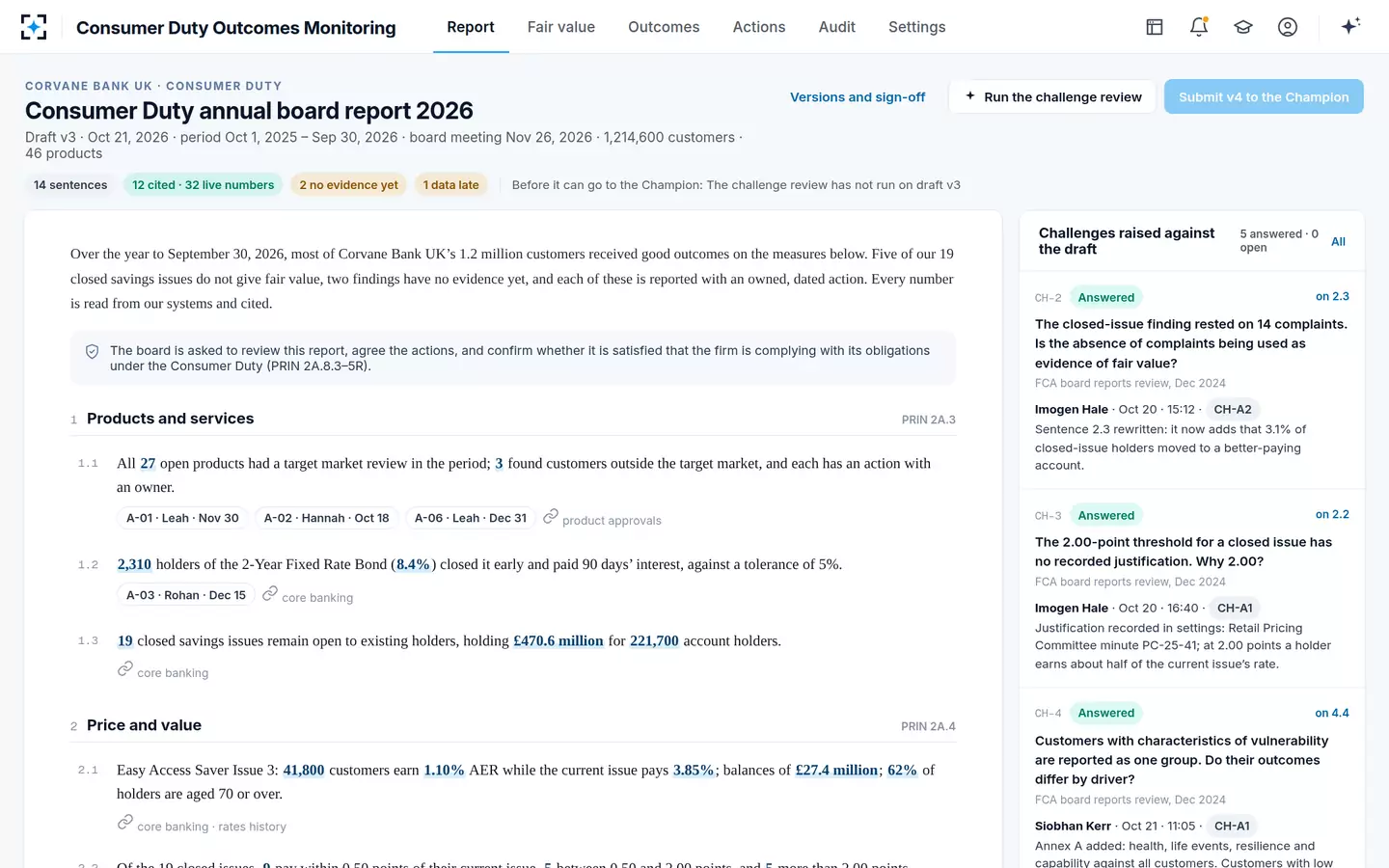
To see the monitoring loop and the report it feeds on the sample bank, start from Consumer Duty Outcomes Monitoring.
Questions people ask
What are the four Consumer Duty outcomes?
Products and services, price and value, consumer understanding, and consumer support, set out in PRIN 2A.3 to 2A.6. Outcomes monitoring under PRIN 2A.9.9R must let a firm determine whether each is being delivered.
Does outcomes monitoring have to cover closed products?
Yes. The Duty applied to closed products and services from 31 July 2024, according to the FCA's PS22/9 page, and monitoring under PRIN 2A.9.8R covers the products a firm manufactures or distributes, closed ones included. The FCA's first review of board reports found some firms that did not consider characteristics of vulnerability in their assessments of closed products.
Is there an FCA list of outcomes monitoring metrics?
No. FG22/5 chapter 11 gives a menu of information types, from business persistence and the distribution of fees and charges to file reviews and complaints root-cause analysis, and says firms must use judgement to choose sources that show whether they deliver good outcomes.
Do smaller firms need complex systems for outcomes monitoring?
No. The FCA's July 2026 review described smaller firms using a small number of existing indicators, such as complaints, customer feedback, missed service standards and file checks, tied to plain-language definitions of good outcomes at key journey stages, as a proportionate approach.
What records does outcomes monitoring need?
PRIN 2A.9.15G leaves firms to decide, under the high-level record-keeping rules in SYSC 3 and SYSC 9, what records the Duty requires. FG22/5 adds that there is no prescribed format but firms should keep records they can provide on request, including the issues found and the actions taken.