Consumer Duty MI measures are the numbers a firm uses to show whether its retail customers get good outcomes on products, price and value, understanding and support, and whether any group of customers fares worse than another. The FCA does not prescribe a list. It does require the monitoring behind them under PRIN 2A.9, and it has published, report by report, where firms' MI let their boards down: thresholds with no stated reason, groups averaged away, conclusions the numbers did not support. The hard part is rarely choosing measures. It is keeping one number intact from the system where it is born to the sentence the board approves. Botminds' Consumer Duty Outcomes Monitoring does that by citing every number in the board report to its system, query and as-at time, and by keeping each threshold's written reason beside it.
The measure followed on this page comes from a fictional sample bank, Corvane Bank UK, as it runs through the solution with its 2026 report: 1,214,600 customers, 46 products, 19 savings issues closed to new customers. The FCA findings are linked where they appear.
The FCA has read the MI behind hundreds of Consumer Duty reports
180
firms whose first Consumer Duty board reports the FCA reviewed, 2024
56
firms surveyed for the FCA’s 2026 outcomes monitoring review
12
outcome measures behind the sample bank’s report, each with a written threshold reason
32
live numbers in the sample report’s 14 findings, each cited to its source
What MI does the Consumer Duty require?
The Consumer Duty requires MI good enough to determine the things PRIN 2A.9.9R lists, without naming any particular measure. The monitoring must let a firm determine at least whether customers are sold products designed for their needs, whether those products give fair value, whether customers have the information to make informed decisions, and whether they get the support they need (PRIN 2A.9.9R). FG22/5 adds that firms “will need to produce and regularly review MI on customer outcomes”, proportionate to their size and customer base (FG22/5, paragraph 11.19).
The guidance offers a menu rather than a list: business persistence and reasons customers leave; the distribution of products, prices, fees and charges across groups; behavioural data such as drop-off rates and channel use; file reviews and call monitoring; customer feedback; complaint numbers and root-cause analysis; the results of testing required under the outcome rules; information from others in the distribution chain; and external data such as the FCA's Financial Lives survey. On complaints, it is direct: “firms should develop MI that goes beyond complaints data to gain better insight and assurance on customer outcomes.”
The older reference point is going. Before the Duty, conduct MI had its own guide, written in 2007 for the FSA's treating customers fairly initiative. In June 2026 the FCA listed “Treating customers fairly – guide to management information (2007)” among the TCF publications it is removing from its website, as part of clearing out references that pre-date the Duty and were causing confusion (FCA Handbook Notice 142). A measure inherited from a TCF dashboard has to earn its place again against PRIN 2A.9.
One measure, followed from the core system to the board
Take one measure through the whole chain: how far each savings issue closed to new customers pays below the issue on sale. It matters under the price and value outcome, it is easy to compute, and it is the kind of number the FCA's cash savings work made central. At the sample bank it ends in a sentence the board approves and an action that costs an estimated £753,500 a year, so every link in the chain has to hold.
The life of one Consumer Duty MI measure, from the core system to the board
- 1
SourceWhere the number is born
Core banking system: open accounts, balances and dates of birth per product. Rates history: every rate change on every issue.
- 2
Query and as-atWhere it is cut
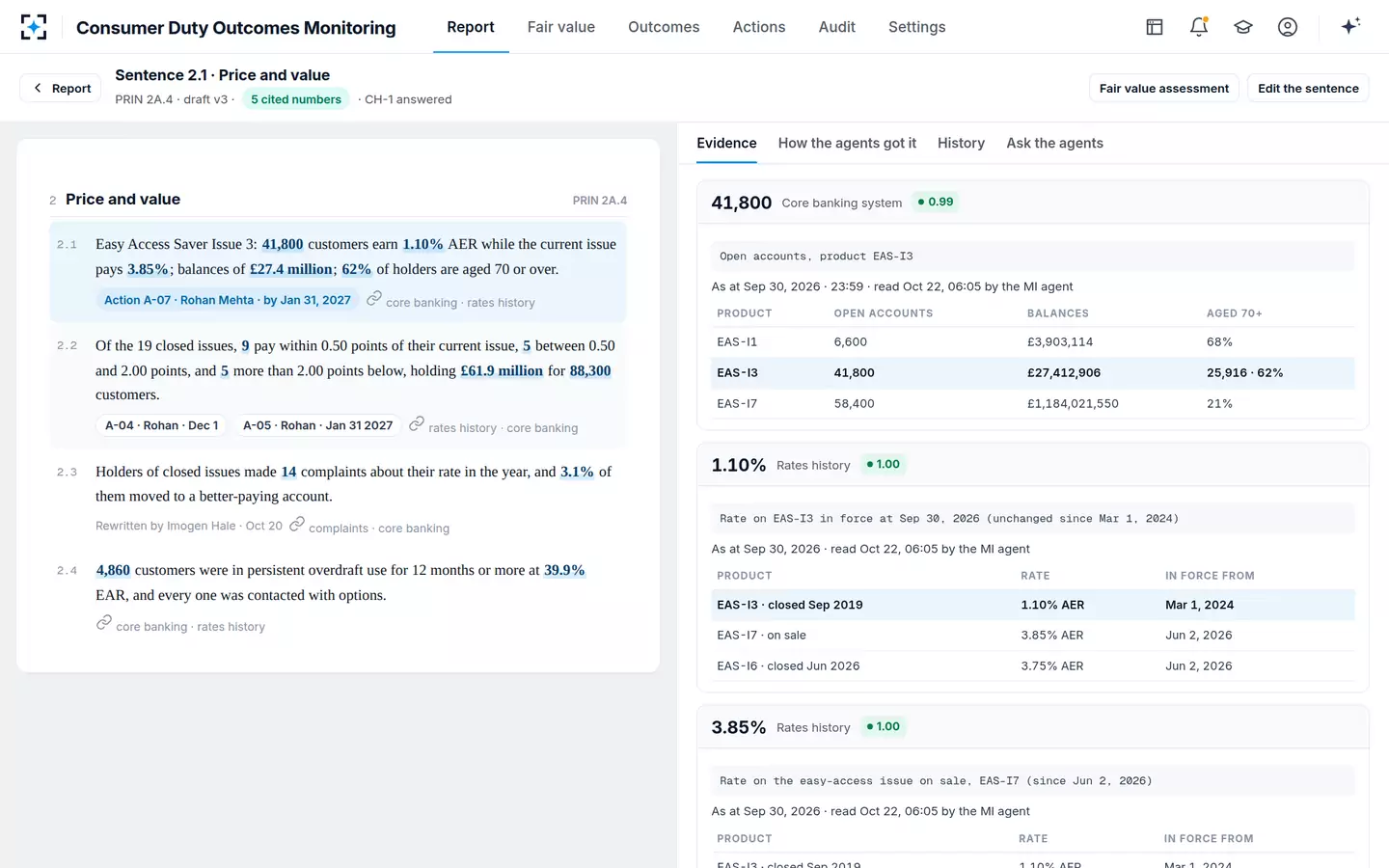
Product EAS-I3, as at 30 September 2026, 23:59; read on 22 October at 06:05; confidence 0.99.
- 3
DefinitionWhat it means
Rate gap = the rate on the issue on sale minus the rate on the closed issue, in percentage points, for each issue closed to new customers.
- 4
ThresholdWhere good becomes poor
More than 2.00 points below is outside threshold. Reason: Retail Pricing Committee minute PC-25-41 — at 2.00 points a holder earns about half the current rate.
- 5
CutWho it hides
By issue, by age (62% of Issue 3 holders are 70 or over) and by vulnerability driver; any group under 50 customers is not reported.
- 6
SentenceWhat the board reads
“Of the 19 closed issues, 9 pay within 0.50 points of their current issue, 5 between 0.50 and 2.00 points, and 5 more than 2.00 points below, holding £61.9 million for 88,300 customers.”
- 7
Challenge and actionWhat the board decides
CH-3: “Why 2.00?” answered with the minute. Actions A-04, A-05 and A-07 cover the five issues; A-07 raises Issue 3 to 3.85% from 1 December 2026.
Each of the seven steps is a place where a measure can break, and the FCA's reviews have found breaks at most of them. The five below are the ones that change what a board believes.
One sentence opened: each number with its system, query, as-at time and confidence
Break point 1: the definition
A measure breaks first when two people mean different things by its words. “Closed” is the clearest case in Consumer Duty MI. In a bank's product system it often means closed to new customers. For the Duty it is narrower: a closed product must have existing customers who took it out before 31 July 2023 and must not have been marketed or distributed, renewals included, since then, so a product closed to new customers on or after that date is, for the Duty, an existing product rather than a closed one (FCA, Consumer Duty information for firms).
The sample bank's list shows why it matters. Its 19 issues closed to new customers include Easy Access Saver Issue 6, closed in June 2026, which under the FCA's definition is an existing product, not a closed one. For a rate-gap measure the distinction changes nothing, because fair value applies to both. For a board report that says “our closed products” it changes the scope of the claim. A measure's definition should be written once, in words a director can read, and the report should use those words; what a closed product is under the Consumer Duty works through the definition in full.
Break point 2: the threshold and its reason
A measure without a threshold cannot say whether an outcome is good or poor, and a threshold without a reason cannot be challenged. The FCA's first-year review found that “some reports failed to include thresholds that were being used to monitor MI”, and where thresholds were stated, they often came without justification. Its prescription is precise: “Providing the rationale for setting MI thresholds at certain levels would allow boards to assess whether these thresholds reasonably reflect the boundaries between good and poor outcomes for customers. Such reasoning might include baselining against past levels or explanations of the differing outcomes firms would expect customers to experience either side of a given threshold” (FCA board reports review).
The sample bank's twelve measures show four kinds of reason a board can test. A baseline: calls asking what rate an account pays have a 1.0% threshold, set from a 2024 baseline of 0.9%. A multiple of history: early closures of a two-year fixed bond have a 5% threshold, twice the 2.4% average of 2023 to 2025. A regulatory clock: complaints with a final response within eight weeks, where the eight weeks come from the FCA's complaints rules and the 95% floor is the conduct risk committee's. And a customer breakpoint: the closed-issue gap of 2.00 points is where a holder earns about half the current rate, and the extra-wait threshold of 60 seconds for callers aged 70 or over is where, in the bank's 2025 call data, older callers abandon calls twice as often.
The FCA's 2026 review described a firm that set its targets from past performance and then reviewed and challenged them through governance at least once a year, so they did not become too easy to meet (FCA outcomes monitoring review). In the solution every threshold carries its written reason, and changing one needs a second person. On the sample bank's draft the Challenge agent asked “Why 2.00?” of the closed-issue threshold, and the answer, the pricing committee minute, now sits beside it in the settings.
Break point 3: the cut that hides a group
An average across all customers can look fine while one group fares much worse, which is why PRIN 2A.9.10R requires monitoring that can tell whether any group of customers of a product gets different outcomes from another group of the same product. FG22/5 widens the lens beyond vulnerability and protected characteristics, suggesting groups such as “longstanding customers, customers from a particular geographical region or customers who buy a product through a particular distribution channel” (FG22/5, paragraph 11.12).
At the sample bank, 7.3% of all customers hold a closed issue paying more than 2.00 points below its current issue. Split by the four drivers of vulnerability in the FCA's FG21/1 guidance, the same measure ranges from 3.9% to 16.5%.
The same closed-issue measure, cut by group, at the sample bank
Two things in that chart change a board's reading. Customers with low capability are more than twice as likely as everyone else to sit in a poor-value closed issue, which an all-customer figure of 7.3% hides completely. And low resilience sits below the average. A single “vulnerable customers” line would have averaged the two and shown a modest gap where there are really two different stories. The vulnerability side of this split, and what the FCA expects of it, is covered in FCA vulnerable customer outcomes in the Vulnerable Customer Support series.
Break point 4: data that arrives late
A measure can be right in its definition, threshold and cut and still be stale. The FCA's 2026 review found that firms “sometimes relied on lagging indicators, lacked clear thresholds or forward‑looking metrics, or did not have complete audit trails from identifying an issue through to action and outcome”, and that gaps in key data sometimes limited what firms could evidence (FCA outcomes monitoring review).
The honest response to a late feed is to say so in the report. On the sample bank's draft, the measure of calls asking what rate an account pays stood at 1.5% against a 1.0% threshold, but the contact centre transcripts behind it had last loaded on 19 October; the finding carries “Data late” until the feed catches up, rather than presenting a September number as current. Two other findings, comprehension testing of a key letter and bereavement settlement times, carry “No evidence yet”, because no feed holds the data at all. Each goes to the board as a gap with an owned action, which is what a board needs to judge how much of the report to rely on.
Break point 5: a conclusion the MI does not support
The last break is between the numbers and the words. The FCA's first-year review put it plainly: “Some firms made statements and drew conclusions about the outcomes they were delivering that did not seem to align with the provided MI.” A year later the problem had changed shape rather than gone away: “Some firms presented extensive data without sufficiently explaining how it demonstrated good or poor outcomes” (FCA, Year 2 Consumer Duty Board Reports).
The commonest unsupported conclusion is the one built on silence. The FCA warned smaller firms that “an absence of complaints can be an indicator itself, and should not be relied upon solely as evidence that outcomes are being met.” The sample bank's draft made exactly that mistake on its closed issues: the finding rested on 14 complaints about rates in a year. The Challenge agent asked whether the absence of complaints was being used as evidence of fair value, and the conduct risk lead rewrote the sentence to add that only 3.1% of closed-issue holders had moved to a better-paying account. Few complaints and few movers together describe inertia, not satisfaction.
What are good Consumer Duty outcome measures?
Good Consumer Duty outcome measures describe what customers experience rather than what the firm did, carry a threshold with a reason, can be split by group, and lead to an action someone owns. The FCA's 2026 review found that some firms let activity counts stand in for customer outcomes without defining what good looked like at each stage of the journey; FCA Consumer Duty outcomes monitoring sets out that finding and what the review praised instead. The checklist below turns the five break points into tests a measure should pass before it reaches a board.
Seven tests for a Consumer Duty MI measure before it reaches the board
- It measures an outcome, not an activity
Customers moved to a better rate, not letters sent; complaints resolved first time, not calls answered.
- Its definition is written in the board’s words
“Closed issue” or “closed product”: say which, and use the same words in the report.
- Its threshold has a reason a director can test
A baseline, a multiple of history, a regulatory clock or the point where customers’ outcomes change.
- It can be split by group
By age, channel, tenure and vulnerability driver at least, with a minimum group size so small numbers are not over-read.
- It carries its source and as-at time
The system, the query and the date of the data, visible from the sentence that uses it.
- It says when it is late or missing
“Data late” and “No evidence yet” are findings; a stale number presented as current is not.
- It ends in an action someone owns
With a date, and with the same measure named as the evidence that the action worked.
The sample bank's twelve measures are one way to apply those tests across the four outcomes. Three to a section is not a rule; the FCA's smaller-firm examples used a handful of existing indicators, and what mattered was that each one was tied to a stage of the customer journey and a risk of harm. The measures are the backbone of any Consumer Duty dashboard template, but the dashboard is only as good as the reasons and cuts behind each line.
Consumer Duty Outcomes Monitoring: twelve outcome measures, each threshold with its reason
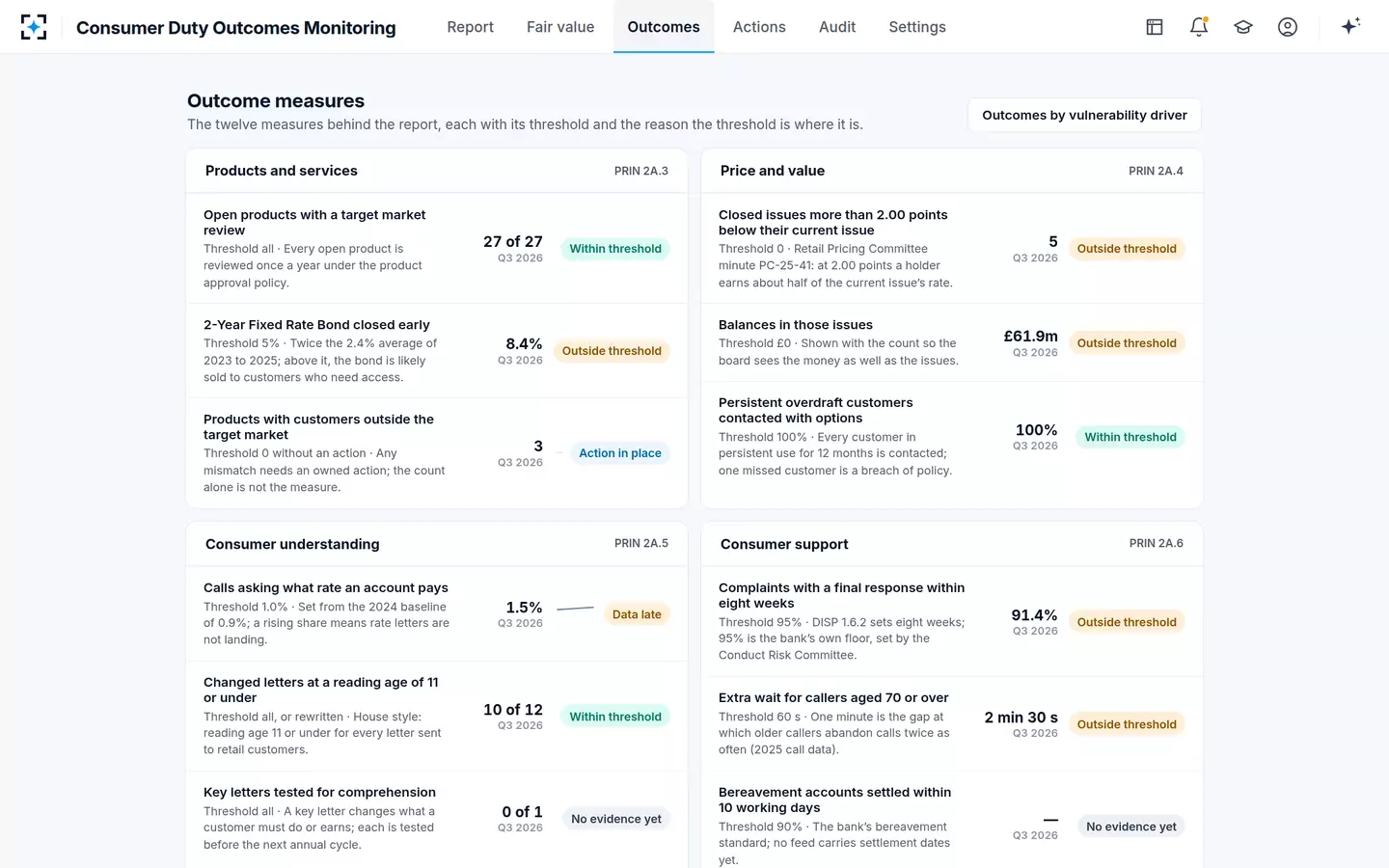
To see one of these measures traced from the board report to its source on the sample bank, start from Consumer Duty Outcomes Monitoring.
Questions people ask
Is complaints data enough for Consumer Duty MI?
No. FG22/5 says firms should develop MI that goes beyond complaints data, and the FCA's board reports review warned that an absence of complaints should not be relied on alone as evidence of good outcomes. Complaints are most useful with root-cause analysis and alongside behavioural data such as switching, drop-off and repeat contact.
How granular should Consumer Duty MI be?
Granular enough to compare groups of customers of the same product, as PRIN 2A.9.10R requires, and to locate the journey stage where an outcome goes wrong. FG22/5 asks whether firms use the same level of segmentation to monitor outcomes as they use to target sales, which is a practical benchmark for most banks.
What is outcomes-based MI?
MI that measures what happened to customers rather than what the firm did: customers who moved to a better rate rather than letters sent, issues resolved first time rather than calls answered. The FCA's 2026 review criticised firms that used activity metrics such as conversion rates or review completion as a proxy for outcomes without defining good and poor outcomes.
How often should Consumer Duty MI thresholds be reviewed?
The FCA sets no interval. Its 2026 review praised a firm that reviewed its targets at least once a year and adjusted them where performance improved or a measure no longer reflected the most relevant risks, so they did not become too easy to meet.
Who owns Consumer Duty MI?
The business owns the outcomes and the measures; the FCA criticised board reports that compliance teams wrote more or less on their own. In practice product owners own their products' measures, a conduct or MI team owns definitions and data quality, second line challenges, and the board decides what the results mean for actions and strategy.