FCA vulnerable customer outcomes are the results customers with characteristics of vulnerability actually get from a firm's products, communications and support, judged against the results other customers get. The regulator's aim, stated on the page that introduces its guidance, is that "We want vulnerable consumers to experience outcomes as good as other consumers", and since the Consumer Duty a firm must monitor whether any group of customers fares worse than another on the same product and act if it does. The difficulty is measurement: in 2025 the FCA found banks reporting how fast they answered calls rather than whether needs were met. Botminds' Vulnerable Customer Support adds an Outcomes agent that compares customers with recorded needs against everyone on nine measures, by driver, and drafts the quarterly report with every number cited, for compliance to verify and the Consumer Duty manager to sign.
This is UK regulation. No US federal rule requires a bank to record vulnerability or to report outcomes for customers with recorded needs, though the comparison method below works for any customer group a bank chooses to watch. Worked examples are from a fictional sample bank, Corvane Bank UK.
Firms measure outcomes with the data they already have, not the data that shows outcomes
What does the FCA mean by vulnerable customer outcomes?
The FCA means whether customers with characteristics of vulnerability receive the four outcomes the Consumer Duty sets for every retail customer, products and services that meet their needs, fair price and value, information they can understand, and support that works, as well as other customers do. The comparison is the point. A bank where everyone waits 20 minutes has a service problem; a bank where customers with hearing loss wait 20 minutes and others wait 5 has an outcome gap.
The rule behind it is PRIN 2A.9. A firm must regularly monitor outcomes from its products, communications and customer support, and its monitoring must enable it to identify "whether for any product the firm manufactures or distributes, any group of retail customers is experiencing different outcomes compared to another group of retail customers of the same product". Where a group fares worse, PRIN 2A.9.12R says the firm must take appropriate action. Customers in vulnerable circumstances are the group the FCA most often has in mind.
What MI does the FCA expect on vulnerable customers?
The FCA does not prescribe a list. FG21/1 says it "does not require firms to monitor or report on specific metrics", and in July 2026 the FCA added a note to the guidance page pointing firms to its Consumer Duty pages for its latest expectations on management information, because FG21/1 refers to publications that pre-date the Duty. What the FCA expects is MI that lets the firm see the outcomes customers in vulnerable circumstances experience "in comparison to other consumers", collected at different points in the journey and acted on.
FG21/1's own examples still read as a good starting list, and one is sharper than most banks' dashboards: a review of "whether consumers with characteristics of vulnerability (where known) are more likely to incur particular fees and charges". That single comparison would catch a large share of the harm that recorded needs are meant to prevent.
The chart above shows the gap between that expectation and practice. Complaints, staff feedback and quality assurance are available in almost every firm. Feedback from the customers themselves, behavioural data and the take-up of extra support, the sources closest to an outcome, are used by a half to under a third.
Outputs are not outcomes
An output measures what the bank did; an outcome measures what happened to the customer. The FCA's retail banks review found "a particular focus in some firms on monitoring performance against SLAs", which matters for urgent cases but "does not necessarily give a full explanation of whether customers’ needs were met." The wider review found firms that chose to monitor readily available data, such as whether calls were handled in line with process, "which does not directly measure customer outcomes."
The FCA's July 2026 review of outcomes monitoring put the principle in one line: "Collecting data, listing metrics or reporting management information (MI) will not, by itself, show whether customers are receiving good outcomes." Firms should be able to say what the information tells them, how it identifies risks, what action they take and whether the action worked.
The same journey measured as an output and as an outcome
Output the bank can report: Days to register a death; share of cases within the service level.
Outcome the customer experienced: Charges and interest the bereaved paid after the bank knew; whether anything was addressed to the person who died.
Output the bank can report: Number of large-print requests logged.
Outcome the customer experienced: Share of letters actually sent in the format asked for.
Output the bank can report: Customers on the do-not-call list.
Outcome the customer experienced: Sales contacts made to customers who asked for none.
Output the bank can report: Disclosures recorded this month.
Outcome the customer experienced: Customers who had to tell the bank the same need again within 90 days.
Output the bank can report: Average time to answer; abandonment rate.
Outcome the customer experienced: First-contact resolution and complaints for customers with needs, against everyone.
How do you compare outcomes between customer groups?
You compare a defined group, such as customers with a recorded need, against all customers on the same product and the same measure, over the same period, and treat the difference as a finding when it exceeds a tolerance the firm has set and justified. The parts that go wrong are the definition, the group size and the tolerance.
The FCA's 2025 report gave a clean example of the method finding real harm. A lender cross-referenced credit rejections against support needs captured at application and found that "customers with extra mobility needs were being automatically declined at a high rate"; the cause was an automated policy declining applicants whose main income was benefits. Nothing in a service-level report would have shown it. Another firm reviewed early withdrawals from fixed-term savings and refunded penalties charged to customers in vulnerable circumstances where it did not feel the charge was fair.
National data shows the scale of gap a bank should expect to find. The FCA's research and its Financial Lives survey, as reported in 2025, found customers in vulnerable circumstances less well served on every communication measure it cited.
Customers in vulnerable circumstances report worse service on every measure the FCA cited
Two settings make a comparison trustworthy. A minimum group size stops a gap built on a dozen customers from reaching the board; the sample bank's Outcomes agent never reports a group under 50. And a tolerance turns a difference into a finding by a rule the bank wrote down: the sample uses five percentage points. The FCA noticed that all of the banks and building societies in its outcomes-monitoring work had red, amber and green ratings for customer outcomes, but "it was not always clear that firms had strong rationales for their RAG rating thresholds." Whatever the threshold, the reason for it belongs in the policy.
Nine measures that show an outcome gap
A useful set mixes contact measures, measures of whether recorded needs were applied, and measures of harm, each defined so that a tester can rebuild it from source. The nine below are the ones the sample bank's Outcomes agent compares; a bank should choose its own, but each of these maps to a Consumer Duty outcome and to a system that already holds the data.
Nine outcome measures for customers with recorded needs, and where each comes from
| Measure | Definition | Source system | Duty outcome |
|---|---|---|---|
| First-contact resolution | Share of contacts resolved without a repeat contact on the same issue | Contact centre platform | Consumer support |
| Complaints per 1,000 customers | Complaints received in the quarter per 1,000 customers in the group | Complaints system | Consumer support |
| Complaints upheld | Share of complaints from the group found in the customer’s favour | Complaints system | Consumer support |
| Average time to answer a call | Mean wait before a person answers | Contact centre platform | Consumer support |
| Told us a need again within 90 days | Customers disclosing a need already recorded, within 90 days of recording | Support needs records | Consumer support |
| Charged overdraft interest after a bereavement was known | Bereaved customers paying overdraft interest in the 30 days after the bereavement was recorded | Core banking charges | Price and value |
| Letters sent in the format asked for | Share of letters to customers with a format need sent in that format | Correspondence system | Consumer understanding |
| Sales contacts to customers who asked for none | Count of sales contacts to customers with a no-sales need | Sales dialer and campaign lists | Products and services |
| Bereavement settled within 10 working days of documents | Share of estates settled within 10 working days of receiving the documents | Core banking and the referral | Consumer support |
Three of the nine are not comparisons at all but direct measures of whether a need was honoured: letters in the format asked for, sales contacts to customers who asked for none, and repeat telling. In the sample's third quarter they read 99.2% against a target of 100%, 14 against a target of zero, and 3.1% of customers telling the bank a need again within 90 days. Each is a count of a promise not kept, which is why they move faster than any satisfaction score. How those misses are found contact by contact is set out in our guide to recording vulnerability.
Split by driver, not one vulnerable bucket
A single "vulnerable" cohort hides the gaps that matter, because customers with a bereavement, a hearing impairment and low digital skills need different things and fail in different places. The FCA's 2026 review saw exactly this: "one firm aggregated its vulnerability MI rather than splitting it by drivers such as health, financial resilience or life events." The firm said low volumes made a finer split hard, and had itself marked it as an area to improve.
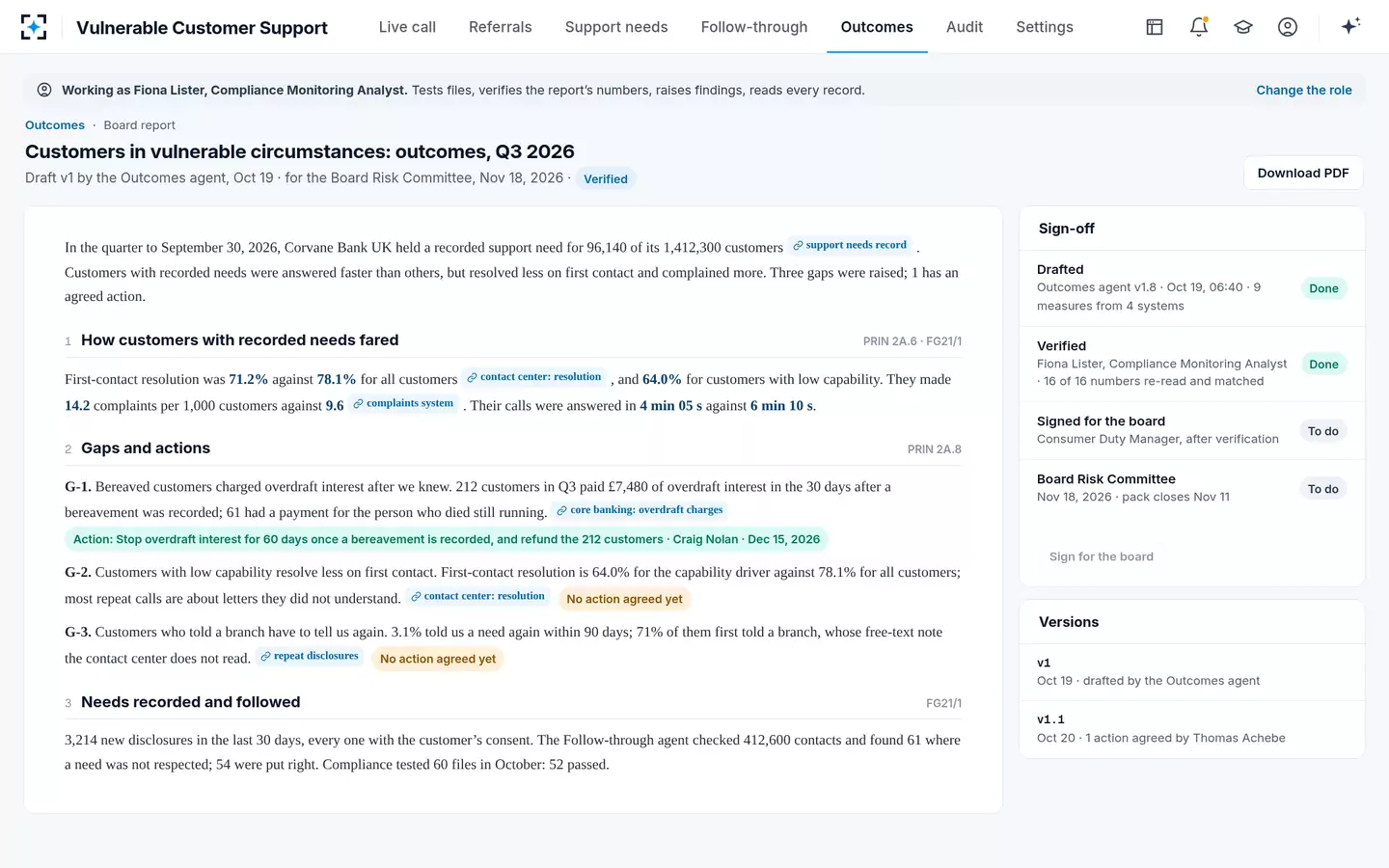
The sample shows why the split pays. Across all customers with recorded needs, first-contact resolution was 71.2% against 78.1% for everyone. For customers under the capability driver it was 64.0%, and most of their repeat calls were about letters they did not understand. That is a different fix, plain-English summaries on letters, from anything the bereavement figures suggest, and it would be invisible in the aggregate.
One quarter at the sample bank: customers with needs against everyone
71.2%
first-contact resolution for customers with a recorded need, against 78.1% for all customers
64.0%
first-contact resolution for customers under the capability driver
14.2
complaints per 1,000 customers with a recorded need, against 9.6 for all customers
4:05min
average time to answer customers with needs, against 6:10 for all customers: faster, but not better resolved
The last figure is the one a service-level report would have celebrated. Customers with needs were answered faster than everyone else, and still left with their issue unresolved more often. It is the FCA's point about SLAs in a single row.
Turning a gap into an action with an owner
A gap becomes an outcome only when someone fixes it. The FCA's 2025 report found that many firms pointed to improvements but showed "limited evidence of firms consistently reviewing the effectiveness of actions", and that interventions often fixed one customer's problem without asking whether others shared it. A useful record of a gap therefore carries the evidence, the cause, an estimated cost of the fix, an owner, a date and the measure that will show it worked.
The sample's first gap shows the shape. In the third quarter, 212 bereaved customers paid £7,480 of overdraft interest in the 30 days after the bank recorded their bereavement, 61 of them with a payment for the person who had died still going out. The agents suggested stopping overdraft interest for 60 days once a bereavement is recorded, and refunding all 212. The Consumer Duty manager, not the agents, decided: he agreed the action with the current accounts product owner as owner, due 15 December 2026, and named the measure that would show it worked. Any refund it causes is approved and checked by two people.
Note what the action targets. Not the 212 alone, though they are refunded, but the product rule that produced them, which is the difference the FCA drew between fixing an individual case and improving a product or service.
What the board needs to see on vulnerability
The board needs to see, at least once a year and preferably every quarter, where customers with needs fare worse than others, why, what is being done, by whom and by when, and whether last period's actions worked. PRIN 2A.8 requires the governing body to "review and approve the firm’s report on the outcomes being received by retail customers" at least annually and to agree any action needed. The FCA's 2026 review noted that some firms reported outcomes to their boards throughout the year rather than as a standalone annual exercise, with named owners for actions.
It also needs to trust the numbers. In the sample bank the Outcomes agent drafts the report with every figure cited to its source; a compliance monitoring analyst re-reads each one against source, 16 of 16 in the third-quarter report, before the Consumer Duty manager can sign it; and the person who signs cannot verify. Whether the FCA's 2025 findings would apply to a given bank is a question our guide to the FCA vulnerable customers review helps answer.
A board report from Vulnerable Customer Support, verified number by number before it is signed
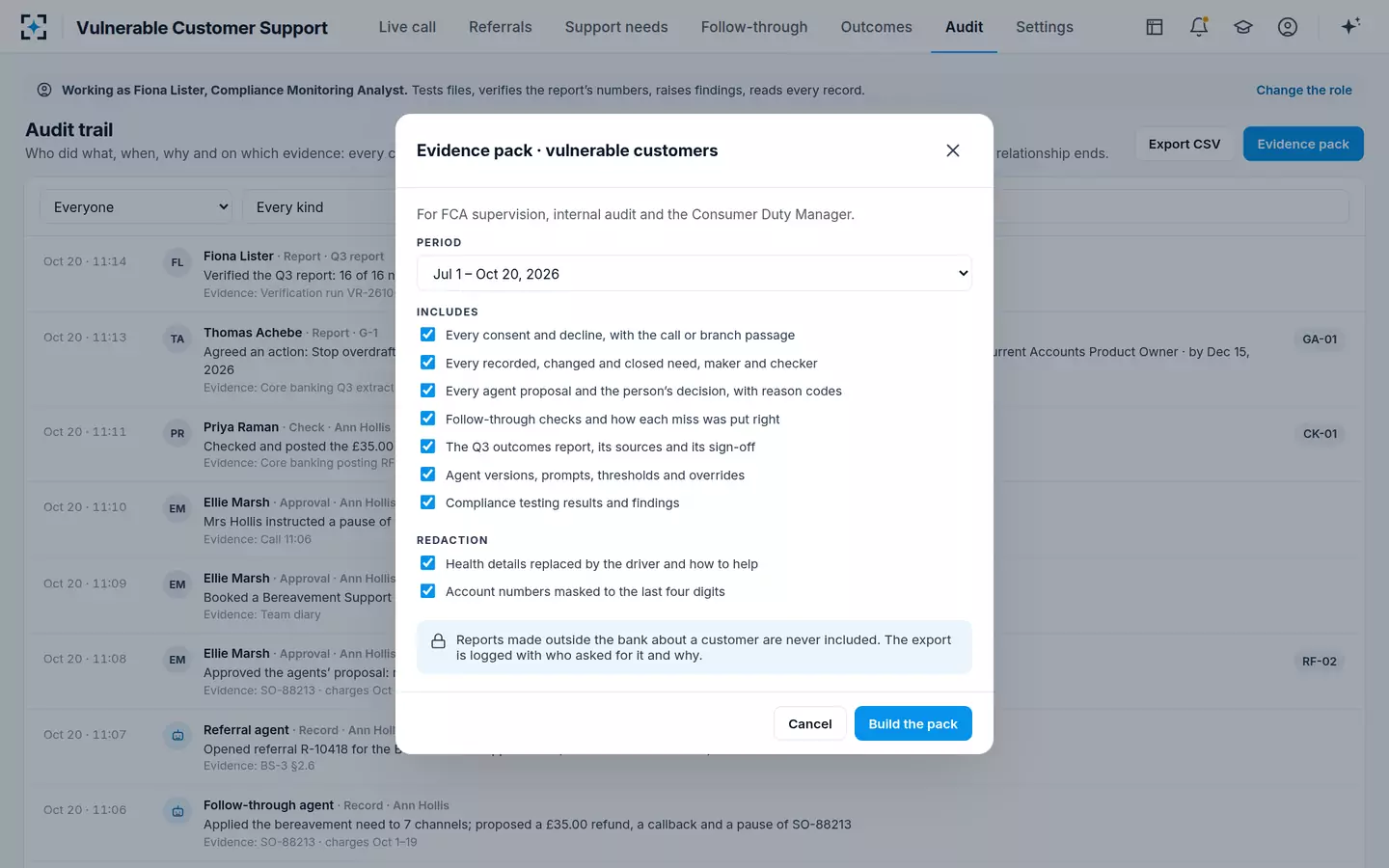
An evidence pack for the FCA or internal audit, built from the same trail
Which of these measures a CRM flag can support, and which need a tool that checks contacts, is weighed in our guide to choosing a vulnerable customer support tool. The full product is described on the Vulnerable Customer Support page.
Questions people ask
What is an outcome gap?
The difference between the outcome one group of customers receives and the outcome another group receives on the same product and measure. PRIN 2A.9.10R requires a firm's monitoring to identify such differences, and PRIN 2A.9.12R requires action where a group is receiving worse outcomes.
What did the FCA find about outcomes monitoring?
That most firms in its multi-firm work on outcomes monitoring, published in March 2025, could not show how they effectively monitor and act on outcomes for customers in vulnerable circumstances. It found unclear definitions of good and poor outcomes, data lacking breadth and detail, and a focus on service levels; its July 2026 review added aggregated MI that was not split by driver.
How often should vulnerable customer outcomes be reported?
The Consumer Duty requires the board to review and approve an outcomes report at least annually. The FCA's 2026 review noted that stronger firms reported outcomes to their board throughout the year; quarterly is a common rhythm, and the sample bank's report goes to its Board Risk Committee each quarter.
What are good KPIs for vulnerable customers?
Measures that compare customers with recorded needs against everyone, such as first-contact resolution and complaints, alongside direct measures of whether needs were honoured, such as letters sent in the format asked for, sales contacts to customers who asked for none, and repeat disclosures within 90 days. Measures of fees and charges paid by customers with needs catch harm that service metrics miss.
Should outcome reports name individual customers?
No. Reports to a board or committee work on groups; the sample bank's Outcomes agent never reports a group under 50 customers, and evidence packs replace health details with the driver and how to help. Individual cases belong in the referral and the audit trail, where access is restricted.