Customers in vulnerable circumstances are people whose personal situation, such as poor health, a bereavement, low financial resilience or difficulty with reading, numbers or digital services, makes them especially likely to be harmed when a firm does not take enough care. In the UK that describes almost half of all adults, 26.4 million people in 2024 by the FCA's measure, yet research for the FCA found only 4 in 10 of those with characteristics of vulnerability had told any of their financial services providers. That is the hard fact under every vulnerability policy: a bank that serves only the customers who speak up is serving a minority of the people its policy is for. Botminds' Vulnerable Customer Support is built for both groups: it helps colleagues ask when a sign appears, records the need once with the customer's agreement, and checks every letter, fee, sales call and collections contact against the needs the bank already holds.
The figures and rules here are British: the FCA's Financial Lives survey, research it commissioned, its guidance FG21/1 and the Consumer Duty. No US federal rule requires a bank to record a customer's vulnerability, but the disclosure problem is not peculiar to Britain, and the design ideas below travel. Product examples come from a fictional sample bank, Corvane Bank UK.
Six in ten consumers with characteristics of vulnerability have told no provider
Consumers with characteristics of vulnerability
- Told a provider · 40%
- Never told any provider · 60%
Who are customers in vulnerable circumstances?
They are customers who, in the FCA's words, "due to their personal circumstances, are especially susceptible to harm, particularly when a firm is not acting with appropriate levels of care." The FCA groups the circumstances under four drivers: health, life events, resilience and capability. The phrase the regulator now uses most, customers in vulnerable circumstances, puts the weight on the situation, which can change, rather than on the person.
Two points from the guidance shape everything else. Having a characteristic does not make someone vulnerable: FG21/1 says not all customers with characteristics of vulnerability will be vulnerable, but they may be more likely to have additional or different needs. And circumstances move. A bereavement is a life event for months, not years; low resilience comes and goes with income; a hearing impairment usually stays. A bank's picture of its customers is therefore always partly out of date, and mostly incomplete.
How many people are in vulnerable circumstances?
The FCA's Financial Lives survey found that "Almost half (49%, 26.4m) of UK adults showed one or more characteristics of vulnerability in 2024", down three percentage points since 2022. Low resilience was the most common driver, affecting 26% of adults, then a recent negative life event at 20%, low capability at 17% and poor health at 9%. Many people sit under more than one.
Vulnerability is common, often multiple, and concentrated where money is tight
26.4m
UK adults with one or more characteristics of vulnerability in 2024, 49% of all adults
9.8m
had characteristics under two or more drivers: 37% of those with any
76%
of unemployed adults showed characteristics of vulnerability
73%
of adults in low-income households did
Overlap matters more than the headline. The FCA's research and its 2025 review both found that customers with several characteristics fare worst: among adults with characteristics under all four drivers, at least 51% found dealing with customer services on the phone difficult because of their health, against 7% of those under one driver. A bank's most difficult cases are rarely the ones with a single, clear need.
Set those national figures beside a bank's own register and the gap is plain. The fictional sample bank holds a recorded need for about 96,000 of its 1,412,300 customers, 6.8%, after years of recording at branches and on calls. If its customers resemble the UK adult population, something like seven times that number show characteristics of vulnerability. The difference is not a failure of recording alone; most of those customers have simply never said anything, and many never will. A policy measured by the size of the register measures the wrong thing.
Why do customers not disclose vulnerability?
Customers stay silent because they do not see why the bank should know, feel stigma, fear a worse deal, or do not trust the bank to help. Those were the four reasons the FCA's commissioned research heard in interviews, and the survey behind it measured the discomfort: "About a quarter (25%) of those in vulnerable circumstances said they feel uncomfortable explaining their situation to a financial services provider." Of those, one in five did not know their provider could do anything to help.
Four reasons customers give for not telling, and what a bank can change
What customers told the FCA's researchers: A heart condition has "got nothing to do with" the bank.
What a bank can change: Say what the bank can do differently, on the channel where it matters: more time, a different format, a pause, a named team.
What customers told the FCA's researchers: Some conditions feel too hard to discuss with anyone, let alone a firm.
What a bank can change: Never use the word vulnerable; ask about needs; let customers tell the app or a letter instead of a voice.
What customers told the FCA's researchers: Disclosure might bring a worse deal or unwanted restrictions.
What a bank can change: Show that a need changes service, not eligibility, and test that it does: compare outcomes for customers with needs.
What customers told the FCA's researchers: Firms "only want your money".
What a bank can change: Act on what is told. Of those who did disclose, 58% said the provider made changes; the rest are the next round of silence.
The fourth reason is the one a bank controls most directly, because trust is built by what happens after the first disclosure. The FCA's 2025 report found that only 19% of consumers felt their provider encouraged them to disclose. Asking well is the subject of our guide on how to identify vulnerable customers.
Which customers are least likely to disclose?
People with mental health conditions or anxiety are among the least likely to disclose, according to the FCA's commissioned research: "those with mental health and/or anxiety conditions are some of the least likely people to reveal they may be having difficulty." Older customers were more likely to say they were comfortable disclosing than younger ones. The groups a bank most needs to hear from are not evenly vocal.
The channel matters as much as the person. The FCA found identification and encouraging disclosure challenging for most firms, and "In particular, we saw this in firms that have primarily digital customer journeys." In 2026 it found payments firms that had identified very few, or no, customers in vulnerable circumstances despite customer bases where such characteristics could reasonably be expected. A low count is rarely good news. It usually means the firm has not given customers a way to tell it.
What happens when they do tell
Most customers who disclose have a reasonable experience, which is the best argument for making disclosure easier. In the FCA's research, of those who disclosed, 74% agreed the provider asked the right questions, 58% said it made changes and 57% felt it cared. The other side of those figures is the problem: more than four in ten disclosers did not say anything changed.
After telling a provider: most were asked the right questions; fewer saw anything change
The research described what "no change" looks like. One respondent, who is blind, was repeatedly asked to do things she could not, such as read out a reference number; adjustments were eventually made each time, but never remembered. The FCA's summary of her case is that she was frustrated at having to repeat her needs every time she contacted the firm. A customer who tells a bank once and is ignored learns the fourth reason for silence.
Designing for the six in ten who never tell
A bank serves the silent majority by designing products, letters and journeys that work for people with common needs without requiring them to identify themselves, and by making telling easy for those who want to. The Consumer Duty frames both halves: firms should "set up systems and processes in a way that supports and enables retail customers with characteristics of vulnerability to disclose their needs", and must deliver good outcomes for all retail customers, disclosed or not.
The FCA has acknowledged the gap in its own guidance. Experts in its 2025 review asked for "Further guidance on how to treat customers who do not disclose vulnerability", both where the firm could detect it and where it does not see its customers. Pending that, the practical steps are well understood.
Serving customers who will not say: six design choices
- Offer more than one channel, and let customers switch without repeating themselves
In 2024, 61% of customers in vulnerable circumstances felt there were suitable ways to contact their provider, against 72% of others.
- Write every letter for someone who is struggling
Plain English, a clear next step, and a phone number answered by a person. One firm in the FCA’s report reviewed and amended 140 pieces of customer information.
- Put the offer of help where the trouble is
On arrears letters, fee notices and bereavement forms, not on a separate vulnerability page.
- Let customers tell you without a conversation
FG21/1 describes an app with a box to share circumstances in the customer’s own time.
- Make staff free to take longer
The FCA saw firms remove or adjust call-time targets for staff dealing with customers in vulnerable circumstances.
- Check outcomes for everyone, not only the flagged
A product rule that hurts people in vulnerable circumstances will show up in fees, complaints and arrears before anyone discloses.
Automation needs the same care. The FCA's October 2026 publication on AI listed among good practice letting consumers choose between AI-enabled and other support and "switch channels without having to repeat information", and flagged as poor practice journeys that make it harder to reach a person.
What a bank can learn from what it already holds
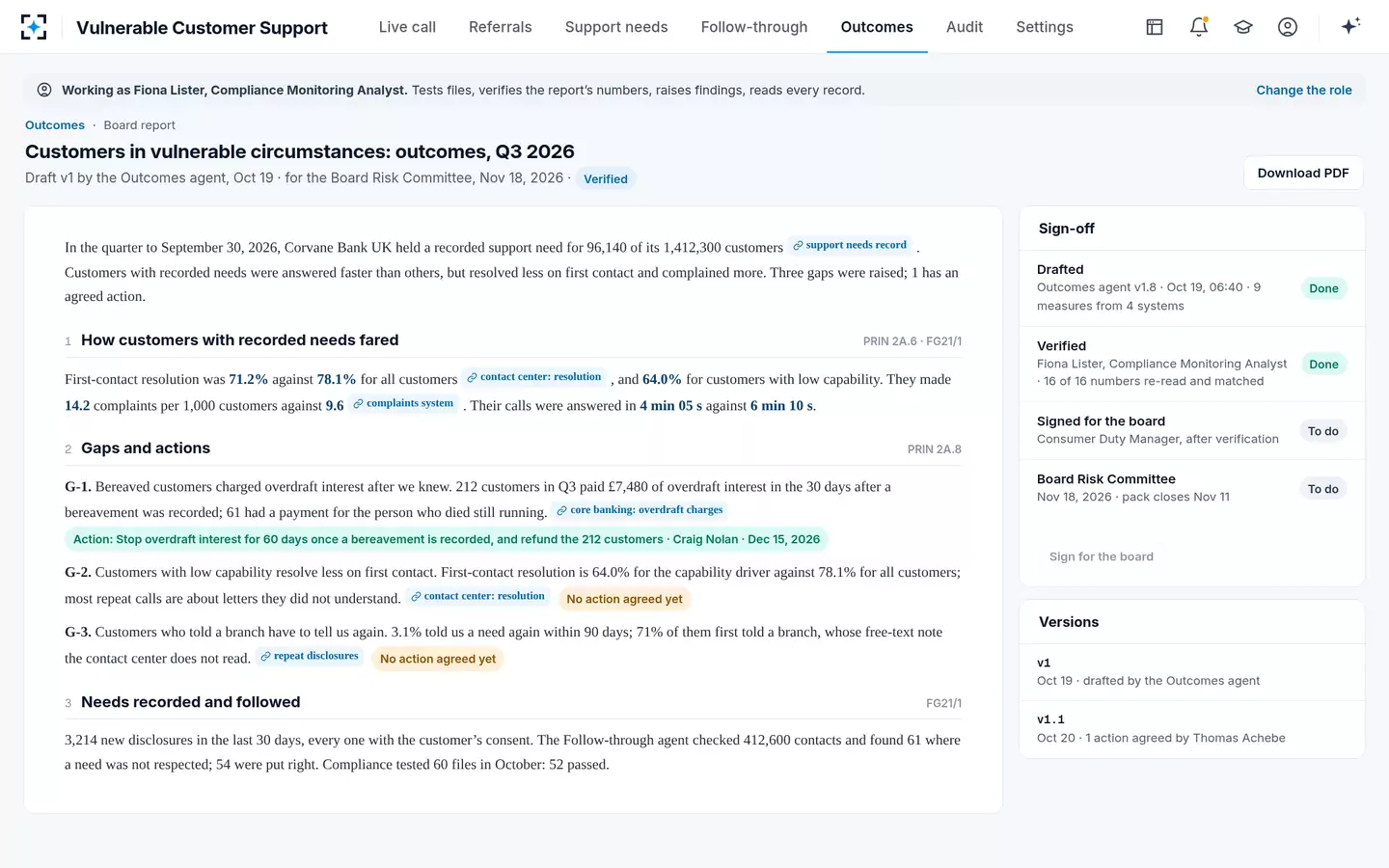
A bank already holds much of what customers have told it, scattered across systems, and some of what their accounts imply. The first is the easier win. In the sample bank, 3.1% of customers with a recorded need had to tell the bank a need again within 90 days, and 71% of those had first told a branch, where the note was free text the contact centre did not read. Every one of those customers had disclosed; the bank behaved as if they had not.
A board report in Vulnerable Customer Support that counts the customers who had to say it twice
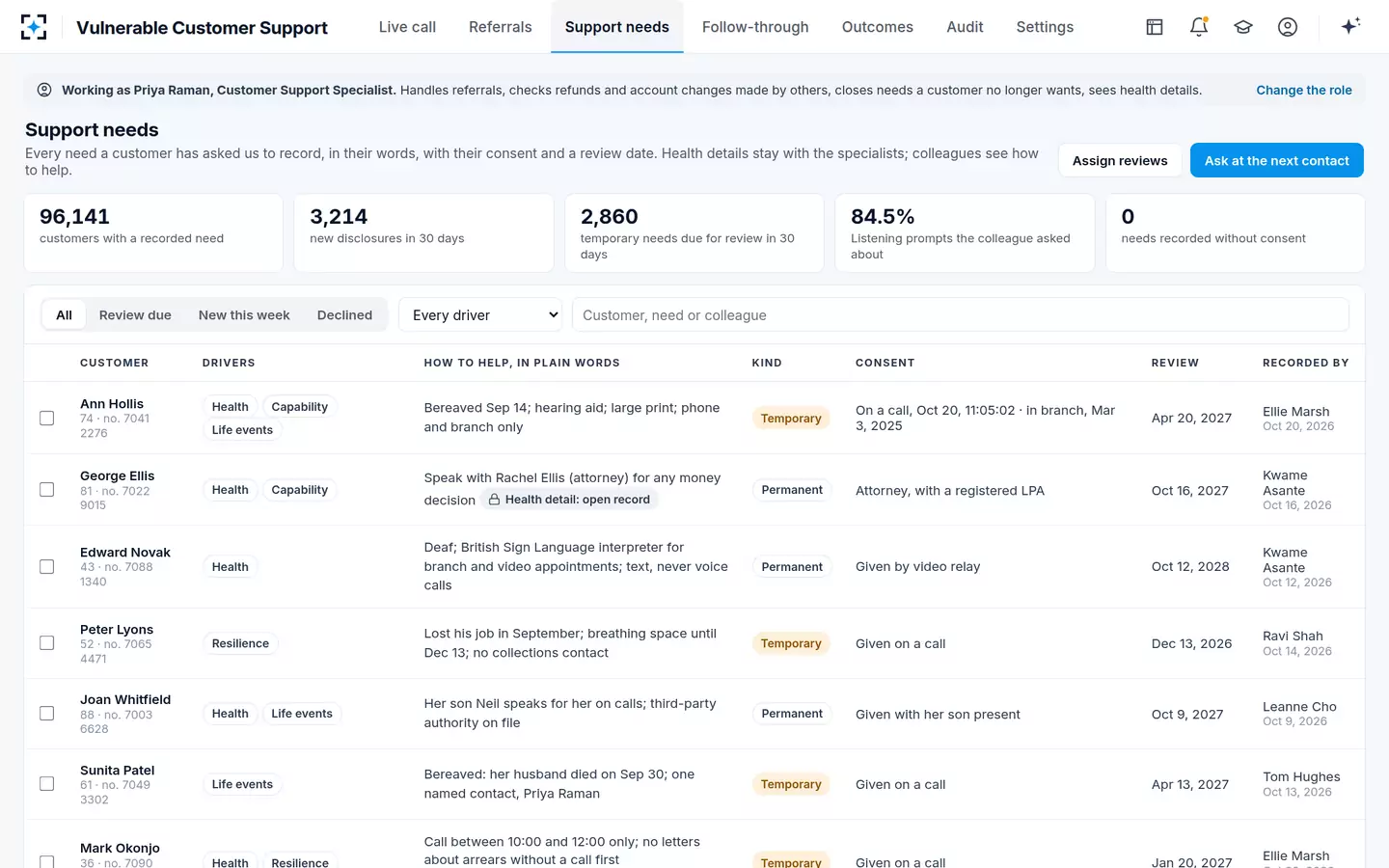
The second source needs a lighter touch. FG21/1 lists payment changes, such as payments stopping suddenly or regular unarranged overdrafts, among signs to watch for, and the FCA has seen firms use transaction patterns to find customers who may need help. A pattern is a reason to make an offer of help at the next contact, not to label a customer, and inferred health information is likely to be special category data. In the sample, Mrs Hollis did not know her late husband's care-home standing order was still being paid until it overdrew her account; the bank's records could have told it before she called.
Needs customers have already shared, in one register the whole bank reads
How should banks treat customers who have not disclosed?
Exactly as the Consumer Duty requires for every retail customer: with products, communications and support that deliver good outcomes, and with staff who notice clear signs and ask. FG21/1 is careful about the limit: staff should encourage disclosure where they see clear indicators, but are not expected to go further to proactively identify vulnerability. A bank cannot require disclosure, and should never make service conditional on it.
In practice that means three things. Make the default service good enough for a tired, worried or unwell customer. Make the offer of help visible at the moments of strain. And when a sign does appear, ask once, politely, and act on the answer. Where the customer tells a colleague, that colleague's note has to travel; how the different desks make it travel is the subject of our guide to dealing with vulnerable customers, and the product is described on the Vulnerable Customer Support page.
Questions people ask
What percentage of customers tell their bank about vulnerability?
About four in ten. Research commissioned by the FCA found only 4 in 10 consumers with characteristics of vulnerability had disclosed their circumstances to any of their financial services providers, and 19% felt their provider had encouraged them to do so.
What does the Financial Lives survey say about vulnerability?
The FCA's 2024 survey found 49% of UK adults, 26.4 million people, showed at least one characteristic of vulnerability, down three points since 2022. Low resilience was the most common driver at 26%, and 37% of those with any characteristic had characteristics under two or more drivers.
How can banks encourage disclosure?
By explaining what the bank can do differently, asking about needs rather than vulnerability, offering ways to tell without a phone call, and visibly acting on what is told. In the FCA's research, 19% of those uncomfortable disclosing did not know their provider could help, which is the cheapest barrier to remove.
What is a characteristic of vulnerability?
A circumstance under one of the FCA's four drivers that can raise the risk of harm: for example a hearing impairment or long-term illness (health), a bereavement or relationship breakdown (life events), over-indebtedness or low savings (resilience), or poor literacy or digital skills (capability). Having one does not make a customer vulnerable, but it may mean different needs.
Does the Consumer Duty protect customers who have not disclosed?
Yes. The Duty requires firms to deliver good outcomes for all retail customers and to monitor whether any group fares worse than others, whether or not individuals in it have told the firm anything. Disclosure helps a firm tailor support; it is not a condition of protection.