AI and vulnerable customers meet in three places at a bank: tools that listen to calls or read chats for possible signs of vulnerability, tools that draft or check what happens next, and automated journeys that customers in vulnerable circumstances must get through. The UK regulator's position, set out across its 2025 reviews and an October 2026 publication on AI, is that firms may use AI here, have seen it work, and remain responsible for every outcome it produces; it found firms placing too much confidence in language models to spot vulnerability, and human review that had become a formality. The safe line is that AI prompts, drafts, checks and compares, while people decide what is recorded, what is said to the customer and what happens to their money. Botminds' Vulnerable Customer Support is built on that line: its Listening agent hears a possible sign and prompts a colleague once; it never records a need and never speaks to the customer, and compliance measures its accuracy every month.
The rules here are the FCA's and UK data protection law. No US federal rule requires a bank to identify or record a customer's vulnerability; US readers can treat what follows as a reference design rather than a requirement. Examples come from a fictional sample bank, Corvane Bank UK.
What AI may do with customers in vulnerable circumstances, and what it may not
| Task | AI may | AI may not | Why the line sits there |
|---|---|---|---|
| Noticing a sign | Flag a possible sign in a call or chat, quote the words and show its confidence | Decide that a customer is vulnerable, or label them | The FCA saw real-time and after-call speech analytics as good practice, and warned against assuming a model can reliably identify vulnerability |
| Asking | Suggest words for the colleague to use | Ask the customer itself on a voice call, or repeat a question the customer declined | FG21/1: stop asking a customer who is clearly unwilling; the customer decides what is noted |
| Recording | Draft the need in the customer’s words for a colleague to edit | Save a need, or add a diagnosis the customer did not give | Recording special category data needs a lawful basis the bank can evidence |
| Acting on a need | Apply the bank’s channel rules; check letters, fees, sales and collections against needs | Move money, change an account or close a need | The firm remains responsible for outcomes; money and account changes need a second person |
| Routing | Route to a specialist team with a service-level clock | Remove a customer from a channel by default because of a vulnerability indicator | The FCA’s 2026 publication flagged automatic exclusion from AI journeys as an area to improve |
| Reporting | Compare outcomes by group and draft the report, every number cited | Sign the report, or report a group too small to be anonymous | The board approves; a person verifies each number first |
Can AI identify vulnerable customers?
AI can identify possible signs of vulnerability; it cannot reliably identify vulnerable customers on its own. The difference matters. A sign is a phrase, a pattern or a behaviour that suggests a need, such as "he died last month" or payments to a care home continuing after a death. A vulnerable customer is a person whose circumstances make harm more likely, which only a conversation can establish and only the customer can choose to share.
The FCA has documented the useful version in four publications. In its 2025 work it described a firm whose "prompts based on real-time speech analytics" appeared for frontline staff when a customer said something that could indicate vulnerability, and another that reviewed call recordings afterwards and contacted customers where support had been missed. In 2026 it described payments firms that analysed chat language and routed customers to people, and a firm whose chatbot used keyword recognition to escalate possible vulnerability to the right team.
The limits are as well documented. In October 2026 the FCA named, as an area for improvement, "Assuming an LLM can reliably identify vulnerability without sufficient testing or safeguards", observing that some firms "placed too much confidence in an LLM's ability to identify text-only indicators of vulnerability, particularly temporary ones." And the transcript a listening tool works from is itself uneven: a peer-reviewed study of five commercial speech recognisers found an average word error rate of 0.35 for Black speakers against 0.19 for white speakers (Koenecke et al., PNAS, 2020). Today's systems differ, which is exactly why a bank has to measure its own.
What the FCA has said about AI and vulnerable customers
The FCA has said that its existing rules apply to AI, that firms remain responsible for the outcomes AI produces, and that AI used carefully can help identify customers who need support. It has not written a vulnerability rule specific to AI and has said it is not introducing new requirements on vulnerability.
From guidance with no AI in it to a publication on AI and vulnerability, 2021 to 2026
| Date | FCA publication | What it says that bears on AI |
|---|---|---|
| 23 Feb 2021 | FG21/1, guidance on the fair treatment of vulnerable customers | Nothing on AI; sets the recording, data protection and monitoring expectations any tool must meet |
| 31 Jul 2023 | Consumer Duty rules in force (open products) | Firms must monitor outcomes by group and help staff actively identify vulnerability |
| 7 Mar and 12 Apr 2025 | Vulnerability review and retail banks review | Real-time and after-call speech analytics described as good practice; guidance kept unchanged |
| 27 Jul 2026 | Outcomes monitoring: good practice | A chatbot using keyword recognition to escalate possible vulnerability to the right team |
| 17 Sep 2026 | Payments firms and vulnerable consumers | Pilots analysing chat language and routing customers to people |
| 19 Oct 2026 | AI: good practice and areas for improvement | Firms remain responsible; do not over-trust LLMs to spot vulnerability; do not rely on human review alone |
The October 2026 publication is the one to read in full. It lists the Consumer Duty and FG21/1 among the rules that already govern AI, and states the principle that frames everything else:
Where firms are deploying AI-supported tools, they remain responsible for consumer outcomes.
FCA, AI: good practice and areas for improvement, October 2026
The same publication describes good practice that maps closely onto a listening tool: a firm that "worked with frontline staff to decide which vulnerability indicators the tool should look for", kept a live list of terms the tool flags to staff, and monitored whether the support improved outcomes. And it records the adoption context: the FCA reports that 75% of firms have already adopted some form of AI.
What AI may do, and what it may not
AI may do the work of noticing, drafting, applying, checking and comparing; it may not take decisions that belong to the customer or that move money. The table at the top of this page sets out the line task by task. Three of its rows deserve more than a cell.
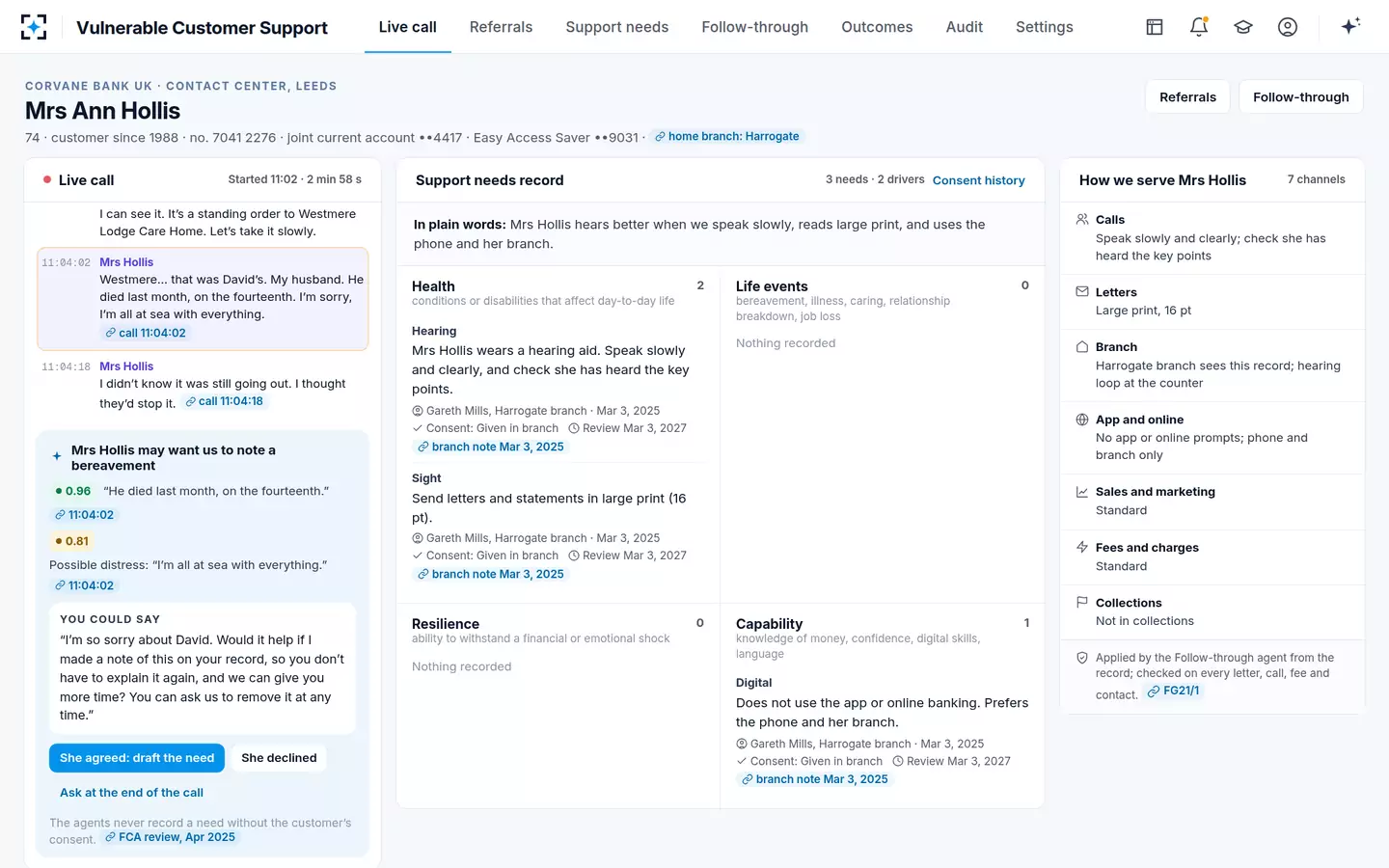
Recording is the first. A model that writes a need to the customer's file has made a data protection decision and a service decision at once, on the customer's behalf. In the sample bank the Needs Record agent drafts the need in the customer's words, and nothing is saved until the colleague saves it, with the customer's agreement on the bank's chosen basis. The FCA's guidance suggests firms do not use the label with customers at all; a model that labels silently is further from that than any person.
Exclusion is the second. The FCA's October 2026 publication flagged firms that, to reduce risk, "automatically excluded consumers with vulnerability indicators from AI journeys", which could unfairly shut those customers out unless another route to support exists. Routing a customer to a person is good; removing their choices is not.
Money is the third. In the sample, the Follow-through agent proposes a £35.00 refund of overdraft charges caused by a late husband's standing order, with the passage from the core banking record that justifies it. The colleague approves within a £50 mandate; a specialist checks before it posts; the person who approved cannot check. The agent never acts.
Vulnerable Customer Support on a live call: the agent prompts, the colleague chooses
Does AI need consent to record vulnerability?
AI does not change the legal question; it makes it arrive sooner. Transcribing a call in which a customer mentions a health condition is processing personal data, and the words can be special category data the moment they are captured. A bank needs a lawful basis under Article 6 of the UK GDPR and, for health information, an Article 9 condition, whether a person or a model is listening. FG21/1's appendix is clear that consent is one route, not the only one, and that a data protection impact assessment may be needed.
Two practical consequences follow. First, keep what the model hears apart from what the bank records: in the sample, call transcripts are kept for 12 months with card and account numbers redacted at capture, while a need enters the customer's record only when a colleague saves it on the bank's basis. Second, decide in advance what the model may infer. A transaction pattern that suggests a health condition is likely to be special category data even if the condition is never named, as FG21/1's appendix notes. Whether a customer must agree before a need is noted, and the alternatives when they cannot, is set out in our guide to recording vulnerability. None of this is legal advice; the bank's data protection officer decides.
Why a human in the loop is not enough on its own
A person reviewing AI output is a control only if the review is designed to catch errors, and the FCA found that it often was not. Its October 2026 publication listed "Excessive reliance on human-in-the-loop controls" as an area for improvement, warning that "Human review may mask weaknesses in the model", and described a firm where reviewers "increasingly accepted AI-generated recommendations without sufficient scrutiny" until the role became a tick-box.
Human review as a tick, and human review as a control
Review as a tick: The model’s answer, pre-filled, with an Approve button.
Review as a control: The quoted passage, the confidence and the source, with the decision left open.
Review as a tick: Not at all; approval rates look like accuracy.
Review as a control: Some cases reviewed blind, without the model’s proposal, and compared. The FCA described a firm doing this for affordability decisions.
Review as a tick: Proceeds like any other output.
Review as a control: Below a set threshold the model abstains; nothing is shown.
Review as a tick: Not recorded, or recorded without a reason.
Review as a control: Recorded with a reason code and fed into the next version.
Review as a tick: Go live when the vendor ships them.
Review as a control: Run beside the old version on last month’s calls before an accountable manager approves.
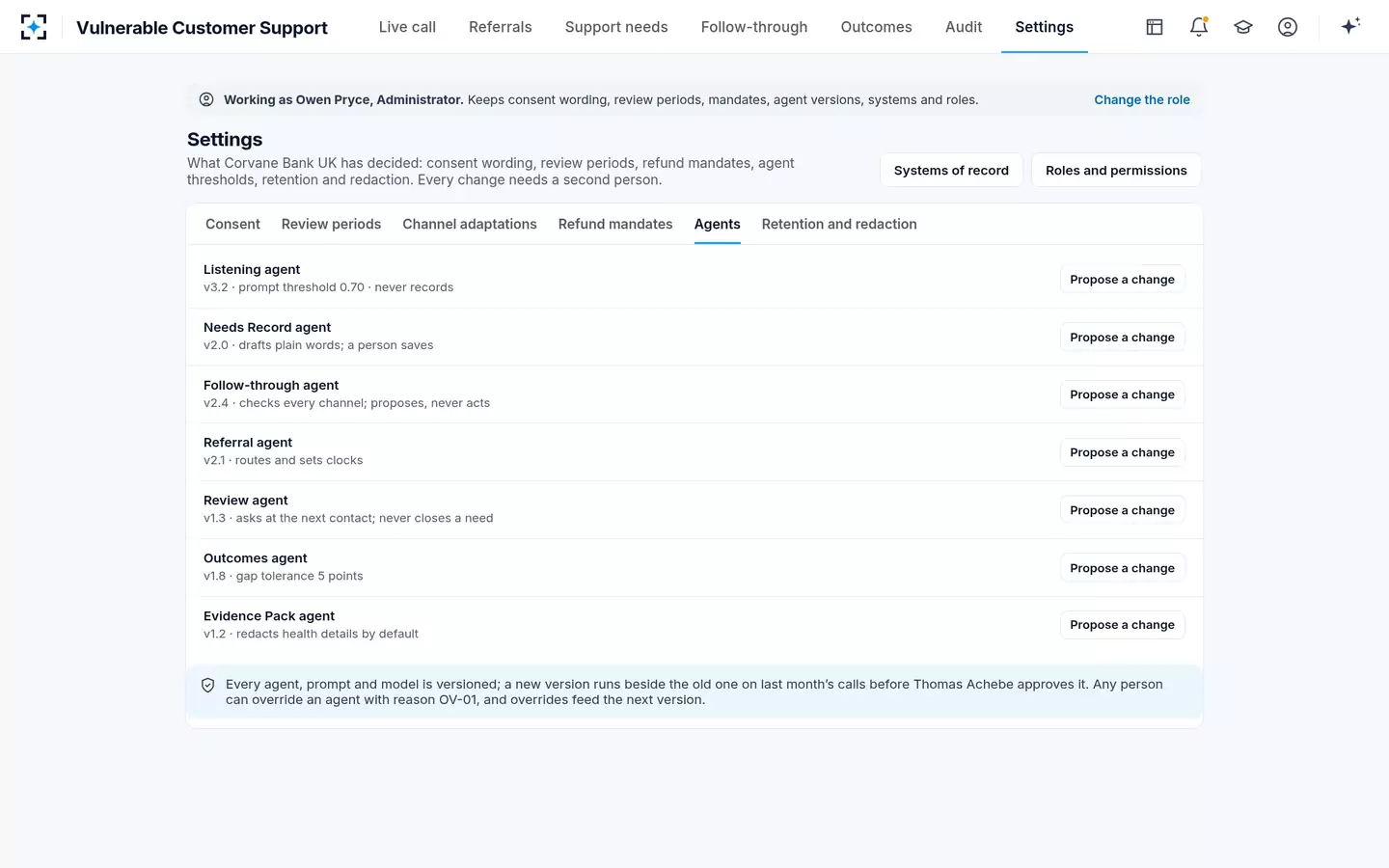
The FCA's own framing is that firms should choose "where AI should support, automate or abstain" and build technical checks and monitoring into the system, "rather than only relying on a person to review, approve, challenge or override its outputs or decisions." In the sample, that means a threshold below which the Listening agent says nothing, a limit of one prompt per sign per contact, and monthly accuracy measurement by compliance alongside the colleague's judgement.
Testing a listening model before it goes live
Test it on the bank's own recorded calls, against labels people have agreed, by driver and by speaker group, and keep testing after launch. A vendor's headline accuracy on someone else's calls says little about hearing-aid users ringing a Leeds contact centre.
A test plan for a model that listens for signs of vulnerability
- Label a sample of your own calls first
Two people agree, for each call, which signs were present and which needs a colleague should have asked about.
- Measure misses and false prompts separately
A missed bereavement and a prompt on a customer with no need do different harm; report both, by driver.
- Test temporary signs on their own
The FCA singled out temporary characteristics as the ones firms over-trusted models to find.
- Test by speaker group
Accents, older voices, speech affected by health conditions and calls where a carer speaks. Transcript errors are not spread evenly.
- Run new versions beside the old
On last month’s calls, before an accountable manager approves; record what changed.
- Measure what colleagues do with prompts
A prompt nobody acts on is noise. In the sample, colleagues asked about 84.5% of prompts.
- Keep auditable records
The FCA cites firms keeping prompts, outputs, model versions, filters and escalation decisions.
- Review live outcomes often
The FCA warned against long gaps between reviews and vague escalation triggers.
What the FCA reports about firms and AI, and what the sample bank measures
75%
of firms have already adopted some form of AI, the FCA reports
84%
of firms have an individual accountable for their AI approach
84.5%
of the Listening agent’s prompts that colleagues asked the customer about, on the sample data
Can AI treat vulnerable customers unfairly?
Yes, in at least three ways the FCA has described: by misreading some customers more than others, by excluding customers with indicators from journeys and benefits, and by using what it spots against the customer's interest. The first is a testing problem, the second a design problem, and the third a governance one.
The FCA's October 2026 publication gives an example of the third handled well: a firm's AI found spending patterns suggesting vulnerability, and the firm asked its ethics committee to decide whether to keep providing credit in those circumstances before refining its models. The Consumer Duty's guidance adds a legal edge: PRIN 2A.7.5G says that where health is a driver of vulnerability "it will likely have substantial overlap with the protected characteristic of ‘disability’ under the Equality Act 2010". A model that treats customers with health-related signs worse is a Consumer Duty problem and may be an equality problem too.
The defence is the same comparison the Duty asks for everywhere: outcomes for customers the model flagged, against everyone, by driver. In the sample the Outcomes agent never reports a group under 50 customers, and any gap over five percentage points is raised with the evidence.
What to ask a vendor
Ask what the tool may not do, how you will know when it is wrong, and who can change it. A vendor that answers the first with a feature list has not understood the question.
Specifically: does the tool ever write to the customer's record or speak to the customer without a person; what is its confidence threshold and who owns it; how is it tested on your calls, by driver and speaker group; how are new versions approved; are overrides recorded with reasons; what is kept, for how long, with what redaction; and can you export the trail for the FCA or internal audit. The October 2026 publication adds two governance points worth putting in a contract: a named owner for each AI use case, and, for agentic systems, "Clear ownership of AI agents", with agents registered in an inventory so the firm knows which are live and what they can reach. The wider buying question, what a support tool covers that a CRM flag does not, is in our guide to choosing a vulnerable customer support tool.
Every agent in Vulnerable Customer Support listed with its version, threshold and limit
How the prompt fits into the colleague's call is shown step by step in our guide on how to identify vulnerable customers. The product itself is on the Vulnerable Customer Support page.
Questions people ask
Is it legal to use speech analytics for vulnerability in the UK?
Yes, within data protection law and the Consumer Duty. The FCA described real-time and after-call speech analytics that highlighted possible vulnerability as good practice in its April 2025 bank review. The bank needs a lawful basis for processing call content, an Article 9 condition for health information, and may need a data protection impact assessment.
Does the Consumer Duty apply to AI?
Yes. The FCA's October 2026 publication lists the Consumer Duty and FG21/1 among the existing rules that govern firms' use of AI, and says firms deploying AI-supported tools remain responsible for consumer outcomes, including those delivered through support and communications.
What should a human decide about vulnerability?
Whether to ask, what the customer agrees to have noted, what is recorded and on what basis, any refund or account change, whether a need is closed, and what action follows an outcome gap. In the sample bank the agents may not record a need, speak to the customer, move money, change an account, close a need or sign a report.
What are the risks of AI for vulnerable customers?
Missing signs, especially temporary ones; prompting wrongly for some speaker groups because transcripts are less accurate for them; labelling customers silently; excluding them from journeys by default; and review that becomes a tick. The FCA's October 2026 publication names most of these as areas for improvement.
Can AI speak to a customer about their vulnerability?
Some firms use chatbots that ask about support needs, and the FCA has described one that adapted its questions with frontline staff and passed flagged customers to people. On voice calls in the sample bank, the agent never speaks to the customer; it gives the colleague words to use.