Dealing with vulnerable customers at a bank means noticing when someone's circumstances make them more likely to be harmed, asking what would help, recording it with a lawful basis, and then serving that customer accordingly everywhere the bank touches them: on calls, in letters, at the branch, in sales, fees and collections. The hard part is not the conversation. It is that the colleague who hears the need is rarely the person who sends the next letter, sets the next fee or makes the next collections call, and the UK regulator found exactly those hand-offs failing in 2025. Botminds' Vulnerable Customer Support is software built around that problem: agents listen for possible signs on a call, draft the need in the customer's words for a colleague to save, carry it to every channel and check each contact against it, while people decide what is recorded and every refund is checked by a second person.
The rules on this page are the Financial Conduct Authority's: its guidance for firms on the fair treatment of vulnerable customers, FG21/1, and the Consumer Duty in its Handbook, PRIN 2A. No US federal rule requires a bank to record a customer's vulnerability, so a US reader can take the FCA framework as a working model rather than an obligation. The worked examples come from a fictional sample bank, Corvane Bank UK, as it runs through the solution.
Firms say staff are trained; the outcomes say the hand-offs are not working
88%
of 725 firms surveyed by the FCA reported full or strong action to train frontline staff on vulnerability
39%
had a formal governance body that oversees outcomes for customers in vulnerable circumstances
4 in 10
consumers with characteristics of vulnerability had told any of their financial services providers
What does dealing with vulnerable customers mean at a bank?
It means treating a customer according to the circumstances that make them more susceptible to harm, not according to a label. FG21/1 defines vulnerable customers as people whose personal circumstances leave them especially open to harm, above all when a firm is not taking enough care (FCA FG21/1; the definition is read word by word in customers in vulnerable circumstances), and it sorts those circumstances into four drivers: health, life events, resilience and capability. A hearing aid is a health characteristic, a bereavement a life event, an overdraft that will not clear a resilience one, no use of the app a capability one. By the end of one call, Mrs Hollis in the sample has needs recorded under three of the four.
The scale is not marginal. The FCA's Financial Lives survey counted 49% of UK adults, about 26.4 million people, with at least one characteristic of vulnerability in 2024. For a retail bank that means a large share of any day's callers, most of whom will never use the word. FG21/1 is explicit that firms should not use it either: it suggests firms "do not use this label in their interactions with consumers" and focus instead on what harm the customer may be exposed to and how to respond.
That reframing is what makes the work operational. The question at each desk is not "is this customer vulnerable?" but "what does this customer need from this desk, and does this desk know it?"
What the FCA expects from frontline staff
The FCA expects frontline staff to listen for signs, ask where a sign is clear, respond to what they hear, and know how to record and later use what the customer said. Since 31 July 2023 that expectation sits in the Consumer Duty itself: PRIN 2A.7.4G asks a firm to help frontline staff spot information that may point to vulnerability, to ask for what they need in order to respond where that is relevant (PRIN 2A.7.4G), and to set up systems that let customers disclose. The wording, and how a prompt on a call follows it, is in how to identify vulnerable customers.
FG21/1 sets the limits as carefully as the duty. Staff should encourage disclosure where they see clear indicators, but the guidance does not ask them to go looking for vulnerability beyond that, and if a customer is clearly unwilling to share more, it may not be reasonable to keep asking. The colleague's job is to make telling easy and asking polite, not to diagnose.
Four desks share one disclosure, and each holds a different part of it
Today
Hears a bereavement or a hearing problem between security questions and a payment query; what they type is free text the next team may never read.
With agents
Gets one prompt with words to ask, saves the need in the customer’s words when the customer agrees, and approves small refunds within a mandate.
Still theirs: asking, listening, and what goes on the record
Today
Picks up bereavement, attorney and financial-difficulty cases from a queue, often re-asking what the customer already said.
With agents
Opens a referral with the need, the evidence and a service-level clock, and checks every refund or account change a colleague approves.
Still theirs: the decision on money, accounts and closing a need
Today
Run on their own systems and lists; a need recorded on a call reaches them late or never.
With agents
Every letter, sales contact, fee and collections contact is checked against recorded needs, before it goes where it can.
Still theirs: fixing the template, the dialer list or the process
Today
Test a sample of files by re-listening to calls, and report service levels to the board, which do not show whether customers with needs fared worse.
With agents
Test files with the quoted passage, consent and decision on each; see outcome gaps against all customers, by driver, with evidence and an estimated cost of the fix.
Still theirs: the test finding, the agreed action with an owner and a date, and the signature
How should staff deal with vulnerable customers on the phone?
On the phone, staff should listen for the phrases and behaviours that suggest a need, acknowledge what the customer has said before moving on, ask whether they would like it noted and explain how it will be used, check what the bank already knows, and adapt the rest of the call. FG21/1 gives a practitioner's list of what to listen for, drawn from the FCA's earlier practitioner pack, and most of it is plain speech rather than anything clinical.
What to listen for on a call, and what to do next, from FG21/1
- Listen for the customer’s own words
FG21/1 lists phrases such as "I can’t pay", "I can’t read my bill", "I can’t hold on all day" and "I hate these press buttons".
- Watch for behaviour, not only words
Asking for repetition, signs of confusion, shortness of breath or agitation, and any mention of medication.
- Acknowledge before you process
The FCA’s 2025 bank review found staff who did not acknowledge customers who were noticeably distressed.
- Check what is already on file
A need recorded at a branch should change how this call is handled; the review found staff failing to check recorded needs.
- Ask, explain, then note
Thank the customer, explain how the information will be used, and ask whether they want it noted. If they decline, stop asking on this contact.
- Adapt the rest of the call
Slower pace, a summary at the end, a callback at a better time, or a hand-off to a specialist team with the context passed on.
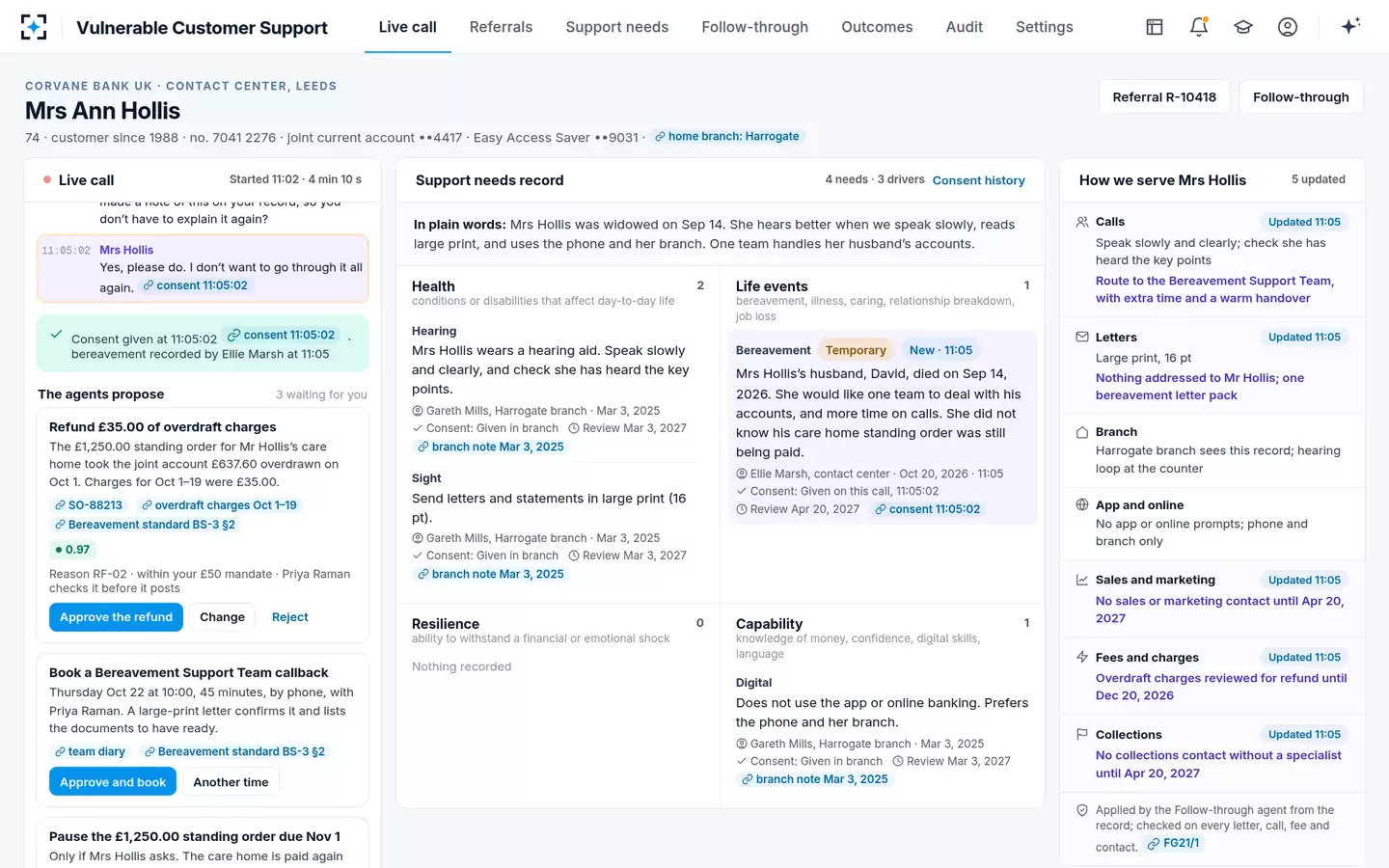
The sample call shows the sequence at work. Mrs Hollis, 74, rings the Leeds contact centre about a £1,250 standing order to a care home that left her overdrawn, and says the payment was her husband's and that he died last month. Her file already holds what she told the Harrogate branch in March 2025: a hearing aid, letters in 16 pt large print, and no app. The colleague is prompted once, with words to use: "I’m so sorry about David. Would it help if I made a note of this on your record, so you don’t have to explain it again, and we can give you more time?" Mrs Hollis agrees, and the bereavement is saved in her words, with a review in six months. How the prompt is decided is the subject of our guide on how to identify vulnerable customers.
One FCA observation is worth putting in front of every contact-centre manager. Among the good practice it saw was "Removing or adjusting performance targets related to call times and volume of cases for frontline staff dealing with customers in vulnerable circumstances." A colleague measured on average handling time has a reason not to hear the bereavement.
The specialist desk: bereavement, attorneys and financial difficulty
The specialist desk handles what a frontline colleague should not settle alone: bereavement and the accounts of someone who has died, powers of attorney and carers, financial difficulty and breathing space, and cases that need more care than a single call allows. The FCA found "Most firms had dedicated bereavement teams", and also staff who were unclear what to do in an emergency, such as when a customer's capacity suddenly changed or funds were urgently needed.
The duty here is specific. PRIN 2A.6.5R says that where a person is authorised by the customer or by law to help with their affairs, such as an attorney, the firm owes that person the support it would have given the customer (PRIN 2A.6.5R). The FCA's review found attorneys often could not use online or app banking at all. How a bank verifies attorneys and deputies and gives them that support is set out in our guide to dementia friendly banking.
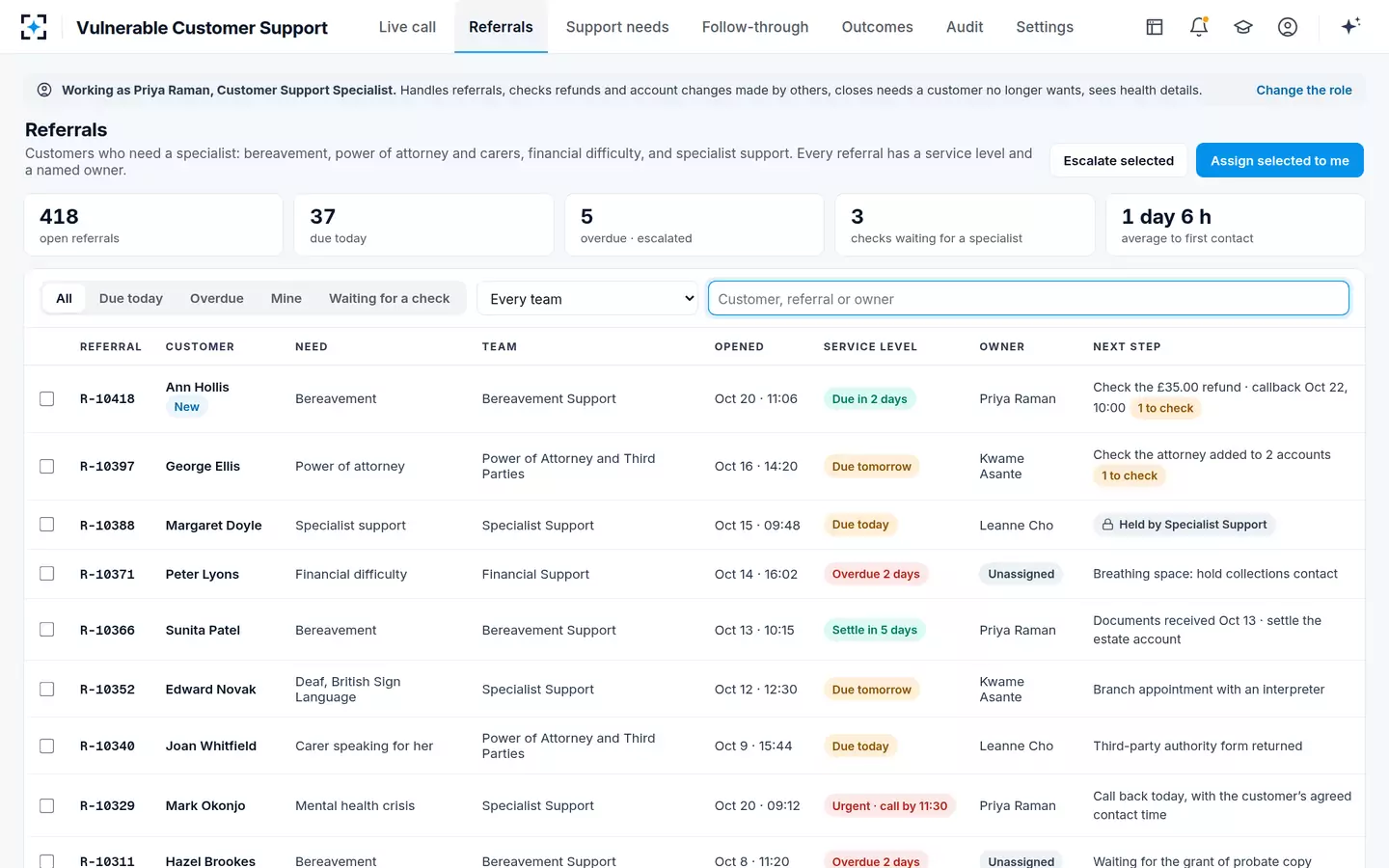
What makes a specialist desk work is the hand-off. The FCA described customers who "had to repeat information when speaking to different staff members", and cases delayed or dropped because they had been lost in the firm's systems. A referral should arrive with the need, the customer's words, the documents still outstanding, an owner and a clock.
A specialist queue in Vulnerable Customer Support: each referral with a team, a clock and an owner
Letters, sales, fees and collections: the desks that never hear the call
The desks most likely to harm a customer with a recorded need are the ones that never speak to them. A correspondence system prints from a template, a sales dialer works from a list, a fee engine applies its rules overnight, and a collections strategy runs on days past due. FG21/1 gives the collections case directly: a customer tells one part of the business about financial difficulty caused by illness, but the firm's systems never pass it to collections, so the collection process does not change and the customer's position gets worse. How one register can feed every desk is in a vulnerable customer register every system reads.
The FCA's 2025 good-practice report has a sharper example. A bereaved man paid off his late wife's debt; the creditor failed to close the account and sold it on; when he complained, both the final response and the £30 compensation cheque "were addressed to his wife". Nobody in that chain was unkind. The system simply did not know.
In the sample bank, the solution checked 412,600 letters, calls, fees, sales and collections contacts against recorded needs over 30 days and found 61 that did not respect one; 54 were put right. One was Mrs Hollis's own savings statement, printed at 11 pt in September although she had asked for large print eighteen months earlier, because the statement template had no large-print setting. The fix was to reprint it and correct the template, so the next customer is not caught by the same gap.
One saved need changes five channels at once
Who is responsible for vulnerable customers in a bank?
Under the Consumer Duty the firm is responsible, and its board answers for it: at least once a year the governing body must review and approve a report on the outcomes retail customers are getting, and agree any action needed (PRIN 2A.8; the measures that report needs are in FCA vulnerable customer outcomes). Below the board, responsibility is usually split between a senior manager who owns the vulnerability policy, a Consumer Duty manager or champion who reports outcomes, the heads of each channel who must apply recorded needs, and compliance, which tests whether it all happens.
The FCA's survey shows how unevenly that structure exists. Most firms had organisation-wide vulnerability policies, but only 39% had formal governance bodies or committees able to oversee and influence outcomes for customers in vulnerable circumstances, and the FCA found firms with such bodies tended to measure and respond more effectively. A useful test of any structure is to follow one disclosure through it and ask who would notice if it stopped.
One disclosure, followed from the call to the board
Agent
Listening agentHears a possible bereavement at 0.96 confidence, checks the existing record and prompts the colleague once, with words to ask.
Never: Records a need or speaks to the customer
A person decides
Customer service colleagueAsks; the customer agrees; edits and saves the need drafted in the customer’s words, with a review date.
Agent
Follow-through and Referral agentsApply the need to calls, letters, branch, app, sales, fees and collections; look back 30 days for charges; open a specialist referral with a clock.
Never: Move money or change an account
A person decides
Customer support specialistChecks the refund the colleague approved and posts it; handles the documents and the joint account.
A person decides
Compliance, then the Consumer Duty managerThe Outcomes agent compares customers with needs against everyone on nine measures; compliance re-reads each number against source; only then can the manager sign for the board.
Training that changes what staff do
Training works when it closes what FG21/1 calls "the policy/practice gap": a firm with sound high-level policies whose frontline staff do not have the knowledge or skills to apply them. The FCA's bank review found the gap in practice. Some assurance reviews noted that issues with training and competency were contributing to staff failing to follow the correct process, including failing to record a customer's needs, and some firms did not add training or competency checks after errors were found.
Three features separate training that changes behaviour from training that is completed. It is specific to the role: a collections agent needs to know how breathing space changes their script, a letters team how a format need reaches a template. It uses the bank's own cases, including the misses, which is why a check that finds a large-print letter sent at 11 pt is a training asset as well as a correction. And it is followed by measurement of the same behaviour: in the sample, the register shows the share of the Listening agent's prompts that colleagues asked about (84.5%), a figure a team leader can coach to. The FCA also asks firms to support staff themselves, with time away from the phone after difficult calls.
Where Vulnerable Customer Support sits at each desk
Vulnerable Customer Support does the carrying, checking and drafting between desks, and leaves every judgement with a person. Its agents may prompt, draft, apply, check, route and compare; they may not record a need, speak to the customer, move money, change an account, close a need or sign anything. Botminds estimates the effect on one disclosure below, from the call to the evidence for the board.
Where the minutes go on one disclosure, by hand and with the agents
Two boundaries matter. Suspected financial abuse goes to a restricted specialist team and shows only "Held by Specialist Support" elsewhere; detecting exploitation of older customers is a separate discipline, covered in our series on how banks prevent elder fraud. And the solution does not replace the bank's own policy: consent wording, review periods, refund mandates and channel adaptations are the bank's settings, changed only with a written reason and the Consumer Duty manager's approval. More on the agents and screens is on the Vulnerable Customer Support page.
Questions people ask
What should a colleague do when a customer seems vulnerable?
Acknowledge what the customer has said, check what the bank already holds, and ask whether they would like it noted so they do not have to explain again, saying how it will be used. FG21/1 says staff should encourage disclosure where there are clear indicators but are not expected to go further, and should stop asking if the customer is clearly unwilling.
What is a vulnerable customer specialist?
A member of a team that handles cases needing more time or authority than a frontline call: bereavement, powers of attorney and carers, financial difficulty, and complex health or capacity needs. The FCA's 2025 review of seven banks and building societies found most had dedicated bereavement teams, and one had set up a dedicated phone line for power of attorney queries.
How should collections treat vulnerable customers?
Collections should see and apply recorded needs before contact, not after. FG21/1's own example of harm is a customer whose illness-related financial difficulty was told to one part of the business but never reached collections. In the sample bank, a recorded breathing space holds collections contact, calls happen at the times the customer agreed, and arrears letters wait for a call first.
What training do staff need for vulnerable customers?
Role-specific training on recognising and responding to the four drivers, how to ask and record, and when to escalate, followed by checks that it is applied. The FCA's survey found 88% of firms reported strong action on staff training, yet its bank review still found staff failing to check recorded needs and some firms adding no training after errors.
Does dealing with vulnerable customers apply to US banks?
Not as a rule: no US federal regulation requires a bank to identify or record customer vulnerability. US banks do have related work, such as the federal regulators' interagency statement on elder financial exploitation, and the FCA's framework is a useful model for a consistent approach across channels.